
Capitol View - John Shaw, Author, "The Education of a Statesman"
10/24/2024 | 26m 46sVideo has Closed Captions
Capitol View - John Shaw, Author, "The Education of a Statesman"
Fred Martino interviews John Shaw, Director of the Paul Simon Public Policy Institute at Southern Illinois University Carbondale. Shaw is author of the new book, "The Education of a Statesman - How Global Leaders Can Repair a Fractured World."
Problems playing video? | Closed Captioning Feedback
Problems playing video? | Closed Captioning Feedback
CapitolView is a local public television program presented by WSIU
CapitolView is a production of WSIU Public Broadcasting.
Capitol View - John Shaw, Author, "The Education of a Statesman"
10/24/2024 | 26m 46sVideo has Closed Captions
Fred Martino interviews John Shaw, Director of the Paul Simon Public Policy Institute at Southern Illinois University Carbondale. Shaw is author of the new book, "The Education of a Statesman - How Global Leaders Can Repair a Fractured World."
Problems playing video? | Closed Captioning Feedback
How to Watch CapitolView
CapitolView is available to stream on pbs.org and the free PBS App, available on iPhone, Apple TV, Android TV, Android smartphones, Amazon Fire TV, Amazon Fire Tablet, Roku, Samsung Smart TV, and Vizio.
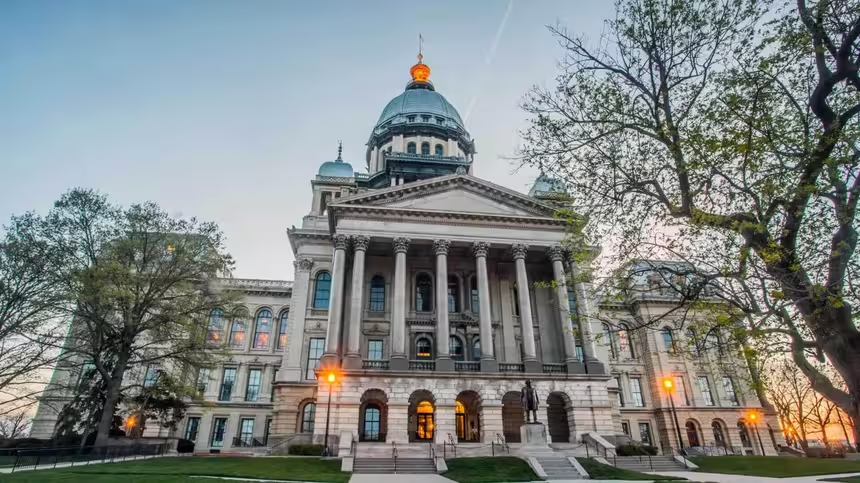
CapitolView
CapitolView is a weekly discussion of politics and government inside the Capitol, and around the state, with the Statehouse press corps. CapitolView is a production of WSIU Public Broadcasting.Providing Support for PBS.org
Learn Moreabout PBS online sponsorship(bright music) - Thanks for joining us on this special edition of "Capitol View."
I'm Fred Martino.
We take a break from the weekly update of Illinois General Assembly news for an issue that affects legislation at every level of government.
Merriam-Webster defines a statesman this way.
One actively engaged in conducting the business of a government, or in shaping its policies.
What a refreshing idea.
A focus on government, on policy.
Some say that is needed more than ever in our hyper-political environment.
Consider immigration and border policy, one of the biggest issues in the presidential campaign.
And unlike many other controversial issues, Republicans and Democrats came together.
They worked through the very difficult process of crafting legislation expected to pass.
That is until former President Donald Trump said the bill would be a, quote, gift to Democrats ahead of the presidential election.
Critics say it was another case of politics over policy.
My guest has thought a lot about the opposite idea being a statesman, not one simply driven by politics.
John Shaw is the director of the Paul Simon Public Policy Institute at Southern Illinois University Carbondale.
Shaw is author of the new book, "The Education of a Statesman: How Global Leaders Can Repair a Fractured World."
The book examines Jan Eliasson's remarkable diplomatic career, including Swedish diplomat, president of the United Nations General Assembly, and deputy secretary general of the United Nations.
He scrutinizes lessons very relevant to our current period of great danger in global affairs.
I'm very pleased to welcome John Shaw to "Capitol View."
John, it is great to have you here.
- Fred, great to see you again, thank you.
- It is great to have you here and a very, very interesting book that you write about.
We're gonna get to a lot of details in the book in just a moment, but I wanna begin, and that's why I started with that introduction on being a statesman.
How much more difficult, in your view, someone whose followed politics for decades, lived politics, we might say, how much more difficult is this in today's political climate?
- It's really hard.
And there do not seem to be a huge amount of political rewards for rising above partisanship, doing hard things, taking on problems that have long term implications, taking tough steps that might hurt you in the short term, but pay off in the long term.
So, I mean, Americans have always been a culture that's been very focused on the present and the immediate.
And so to have leaders push policies that, you know, we'll see benefits decades, years, decades in the future, it's always been hard.
It's even harder now in the era of social media and cable TV.
It just feels like there is very few rewards for doing these kind of hard things.
And we seem to be seeing less and less of it, although, I will argue that it's still there, and it's important to recognize it when we see it, and to have people, you know, reward that kind of behavior when it's evidenced.
- Yeah.
I mentioned former President Trump in the introduction, and you and I have been doing this a long time, following politics, but really this last decade since President Trump first ran for president, and then was elected in 2016, things have been different, this environment the kind of nastiness in public and whatnot.
Is this part of it, too, in terms of making it more difficult to even appear as you are a statesman, someone advancing this idea of statesmanship?
- Yeah, I mean, I think, you know, a lot of ink has been spilled trying to understand the appeal of Donald Trump and understand his impact on American politics.
It has been profound.
And I do think that the whole debate surrounding him has been very rancorous and very polarized, but I think one of the things, too, is that we've spent so much time talking about him and thinking about him, that we're not talking a lot about the problems that the country faces.
I mean, think of all of the hours and hours that have been spent analyzing the personality of Donald Trump, and contrast that to the hours we've spent really digging into immigration policy, or the federal budget, that policy, or income inequality, or racial tensions, or climate change.
I'm not saying these other issues have not been looked at, but we've been so focused on the personality of Donald Trump that I think it's detracted us, or distracted us from really some of the bigger challenges that face the country.
- But on the other hand, you know, he has many supporters who have been elected and continue as we tape this in office.
People like Marjorie Taylor Greene, Matt Gaetz, Lauren Boebert, who kind of model this kind of outrage politics, the show.
Kevin McCarthy was even thrown out as House speaker for trying to essentially do his job, right?
Come up with negotiations, negotiated settlements, and he was thrown out.
And we don't know what the future will hold if the Republicans maintain control of the House for the current speaker even.
- That's a great point, but one thing, you know, I was a congressional reporter for 25 years and the one thing that I realized, and it was very striking, is that if you would have a debate on an issue, and I would have to, you know, sit through hours of debate and you would have some really thoughtful, interesting, centrist views articulated, and then you watch the news at night and you would have a clip of the most extreme on the left and the most extreme on the right.
- Right.
- Oftentimes in the most colorful, disrespectful language.
And I do think, you know, you and I have talked about this, that the press plays a role.
I mean, we gravitate towards the spectacle and the colorful personality, the big person.
- Particularly in broadcasting, I mean, because you're talking especially on the commercial media, you're talking about, you know, sometimes you talk about hours of debate then distilled into 90 seconds, if you're lucky.
- Yeah, yeah.
So I think that's part of our problem with statesmanship is that what we tend not to be focused on kind of the quiet problem solvers who are doing really constructive, important work.
And I mean, one person that I wrote about some years ago was Richard Lugar, the senator from Indiana.
Quiet, soft spoken, self-deprecating.
And, you know, he didn't go after the headlines and he didn't go after the glamorous issues, but he did all of the hard things.
And he spent 20 years working on this very technical program to eliminate nuclear weapons in the former Soviet Union, also biological and chemical.
And he was one of these statesmen who the press sort of ignored, certainly didn't pay a lot of attention to, but I think did really, really important work.
And I think history is gonna treat him kindly.
It is treating him kindly.
So, I think when we think of incentive structure, the one thing of people really, men and women stand up and do hard, difficult things, I think history tends to reward them.
- Yeah, and I'm glad you mentioned Senator Lugar 'cause he's a good example for another reason, which sometimes this lack of statesmanship is not good politically either, because while he lost his primary, his Republican primary, the person who beat him in the primary then lost in the general election to a more moderate Democrat who appealed to more voters in the general election.
- Right, right.
- And, of course, you can say that on both sides of the aisle, right?
I mean, the people that fall too far to the left, or too far to the right may not work in a general election, even if they're quite victorious in a primary.
- That's it, yeah.
Again, our primary system does tend to reward people on the extremes, but then they become, some of them lose general elections that are very winnable for their party, had a more moderate been chosen, so.
- Yeah.
So we now move to just the opposite, the great example that you write about in your book, Jan Eliasson and his diplomatic career.
Tell us a little about him and why you chose to write a book about him, because many people watching this, it may be the first time that they have even recalled hearing that name, Jan Eliasson.
- Well, you know, he's someone that I met many, many years ago.
I was a reporter in DC in an earlier life, and I wrote a book.
I wanted to write a book about what a modern ambassador does.
And so I approached him and I said, "Could I shadow you for a year or so?"
I was keeping my full-time job, but could I shadow you and just kind of look over your shoulder and see how you work and do, you know, what you do?
And he said, "Sure."
He thought it was near the end of his career and he was this amazingly, competent, hardworking, charismatic ambassador.
So I wrote this book, it was called "The Ambassador."
This is about 20 years ago.
And he says, "Okay, I'm gonna fade away into the sunset."
Well, after the book came out, he became Sweden's foreign minister, then he became president of the UN General Assembly.
He became the UN's special envoy to Darfur.
And then he also became the deputy secretary general of the UN, the number two position.
So he's had this remarkable kind of late career resurgence.
And so he and I have kept in touch over the year.
And then, actually, you know, during COVID, the institute developed some virtual series, and one of the first people I wanted to talk to was the ambassador to get a sense of just the international perspective on COVID.
So we had this wonderful Zoom conversation, and I said, "Man, we gotta do another book."
And he said, "Well, who really wants to hear about a Swedish diplomat?"
I said, "You've had such an interesting and important career."
So what we did is, yeah, I had to do some persuading, but this book is based on about 15 Zoom interviews that we had, oftentimes hour and a half, two hours, carefully prepared by me, in which I would lay out the questions and so forth.
And I wanted to just sort of understand the second phase of his career, but even more importantly, I wanted to kind of draw from him the lessons he's learned from a career in diplomacy.
What are the big things you have learned?
- And we'll talk a little bit about that.
In the book you describe three elements of statesmanship, statecraft, stagecraft.
And this is an interesting one, soulcraft.
- Right.
- So let's talk about those.
- Okay, statecraft is the sort of traditional work of government and diplomacy.
It is putting together agreements, making programs work, just sort of the mechanics of governance.
And in his case, I mean, the ambassador did a lot of things, negotiated a really important Human Rights Council for the UN.
And I describe that in the book, just the mechanics of trying to negotiate a whole new entity in the UN.
You need 170 some countries to sign on.
So it was really quite a complex negotiation.
So, statecraft, I think of as just sort of the mechanics of governing.
- And it can be very hard work, right?
- It is.
- I mean, you know, I was thinking about this when I knew that I would be talking to you today and thinking about this very difficult negotiation where Democrats and in some cases the most party line Republicans came up with an agreement on immigration and border policy, made a lot of concessions, both sides made a lot of concessions.
Some would argue Democrats made even more concessions to get an agreement.
And then we thought it would pass.
And former President Trump said, "No, we're not gonna do this."
And sure enough, it was stopped, it was stopped.
It didn't even come up for a vote, so very hard work.
- It is, and oftentimes, that's a perfect example of not being rewarded.
You work in the vineyards for a long time.
You craft, you know, careful agreements, and then political forces take control and your work is pushed aside.
- So that's statecraft.
We have stagecraft and soulcraft.
- Well, stagecraft is, and it relates to this, I mean, to me, it is the art of communicating, of explaining.
And, you know, we've talked a lot about how do you communicate in this era?
And that was the one thing the ambassador would say is that, you know, you can come up with a great policy, but you need to be able to communicate it.
You need to be able to explain it.
And sometimes it's, you know, just traditional interviews and so forth, but a lot of times it involves some theater.
And in this case, like the ambassador was very interested in international water issues.
And so he would oftentimes go to, you know, very elegant parties and receptions and talk about water.
And he had this little technique.
He'd hold up a glass of water and he would, you know, he would use his wedding band to just make it resonate.
And then he would say, you know, "Water is life."
Water is essential for millions of people who are going without it."
And it was just sort of a visual way of kind of pulling people in.
And actually his TED Talk, which has gotten quite a few views, I mean, he's very theatrically holding up this glass of water to illustrate, you know, the problem of water in a way that otherwise might be thought of as technical and hard to grab.
So stagecraft is finding ways to communicate to your audience.
And it might be different ways for different audiences.
It usually is.
- And soulcraft, is this your word?
- [John] That's his word.
- It's his word?
- Yeah, I mean, it's a word that came out in the course of our discussions, I should say.
I forget who actually brought it out.
I'll give him credit for it, but it's just basic thought is that for so much of government work, it needs to be undergirded by a kind of a deeper connection with people, you know, why is it important to their lives?
Policy can be very technical and kind of distant.
One of his views was that music was an important way to kind of bring people together and find some common ground.
So at times during the UN, he would have, like, a reading with classical music and they would bring in a classical musician, you know, convening diplomats.
And it was just in a different context in which they would see each other.
There'd be sort of meditations that were read and then classical music in the background.
And he thought that was a way to just kind of bring people together on a whole different level and, you know, sort of have a shared humanity that is not oftentimes done when you're involved in formal negotiations.
- Yeah, very interesting.
Well, you know, this gentleman that you write about recognized, of course, in the international scene for statesmanship, while it has not been covered in the U.S. media, particularly the broadcast media extensively over the last four years, President Biden has been recognized by people on both sides of the aisle for his international work.
Can you briefly, as we discuss statesmanship, assess some of the achievements of the Biden administration that may illustrate some of the qualities in this book?
- Yeah, I mean, I do think that President Biden has had a view of the long term.
And maybe it is the fact that, you know, he knows that his public service is coming to an end even before it came to an end, quicker than he wanted, but I think just even some of his policies on immigration that have been, you know, immigration is such a hard issue for Americans to grapple with now.
And it seems like at least, initially, at least, he was trying to find a way that you combine both the security aspects of immigration with the humanity and this sort of the ideal of America as a nation of immigrants.
So I think that was really big.
I think his infrastructure bill would be a classic example of something that, you know, will pay dividends decades into the future when we have, you know, better roads and bridges and airports, and so forth, so.
And I think just some of his general policies on making America part of a community of nations, and being part of what's been called the liberal international order, or the rules-based order.
The notion of that we need to play by the rules.
And I think, you know, even his support of Ukraine shows that he believes the principle of sovereignty, and the notion that a country just cannot barrel in and take, you know, breakthrough someone else's borders.
And I think just the way he stood up for that principle has been really significant, and will be an enduring legacy for him.
- And, of course, on that particular issue, many Republicans have supported President Biden publicly and vocally that the threat to Ukraine is a threat to the free world, to everyone.
And so, conversely, President Trump has been criticized for his very public admiration of Vladimir Putin, Kim Jong-Un, and other autocrats.
What do you make of this, John, and how it might damage the United States and our role in the world, irregardless of the results of the election?
- Yeah, you know, I might even just connect it to the ambassador because I've talked to him a lot about.
I mean, he lived in the United States as a high school student, and he has lived here much of his life.
His daughter lives in Washington, is married to an American.
So he loves United States.
He's deeply interested in it.
And he says, "At times I do not recognize your country.
It has shifted so much."
And this is the thing, I mean, particularly with, you know, President Trump's just embrace of people that, you know, are fueled by values completely contrary to those of ours.
It's hard to explain what the attraction is for President Trump.
And it's even harder to explain why some of the people in his coalition seem to kind of go along with it.
I mean, you know, I'm old enough to remember when Republicans were very hard line in any sort of, you know, softening of a hard line position towards Soviet or Russian leaders was, you know, grounds for swift enunciation.
And to see their standard bearer just, you know, refuse to say that he wanted Ukraine to prevail on this war.
I mean, he conspicuously said that he was not particularly concerned about who wins this war.
That kind of value-free approach to governance it's just something that is, to me, really contrary to the American way.
And it's also contrary to the whole notion of statesmanship, I think.
- Yeah, it's such an important issue.
So we have kind of touched on this very briefly, but I do wanna ask you, and I like the way that you put it that, you know, how can we expect more when there may not be rewards for it?
I wanna talk about the media, and how that could play a role in the fact that we don't see as many examples as we should, perhaps, of people like Jan Eliasson, who you write about here.
There is so much coverage that does not focus on governing and on issues, but instead on the horse race, who's up and who's down, and what someone said based not on the importance of it, but the flash of it, right?
Especially in the case of the presidential race where you sometimes hear from President Trump pretty outrageous language some would argue.
So the question would be, I mean, how do we expect leaders to focus on issue oriented governance when public understanding of government is often driven by often not the best media coverage, sometimes incomplete.
And other times you might even argue misleading.
- Yeah, I think at core, leaders need to have a kind of inner motivation.
And it has to be kind of based on the notion that political careers are great and long political careers, you know, particularly if you love politics are fun, but it's better to have a short career that ends with honor and distinction and with accomplishment than just surviving.
And I might even tell a quick Paul Simon story 'cause as the director of the institute, I think a lot about him.
And this was a letter I saw in which some constituent had written him a sharp letter, I think it was on the issue of guns, and said, you know, "Senator Simon, I really disagree with you."
You know, a very, very kind of sharp letter.
And Senator Simon wrote back and said, "Thank you for your letter on guns.
Your position is this, mine is that.
So if this is an important issue for you, you should vote for someone else."
And you think about it, I mean, wouldn't you rather have a political career premised on that than one in which you're saying, well, you know, we sort of agree, but not really.
You know, it's just, and also recall what he didn't do.
He didn't challenge this person's patriotism, or their intelligence, or their, you know, value as a human being, but just said on this issue, you know, let's disagree, and if you don't support my position vote for someone else.
And I tell that story to my students.
I say, if you go into politics, think about that approach to public service, you know, that's gonna make you feel better at the end of the day, I think.
- And we're gonna be hearing a lot more from you about statesmanship because you're gonna be writing a column already started with the "Chicago Tribune."
A wonderful idea, and I'm glad to see that they're doing that.
You're gonna be doing more work with the Simon Institute to encourage statesmanship.
Briefly, tell us about that work and what you've been doing.
- Well, the one that I'm really excited about, we have an award with former Governor Jim Edgar called the Simon-Edgar Award.
And the premise is, you know, statesmanship on the national and international stage is really important, but so is the statesmanship at the local level.
And so we have this award for statesmen, stateswomen, and local government.
And even the winner this year really makes me feel great.
He's a former mayor of Ottawa, Illinois.
Robert Eschbac is his name, and he stayed in his community.
He has a law degree from U of I, but he stayed in his community and over the course of 20 years as mayor just fundamentally transformed it, you know, helped bring jobs to the community, developed careful city planning, fun, plain management, just in a remarkable transformation of the community.
So that's one example of statesmanship, and I was delighted to highlight it.
- I have about a minute left.
As we leave people with a reminder of the book, "The Education of the Statesman."
In that minute or so, what's one thing that really, when you think of Jan Eliasson, an example of his statesmanship that you can condense into that amount of time?
- Yeah, no, I think his leadership on creating a Human Rights Council was really courageous.
He actually ended up confronting the Bush administration, George W. Bush administration.
There was a lot of people who said, put it aside.
Let's try to find, you know, another day.
And he just said, "This is important.
Human rights is central to the work of the UN, central to American values."
And was shrewd, smart, strategic, and pushed through and just was relentless and sort of knew when to pull back, but then at the end of the day he pushed forward.
And I think that's an accomplishment that will endure as an example of statesmanship on the global level.
- A great example, a great topic.
I'm glad I'll be able to read more about it in the "Chicago Tribune" as you continue to do columns on statesmanship.
And I'm glad I'll be able to read the entire book.
It's debuting this month, and so anyone can find it online.
"The Education of a Statesman."
John, thank you so much for being with us.
- Thank you, Fred, it's always a pleasure.
- Great to have you here.
My guest was John Shaw.
He is director of the Paul Simon Public Policy Institute at Southern Illinois University Carbondale.
Again, author of the new book, "The Education of a Statesman: How Global Leaders Can Repair a Fractured World."
For all of us at WSIU, I'm Fred Martino.
Thanks for being here.
Have a great week.
(dramatic music)

- News and Public Affairs

Top journalists deliver compelling original analysis of the hour's headlines.

- News and Public Affairs

FRONTLINE is investigative journalism that questions, explains and changes our world.












Support for PBS provided by:
CapitolView is a local public television program presented by WSIU
CapitolView is a production of WSIU Public Broadcasting.