
Capitol View - July 11, 2024
7/11/2024 | 26m 46sVideo has Closed Captions
Capitol View - July 11, 2024
Analysis of the week’s top stories with John Jackson from the Paul Simon Public Policy Institute at Southern Illinois University Carbondale and Alex Degman from WBEZ.
Problems playing video? | Closed Captioning Feedback
Problems playing video? | Closed Captioning Feedback
CapitolView is a local public television program presented by WSIU
CapitolView is a production of WSIU Public Broadcasting.
Capitol View - July 11, 2024
7/11/2024 | 26m 46sVideo has Closed Captions
Analysis of the week’s top stories with John Jackson from the Paul Simon Public Policy Institute at Southern Illinois University Carbondale and Alex Degman from WBEZ.
Problems playing video? | Closed Captioning Feedback
How to Watch CapitolView
CapitolView is available to stream on pbs.org and the free PBS App, available on iPhone, Apple TV, Android TV, Android smartphones, Amazon Fire TV, Amazon Fire Tablet, Roku, Samsung Smart TV, and Vizio.
CapitolView
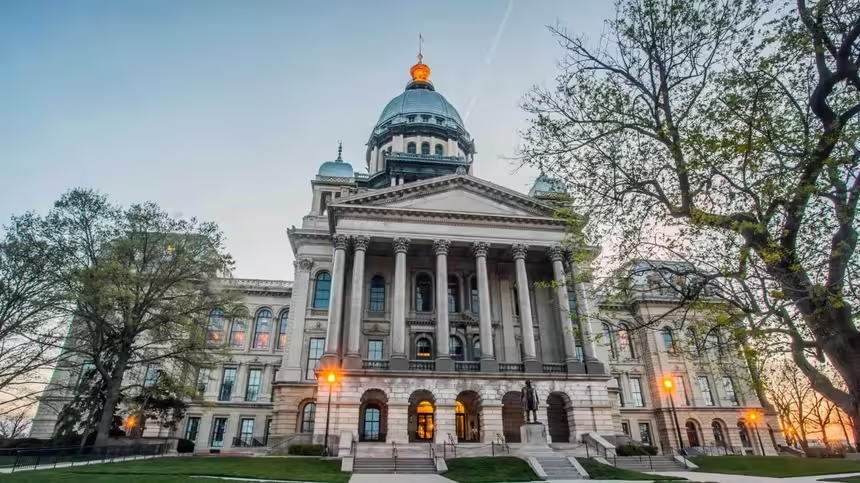
CapitolView is a weekly discussion of politics and government inside the Capitol, and around the state, with the Statehouse press corps. CapitolView is a production of WSIU Public Broadcasting.Providing Support for PBS.org
Learn Moreabout PBS online sponsorship(bright music) (device beeping) (lively music) - Thanks for joining us on Capitol View.
I'm Fred Martino.
Some surprising new data on traffic stops in Illinois, big stake incentives for some technology companies, and after nine months we are getting a better idea about the impact of the state's decision to end cash bail.
Those stories and more this week with John Jackson from the Paul Simon Public Policy Institute at Southern Illinois University Carbondale and Alex Degman from WBEZ.
Alex, new data is showing an increase in police traffic stops across Illinois in 2023.
Tell us about this.
- Yeah, my colleagues at the Sun-Times, and WBEZ did a really good writeup on this.
It's part of the annual traffic stop study that IDOT does.
They've been doing this since 2004, basically studying as many of the traffic stops that they can analyze around the state as possible.
And police departments have been required by law to submit this information, but still more than 150 didn't do so last year out of nearly 1,000 that are studied.
But what the data showed overall is that there were 12% more traffic stops in 2023 than there were the year prior.
And putting it in raw numbers, and I'm sorry in advance, this is a really numbers-heavy story, but try to bear with me.
So, in 2022, there were about 2 million stops, and then in 2023 that went to two and a quarter million.
Now, the thing that may not surprise you is one of the common complaints that always comes up when this study comes out is that there is a disproportionate number of traffic stops that affect drivers of color, and that's still the same case this year.
The ACLU says that's particularly true with departments that do 50 or more traffic stops a year, so like some of the medium sized to larger departments I suppose that would be.
And out of those departments, 95% of them, 95% of them stop Black drivers at a higher rate than white drivers, and 81% of them stop Latino drivers at a higher rate.
And if you go to the story on the Sun-Times website, there's a pretty good interactive tool you can go through where you can enter in your community to see 2022 data.
We haven't been able to make a table for 2023 yet.
Breaking it down a little bit further to Chicago, Chicago, the city itself, accounted for roughly a quarter of all traffic stops in 2023, and that's about a 5% increase over the year prior.
And in 2023, Black drivers were 51% of all CPD stops compared to 31% for Latino drivers.
And the other thing about this is it's kind of hard for the board that's overseeing all this data to keep members...
They've had a lot of vacancies.
Sorry, I'm having trouble getting these words out.
The Racial Profiling Prevention and Data Oversight Board, it has four vacancies right now, and it's hard for them to meet because they don't have enough members a lot of the time.
The last few times they've tried to meet, I think 4 out of the last 10 meetings, they haven't had a quorum.
So it's a work in progress still, and that's pretty much the data as it stands.
- Yeah, very interesting and good to see that that's happening every year so that we can track changes and what's happening.
And certainly, more transparency is considered a very important part of this, not only through the data on stops but as well, of course, the police having cameras on during any kind of connection with the public so that if something happens, we have a chance to see that as well.
John, we're going to move on to another story related to criminal justice now and the Chicago Sun-Times again reporting on this one.
Domestic violence survivors in Illinois are sometimes in prison in relation to their abuser's crimes.
This was an interesting report.
Tell us more.
- Well, the major characters are one Pat Johnson who was in this abusive relationship with the abuser named Rey Travieso.
He was 35 at the time.
She was 17.
There was evidence that she had been abused frequently and she claimed that, not surprisingly, she was afraid of him.
The crime was three murders.
Travieso was in business with a partner.
The murder was of the partner, his wife, and his young child.
So the three murders involved, as well as thievery, which she got involved in to the extent that he told her to pick up the money and the drugs and they fled with it.
So the question is, this was 1993, and the question's been raised now, is this really justice?
It comes under the theory of liability as it's called, and that's the question of one that assists in the crime.
She had some role in it.
But, of course, the study is being done and has been put forward by something called The Marshall Project.
And they found that there were more than 100 cases nationwide of such partner abuse leading to this kind of situation.
Because she got life in prison just like he did, and the questions are whether or not they assisted under what circumstances, did they support the crime, and did they fail to stop the crime, all of which are pretty tall orders under the circumstance.
The Illinois Prison Project says certain cases like this, the partner should really be considered collateral damage 'cause it's mostly women in this case, a much younger woman in these kinds of situations.
It's going to be hard to change this though.
For example, we're in a law and order kind of mentality and looking soft on crimes is not something many state legislators are going to want to do.
- Yeah, absolutely.
Very important story and one often overlooked, so I'm glad that we were able to cover it this week.
Alex, perhaps another under-reported story from the General Assembly, quantum technology companies are set for big tax incentives under a new law.
Tell us about this.
- Yeah, quantum technology, and I'll be honest right off the bat, it's not something that I'm really able to wrap my head around just yet because the science is just way beyond my chemistry-failing brain.
That's why I got into journalism.
But basically, what's going on is state lawmakers approved half a billion dollars in this year's capital budget to build, basically a campus, a quantum computing campus, at a place that they haven't decided yet.
It's going to be somewhere in Illinois.
My guess is that it's going to be somewhere in the northeastern quadrant by Chicago.
Companies that go and build at this site to be determined would get some tax incentives to do so; they would get tax breaks on construction materials.
And the state has set aside about $100 million dollars for that purpose.
$200 million of that half a billion would go toward building a cryogenic facility.
And Capitol News Illinois also reports that $200 million of that's going to be set aside for matching money that the state can put up to capture some federal grants.
Now, like I mentioned, it's a little hard for me to wrap my brain around, but quantum computing is a pretty new technology that basically uses the function of quantum mechanics to solve computer problems a lot faster.
So complex problems that would take modern supercomputers today that we have available thousands of years can be done in a matter of minutes or hours with quantum computing.
It's a whole thing with subatomic particles and how they're observed, and what happens when that happens that I don't know.
And to be honest, there are a lot of folks in this field, or at least in state government, trying to attract it that don't know the exact applications for this yet.
We've seen a few things come out so far, but we've really only started studying this in the past 5 to 10 years or so.
So we don't know exactly how the technology's going to be used yet, but it's a really interesting thing to point out that people were saying the same things about an emerging technology called the internet in the late 1980s and the early 1990s.
You might remember when the internet came out like, "Oh, it's a fad."
Nobody really knows what this is going to be and what it's going to look like, and who can afford to have a computer in their house.
So nobody really knew what to do with it.
But then, you know, in the '90s and early 2000s, you had companies like eBay and YouTube formed in Illinois, but they left.
And part of that, Governor Pritzker said, is because we didn't have the infrastructure to keep those kind of technology companies in place.
So circling back to quantum computing, that's what they're hoping to avoid with this go around of new technology.
They want to make sure that the state infrastructure is in place to capture it while they can.
- And even a quick search will show you that Illinois is not alone in trying to jump on this.
There's a lot of competition around the country.
John, I want to move on now.
Some may hope that those economic incentives that we just talked about will be effective because a new report shows that the state may need new business to help Chicago with its budget issues, which are always in the news.
This latest report shows that the city's pension debt is more than 37 billion, that's billion with a B, dollars.
- Yes, that was a headline in the Tribune article.
Note that that's the accumulated debt compared to it being 100% funded.
I want to come back to that point later.
But the more realistic number is what are required payments each year and can the city continue to make those required payments, just like the question, can the state of Illinois continue to make those required payments.
Here too some statistics, the mayor has a working group to try to address this.
And under Mayor Lightfoot, the last budget she put in $2.6 billion, which was funded to meet that year's obligation.
The mayor put in $2.8 billion in his first budget.
But the problem is the mayor has also adamantly said there'll be no more property tax increases to come up with any new money, but indeed the meeting of the annual payment is going to require something to have new money capability of generating.
Because, for example, the Chicago police went from 1.5 to 3.0 on their increase, so that requires some additional money.
There's also some idea that this is a better accounting for how much the interest on the money that the pension fund generates each year that the CFO for the mayor says that we're using more accurate data.
So that's the issue.
The question I think, however, is to focus on the annual.
And that is really a good news story in Illinois, not necessarily Chicago, but certainly in Illinois; we have been meeting our annual pension obligations routinely.
In fact, we've been paying down some of it.
The city of Chicago needs to do the same thing, and the question is, can they do that?
But the Illinois situation has much improved from when we were taking, quote, pension holidays.
That meant the governor and General Assembly didn't want to pay any of the state's payment that's required.
So that's when we got behind.
So keep your eye on the annual payment, not the total accumulated debt.
- Yeah, interesting, and, of course, just one of the challenges for Chicago and consequently the state of Illinois.
Alex, after nine months, state data beginning to shed light on the end of cash bail in Illinois; another follow-up story, another important one.
Tell us about this.
- Yeah, the top line is that the state Supreme Court is studying the law's effectiveness and supporters and detractors for that matter think that that's really important that their office of pretrial services does.
And to be clear, though, they only have data, this office of the state Supreme Court only collects data on 75 counties.
Doesn't cover Cook or any collar counties except Will and some of the counties with smaller cities like Winnebago, Sangamon, Macon, Knox, St Clair, they're not included either.
I'll talk about some of those later.
But in the 75 counties that were covered, judges only issued a failure to appear warrants in about 5% of cases, and there were about 28,000 of them in those nine months.
And judges also approved in those counties nearly two thirds of cases where prosecutors requested a pretrial detention.
So that's the system that replaced cash bail.
You might remember the system before was a judge set a bail amount, and if you were able to post some of that, you were able to go.
And the argument against that was people can, number one, even if bail is set really high, if they have connections they can get out.
And the other argument was this system kind of sweeps up a lot of people that might not deserve to be in jail.
Think the mother with four children who's just trying to feed her kids.
That's the image that a lot of people are putting out.
So a judge in this system determines basically should you be kept in jail based on the crime you committed, based on the level of danger you pose to the community, and things like that.
And this to supporters, the number of people who are being released pretrial is a sign that the system's working.
A third of the people are being let out.
Whereas, if almost everyone was being detained, there would probably be some further questions about whether the system is doing what it's intended at all.
And as I mentioned a little bit earlier, Cook County and some of the other collars are not included, but they do provide data separately.
Capitol News Illinois said that when you look at Kane, McHenry, and DuPage Counties, they approve pretrial detention petitions at a little bit of a lower rate, the upper 30s to low 40% range.
Cook County splits it up even further.
But the most important category, at least I think, is what happens in felony cases.
There are about 2,600 felony cases in Cook County in the nine months that this was studied and there were pretrial detentions approved in 70% of those.
But the main question I think, and we're going to come back to this, is will it work long term?
Is this going to continue to work?
And supporters, like I said, they indicate that early data is a good suggestion that it might, but it's still too early.
We need more time.
- All right, well, we will be watching and so will states really across the country because this is something that is a discussion nationally.
John, another national discussion, certainly always in the news, and that is dealing with guns and gun violence and the battle over the assault weapons ban in Illinois will continue after the US Supreme Court has declined to get involved.
Tell us about this.
- Fred, you're quite right.
This is a continuing saga.
The battle's going to go on.
What to do about gun crime and gun violence in this country is very much a national conversation.
In Illinois, this particular law grew out of the Highland Park tragedy.
We just passed two-year anniversary on July 4th.
There were seven killed and more than 40 injured by one lone gunman up on a second store looking down on a massive July 4th crowd and just taking target practice, and did murder and mayhem everywhere you could with an assault weapon.
So what to do about that, and Illinois General Assembly passed this assault weapons ban.
And, of course, not surprisingly, the Rifle Association and others took it to the US Supreme Court.
The court refused to hear it and denied cert is what they technically call this.
They didn't want to hear this one now.
And they, basically, having to do this case by case and state by state because of the bureau's decision of 2022.
And the Federal Appeals Court in Chicago had held, in spite of that durance decision, that this is not a violation of Second Amendment rights much to the chagrin of the state Rifle Association, for example.
I think this is an interesting case of what is the philosophy of the majority of the court called originalism where they maintain that you have to take the historic context or the historic tradition and rule according to that.
Well, if they don't stay true to that, they had muskets 240 years ago; they did not have automatic weapons.
So was that the historic tradition that has to be brought forward to cover assault weapons and military grade weapons?
That is the issue.
Now, this doesn't settle it.
There's a court in southern Illinois going to start hearings on it very quickly with a different federal judge and he may rule ultimately differently.
But the battle goes on, and it's just the kind of worms that the Supreme Court has opened up for itself.
- For a minute there, John, it sounded like you were trying to bring facts and context into this politically fraught issue.
What a concept, huh?
- Yeah, I think that originalism has some ivory tower kinds of qualities.
- Yeah, there are some issues there.
Well, we have, fortunately, Alex, plenty of time to cover our last issue today.
We will not be rushed thankfully as we are sometimes.
We have about six minutes to talk about this, and it is big and it is a follow up.
With July always comes new laws, and Governor J.B. Pritzker has signed some blockbuster election changes.
Tell us about those and the reporting on this now that it is July and they're no longer ideas but laws.
- Yeah, so there was, what we in State House circles like to call, an omnibus bill.
That's when a lot of ideas are taken together and put in one bill, and this is an elections omnibus bill.
One of the tenets of this is now that state parties can spend unlimited amounts in campaign races.
And given when this was put into effect in 2009, I think this might have been one of the first campaign finance or election reform things that I ever covered as a journalist.
Pat Quinn came in and wanted to put this in as a way to decentralize party power.
That was seen as a reform at the time.
But fast forward to 2024, and that system isn't working out so well anymore.
We saw in this election cycle several candidates who were backed by the state party failed, and part of that was due in part to house speaker Chris Welch who helped fund a few races against incumbents in his own chamber.
And now, the state party theoretically could offset that.
And I should also mention that there was a pretty tight primary in the state senate where the state party backed candidate also lost to a progressive challenger.
So opponents are worried about the fact that this is going to recentralize power with the state party and it's going to, among other things, going to just put more and more money into politics.
And part of the big criticism of politics, especially over the last 10 years, is just the sheer amount of money that's put into it.
To be fair, we've had our last two governors, J.B. Pritzker and Bruce Rauner, I mean, they kind of changed the game when you think about it when these people who are, you know, figureheads of the party can make donations to the party and kind of act as like a shadow donator.
That's probably not the term that I want to use.
Essentially, you know, defacto donating to candidates through the state party, that might become a thing now.
So my theory is that you might now have races between the party and then figureheads in the party to just put as much money as possible into this race to see who can eventually come out on top; basically, who can spend the most.
And is that the kind of system that we want here?
That's up for the supporters and detractors to decide.
Also in the new law, electors, those are the folks who actually select the president, they are now bound to vote for whomever wins the state's presidential primary.
So this is a kind of a way to make sure that the popular vote is taken a little bit more seriously.
Not that it wasn't before, but previously there could have been in Illinois what are known as faithless electors.
In 2016, this happened seven times, not in Illinois, but of the 538 electors nationwide, seven of them were able to vote against the candidate that was selected by their state's voters in the primary.
Illinois is the 34th state to implement this change.
And the law also says, the last tenant of this law, is that the law says voter data can't be used for any personal, private, or commercial reason.
And this was largely drawn out of incidents a couple years ago when there was some voter data that was published on a series of Conservative websites run by the Local Government Information Service, I think that's what it's called, or services.
But they published sensitive information like birthdays and home addresses, which as we are learning, as we go further into the future and learn more and more about cybersecurity, there is a lot that people who wish you harm can do with that information.
They don't need a whole lot of information to start gathering data, and that's pretty dangerous.
So the state's attorney general filed suits basically right away, and a new law was formed because of this.
So the reasons that you can't use this information according to the law include just anything from marketing to intimidation, threats, deception, a whole host of other things ranging from, you know, not so serious to very serious.
And it became kind of, it got a little personal actually for some of us in the media because there were some articles that were written based on that information that outlined how reporters voted in the primary or voted in various primaries going back 'cause as you might be aware, primary information is public information.
So a lot of reporters for that reason don't like to vote in primary elections.
But for those who do, some of them appeared on this list, and it was used to kind of, you know, to put questions into people's heads.
It was used to say, "Oh, look at this Chicago reporter "in Chicago voting in the Democratic primary.
What does that mean?"
- Yeah, I mean, it's an argument, isn't it, Alex?
This is something I've thought about for decades being in journalism for many, many years and have lived in states where we have had a truly open primary where you do not have to register with a party to vote in the primary.
You go and you vote.
Of course, you can only vote in one party primary, but you do not have to register, whereas, there are other states where you do, to vote in the primary, have to register as a member of that party, and that is public information.
And people may falsely gather thoughts about your political ideas based on that as opposed to the desire to simply vote in a consequential primary.
- That's right.
And especially, like I mentioned, it's a little misleading, especially because, as we all know, in Chicago, there are a lot of instances where the primary is basically the election because there are no Republican candidates that are running in the general election, or if they are, it's very difficult for them to gather steam.
So essentially, if you don't vote in the primary, what are you going to do?
- Then, you don't vote.
- But that information is used to, as we've talked about, kind of paint a picture, so to speak.
- Yeah, interesting.
We are out of time.
John and Alex, thank you very much for being with us.
Capitol View will be off next week because we have live coverage of the Republican National Convention from PBS News.
Thank you for being with us at home.
For everyone at WSIU, I'm Fred Martino.
Have a great week.
(lively music) (lively music continues)

- News and Public Affairs

Top journalists deliver compelling original analysis of the hour's headlines.

- News and Public Affairs

FRONTLINE is investigative journalism that questions, explains and changes our world.












Support for PBS provided by:
CapitolView is a local public television program presented by WSIU
CapitolView is a production of WSIU Public Broadcasting.