
Capitol View - July 14, 2023
7/13/2023 | 26m 46sVideo has Closed Captions
Capitol View - July 14, 2023
In this episode of CapitolView: Gov JB Pritzker heads overseas with state leaders on an economic development trip; the face for Illinois’ 12th Congressional seat is already very tight; and new reports detailing mismanagement, abuse, and neglect at state run facilities have some calling or hearings and action.
Problems playing video? | Closed Captioning Feedback
Problems playing video? | Closed Captioning Feedback
CapitolView is a local public television program presented by WSIU
CapitolView is a production of WSIU Public Broadcasting.
Capitol View - July 14, 2023
7/13/2023 | 26m 46sVideo has Closed Captions
In this episode of CapitolView: Gov JB Pritzker heads overseas with state leaders on an economic development trip; the face for Illinois’ 12th Congressional seat is already very tight; and new reports detailing mismanagement, abuse, and neglect at state run facilities have some calling or hearings and action.
Problems playing video? | Closed Captioning Feedback
How to Watch CapitolView
CapitolView is available to stream on pbs.org and the free PBS App, available on iPhone, Apple TV, Android TV, Android smartphones, Amazon Fire TV, Amazon Fire Tablet, Roku, Samsung Smart TV, and Vizio.
CapitolView
CapitolView is a weekly discussion of politics and government inside the Capitol, and around the state, with the Statehouse press corps. CapitolView is a production of WSIU Public Broadcasting.Providing Support for PBS.org
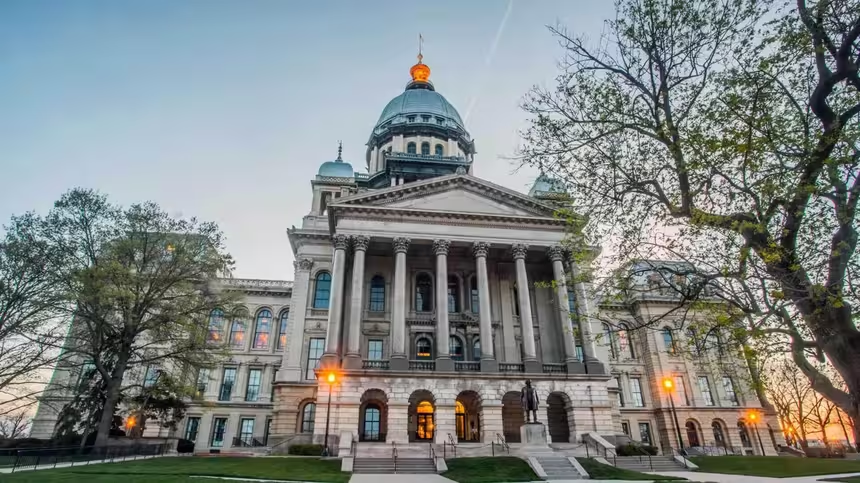
Learn Moreabout PBS online sponsorship(upbeat music) (camera beeping) (dramatic music) - Welcome to "Capitol View," our weekly look at the happenings inside and outside the Illinois State Capitol.
I'm your host, Jennifer Fuller, and this week we're joined by John O'Connor of The Associated Press and Brenden Moore of Lee Enterprises.
Gentlemen, thanks so much for taking the time this week.
- Thank you, Jen.
- Thank you, Jen.
- Let's get started with, well, the news from the governor's office.
Governor JB Pritzker, along with some other state leaders and educational leaders and business leaders, have taken off for a trip to the United Kingdom.
It's billed as an economic development trip.
England is Illinois' ninth biggest export partner, and Pritzker's office says the trip is going to focus on clean energy, quantum computing, and higher education.
John, how does this track with Pritzker's priorities statewide?
- Tracks, in my view, fairly directly.
He's at the Goodwood Festival of Speed today with a smaller group, a smaller contingent, that he's paying for.
The actual trade mission doesn't start till Sunday, when that group you mentioned will join him.
But he's at this high-tech speed festival that occurs each year, and he's talking with leaders of the industry and automobiles and electricity generation, et cetera, about electric cars.
And of course, that's one of his major points on his agenda, is clean energy.
And he signed a bill a couple of summers ago that will eradicate coal-fired plants by 2045.
And he's all about electric, and he wants to see electric cars.
He's part of developing an electric vehicle industry in this state.
We have Rivian in the old Diamond-Star plant in Bloomington & Normal.
And of course, manufacturing.
Every governor wants to see manufacturers come to the state.
What's interesting, what occurred to me when he announced this trip, is that he's really the first governor that's gone overseas since Jim Thompson, who left office 30 years ago.
A lot of that has been due to the economy and the budgets.
It didn't behoove many governors in the interim to leave the state and go overseas when people perceive them as junkets and budgets are tight.
But the budget is fairly flush at the moment.
There are obviously problems, but he's eliminated a lot of debt, and so he feels freer.
he's been to Davos, Switzerland earlier this year.
Last year, he went to Glasgow.
Glasgow was a climate conference, for example.
But in both those places too, he talked about developing trade.
- Well, let's drill down a little bit more on the economy.
John mentioned the fact that every governor would like to see more manufacturing in their state.
It's not just a Midwest thing.
But how do things look, Brenden?
Unemployment numbers, you know, can be a really mixed bag month to month, but the state leaders continue to say it's getting better.
We're doing better, and we're starting to track more along with the national rates.
- Right.
If you look at Illinois, I mean, if Illinois was its own country, I mean, I believe, and I have it in front of me, but we'd probably be a top 20, you know, country in terms of GDP.
Illinois has a very large, robust economy, and if you look at some of the smaller numbers in there, you know, such as unemployment, Illinois has, at least for the past few years, has, you know, been a little bit behind national trends.
It's been a little bit higher than the national average, a little bit higher than some surrounding states.
But at this point, I believe the last number I saw was like 3.4%.
It was a very low number, which would suggest full employment.
So things are are pretty good when it comes to the economy.
Obviously, we saw nationally that inflation has been at its lowest that it's been in a few years, which is undoubtedly a positive sign.
And I think, you know, to what John was saying about Governor Pritzker going overseas, and, you know, he likes to call himself the chief salesman for the state, and you really see him in this role trying to bring back businesses and, you know, manufacturing and, you know, essentially electric vehicles.
And I think that you're gonna see more of that as, you know, again, the state, I guess, moves out of COVID and, you know, tries to move to I guess the next generation of, what the economy of the future looks like, which is advanced manufacturing, electric vehicles, clean energy, et cetera.
- You know, as Brenden points out, most economists consider full employment to be 5%, and the state is at 3.6% now.
Full employment, to them, means this is as good as we're going to get.
There are some people who are not going to seek employment.
But the thing that I think needs to be pointed out is that full employment in 2003 is a lot different than full employment in 1963.
Full employment in 1963, in Springfield, for example, would've had people working at the Allis-Chalmers plant, which, you know, employed 6,000 people at one time.
You know, well-paying, good-paying manufacturing jobs.
And now we're in a service economy where, you know, wages are a lot lower.
But as Brenden also pointed out, you know, that likely will change as we develop the clean energy industry and electric vehicles, that sort of thing.
- And I'm just gonna add one last point, that, you know, there, obviously, these trips are expensive, these trade missions, the governor's paying his own way, he is paying for his staff to go, but there are some deliverables.
There are some things that they bring back.
I remember the governor, there was a mission, I believe, to Asia a few years ago, and that helped lead to LG Chem basically deciding to part partner with ADM in Decatur on a plant to produce chemicals.
Obviously, John mentioned Governor Thompson, when, you know, they went on some trade trips to Japan in the '80s, helped land the Mitsubishi plant for Normal.
So I think that there'll be a focus on that in order to get some of those jobs that could, you know, be better paying, better benefits than some of them in the service economy.
- Certainly something that's a little bit more stable.
You both bring up good points.
And one of the things that the state also celebrated in the last week or so was a dramatic increase, record numbers, in fact, when it comes to tourism.
And those are hotel stays, people eating out, people visiting sites all across Illinois.
And that's a very big deal, but John, you point out, because that's a service industry, sometimes those jobs are not so stable.
They don't pay the high wages that many people are looking for.
So is this a mixed bag kind of announcement?
- Well, no, you always have a tourist industry, if you're lucky.
Every state wants to tout its tourist sites.
And Illinois has a fairly rich trove when you think about Chicago, of course, being home to all kinds of innovation over time and the variety of peoples who have come there and established, you know, sites that have become historical.
Springfield is the home of Abraham Lincoln.
Galena was a major mining city and the home of Ulysses S. Grant.
Southern Illinois has the Shawnee National Forest.
So Illinois, you don't ever discount that.
And that's money in the pockets of restaurants and hotels and the people who work there.
Yes, those wages are lower, but that's always been there, and it'll continue to be there.
The minimum wage is going up; it'll be $15 by 2025.
It never hurts to bring people into your state.
They're going to come in, and they may leave and never come back again, but they've spent money here.
They may come here and see something they like and choose to live here, although, you know, the previous governor, Bruce Rauner, made a lot of noise about people leaving the state because of high taxes here.
But if you can get them to come and to stay, they might live here, they might bring their business here.
And that's obviously the ultimate goal.
- Sure, absolutely.
Let's change gears a little bit and take a look at some of the headlines.
When it comes to Northwestern University and its football program, people are probably familiar that there's a scandal that has erupted over the last week to 10 days or so involving head coach Pat Fitzgerald, who was let go from Northwestern this week after an investigation that really came out of some great reporting from the student newspaper there at Northwestern showing hazing, perhaps some sexual harassment.
In some cases, there are some allegations even stronger than that.
But there are already rules when it comes to hazing.
There are already laws on the books.
And so a lot of people are looking at this and saying, "How is this happening again?
How did no one know what was going on?"
John, what do you expect in terms of lawmakers looking at this and saying, "Do we need to take action, or don't we need to take action"?
- As you mentioned, Representative Kam Buckner has legislation to kind of stiffen the penalties for hazing.
That's something that you see repeatedly in the legislature.
You have a law on the books, this aggravated battery.
But a policeman gets punched, then we have a new law that heightens the penalty for aggravated battery against the policemen.
An elderly person's apartment is broken into, and she is roughed up.
Well, then we have aggravated battery against the elderly.
And this is the kind of situation, my point is that you would see that kind of enhancement in the penalty.
And some people say that it doesn't make a lot of sense.
You've got the law, it just needs to be enforced.
And people who engaged in it, or in the case of a coach, you know, turned a blind eye to it, need to be held accountable for it, whether that's with the original law that's on the books or an enhanced penalty.
Legislators are here to make laws, and, you know, sometimes they, some would argue they get carried away and pass too many laws.
But it's definitely in a legislator's purview to take a look at this and say, you know, "Is the law that we have sufficient?
And do we need to tighten it or tweak it, or, you know, enhance the penalty, to send a message?"
- Brenden, when we take a look at the legislation from Representative Buckner, it really adds more teeth on specific things like gender equity issues, adding perhaps, expanding protected classes, things like that, in cases of hazing and other types of harassment.
John has mentioned that this kind of story gives legislation like this legs.
Do you think that this bill, which didn't make it out of the legislature in the spring, might have more legs now that this story has broken?
- Yeah, I absolutely think so.
I think oftentimes there are legislative efforts that really go nowhere until you get like the news back.
You get something that happens, whether it's somewhere else or here in Illinois, obviously, this case, the hazing scandal, happened at Northwestern, that spurs lawmakers to action.
I think we've seen that in a number of issues.
We saw that on abortion.
We saw other states enacting restrictions.
Obviously, the Supreme Court and lawmakers had a legislative response.
Whether or not they're able to get something done on this is an open question.
Whether there's enough will there to get something done 'cause as John said, I mean, there are some laws already on the books.
But obviously, Representative Buckner, former University of Illinois football player himself.
You know, as this legislation has been tasked by the speaker, who happens to be a Northwestern baseball alum, the baseball program also has a scandal there.
So I think there's some interest there from legislators to look at this.
Yeah, they have a veto session coming up in October.
Perhaps that would be a time where they could, you know, stiffen, you know, some of these laws.
Then again, in recent years, the legislature has shied away from penalty enhancements.
So if there are penalty enhancements in this effort, that might be an uphill climb.
But, you know, yes, it is very common for, you know, legislators are reactionary, in some ways.
You know, they react to the news of the day.
They react to, you know, things that happen to their constituents, happening in their communities, and, you know, this is no different.
- Sure.
Brenden, I'm gonna stay with you.
You did some reporting this week.
We spent a lot of time last week talking about former state senator and GOP gubernatorial nominee Darren Bailey challenging US representative Mike Bost for the 12th congressional seat in Southern Illinois.
At the time we were talking a lot about fundraising.
We were talking about where levels of support might fall between these two very conservative lawmakers from very similar parts of the state.
This week, though, some polling numbers.
And it's still a long way to the primary, but were you surprised at all at what some of these numbers said?
- I don't know if surprised would be the right word.
I think that, I guess, intrigued is maybe a more appropriate word.
The poll showed that Mike Bost, the incumbent, at 43% and Challenger Darren Bailey at 37%, the rest undecided.
It's an intriguing result because it's kind of unusual for an incumbent congressman to be below 50% and only up single digits against a primary challenger.
Usually, incumbents have a lot of advantage in terms of name ID.
They obviously, you know, have run before, and, you know, their constituents know them.
But obviously, this is a unique case.
Darren Bailey has a lot of name recognition.
He just ran statewide last year.
So there's a lot of residual from that.
There's actually it within these results, it shows that he actually has higher name recognition than Mike Bost does within the 12th congressional district, which is not a great sign if you're the incumbent, but also, I guess, presents an opportunity because he has possibly more room to go up if he gets his name ID up.
And he'll have a chance to do that 'cause he has a pretty large money advantage.
He has over a million bucks in his campaign account.
The NRCC, the Republican campaign arm, is gonna come out for him.
And Bailey has no money.
So I think that he has room to grow.
It's not a great, again, you don't wanna be an incumbent at 43% in, you know, single-digit lead.
That's not a great place to be.
But he has opportunities to grow.
There were also some regional differences.
Bost was very strong in the Metro East and Little Egypt, in deep southern Illinois.
Bailey was very strong in southeastern Illinois and central Illinois, some of the areas that he represented in his old senate district.
So it just shows it's gonna be a barn burner of a race, that this is not gonna be, you know, one of those where, you know, you could put it to bed pretty early.
This is gonna be a dog fight.
- Not only is he only up by six percentage points, but Brenden is in the margin of error, plus or minus 3%, which would make it a dead heat.
- Yeah, yeah.
That's a good point, John.
- It's basically a tie, which would be very disappointing for Bost, as Jeremy just pointed out.
But this is, right, as Jennifer pointed out, is at the very beginning.
And we just got a bump, or Bailey just got a bump because he just announced.
And of course, that name's been in the news, so that gives him a bump.
But I was very surprised to see Mike Bost, who's been virtually untouchable since he went to Congress, to be even, you know, that close, as Brenden pointed out.
- Does it seem at all, Brenden, like this is, and we touched on this a little bit last week.
The 12th district, as it is drawn now, is still relatively new to Representative Bost.
It expanded quite a bit when they redrew the maps two years ago.
Last year was the first year that Bost was running in the area that includes where Senator Bailey is from.
So does this feel more like an incumbent running against an incumbent?
- I suppose, again, in some sense 'cause I think Bailey has some benefits that an incumbent would have in terms of, you know, people know who he is.
They're familiar with him from when he was in the legislature, ran for governor.
And as you said, this district is quite different.
The Democrats who controlled the redistricting process last time took out a lot of the Metro East portions of this district and added a lot of deep southern Illinois, southeastern Illinois, some of these areas where Darren Bailey represented and, you know, has a lot of grassroots support.
So it certainly is.
It's a different district than the one Bost represented for the first, you know, eight years that he was in Congress.
And so, you know, I think it's gonna be incumbent upon him to, you know, I guess, introduce himself to a lot of these voters because quite frankly, a lot of people don't really pay attention to Congress.
You know, and so he's gonna have to, you know, get his name recognition up.
He's gonna have to run some positive ads introducing himself, explaining what he's done in Congress, and why he would be a better representative for them than Darren Bailey.
And there's a way to do that.
I mean, if they execute, he can certainly do that.
But yeah, so some of the benefits of incumbency are, I guess, not there for Bost in that sense because he is so relatively new for a lot of the voters in this district.
- And still a lot of time to go too.
We're talking about roughly, I believe, if my math is right, something like eight months before the primary.
So there's a lot of time for all of that to change.
We'll keep an eye on that.
John, I wanted to touch on an investigative piece from Capitol News Illinois, ProPublica, and Lee Enterprises Midwest, taking another look at the Choate Mental Health and Rehabilitation Center in Union County, in southern Illinois, but also other state-run facilities where there are instances and reports of abuse, neglect, mismanagement, those sorts of things.
We're seeing Republican lawmakers again call for hearings and additional action being taken through the Department of Human Services and elsewhere.
This investigative report continues to turn up new information, but a lot of people are saying they're not surprised.
John, is change coming, or is this something that may be a black eye for the Pritzker administration, going forward?
- That's a very good question, Jennifer.
It shouldn't be a surprise when we found out about what was going on at Choate if we assume correctly that the people who work at Choate are the same types of people who work at these other facilities.
And by these types of people, I mean that Governor Pritzker has pointed out that we don't pay people enough to get the true professionals and who know how to handle people in crises.
So if someone is acting out because of a developmental disability, what we see is someone who's maybe not, doesn't have the training necessary to handle that properly.
Well, then what needs to be done is it needs to be prioritized, as Representative Charlie Meier and Senator Terri Bryant, these Republicans in the legislature, and others have said.
This needs to be a priority.
And whether they're in, you know, the hope is to put these people into silos, you know, independent living situations, get them out of the institution.
Some need to stay in the institution, but there needs to be more priority in the budget from the Pritzker administration.
- Brenden, that's still a work-in-progress, these plans to repurpose, for example, the Choate Center, where roughly half of the residents would be moved out into other facilities, and half of them would stay.
And then what's left of the facility might be repurposed for something else that the state needs.
But there are a lot of residents and family members saying, "No, this is where they need to be.
This is where they want to stay."
Do you expect that this argument or this disagreement will continue over the next several weeks and months, while these plans are still developed and perhaps implemented?
- Yeah, I mean, I think that what the, and I have to give a quick shout-out to my colleague Molly Parker at the Enterprises and Beth Hundsdorfer at Capitol News Illinois for their amazing reporting on this, which really shows that it's a complicated issue.
There are people that want to be, you know, at these facilities, close to their families, you know, but there are problems.
And clearly, the administration is trying to solve those problems, but as their latest report indicated, these problems extend beyond Choate.
I mean, it's not just Choate.
It's at every facility, you know, that you can think of, every type of these facilities across the state.
You know, so whether or not moving these residents to new facilities will be effective or not, I mean, is an open question.
At the end of the day, I mean, you know, it seems that they're gonna run into a lot of the same problems, just because of the way Illinois does institutional care.
It kind of goes against the grain of what a lot of other states are doing.
And so, you know, the administration is trying to work it out, but also, I think some would say there needs to be a more fundamental rethinking of how Illinois takes care of some of its most vulnerable residents.
- And if you'd like to learn more about that reporting, you can find it at our website, wsiu.org.
That will wrap up our time here on "Capitol View."
I'd like to thank John O'Connor and Brenden Moore for joining us on this week's episode.
And one note of thanks.
This is my last episode as host of "Capitol View."
I wanna thank all of you for joining us and for all of our panelists and bringing great conversation and insight into the happenings in Illinois and outside the state.
I'm Jennifer Fuller.
We'll see you again next time.
(upbeat music) (upbeat music continues)

- News and Public Affairs

Top journalists deliver compelling original analysis of the hour's headlines.

- News and Public Affairs

FRONTLINE is investigative journalism that questions, explains and changes our world.












Support for PBS provided by:
CapitolView is a local public television program presented by WSIU
CapitolView is a production of WSIU Public Broadcasting.