
Capitol View | July 2, 2026
7/1/2026 | 26m 46sVideo has Closed Captions
Brian Sapp host this week’s top stories with analysis from Kent Redfield and Peter Hancock.
Brian Sapp host this week’s top stories with analysis from Kent Redfield from the University of Illinois, Springfield and Peter Hancock of Capitol News Illinois.
Problems playing video? | Closed Captioning Feedback
Problems playing video? | Closed Captioning Feedback
CapitolView is a local public television program presented by WSIU
CapitolView is a production of WSIU Public Broadcasting.
Capitol View | July 2, 2026
7/1/2026 | 26m 46sVideo has Closed Captions
Brian Sapp host this week’s top stories with analysis from Kent Redfield from the University of Illinois, Springfield and Peter Hancock of Capitol News Illinois.
Problems playing video? | Closed Captioning Feedback
Where to Watch CapitolView
CapitolView is available to stream on pbs.org and the PBS app.
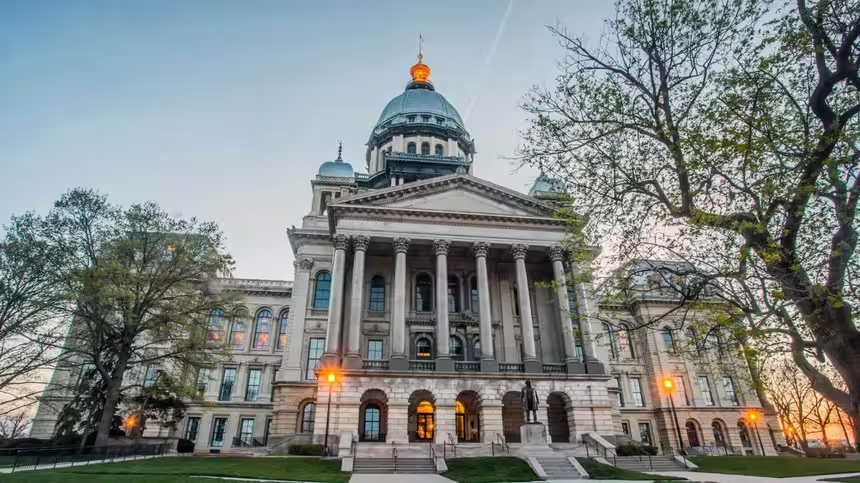
CapitolView
CapitolView is a weekly discussion of politics and government inside the Capitol, and around the state, with the Statehouse press corps. CapitolView is a production of WSIU Public Broadcasting.Providing Support for PBS.org
Learn Moreabout PBS online sponsorship[MUSIC] >> Welcome to capital view on WSIU.
I'm Brian Sapp with the beginning of July.
That means new state laws are going into effect.
We'll look at one that creates a new department of early childhood.
Also storms have rocked communities across Illinois this year, and the National Weather Service has confirmed at least 153 tornadoes in the state this year.
That's a record.
And while these residents are cleaning up the mess, there are worries that they may not receive the help from the federal government under the Trump administration.
Joining us to talk about these issues today are Kent Redfield.
He's a political scientist, professor emeritus at the University of Illinois, Springfield, and Peter Hancock, reporter with Capitol News, Illinois.
Kent and Peter, it's good to see you too.
Thanks for joining us.
>> Good to meet you.
Thank you.
>> Let's start off, Peter.
You've covered this story, written a couple of articles and worked on this, the new Illinois Department of Early Childhood.
Can you tell us the purpose of this new department and what what changes we can expect to see?
>> Yeah, this is something they actually created this a couple of years ago, but it has taken two years to get fully off the ground.
Governor JB Pritzker called for this initially back in the fall of 2023, and the idea was to bring all of these different programs that serve infants and toddlers and and their families under one roof and where they can put more focus on them.
So you have things like, um, home visitations for newborns and young mothers and early interventions, uh, that have been done by the Department of Human Resources.
Uh, you have child care, uh, facility regulations, Daycare, licensing, those sorts of things that have been run by the Department of Children and Family Services.
And then you have preschools and early childhood education that's been run by the Illinois State Board of Education, including the distribution of block grants to preschools.
So those are all being put under one roof.
Now, under this new Department of Early Childhood and July 1st, the start of the new fiscal year is when it officially takes over responsibility for those things.
So this new department has now over 500 employees.
It has a budget of about $4.4 billion.
All of that much of that was, you know, employees transferring from other agencies and budget authority that was being shifted from other agencies into this new agency.
Uh, but Governor Pritzker has also made no secret of the fact that he wants more budget emphasis on early childhood, uh, particularly child care and early childhood education.
Because really, we live in an economy now where parents have to work.
It takes two incomes to support a family, and that means both parents have to work.
And that means children have to be in daycare or preschool or somewhere where they're being taken care of during working hours.
Uh, so it, uh, other states have created similar agencies that focus solely on early childhood development and childhood education.
Uh, Illinois is now joining that pack.
>> Okay.
Um, sounds like.
Yeah, trying to combine a few.
It'd be interesting to see kind of how that goes forward and what that starts to look like.
Kent.
Before we were coming on, we talked about maybe what is the process that you've seen in your experience starting up a new agency and working through a new department?
>> Uh, well, you know, when I got here in 75, we were under the new constitution.
And when Jim Thompson became governor, uh, he made pretty extensive use of authority within, uh, the 1970 Constitution, uh, executive power to move things around, to reorganize, uh, not just, you know, renaming things like, you know, federally, you think Department of Defense, Department of Defense, Department of War, but actually making substantive changes.
Now, there was a process that involves legislative oversight and ultimately things get got, you know, codified into into state statutes and stuff.
And so, and Jim Acker did some of this, uh, it is probably not, you know, one of the reasons that we don't do it that way is that it's probably more efficient to work with the legislature in terms of, you know, getting things in place.
And so you don't have to, uh, kind of, you know, have a big surprise initiative that then everybody else is trying to figure out.
And so Pritzker has kind of done the opposite.
He's used, he's worked very systematically to talk about it to, to move some money, to get some statute to delay implementation.
And, and so, uh, you know, this is, uh, just like anything when you rearrange the furniture, uh, it's, it's always difficult, but, uh, this seems to have been, you know, reasonably, you know, in terms of the process, it's been something that's been, you know, pretty, pretty smooth, though.
Again, it's, it's hard to be against, uh, early childhood development.
That's, uh, you know, that's a pretty good, uh, you know, pretty good, uh, you know, thing to take up if, if you're trying to make a mark as a governor.
>> There's plenty of issues.
And pulling disparate ideas into the same umbrella seems to be something that hopefully will serve the children even better in this state.
Um, Peter, I want to stick with you and kind of stay stick on child issues.
The state Board of Education is working on some changes, you know, through curriculum and their guidance with, uh, districts around the state.
And one of these is a new numeracy plan.
Can you tell us what this new plan is and what maybe some of the changes are?
>> Yeah.
This is a follow up to a process that the state Board of Education went through a few years ago, creating a statewide literacy plan.
The goal of which was to help school districts and help classrooms develop strategies to boost students reading and writing scores.
Uh, this is focused on math scores.
And I think it's no secret.
And it's an oddity, I think, of American culture that, uh, we're not very good at math, or at least we think we're not good at math.
We think that it's, uh, something that's too complicated for us to handle.
And if you look at test scores, whether it's the national, um, what are called nAEP scores or whether it's the scores on the statewide, the state's own standardized tests that they give to students each year.
Uh, math scores and math proficiency rates are always below that of reading and writing proficiency rates.
Uh, and, you know, it's a common thing in American culture to hear people say, you know, I'm just not a math person.
I can't do math.
Uh, nobody says that about reading.
You know, you don't go out and just openly admit I can't read or I'm not into that.
Uh, so math has been both, uh, educationally and culturally a very difficult nut to crack.
And so they've come out with this document.
Uh, and if you read the document, it's not going to teach you how to do math immediately.
Uh, it's more, it's a, uh, an education, uh, you know, sort of industry academic, uh, document about, uh, focusing more resources on training teachers, you know, when they're first getting their education degrees, uh, focusing resources in the classroom about continuing education and training for teachers, uh, developing strategies that are research based that, uh, actually help students learn and how to individualize math education, uh, for students because, uh, all, all people, all students approach it, you know, from different levels and, you know, with different sort of, uh, mental frameworks.
Uh, so it, you know, it's not something, uh, if you're having trouble getting to sleep at night, it's something you might want to, you know, crack open, uh, for the ordinary person, but it is a significant step.
And it shows that, uh, that the education community in Illinois is really focused on getting over this sort of mental block we have about math and getting schools and teachers and everybody up and down the line focused on, uh, getting kids more oriented to be able to do math.
Uh, because it is, you know, so critical.
We're now living in a very tech heavy, uh, Stem oriented society, uh, both just in terms of our daily lives and the way our economy is organized.
This is something that people need to be able to do.
Uh, and students.
Children need to develop these skills in order to have, you know, success later in life.
Uh, so it's a significant step.
And hopefully, you know, it's not going to be a quick turnaround, but hopefully within a matter of, you know, a few years, we should start seeing those math proficiency rates going up.
>> That, yeah, hopefully I did a little bit of reporting as much as you on this.
And just in looking at it, it's quite a thorough document.
You're right.
It's not like, here's how you do this algebra problem.
It's setting up that framework and seems to just naturally flow out of some of those updating, you know, processes.
My wife is a teacher.
She's that's been her whole career.
She taught English.
But definitely in my connection with the education world you talked about, I don't do math.
Like you're right.
Nobody would say that we don't read.
And hopefully they can kind of change just, you know, how we look at we do math and we can see those scores go up.
Um, we want I want to change topics here.
This, uh, we're in the middle of summer.
We're going through a heat wave, but the past few months, we've been dealing with storms throughout the state.
And actually today, Wednesday when we're recording, Governor Pritzker is going to visit the Mount Vernon area, where we had storms go through a week and a half ago, and unfortunately, two people died during those storms.
And then he'll visit Effingham, but has brought up some stories about what federal help we've received.
Can can you kind of walk us through what are some of the questions we're seeing when it comes to support for these people who have gone through these storms?
>> Sure.
No, absolutely.
The, you know, we are have gone through a historic period.
You know, 153 tornadoes, I think 2006, we had 76 tornadoes during the year.
And that was the high water mark.
and we're halfway through this year.
So, uh, you know, this is, you know, very.
I mean, it was very intense and widespread over a number of days or a couple of weeks and stuff.
And so, you know, now we're in the process.
Uh, Peter was talking about, you know, uh, a new roof when we, before we started, you know, I had to find a contractor to cut up a very large tree limb that came down between my house and my neighbor's house.
And so, uh, what you've got is a situation historically where, you know, you had FEMA, which is the federal emergency, uh, you know, disaster relief agency that was not only on the forefront in terms of some federal response, but also was, you know, doing evaluations.
And so, you know, states make, uh, you know, requests for the federal government, uh, and ultimately the president to make the declarations that then open up not only federal, you know, money can, you can have congressional, uh, you know, particular specific relief bills for, you know, I think hurricane Sandy and, you know, things that are multi-state kinds of, of things.
And so this has been a process that has been bipartisan in terms of, you know, I didn't get my state didn't get whacked in this storm, but it might in the next one.
And then, you know, some allowing the agency to use their expertise in terms of assessing kind of the level of damage.
And, and then it hasn't been, I wouldn't say proforma, but but clearly, you know, the, the, the approval of these has been a much more has been, you know, a professional kind of, you know, evidence based kind of a process.
And unfortunately, what we're finding and, and there's been reporting, uh, in, you know, uh, through Politico and Capital News Illinois, you know, looking at the situation and, um, you know, there's been a dramatic change in at the federal level in terms of how these requests for declarations, uh, disaster declarations have been been traded.
You know, you've, you've gone, if you look at kind of the first year of the Trump administration, it takes about 80 days for a, a request from a state, a blue state, Democratic governor, state, about 80 days to process as opposed to 39 days in terms of an average for a request coming from, uh, you know, red state Republican governor.
And then when you get to the actual approval process, it's about 23% in terms of requests that come from, uh, blue state Democratic governor and 89% approval in terms of red state Republican governor.
And that's, you know, that's a big change from what the historical precedent has been.
I mean, the overall average has been, you know, more like about 70%.
And, um, you know, even and, and it's been again, much more kind of need based.
If you look at, uh, during Trump's first term, actually approved more declarations for, uh, involving Democratic states than Republican states.
And so that has become, you know, a major concern as you start to look at your state budget, uh, you know, and how much federal money are you going to get on things that you normally could count on?
But now in terms of grant programs may be, uh, you know, delayed and in some cases, uh, you know, it, the money never materializes.
But now when you've got, you know, what we're, you know, we're, we call, you know, an act of God, then, uh, you know, the idea that that gets politicized is, uh, you know, it's, it's, it certainly seems to be a sign of the politics that we're, we're currently in.
And so this is, is not a one off in terms of, uh, Hoare relationships between state and the national government, uh, you know, differ, you know, big differences in terms of, uh, you know, the partisan, uh, you know, the partisan identity of, of, of the, the people that are, that are involved.
>> Yeah.
Those numbers were what struck me.
Um, and, you know, just until recently, we hadn't suffered many storms.
So, you know, it's one of those things that's kind of outside out of mind, but, um, appreciative of the reporting to just look at these numbers.
And unfortunately, this is going to have to be an issue or we're going to have to continue to rely on the reporting to see, you know, see what is truly going on.
I want to switch over to politics a little bit.
It's the middle of summer.
Hot things are kind of slow.
But Governor Pritzker and Darren Bailey, his opponent, have been out there, um, campaigning a little bit.
The governor recently went to Texas and um, was campaigning on part of, I believe, the Senate candidate, Mister Talarico.
Um, and he's also been facing some questions here about how the spring session went.
I'm sure that's how it normally goes, but can you kind of tell us the week the governor's having as he is figuring things out?
>> Yeah, it got you know, one of the highlights of last week was that he was at the Texas Democratic Convention that the that the state party was having.
And, uh, this was a love fest because, uh, the governor welcomed all the Texas legislators that were fleeing Texas to try and, uh, you know, keep the, the Texas legislature from having a quorum trying to frustrate, uh, Governor Abbott's, uh, legislative agenda.
And so, uh, you know, there are plenty of stories at the time of us welcoming, uh, these legislators that were fleeing Texas.
And so Pritzker was back among that crowd, uh, talking about, uh, you know, the, the good old days and the great Relationships and stuff.
And, and then, you know, because of.
The who, where Illinois is and the things that are involved with.
And because the governor has, you know, certainly been acting like someone who wants to test those presidential waters, uh, relations, uh, and the level of rhetoric between JB Pritzker and President Trump have, have, have not been great.
And so, uh, the, you know, this was a crowd in which, uh, you know, the governor had, uh, you know, got a lot of applause lines at the expense of, uh, the president.
And, uh, you know, this is, you know, this kind of what are you doing locally versus, you know, what are you what are you doing with your national images?
You know, that's a problem for, you know, for almost any, any politician is, you know, uh, are you abandoning the home front and, you know, those sorts of things.
But we came through a pretty messy session with the lots of, you know, less than good relationships.
House in the Senate, a messy appropriation process that resulted in, you know, a $500 billion typo in a in a budget bill.
And so, uh, you know, this is something that Darren Bailey, the Republican candidate for governor, you know, that certainly is going to be a theme about, you know, is Pritzker really taking care of business?
Now, it may turn out that, uh, you know, this is may play out more into presidential ambitions than the governor's re-election ambitions because, uh, it's pretty clear that Illinois is a very blue state in its voting behavior.
And I believe Darren Bailey had about $82,000 in his.
You know, at his most recent report, his campaign fund.
And the governor had about 14 million.
After spending about, you know, 11 or something.
But he also spent $145 million in 2022 on his on election activity.
So it's not, you know, this is this is probably not going to hurt the governor in terms of reelection, but it will be an issue in terms of his national profile.
>> Peter, I wanted to wrap up.
You covered the end of the session.
Was there I mean, was there any real talks about people being concerned that the governor governor's attention might be to split?
Had you heard anything like that?
>> Oh, I don't think people were really focused on that.
I mean, it is an election year, and the governor has both the statewide presence and a national presence.
That's no big secret.
Uh, and we're going into midterm elections.
Just as Kent was talking there, I was remembering that it's kind of hard to believe that it was just less than one year ago, uh, when the Texas Democrats, uh, Texas House Democrats fled and many of them stayed here in Illinois, uh, in order to prevent there from being a quorum in the Texas house so that they couldn't pass these gerrymandered redistricting maps.
Uh, the maps ended up getting passed.
Anyway, uh, we're going into a midterm election.
And I think when you saw the governor in Texas, this was part of his national campaign, is, uh, not only is he running for re-election, but he's trying to get Democrats up and down the ballot elected, uh, across the country.
Um, and, uh, you know, it's a midterm election.
The president's party usually loses seats in midterms.
This president has very low approval ratings right now.
The war in Iran, the high gas prices, a lot of things working against him.
So there's a lot of fear that Republicans could lose both the House and the Senate.
Uh, that is obviously why the president engaged in, you know, pressuring states to redraw their maps in the middle of a decade, uh, in Republicans favor in order to minimize their losses.
And we're going to see whether or not, uh, you know, that, uh, bears any fruit.
But in the meantime, while Governor Pritzker is running for re-election here, he's also stumping around the country, trying to get Democrats elected to Congress and to governors offices and state legislatures around the country.
Uh, it's a very political year.
And, uh, October and November are going to be very interesting months.
>> Definitely politicians are going to politic.
I think that's their job.
We have just a little about two minutes left, maybe a minute and a half.
Kent, I wanted to finish.
We're on a holiday weekend.
One of the new state laws, if you can kind of wrap it up for me.
This new cocktails to go becoming permanent.
Can you wrap me up here for about a minute and a half for me?
>> Yeah.
And you know, Illinois has a law against open containers.
You can't drive down the street with a beer in your hand.
Uh, that's clearly the case.
But during the pandemic, uh, we changed the law to say that bars and restaurants could both deliver mixed drinks, and you could pick up mixed drinks.
And so, uh, that has continued as a temporary.
And now, uh, we have made it permanent within the statute.
And so, uh, you know, you can, if you want one for the road, uh, you can take it with you.
You don't have to drink it at the bar.
You do have to ask to be in a sealed container without any opening, so you can't put a straw in it.
Uh, you know, if you're delivering it, it has to essentially be in the trunk.
If a bar is is doing a delivery, but, you know, it's a hold over from the pandemic, uh, that, uh, rather than just leave it, they said, well, let's see what, you know, what's, what's, what's the pleasure of the body?
And the legislature approved, uh, making the law permanent.
>> Definitely.
And it doesn't mean you can drink while driving.
That's the key.
It's got to be sealed.
Wait till you get home.
Enjoy it.
Go out in the back porch, sit by the pool, uh, whatever.
But makes us think about the July 4th, 250 years since the signing of the declaration.
So I look forward to this weekend.
Plenty of celebrations I know around the state.
Definitely down in our area.
There'll be readings of the declaration on the eighth, which is when it was kind of officially released.
A gentleman, I appreciate talking to you and it was a great week talking about all these topics.
>> Great.
Have a have a good holiday.
>> That's it for this.
That's it for this week's edition of Capital View.
I'm Brian Sapp for Kent Redfield and Peter Hancock.
Thanks for joining us.
[MUSIC] [MUSIC]
 New Episode
- News and Public Affairs

Top journalists deliver compelling original analysis of the hour's headlines.

- News and Public Affairs

FRONTLINE is investigative journalism that questions, explains and changes our world.

 New Episode
 New Episode
 New Episode
 New Episode
 New Episode
 New Episode
 New Episode
 New Episode
Support for PBS provided by:
CapitolView is a local public television program presented by WSIU
CapitolView is a production of WSIU Public Broadcasting.