
Capitol View - July 27, 2023
7/27/2023 | 27m 45sVideo has Closed Captions
Capitol View - July 27, 2023
In this episode of CapitolView: A conversation with Illinois State Senator Dale Fowler (R-Harrisburg) about efforts to increase bipartisan cooperation and much more. Fowler is co-chair of the Higher Education Committee. Plus: analysis on a variety of stories, including efforts to boost the electric vehicle industry in the state and more controversy over a state healthcare program.
Problems playing video? | Closed Captioning Feedback
Problems playing video? | Closed Captioning Feedback
CapitolView is a local public television program presented by WSIU
CapitolView is a production of WSIU Public Broadcasting.
Capitol View - July 27, 2023
7/27/2023 | 27m 45sVideo has Closed Captions
In this episode of CapitolView: A conversation with Illinois State Senator Dale Fowler (R-Harrisburg) about efforts to increase bipartisan cooperation and much more. Fowler is co-chair of the Higher Education Committee. Plus: analysis on a variety of stories, including efforts to boost the electric vehicle industry in the state and more controversy over a state healthcare program.
Problems playing video? | Closed Captioning Feedback
How to Watch CapitolView
CapitolView is available to stream on pbs.org and the free PBS App, available on iPhone, Apple TV, Android TV, Android smartphones, Amazon Fire TV, Amazon Fire Tablet, Roku, Samsung Smart TV, and Vizio.
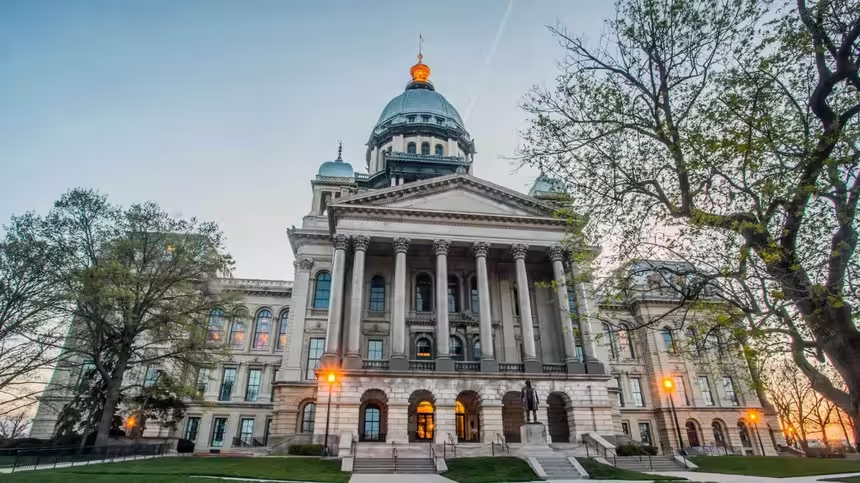
CapitolView
CapitolView is a weekly discussion of politics and government inside the Capitol, and around the state, with the Statehouse press corps. CapitolView is a production of WSIU Public Broadcasting.Providing Support for PBS.org
Learn Moreabout PBS online sponsorship(bright music) (camera beeping) (uplifting music) - Thanks for joining us on "Capital View," I'm Fred Martino.
Upfront this week we continue our conversation with Illinois state senator, Dale Fowler.
At a recent event at Southern Illinois University Carbondale, Fowler, a Republican, joined Democratic Governor J.
B. Pritzker to talk about a funding increase for higher education.
Fowler is the co-chair of the Senate Higher Education Committee and at the event he noted the significance of the bipartisan co-chair arrangement.
We begin part two of our conversation with Fowler's thoughts on ways to increase bipartisanship - Absolutely, my platform has always been to work with everyone.
I was elected in the 59th Senate District to represent everyone, no matter what the politics are, and that's always been my platform, to be able to work across the aisle, and I think that's been noted.
It's been noted by the administration and I think that's one reason why Senate President Don Harmon, and minority leader John Kern, and the governor's administration decided to start this process.
And I think this is the beginning of more bipartisanship work.
I'm not one of those, the bomb thrower.
I'm one of those that tries to work with everyone.
Sometimes I have very important legislation that I have to work sometimes across the aisle to ensure that it passes the general assembly.
So to have that relationship with my colleagues throughout the entire Senate, especially on the other side of the aisle, means a lot to me.
And then I work with them as well to be a chief co-sponsor or a co-sponsor for their legislation, especially if it's great for the district that I represent.
So I think this is a great start.
As I mentioned earlier, that this is the first time in a few decades that, to my knowledge, that there has been a co-chair on a committee, and especially since I represent Southern Illinois University.
Of course, I represent the entire state of Illinois too when it comes to higher education, but I think it really shows the momentum and the enthusiasm to be able to work in the chamber with everyone, and that's what I was elected to do and I intend to continue doing that.
- All right, well, at the event at SIU Carbondale, you also talked about higher education in terms of economic development, noting the so-called brain drain that happens when talented Illinois high school graduates go to an out-of-state college.
I wanted to give you a chance to talk about that today because it's often a discussion that is missed when we talk about higher education.
- Absolutely, the brain drain, as you mentioned, has been a concern throughout the entire state of Illinois, especially down here in Southern Illinois where it's easy to go to Missouri, Indiana, Kentucky, Tennessee, and not have to travel far and to see the enthusiasm that we're garnering here in Southern Illinois.
And especially with all the economic development projects that we have now in Southern Illinois with a lot of these, you see what's happening in our healthcare.
There's a lot of jobs, job creations, good paying jobs.
You see what's going on in our infrastructure bill.
We have over $800 million that was just announced that's going into infrastructure improvements in my district, that announcement with the Illinois Department of Transportation, and the education field growing and as I mentioned, the medical field, and all these great jobs that are coming with the meat processing plant, and the ports, and just a lot of opportunities.
And something that also I enjoy promoting is our tourism.
Where we live here in the Midwest is a special place to live, a special place to raise a family.
I have 20 state parks, Illinois Department of Natural Resource state parks in my district, plus the incredible Shawnee National Forest.
The two mighty rivers, the lakes.
Our housing, our housing costs are economical.
We have to continue to work on lowering our property taxes and that's why we wanna continue to fund more dollars into education so our municipalities can lower the property tax rates as well.
So I think it's very special place.
We live in a very special region.
Our geographic location is incredible and I think we have a lot of opportunity, and you see what's going on in our housing market and that's the reason we're working hard to improve our housing market as well to create more opportunities for students to stay right here.
And to see this enthusiasm with our universities and our community colleges and growing is very exciting.
- I wanna ask you about another economic development issues, STAR bonds.
We have a STAR bond district, as you know, in Marion.
These bonds allow developers to recapture construction costs from a portion of the sales tax.
Your thoughts on this program and the importance of it in economic development?
- Oh, it's very important and again, thank you for mentioning this.
It's actually, we're working on some STAR bond development actually as we speak, working with the governor's office and the deputy governor as well.
There's hundreds of millions of dollars of investment that's prepared to come into Southern Illinois that hopefully we'll be announcing soon and STAR bonds is the main driver for this.
So I know this has been something that we've been working on for several months on some of these developments that we're anticipating.
So we're still waiting on administration to sign off on the STAR bonds.
They're working with, a lot of developers are working with the Department of Revenue.
They've been phenomenal to work with.
Still some work to be done on that.
It is something very unique, the STAR bonds, but we see what's going on in Southern Illinois, especially in the Williamson County area.
And this scratching the surface of what's gonna be coming to Southern Illinois, especially with the STAR bonds which we're so fortunate to have.
- Well, Illinois has also recently seen a growth in tourism.
If you talk to economic development experts, most highly support tourism because it brings in dollars from outside the state.
What do you make of the tourism work that's being done in Illinois and where we go from here?
- Absolutely, the governor and the administration is earmarking a lot of money toward tourism promotion and marketing.
In fact, some of that's gonna be coming here to my district to be able to market Southern Illinois throughout the Midwest especially.
And as I mentioned, I have 20 state parks, the Shawnee National Forest.
Tourism is growing, it's unbelievable, and you see what's going on in the industry of campers, and boating, and fishing, and hiking, and kayaking.
List goes on and on and there's a lot of investment.
We had the budget didn't pass a few years ago which was devastating to our tourism.
It's devastating to state of Illinois as a whole.
But to be able to see an investment going back into our state parks.
We're improving our campgrounds.
We're building a new OHV park, the Sahara Woods State Park in Saline County that's gonna be opening up this fall that's gonna be a huge driver to bring more people into Southern Illinois.
And you see the Golconda Marina.
There's been a lot of investment in it.
The Fort Defiance State Park.
There's gonna be some economic improvements there.
The list goes on and on.
Dixon Springs, a lot of this investment, and I travel around my state parks a lot.
I really do, I have an initiative called Southern Illinois Treasures that's on my senatorfowler.com website to really promote tourism, and it's fun to drive through our state parks, especially our Shawnee National Forest and look at the license plate and all the different states that people are flowing in.
And that's the reason why we're gonna continue to work toward creating more campsites for individuals to stay here and come to Southern Illinois and visit.
So it's really exciting.
Tourism is a huge economic driver to Southern Illinois.
Some of my colleagues since I've been in the state senate have been traveling, having family vacations down here in Southern Illinois, and they contact me or I meet with them while they're here, and they say, "This is unbelievable.
We didn't know what you had here," it's phenomenal.
- It really is, I know anytime I have visitors taking them to Giant City State Park or Ferncliff, incredible highlights of their visits and one of the investments that Illinois makes of course, allowing a free admission to those parks to allow everyone to go regardless of their income.
We have about five minutes left, Senator, in our conversation today.
We've talked about a lot of positive things, but I do wanna touch on something that some argue is a long-term need in Illinois, an effort to cut property taxes in the state.
As you know, I'm sure you hear about this from your constituents all the time.
It's a major concern for people and I wanna give you a chance to address it.
- Absolutely, that's why it's so incredible to continue to improve with our local government distributor funds to be able to continue to increase those funds going back into our local governments and you're seeing that with this administration as well.
And also continue to be able to invest more dollars in education or K through 12.
We know a lot of our property taxes, usually in most communities, in most counties, over 50% of your property taxes are going to education and education is one of the most important things that we do.
So we hope to be able to continue to fund education at a higher level so these counties and cities can offset some of the property tax costs to the citizens.
We do have some of the highest property taxes in the country and that's something I don't think that we're paying enough attention to.
I know we are as legislators.
But on the statewide level, we have to do everything we can to continue to alleviate property taxes.
You're seeing other states announcing certain percentages of property taxes are now being cut and that's why, another reason why we're having an out-migration of some people leaving the state of Illinois, especially in the northern part of the state because of the high property taxes.
With the cost of homes that have been going up, well, what's that do to your property taxes?
Obviously it increases your property taxes and it's driving citizens to other states.
So that's something that's it's a priority of our caucus and it's gonna be a priority hopefully for the entire state of Illinois to get those taxes down, give some pressure off these homeowners so we can continue to improve our housing market.
That's one reason why our new housing has been diminished a little bit because of what it costs in property taxes after it's constructed.
So it's something that has to continue to be a top priority and this continuing to fund education at a higher level will hopefully help alleviate some of that pressure.
- Something I'm sure will revisit in future conversations as the legislature tries to work on this issue.
'cause it's such a longstanding concern and issue in the state.
Our final time together here, just a a minute or two left.
Any other things that you'd like to see done by the legislature to bring more people to Illinois and keep the residents and businesses that we already have?
- Absolutely, one thing that we're really working hard on and this has been, I've been a strong proponent of this, is workforce development vocational training.
The former Golconda Job Corps is in the process of being repurposed for vocational training, working closely with our trades, our apprenticeship programs.
You're gonna be seeing more money going into apprenticeship.
So the dollars going into Southern Illinois, we've been kind of left out of that down deep south.
So you're gonna see some of our dollars going into working with our trades and our community colleges, and it's encouraging to see our SIU and our community colleges increasing their vocational training and workforce development initiatives to be able to give the proper training that we need to be able to stop the people from leaving state of Illinois and to be able to give them the resources they need, especially those that have been somewhat less fortunate to show that there's opportunity to be able to go to work and stay right here in some of the most amazing part of the country right here in beautiful Southern Illinois.
- Absolutely, well, Senator, it has been a delight talking with you today.
Thank you for taking some time out for us and talking about all of these important issues.
Senator Dale Fowler joining us today.
Senator, thank you for being here.
- Thank you, it's an honor to be with you.
Appreciate you so much.
- We'd like to share your letters to "Capital View."
Email us anytime, the address is contact@wsiu.org.
Analysis now, and we have a great panel this week.
Hannah Meisel is here from "Capital News Illinois" and Jeremy Gorner joins us from the "Chicago Tribune."
Thank you both for being here.
Jeremy, let me start with you.
A story making news here and across the nation.
Illinois Governor J.
B. Pritzker and others celebrated the Lion Electric Assembly plant.
The plant will build electric school buses and other electric vehicles.
The governor also led a group to the United Kingdom to promote electric vehicles clean energy and more.
Let's talk about this and how important it is for Illinois.
- Yeah, so Lion Electric, so Governor Pritzker beat out a site in Texas in 2021 to bring the Lion Electric plant to Joliet.
Basically Lion Electric says that this brings the prospect of 1,400 jobs and basically the first new vehicle assembly plant in the Chicago Metropolitan Area since 1965.
And it's basically an electric vehicle plant which is really the direction that the Pritzker administration has pushed, especially since the Climate and Equitable Jobs Act was passed a couple of years ago.
And that's kind of what he was touting when he was in England, when he was in England in the last few weeks.
He was really trying to use Illinois', the progress that it's made with electric vehicle manufacturing to kind of let companies in the UK know that Illinois is open for business, especially for something innovative like EV manufacturing.
But not just that.
I mean, he was also, it had also been the first time, he's trying to do more of these international trips promoting Illinois he says because the previous administration under Bruce Rauner didn't do it.
Also there was a lot of ground loss during COVID where the Pritzker administration could not put Illinois in the national scene drawing businesses to the state.
He also said it wasn't about drawing new businesses.
It was about expanding existing businesses that have ties to foreign companies.
But he also had the food processing, representative from the food processing industry there.
Hospitality, manufacturing, aviation, you name it, really to kind of put Illinois on the board especially after, especially recently you've seen companies like Stellantis and Rockford relocate, right?
Their automotive plant, and you've seen Caterpillar, and Boeing, and Citadel, big companies like that leave Illinois.
So obviously Pritzker's really trying to make this kind of his mission in his second term to convince foreign companies that Illinois is back on the international scene.
And it's like in Lion Electric, obviously like you said, huge national story because of it's coming to Joliet out of all places which hasn't seen any kind of auto industry in the last 50 years.
And it really kind of represents a change of just how this administration is trying to move from basically traditional auto fuel emission to more eco-friendly electricity.
- Yeah, it's really quite a story and of course, follows Rivian, so electric vehicle manufacturing on the map in Illinois.
Thank you, Jeremy, Hannah, wanna talk with you about something very interesting too and not directly related to electric vehicles, but sort of an indirect relation here as we talk about climate.
A proposed change in state air pollution regulations will move forward, and that is despite an objection from a legislative oversight committee.
It's crucial though, it allows the state to avoid federal sanctions.
Let's get an update on this and how the situation came down to the wire.
These sanctions would've gone into effect next month without the change.
- That's right, so basically previously, Illinois had always given owners of factories, refineries, power plants, other facilities basically immunity from some civil lawsuits when they exceed their emission limits during shutdown, startups, and malfunctions.
And now federally way back in 2015, Illinois and other states were told hey, you're gonna have to change these rules because we are changing the Federal Clean Air Act to not allow such immunity.
But then the Trump administration kind of put a pause on that and so there was some ambiguity as to whether this would ever actually come to fruition.
But basically in the Biden administration.
the EPA went forward with this new, this is prompted by court ruling.
And if Illinois hadn't complied, we would've eventually, our access as a state to the Federal Highway funding would've been tightly restricted and that is very difficult on a number of planes.
Of course, Illinois is in the middle of a really large multi-year infrastructure plan and of course, that would also be very difficult on state's labor union, especially local 150, a very influential union that does a lot of that highway building.
- Interesting story, and as you point out, crucial.
I mean, something necessary.
It was surprising to see that come down right to the wire.
- Oh, I would disagree.
I've been covering Springfield for 10 years.
I've seen plenty of things come down to the wire.
(Fred laughing) - Yeah, well, there you go, there you go.
I was being kind.
Jeremy, speaking of pollution and climate, safety issues are being raised by a carbon dioxide pipeline project proposed for Illinois and several other states.
What is going on here and could this derail the project?
- I mean, it's hard to tell if it's gonna be derailed.
These problems have been publicized I think for some time now, but basically the Midwest is considering the health and safety issues that are raised by these proposals to build these massive carbon dioxide pipeline projects that span Illinois, Iowa, Nebraska, Minnesota, South Dakota.
And basically the goal of these projects, of this C02 pipeline project so to speak that we've been hearing a lot about is it's aimed to prevent to global warming.
Basically it prevent C02 from entering the atmosphere and what the pipeline's supposed to do is capture it during industrial processes.
So compressing it into fluid, transporting into these steel pipelines, and basically injecting it safely deep underground where it will be trapped ideally for thousands of years.
I mean, this is according to an article by one of my colleagues at the "Tribune" who's been covering this issue, Nara Schoenberg.
The company that is really pushing this navigator says that this can be done safely and points to thousands of miles of C02 pipeline that's already in use of the United States.
This is mostly by the oil industry, but you have environmentalists and landowners say that this should be put on hold because there's just too many gaps in health and safety regulations.
For example, there's no state or federal limit on how close pipelines carrying C02 can be placed near a home, school, or hospital.
There's no requirement that an odorant be added to C02 to alert the public to a leak.
There's no requirement that this be done with C02 as it's done with natural gas and there's no limit on impurities that are allowed in carbon dioxide despite the potential for pipeline corrosion and other health hazards in the event of a leak, among other things.
So I mean, so basically you had more than 150 of these eco-friendly environmental and advocacy groups.
They sent a letter to President Biden calling for a moratorium on these pipelines until federal regulators complete their work.
So we'll see really what happens there.
I mean, this has been kind of, it's a political hot potato so to speak when we talk about climate change and this appears to be a solution to it really to appease a lot of folks who believe that this is a real problem.
But at the same time, clearly there are some safety gaps according to environmental experts that really need to be addressed before this comes to Illinois and surrounding states.
- So interesting, the information you presented there.
I mean, I think probably a lot of people would've expected more federal oversight of something like this.
So we'll keep watch on this, of course.
The pipeline also would be going through other states, so they may have a say as well in where this all goes.
Well, Hannah, I wanna talk about another controversial issue now.
Members of a state rulemaking oversight committee said the Pritzker administration did not seek enough public input on its plan to cap enrollment in healthcare programs for some non-citizens.
Tell us about the latest controversy with this program which of course, is also under scrutiny because of its enormous cost.
"Capital News Illinois" talking about that in a story.
$550 million allocated for this by lawmakers.
Estimates were it could cost 1.2 billion without changes.
- Right, so basically a bit of background.
In 2020, in the first few months of COVID, of course, Latinos were the group that were getting sick the most often, often dying.
This was a program originally presented by the Latino caucus in our very brief truncated Spring 2020 session that would allow a non-citizens age 65 and over to get Medicaid-like benefits.
The program has since been expanded twice and now the minimum age rather is 42.
And this is a program that has kind of flown under the radar until this spring when the state department of Health and Family Services, they said, "Hey, our costs are kind of exploding. "
$1.2 billion as you said.
And so there was kind of a internal fight between the governor's office and Latino caucus that had pushed for this program and expansion in the first place.
And basically lawmakers distributed 550 billion which is a little less than half of that estimated cost and basically left the way to get there, the tools to actually curb that spending, to the Pritzker administration through rulemaking which is a little inside baseball.
You mentioned at the top that this oversight committee that's in charge of the rulemaking was upset from the lack of basically (indistinct).
I would say that's definitely a fair criticism.
Also a fair criticism from Republicans saying this leaves the legislature kind of advocating its responsibility to give the governor's office, the administration more power to curb the spending, and they did that by of course, oh, sorry.
- Thank you, Hannah, we are actually out of time.
Very interesting information about this and something I'm sure we'll be following more in the future.
Thanks to my guest, Hannah Meisel, from "Capital News Illinois" and Jeremy Gorner from the Chicago Tribune.
And thank you at home for all of us at WSIU.
I'm Fred Martino, have a great week.
(uplifting music)

- News and Public Affairs

Top journalists deliver compelling original analysis of the hour's headlines.

- News and Public Affairs

FRONTLINE is investigative journalism that questions, explains and changes our world.












Support for PBS provided by:
CapitolView is a local public television program presented by WSIU
CapitolView is a production of WSIU Public Broadcasting.