
Capitol View - June 13, 2024
6/13/2024 | 27m 5sVideo has Closed Captions
Capitol View - June 13, 2024
Analysis of the week’s top stories with with Mawa Iqbal of WBEZ and Jason Piscia, Director of the Public Affairs Reporting Program at the University of Illinois Springfield.
Problems playing video? | Closed Captioning Feedback
Problems playing video? | Closed Captioning Feedback
CapitolView is a local public television program presented by WSIU
CapitolView is a production of WSIU Public Broadcasting.
Capitol View - June 13, 2024
6/13/2024 | 27m 5sVideo has Closed Captions
Analysis of the week’s top stories with with Mawa Iqbal of WBEZ and Jason Piscia, Director of the Public Affairs Reporting Program at the University of Illinois Springfield.
Problems playing video? | Closed Captioning Feedback
How to Watch CapitolView
CapitolView is available to stream on pbs.org and the free PBS App, available on iPhone, Apple TV, Android TV, Android smartphones, Amazon Fire TV, Amazon Fire Tablet, Roku, Samsung Smart TV, and Vizio.
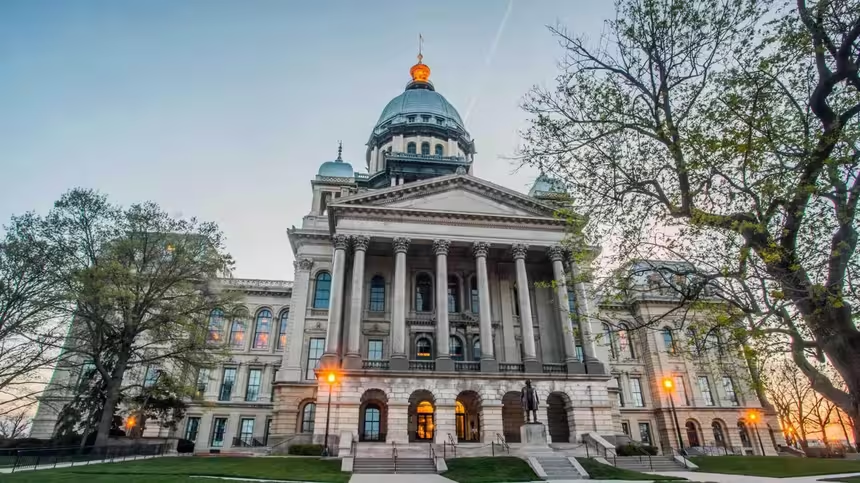
CapitolView
CapitolView is a weekly discussion of politics and government inside the Capitol, and around the state, with the Statehouse press corps. CapitolView is a production of WSIU Public Broadcasting.Providing Support for PBS.org
Learn Moreabout PBS online sponsorship(calm music) (lens beeping) (dramatic music) - Thanks for joining us on "CapitolView," I'm Fred Martino.
We have a very busy week this week, lots of news to get to, so I wanna get right to it with Mawa Iqbal with WBEZ and Jason Piscia, director of the Public Affairs Reporting Program at the University of Illinois Springfield.
We have been talking a lot about the budget and the other bills that passed this year, so this week we're gonna begin with the bills that did not pass, very important not to forget about those.
Jason, Capitol News Illinois highlighted some of those bills.
Give us an update.
- Sure, I mean, the sessions start each spring in January, it seems like we have all the time in the world, a full five months to get everything done.
It seems like nothing happens for those first 4.8 months or so, 5.8 months, and everything passes, including the budget, in the last week or so.
And that leaves a lot of important issues on the table that don't get dealt with, with always a promise of perhaps we'll deal with it in the veto session.
Wanted to run through five quick ones today that sorta highlighted sort of those missed opportunities.
First was involving the Prisoner Review Board.
You may remember the tragic case earlier this spring where a Chicago man, Corsetti Brand, the Prisoner Review Board voted to parole him.
And then, you know, within hours of being released, he went to his ex-partner's house and stabbed her and then fatally stabbed that woman's 11-year-old son.
All this happened while the victim had a order of protection, an emergency order of protection against him to keep him away from her.
This has created lots of fallout in the PRB.
A couple of members resigned.
And Republicans introduced some legislation to cover up the holes in the PRB system, including making members need some enhanced qualifications to be on the board, improving some notification measures to victims when people get out of prison.
But unfortunately it didn't go anywhere, so we'll see where it goes in the next few months.
There are also a couple of wage-related bills that didn't go anywhere.
We've talked for several sessions about eliminating the subminimum wage for workers who have disabilities.
There's an exemption in the federal Fair Labor Standards Act that allows businesses and rehabilitation and residential care centers to pay people with disabilities less than the minimum wage.
This bill would've eliminated the ability to do that.
Once again, that one didn't go anywhere.
There was also another bill to eliminate the tipped wage workers who are tipped, such as waiters and waitresses.
The current minimum wage is $14 an hour for a couple more weeks here.
Waiters and waitresses can be paid as little as 8.40 an hour as long as their tips make up the difference.
This bill would have, you know, deleted that 8.40 wage and made everyone pay at least 14.
Obviously, some restaurants and businesses oppose that due to the increased costs.
Also, a bill.
Alexi Giannoulias, the Secretary of State, who's also the state librarian, was backing a bill that would have increased penalties to people who make threats against libraries or librarians, making them equal to people who make threats against schools.
That bill didn't go anywhere this session as well.
This bill comes a year after the governor signed a bill that would have cut off state grants to libraries that ban books for political reasons.
All this has to do with sort of the increased scrutiny on libraries among the public on which books are allowed and which books are not allowed and sort of the political ramifications of that.
And then one other one, we saw a news conference earlier in the session about hemp-related products, specifically the Delta-8 products.
These are, you know, products that are resemble snacks and cookies and other things that children might like.
And they're unregulated, they can be freely sold in convenient stores.
And there was some talk about putting some regulations in place that would make it harder for these products to get in the hands of children, and that didn't go anywhere either, so we'll see where all these go.
- Absolutely important to really keep track of all of those.
That last one you mentioned, of course, something that's receiving a lot of attention in other states as well, a national issue.
Mawa, you reported on another bill that did not pass.
For a third time, it failed to pass.
It's called Karina's Law.
We've covered it on this program and some other WSIU productions.
Tell us about this and why it didn't pass again for a third time.
- Yeah, so Karina's Bill is named after Karina Gonzalez, who was a woman in Chicago.
She had sought an order of protection against her domestic partner, citing threatening behavior and drug use, and was granted that order of protection.
And the judge also issued the removal of his firearm, or of his FOID card, but not the removal of his firearms.
And so he then allegedly shot and killed Karina as well as her 15-year-old daughter and also harmed her son, Manny.
And so this bill, yes, was introduced last spring, was for the first time.
It had support from Democrats, but it had a lot of pushback against police groups, with some police groups saying that this is, you know, it puts police in a very dangerous situation to try to go and confiscate these guns in these domestic violence situations.
And, you know, police groups are worried about just also the due process issues of, like, you know, confiscating firearms from people who haven't been officially convicted of a crime.
And so, you know, it failed in the spring, but, you know, the democratic supporters and sponsors of the bill thought, okay, let's bring it back for the veto session last fall.
They brought it back, and it failed once again.
And of course there was still, at the same time, all this momentum on the ground from domestic violence survivor groups, from gun control groups, violence prevention groups in general, who really, really wanted to see this bill come to fruition.
And so they brought it back again for the third time this spring session, and it didn't even make it out of committee, much to the chagrin of a lot of the advocates who are on the ground supporting this.
And when I talked to police groups, it seems that as though those concerns that they had last year sort of remain still, where it's a safety issue, right?
That they were saying that, you know, in order to execute a search and seizure of these firearms safely, police recommend that you have four officers do it.
And then there's also the question of where do we keep the guns once we confiscate them, so a lot of these issues kinda revolve around the capacity for smaller departments in more rural areas, you know, like, how do smaller departments who have maybe like one officer on duty do something like this?
So, it's something that when I talk to the sponsor of this bill about, she said that she will come back in the summer and keep working on it.
But I guess another wrench in the plans, but kinda what makes this all so confusing also is the fact that there is a Supreme Court case up right now, it's called the Rahimi case, and it's after this person in Texas who similarly also went on kind of a shooting rampage after he had a domestic violence order of protection taken out against him.
And so the question that's now before the US Supreme Court is, would it violate people's second amendment rights to bear arms to order the confiscation of these guns if you have a order of protection against you?
And so we don't know when that decision will come down, people say it'll be sometime this summer, but the chief sponsor of this bill of Karina's Law definitely said we will have to make sure and see what happens with that before we can move forward.
- Legal matters, always complicated, and a very good overview there that there's also perhaps a funding issue, because if you have a new law, you also have to have the means to enforce the law.
But certainly something we will continue to watch here at "CapitolView" and on other WSIU programs.
Jason, a new report this week in the Sun-Times shows that Chicago's homeless population has tripled, the immigration crisis being blamed for part of that.
And another story in the Chicago Tribune discussing the problem of immigrant men disappearing, leaving women and children with another crisis in addition to building a new life in America.
Bring us an update.
- Yeah, first the Sun-Times story.
Each year, the city of Chicago does sort of a snapshot count of the homeless population in the city.
They did the count this year in late January, and they came up with almost 19,000 people experiencing homelessness on that one night in Chicago.
Almost 14,000 of them were classified as asylum seekers.
You know, living in shelters.
About 5,000 of them were non-asylum-seekers, which was just a 25% increase on just non-asylum-seekers, and as you mentioned, the overall number was triple of what it was last year.
You know, this obviously comes as the migrant crisis continued to build throughout all of last year and into this year.
Somewhat of 43,000 migrants entered Chicago over the last several months.
You know, and at the same time, the experts in the story indicated that lots of pandemic-related relief aid has started to run out, which decreased abilities for cities and governments to deal with this.
And at the same time, there's some, you know, policy changes or at least attempted policy changes in Chicago.
Some have worked, some have not.
You may remember in the March election, the Chicago mayor put out a plan that would've increased taxes on high-end property sales and direct those proceeds to combating the homeless situation in Chicago.
Voters rejected that soundly, so that didn't go anywhere.
But at the same time, the mayor's trying some other financial solutions to try to direct some more money toward homelessness.
And as probably been mentioned on an earlier show, the state budget that was signed recently includes $182 million in state money to help with the migrant population in Chicago.
So that's all there.
And then you mentioned the Chicago Tribune story as well.
Interesting story by Nell Salzman of the Tribune, looking at, I'm not sure you can call it a trend, but she found a few cases of where, you know, migrant families are landing in Chicago perhaps unexpectedly, and they're just trying to make their lives work.
So, you know, a man and his partner or a man and his wife and then some children arrive here, they're looking for work, they're trying to establish their lives, and it's undoubtedly a challenge.
And Nell's story gets into some details about how the men in these families are abandoning their families, leaving their wives, leaving their children, and sort of going off, and we're not sure where they're going.
In some cases, they may be being treated as missing persons cases or maybe they're just gone.
- Yeah, and it's important, as you know, to say we don't know yet the context in terms of is this percentage higher than it would normally be in general, we simply don't know that.
And the numbers are staggering, to say the least, that it's over 40,000 immigrants who have come into Chicago since August of 2022, which is the number that's used in many stories on the immigration issue.
- Yeah, and just one last note on that Nell Salzman story from the Tribune.
They talked to some counselors who work with these families and, you know, they mentioned it just might be a pride issue.
The men are having problems finding jobs, and just because they're unable to provide for their families, they may feel a sense of shame and may just walk away.
So it's a sad story nonetheless.
- Absolutely, we will, again, continue to watch that issue very closely.
Mawa, I wanna move to politics now.
We have only about 12 minutes left in the show.
And this is a very important and interesting story you covered for WBEZ.
Ranked-choice voting is being added across the country.
Tell us more about ranked-choice voting, as it may come to Illinois someday.
- Yeah, so it's really interesting that this is something that's been talked about at least, you know, for the past couple of sessions.
Last spring, there was an effort to bring, actually bring ranked-choice voting into Illinois for the 2028 presidential elections.
And there was a lot of pushback from local election authorities, like county clerks, and then also the State Board of Elections, who were like, you know, we just need more time to really think about, like, how to actually transition to this completely different style of voting.
And so the compromise then became, you know, let's convene a task force instead.
And so this task force had met.
I believe they're done meeting, and now they're in the process of drafting a report on what they think the state should do.
But essentially ranked-choice voting, for those of you who don't know, is when you go to the polls, and instead of picking one person, you rank however many candidates there are, you know, out of however many candidates there are.
And so the candidates that get the top rankings advance on.
If there is, you know, a runoff that needs to happen because not one candidate has reached 50% or more of the votes, then whoever, all the ballots for the bottom two candidates, they get eliminated, and then the people who put whatever their second choice was will go up to the top.
So, it's a little confusing and kind of convoluted, but it's, you know, proponents say that it definitely helps in regards to making the elections more, I guess, civil in a way.
So they said that because the field is more crowded and you aren't picking just one person, you're trying to appeal to multiple different voter bases to try to get either the first or the second or third rankings from voters, the elections and the campaigns become more policy-focused instead of trying to mud, you know, mudsling or, like, smear your opponent.
Of course, opponents, though, of ranked-choice voting say that money is at the heart of the issue, right?
So they're saying that, you know, we don't have the money to transition to new ballot accounting systems and we also would need more money to print larger, you know, ballot sheets because it will take up more space on the ballot sheet itself.
We'll also need to hire more election judges because there'll probably be longer lines since more people will be confused and need more help and may take more time at the polls themselves.
So, there seems to be some, like, logistical concerns that need to be worked out, but overall it does seem like most of the Democrats really like ranked-choice voting and could probably see it coming in 2028.
It's just, I guess, trying to convince the local election authorities to get on board too, which- - Yeah.
- Yeah.
(laughs) - It's gonna be really interesting to see what happens.
I moved here from a city that used ranked-choice voting, and there was a lot of controversy before it was implemented and after it was implemented.
But certainly, there are many, many interesting benefits that many advocates will mention, including what you said, the opportunity for a runoff if you have two folks who simply don't get 50% of the vote.
Some advocates consider that a benefit that you might have the two most popular people running against each other rather than simply one party versus another party, so it does put the focus on policies.
Jason, we're gonna move to justice issues now, and a report in the Chicago Tribune finds Black Chicago drivers are more likely to be stopped by police than to get traffic camera tickets.
Give us the details.
- Yeah, this story in the Tribune reported on a study that some university people did, including at the University of Illinois Chicago.
The data is a little bit old, from 2019, but still revealed some interesting things.
They looked at GPS data from cell phones and data on traffic stops and speed cameras.
As you know, in Chicago, there's a couple of ways you can get a speeding ticket.
There's the traditional way of a police officer observing you going too fast, and then they pull you over and do a traffic stop.
But then they also have these speed cameras in Chicago that, you know, detect your speed and then take a picture of your license plate and then mail you a ticket in the mail.
They looked at, you know, who got speed tickets from officers and who got them from the cameras.
And, you know, reading from the story here now, just to give you the stats, they found on a street where half the drivers were White, the probability of a White driver getting a traffic camera ticket was under 50%, while White drivers made up on average fewer than 20% of actually getting stopped by police.
And then on a street where half the drivers were Black, again, about Black drivers got about half of the camera tickets, but the actual police stops amounted to about 70%.
So the researchers mentioned, you know, there's some clear, at least from the data, showing there's some clear police bias on pulling over Black drivers at a higher rate than White drivers on some of these streets.
This isn't a new issue.
State agencies put out traffic stop data for police departments all over the state, and when they first started doing this, we saw some great disparities racially in the numbers of people pulled over for traffic violations.
As more awareness has come to this, I think those numbers have evened out a little bit, but, again, this new study sorta shed some new light on it.
And it also, you know, there's also an issue with the police speed cameras as well.
There's been studies that show, you know, these cameras are put in neighborhoods that are more racially diverse and may unfairly target those populations as well.
So, interesting to look at, and the police say, the Chicago Police say, you know, they're not pulling over more Black people on purpose, but they're interested in seeing the stats and they're always interested in training and getting better.
- A very important reporting, and very interesting as well.
It will be interesting to see as more recent data is examined to get an update on that.
Mawa, speaking of police, as Chicago gets ready for the Democratic National Convention in August, we are being assured it will not be a repeat of 1968.
That is in a story by the Chicago Tribune.
Tell us more about this.
- Yeah, so what they're referring to, to 1968, was the 1968 Democratic National Convention that was in Chicago as well.
And that convention was marked by mass protests and police riots of people who were there to speak out against the US's involvement in the Vietnam War.
And so what's happening this year is that there are anticipated to be tens of thousands of people coming to Chicago to protest Biden's and the US's involvement in the Israel-Hamas war and Biden, you know, not calling for a permanent ceasefire.
And so it'll be interesting to see, you know, like, how police respond to that, because so far the police have kind of, you know, put on this, you know, sort of, we have everything under control, it's not gonna be like 1968, there will be no police riots, you know, we'll be better equipped and more trained to handle it.
But of course, you know, a lot of it's, and what the Chicago Tribune article talked about, a lot of it does come down to optics, right?
So, like, the governor, JB Pritzker, you know, did a lot to get the DNC to come to Chicago.
And so of course, you know, trying to keep up a good sort of image that, like, everything will be under control is I think what they're hoping, you know, to do.
It's just it'll be interesting to see if that truly is what happens, 'cause there are many, many groups who have vowed to violate city permits to come and protest and to really make their voices heard.
And it also kinda mirrors the schism that's being presented in the Democratic Party itself, with more progressive lawmakers calling on Biden to order, or issue, or call for a ceasefire basically, so.
- Yes, very interesting.
It will be fascinating to see the activity at the convention and also what becomes of the protests, because, as you indicated, there are many that have been announced and planned.
Jason, our final story, we have just about three minutes left.
We're gonna move to the economy.
Illinois governor, JB Pritzker, is in Canada this week, a memorandum of understanding, MOU, was signed with Canada, it's a very important trading partner.
Bring us up to date.
- Yeah, as you mentioned, the governor's been in Toronto all week, or Ontario all week to speak at the US-Canada Summit.
And it sorta came to a head yesterday, or, I'm sorry, as we're taping this on Wednesday, it happened on Tuesday, to sign, as you mentioned, a memorandum of understanding with the Ontario premier, Doug Ford, between the two governments.
Sort of an agreement to continue working together on trade, you know, cooperating on business missions, sharing market information, and promoting investment.
It's interesting, they're strong trading partners already.
Ontario is Illinois's second largest export market, and Illinois is Ontario's fourth largest export market in the US, so things you might not expect.
So it'll be interesting to see where this goes, but, you know, there's already a strong relationship between the province and the state, so it'll be good to continue that.
- I was very surprised, Jason, at the amount of money that we're talking about.
Illinois, the top trading, a top trading partner with Canada, and the number in a press release for 2022 was $92 billion in bilateral trade.
And that press release also said that Illinois exports increased 30% between 2021 and 2022.
Again, I wanna make clear, that was in a press release.
But the numbers continue certainly to be strong, and global trade is incredibly important.
Do you expect this politically to become more and more fraught, though, with, you know, President Biden announcing 100% tax, for instance, on electric cars produced in China?
- Yes, there's always that possibility, but I think, from a political standpoint, I think the US, or at least Illinois and Canada are already pretty friendly, which is different than the relationship between the US and China.
And even during his appearances in Canada this week, the governor, our governor went into some political issues, talking about how Illinois is, you know, a haven for women's rights and civil rights and voting rights and LGBTQ+ rights, sort of mirroring some of the policies in Canada.
So there's already some working together politically there as well- - Right.
- That's not there in China.
- All right, Jason and Mawa, thank you both for being with us.
- Thank you.
- Thank you for being with us at home, "CapitolView" returns on June 27th.
Next Thursday night at seven, join us for a special documentary, "Carbondale, The Little Blue Dot."
That's next Thursday night at seven.
For everyone at WSIU, I'm Fred Martino.
Have a great week.
(dramatic music)

- News and Public Affairs

Top journalists deliver compelling original analysis of the hour's headlines.

- News and Public Affairs

FRONTLINE is investigative journalism that questions, explains and changes our world.












Support for PBS provided by:
CapitolView is a local public television program presented by WSIU
CapitolView is a production of WSIU Public Broadcasting.