
Capitol View - June 16, 2023
6/16/2023 | 26m 46sVideo has Closed Captions
Capitol View - June 16, 2023
With thousands of bills passed out of the Illinois General Assembly this spring, Gov. JB Pritzker is now in the process of considering and signing them into law. We’ll look at some of those new laws – as well as what’s expected later this year.
Problems playing video? | Closed Captioning Feedback
Problems playing video? | Closed Captioning Feedback
CapitolView is a local public television program presented by WSIU
CapitolView is a production of WSIU Public Broadcasting.
Capitol View - June 16, 2023
6/16/2023 | 26m 46sVideo has Closed Captions
With thousands of bills passed out of the Illinois General Assembly this spring, Gov. JB Pritzker is now in the process of considering and signing them into law. We’ll look at some of those new laws – as well as what’s expected later this year.
Problems playing video? | Closed Captioning Feedback
How to Watch CapitolView
CapitolView is available to stream on pbs.org and the free PBS App, available on iPhone, Apple TV, Android TV, Android smartphones, Amazon Fire TV, Amazon Fire Tablet, Roku, Samsung Smart TV, and Vizio.
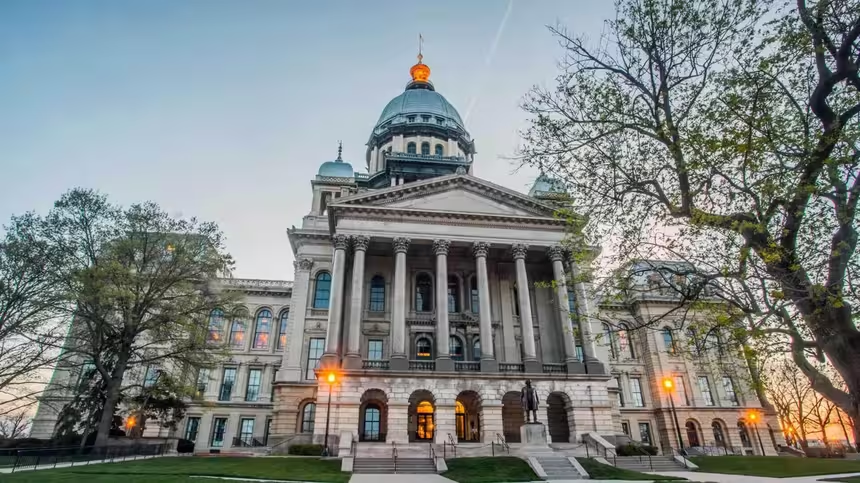
CapitolView
CapitolView is a weekly discussion of politics and government inside the Capitol, and around the state, with the Statehouse press corps. CapitolView is a production of WSIU Public Broadcasting.Providing Support for PBS.org
Learn Moreabout PBS online sponsorship(upbeat music) (upbeat music continues) - Welcome to "Capitol View", your weekly look at the happenings inside and outside the Illinois State Capitol.
I'm your host, Jennifer Fuller.
Our guests this week are "Capitol News Illinois'", Jerry Nowicki and Hannah Meisel.
Thank you both for joining us.
- Thanks for having us.
- Thanks for having us, Jen.
- We had a lot- Sure thing.
We had a lot of news over the last couple of weeks with the end of the General Assembly spring session, the signing of the budget.
And there are still things that are happening as Governor J.B. Pritzker is now considering and in some cases signing into law some of the bills that were passed out of the General Assembly.
Perhaps the biggest news this week in terms of bills that were signed into law is what many are calling the Book Ban ban.
Jerry, we'll lead off with you.
Basically what this does is prevent public school libraries and public libraries from banning books, otherwise they'll lose state funding.
Is that right?
- Right.
And it's not necessarily trying to regulate the process of procurement or anything like that.
The board could still determine which books they put on their shelves and determine their own criteria.
But what it's trying to prevent is taking books that are already on the shelves off of them based on political pushes or whatever other circumstances are leading to people wanting the book off the shelf.
The board's gonna make their decisions as to what books they wanna stock.
But if someone has a mob outside saying, "Get rid of this book!"
They don't want that to be the case.
So they gotta adopt a policy that says, we're not going to do that.
And that policy is within the optional that they adopt their own policy or one by the American Library Association's Bill of Rights, which says basically the same extent that we're not gonna ban books based on political pushes.
- And of course, there is a side of this where you have some people saying that this walks all over local control, for example, of schools and of public libraries.
Hannah, do you expect that this is going to be tested, maybe not in court, but perhaps with boards going ahead and pulling books off the shelves?
- Yes, I do expect.
Most things that go through Springfield, especially big laws like this to be tested in this political environment.
I'm sure that there are First Amendment lawyers who are readying their cases or trying to recruit library board plaintiffs.
But I guess that's to be expected.
And this is an initiative of new Secretary of State, Alexi Giannoulias, who, of course, came in after many, many terms.
I think former Secretary of State, Jesse White, had served in that post since 1998.
And Giannoulias is coming in looking to make his mark.
And this certainly is one of those things that both makes his mark on the office, but also, we've known Alexi Giannoulias for years.
Of course, he had been State Treasurer in the Otts, and he's still young and he's definitely, I think, looking to raise that national profile because he's got a long career ahead of him.
He made his return to politics to run for Secretary of State.
So I definitely could see some challenges here and can see Alexi Giannoulias saying, "Well, we're gonna fight it 'cause this is what's right."
- Speaking of Alexi Giannoulias, now his office will have the authority but also the responsibility of keeping track of how books are either pulled from the shelves, kept on the shelves, these sorts of things.
Does the library or the Secretary of State, and the state librarian, which it's one and the same, does the state librarian already have that power to go back in and individually take a closer look at how the grants are distributed to the public libraries?
Or is he going to have to reorganize some parts of his office in order to put the teeth into this new law?
Hannah, I'll start with you.
- I'm gonna defer to my colleague, Jerry Nowicki, because for a lot of session this spring I was covering that big ComEd trial.
So I'm unfamiliar with the details of this bill.
- Certainly.
And we will of course get to that.
Jerry, do you think that the Secretary of State is prepared to enforce this law?
- I think that the Secretary of State, the grants aren't on autopilot as they are now.
There are scrutiny of those grants, there's making sure there are other conditions of them.
I don't know what they all are, and I'm not even clear on 100% what the process is.
But I think an added box to check is one thing.
It's a fairly simple thing to do to adopt these policies, saying you're not going to do that.
I think we saw a similar thing with statewide building codes that were up in the General Assembly.
Just having passed that law allows Illinois to check a box when they're applying for federal FEMA dollars in the case of a disaster, do you have statewide building codes?
Yes.
I think there will still be some scrutiny.
I think as much of that will come from news media of book bans that are occurring as it would from the Secretary of State's office.
But this didn't make Secretary of State the state librarian.
It didn't create these grants.
So there are people who are going over those documents now and I think there'll just be an added level of scrutiny and an added box to check on those documents when libraries are applying for funding.
- Absolutely.
Stay tuned.
Hannah, I wanna get back to what you were mentioning before and that's one of the criticisms that the Republicans had of the spring session in general, and that is that ethics reform really didn't come to the top of the list when new legislation was considered.
You, as you mentioned, covered what was called the ComEd Four bribery trial.
You are in the midst of covering another trial involving public corruption.
We've all talked in the past about the fact that former house speaker, Michael Madigan, is expected to go to trial early next year.
So, what are Republicans working on?
What do you expect to see perhaps in the veto session when it comes to ethics reform in the state of Illinois?
- Well, to your first question, what are Republicans working on?
They had proposed a variety of legislation that they say would target public corruption.
A lot of it is I think things that in principle Democrats would agree with.
But in practice, some of it could violate First Amendment issues, and some of it is just impractical.
And Democrats and Republicans of course talk about ethics and we live in a state where, of course, our reputation had been marred by corruption scandal after corruption scandal.
But let me tell you, after sitting in that courtroom for eight weeks, watching every detail of the case, to react to a specific public corruption scandal with either overly broad or overly specific proposals on ethics, both miss the mark, because if you do something overly broad, it's gonna be much, much more difficult for people to run for office or it's gonna dissuade certain people especially people who don't have access to money and connections to run for office.
And that's not what you want.
You want people to feel free to enter the political arena whether or not they have that money, whether or not they have those connections.
And if you do something overly specific, it changes nothing.
I mean, in this case, the ComEd bribery scandal had more to do with Mike Madigan himself, the former house speaker who had held the post for 36 years, record breaking, time leading any legislative chamber in the nation.
It had to do with him and how he specifically built and wielded his power.
We don't have that anymore.
That doesn't mean that there's not still problems, but it means that the issue here and how he had his relationship with ComEd, that is no longer happening.
And sometimes it is better to leave things up to federal prosecutors.
And I feel like in the past, I've now been reporting on Springfield for 10 years.
In the past when I have heard that, I've said, "Maybe that's a cop out."
But again, after sitting in that courtroom and listening to every detail of that case... One of my favorite political phrases is "Culture eats policy for breakfast."
And that is 100% true in this case.
The culture needs to be rebuilt.
But that is not something that is gonna be done top down.
It's not something that you can necessarily legislate.
You can't legislate morals, you just can't.
You can't legislate someone's behavior to be more in line with your idea of morality.
That all being said, however, Democrats did promise ethics legislation and I would say that they didn't deliver.
They proposed a few things.
There was a bill that actually didn't go through the entire General Assembly.
I believe it passed in one chamber, but it would have prevented folks who've been convicted of public corruption from being able to run for office again.
But we did get a couple more pieces of ethics legislation.
Jerry can speak to the specifics, but I think this is a Springfield problem, where people talk a big game and then they don't deliver.
And I think that more than some things, that actually is what helps degrade public trust by not delivering.
- Well, Jerry, let's get a little bit into how you change that culture from the bottom up rather than, as Hannah said, from the top down.
And one of the ways that that could happen is through more teeth for the Legislative Inspector General's office.
And there is a new Legislative Inspector General, and that person, Judge Michael McCuskey, is moving from Peoria to the Springfield area in really a way to try and keep a closer eye on things and enforce what he's been tasked with enforcing.
How important is it to have this position and for that position to have enough teeth that lawmakers think twice before they do something that perhaps would violate a code?
- Yeah, it's a bit of a challenging question to ask because everything we saw in the ComEd trial, everything Hannah's covering now in the connected sweepstakes gaming scandal that she's covering in the courtroom, those people are all accused of breaking laws that already exist.
And if you're willing to do that, adding more flaws isn't gonna stop you from doing that.
Right?
And I posed that question to Republicans when they were talking about the ethics reforms not going anywhere this year.
And they said, "We gotta do whatever we can "to stop them from even approaching the line."
And there are things to do that, but the Legislative Inspector General McCuskey, he spoke to our colleague, Nika Schoonover, and he said, "I don't think I'm ever going to do a better job "investigating public corruption "than the Northern District of Illinois "or any other federal offices."
He said, if someone brought him a corruption case and he hasn't had any corruption cases brought to him in one year.
So it's not a matter of his authority to investigate 'em, they just haven't brought 'em to him.
And even so, if he found something there, he'd send it up to the Northern District of Illinois or wherever else, whatever jurisdiction would be investigating that thing.
So he, in the interview with Nika indicated that he's taken a wait and see approach in terms of requesting greater authority from the General Assembly.
A lot of his predecessors have not liked the reliance that office has on the legislative ethics commission in terms of whether it can publish a report or not.
Hannah, I think broke the story in 2021 or so when Carol Pope resigned and said this office... She's another former Inspector General.
She said, "This office doesn't have enough authority to investigate."
But McCuskey said he's gonna wait and see what authority he should request from lawmakers.
- As with so many things, it's something that we're going to have to just keep track of and see how this pans out.
Jerry, I wanna stay with you, and I should let people know that the story you mentioned from Nika Schoonover is available at capitolnewsillinois.com, and you can find more at wsiu.org as well.
One of the other stories that broke this week was really a follow up to an investigation through "Capitol News Illinois'", Beth Hundsdorfer, and Molly Parker of the Lee Enterprise's Midwest Bureau and ProPublica.
And that took a deep dive look into allegations of mismanagement and even abuse and neglect at the Choate Mental Health and Rehabilitation Center in far Southern Illinois in Union County.
Now, as a result of that, lawmakers took a closer look and they passed legislation that would actually make it a little bit easier for people investigating to punish those who've been accused and found guilty of crimes, not necessarily through the courts, but in a more administrative way.
Jerry, do you think that this is where this ends, or will there be more when it comes to what happens at Choate?
- There has to be more.
We're continuing to follow what's going on there now, what's gone on there since we began reporting in September, and what's gone on there since the governor announced his quote unquote, "Transformational changes to the facility.
", 'cause those don't happen overnight.
And all of the leadership that oversaw all of these employees that were arrested, it's still in charge of the facility, which is something we're continuing to monitor.
But I think in terms of just the new law that's giving the greater authority is the Inspector General of that office, Peter Neumer, said he needs this type of authority to act as a deterrent.
And what it allows him to do is if there's a finding of material obstruction is a new offense created that allows the Inspector General to forward this person's name who's been found to have committed that offense to a healthcare worker registry that would ban them from ever getting a job in healthcare outright.
So people who act to stymie an investigation, which is a lot of what we found in the investigation we've done, people who act to stymie those could have their career in healthcare ended entirely, blacklisted in the state of Illinois.
So whether that's gonna be used a lot, Inspector General Neumer said it would be maybe a handful of times a year.
Is it gonna be wide ranging?
Probably not.
Is it going to be a deterrent?
That's the hope of everyone who's gotten on board.
And I think that passed unanimously through both chambers.
So it was a fairly uncontroversial and common sense reform to get at the root of some of the things we uncovered in our reporting.
- As you mentioned, Jerry, there is this entire shakeup of how Choate is going to be utilized as a state facility.
Some residents are going to be moved out to other places and that facility will be used in perhaps new and different ways.
But this isn't the first time that we've talked about a state run facility for among Illinois's most vulnerable population.
We've talked about issues within state veterans homes when it comes to COVID, when it comes to Legionnaires' disease.
How important is it to the state really take a closer look at how it's caring for those vulnerable people and that it holds people accountable if they're put in a position of authority?
- Well, sure, it's extremely important 'cause Illinois is a bit of an outlier among the 50 states in that it relies far more heavily on large institutions for people with disabilities.
There are several factors for that.
A big one is unions will fight any real changes or downsizing to any facilities.
Another is that they're major employers in most of the rural areas in which they are located.
So the locals would fight any changes and it's a hard thing to do.
So the governor, he announced his plan, which essentially would be relocating roughly half of Choate's population.
It would relocate the individuals who were there on more of a voluntary basis, whereas it would remain the place where people have been court ordered to go for whatever psychiatric or help they need in order to become better.
Well, the thing is, if it's a dangerous place, even if you've been ordered there by a court, you still have a right to not get the snot kicked out of you by the staff there.
So just because they're announcing these transformational changes doesn't mean it doesn't need the level of scrutiny that's been given to it in recent months either.
So I just think we're gonna have to keep watching, not just Choate, but every single developmental facility in Illinois.
And one thing I will note is that the governor increased the pay for people who serve people with disabilities in community settings, which is an alternative to institutional settings, but also they're a vulnerable population.
So community settings aren't any panacea of sorts, but giving them the option to live outside of these large institutional facilities is an important thing to do in Illinois as well.
- Many pronged approach certainly.
Hannah, Governor J.B. Pritzker issued a lot of ideas, things that he'd like to get done when it comes to the state of Illinois, both in his budget address and then as he toured the state, kind of touting the fact that most of what he wanted was included in the budget.
Another thing that he has really pushed is to make sure as we were just talking about vulnerable populations, that homelessness is addressed.
And there are a lot of pieces of the Illinois budget that send funding to homelessness prevention programs and services to help people who find themselves either near homelessness or homeless themselves.
Do you think that the state is an outlier when it comes to how it's doing this?
Or is it someplace that people around the nation may come to look at in terms of bringing agencies together?
- Homelessness is such an intractable problem in the U.S.
There's certainly a lack of federal leadership on this issue definitely left up to states, and really big cities to deal with especially.
But make no mistake, rural homelessness is a huge problem too.
And it's just, I would say, under reported on.
Is Illinois an outlier?
I don't think so, but I think that state leaders are hoping that Illinois' approach can become a national leader after a few years.
I wanna say in the fall of 2021, there was a series of hearings in the Housing Committee and I think that the panel of lawmakers on that committee heard from leaders in other states, but I don't think that this is an issue that any state has gotten perfectly.
And certainly the pandemic, despite that is the one federal action that we could point to in recent years, decades, really, the federal moratorium on evictions, despite that, COVID definitely exacerbated this problem.
And for folks, if we remember the first months of the pandemic, that was a time when we were very, very afraid to go near anyone.
And so, of course, homeless shelters really, really struggled with how to address this issue because just like all congregate care living arrangements, that's a place where COVID could spread more easily.
So this Home Illinois initiative, this builds on existing homeless prevention programs that Illinois already had in place.
But the budget that begins on July 1st, according to this press release from the governor's office I'm gonna read from, permits almost $360 million for the initiative, and $85.3 million increase from this current fiscal year.
This includes money for shelter and services.
This is also, especially in the Chicago land area, but I suspect it's going to trickle down to the rest of the state.
Certainly, if migrants who are being shipped from, especially Texas, these red states who are trying to, of course, stick it to blue, so-called sanctuary cities, not treating these migrants from Central South America as political pawns and not for people, this issue of shelter is critical.
And it was, of course, critical before and even more critical now.
This also includes $50 million in what's called rapid rehousing services for 2,000 households.
This is an issue where, if you get evicted, there's a lot of sociological researchers who say that, most people, most Americans, or maybe a surprising number of Americans are only a few medical emergencies say, or other financial emergencies away from suddenly finding themselves homeless.
It is that dire.
So many people live on the bubble, so many people live paycheck to paycheck.
And so, if someone suddenly finds themselves homeless and we should remind people that homelessness is not just the stereotype of folks who are going from shelter to shelter and living on the streets.
Homelessness is people who are crashing with friends or relatives, couch surfing for extended periods of time because they can't afford a place of their own.
Homelessness is people living in their cars.
Homelessness is a lot more than the eye can see.
This also includes $37 million in emergency shelter capital funds to create more than 460 non-congregate shelter units.
Again, we have a lack of shelters, we have a lack of housing.
This is something that city states all over struggle with.
But being the nation's fifth largest state, having a really big city and having mid-sized cities, we're gonna struggle with it more.
- We'll certainly have to stop things there, but that's a big issue and certainly something I'm sure we'll continue to talk about.
I wanna thank Jerry Nowicki and Hannah Meisel for joining us this week on "Capitol View".
And you can find all of our episodes online at wsiu.org and at our YouTube channel.
I'm Jennifer Fuller.
(upbeat music) (upbeat music continues)

- News and Public Affairs

Top journalists deliver compelling original analysis of the hour's headlines.

- News and Public Affairs

FRONTLINE is investigative journalism that questions, explains and changes our world.












Support for PBS provided by:
CapitolView is a local public television program presented by WSIU
CapitolView is a production of WSIU Public Broadcasting.