
Capitol View - June 23, 2023
6/23/2023 | 26m 46sVideo has Closed Captions
Capitol View - June 23, 2023
In the slow time after the 2023 Spring Session, Gov. JB Pritzker is now tasked with considering hundreds of bills that passed the legislature. This week, a discussion of some of his choices – including one to limit government-funded care for undocumented immigrants and others. Plus, the unveiling of a portrait for former Gov. Bruce Rauner.
Problems playing video? | Closed Captioning Feedback
Problems playing video? | Closed Captioning Feedback
CapitolView is a local public television program presented by WSIU
CapitolView is a production of WSIU Public Broadcasting.
Capitol View - June 23, 2023
6/23/2023 | 26m 46sVideo has Closed Captions
In the slow time after the 2023 Spring Session, Gov. JB Pritzker is now tasked with considering hundreds of bills that passed the legislature. This week, a discussion of some of his choices – including one to limit government-funded care for undocumented immigrants and others. Plus, the unveiling of a portrait for former Gov. Bruce Rauner.
Problems playing video? | Closed Captioning Feedback
How to Watch CapitolView
CapitolView is available to stream on pbs.org and the free PBS App, available on iPhone, Apple TV, Android TV, Android smartphones, Amazon Fire TV, Amazon Fire Tablet, Roku, Samsung Smart TV, and Vizio.
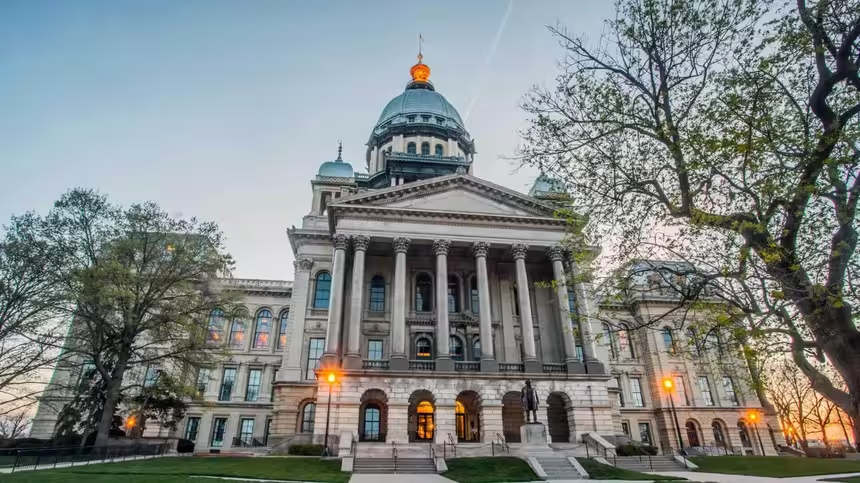
CapitolView
CapitolView is a weekly discussion of politics and government inside the Capitol, and around the state, with the Statehouse press corps. CapitolView is a production of WSIU Public Broadcasting.Providing Support for PBS.org
Learn Moreabout PBS online sponsorship(gentle upbeat music) (camera beeping) (dramatic music) - Welcome to another edition of "Capitol View," your weekly look at the happenings inside and outside the Illinois State Capitol.
I'm Jennifer Fuller.
Our guests this week are Jeremy Gorner, with the Chicago Tribune, and John Jackson of SIU's Paul Simon Public Policy Institute.
Gentlemen, thanks for taking the time this week.
- I'm glad to be here.
- Glad to be here.
- Let's start a little bit with what I typically call the post-session blues.
And that's when, you know, the excitement and everything that happens at the end of the legislative session kind of gets a little quieter.
But we did have some excitement this week with Governor JB Pritzker taking some action.
He signed House Bill 1,298, what's known as the Substance Use Disorder Residential and Detox Rate Equity Act.
Now, that's a lot of words to talk about an act that made some changes to policy that was already in place.
What really happened, though, that really caused a lot of consternation among his own party is an executive power that limits enrollment in some state-funded health plans, particularly for non-citizens.
And Jeremy, can you help break this down?
What was the act about, and why are people so upset with this executive action?
- Well, I mean, this was a result, Jen, of, you know, basically, during his, you know, earlier this year, he had projected that this Medicaid-style program that started in 2020 that was gonna be expanded, he had projected that in this upcoming budget, it was gonna be somewhere around $220 million.
And then there were, you know, cost estimates that it was actually gonna be way more than that.
It was pegged, you know, just over a billion dollars.
You know, of course, what ended up happening at the end of session is that, you know, after talking with the legislature, he was getting pushback, obviously, from some lawmakers on the Democratic side, of course, who were very, very concerned that certain, you know, undocumented immigrants would get cut off from this program, who had never had healthcare before.
What happened was, is that the program ended up, the compromise was $550 million.
But, you know, obviously, under pressure here because, you know, Pritzker is getting pressure from all sides about, you know funding certain things and not funding certain things.
He ended up instituting rules last week that basically capped the immigrant healthcare program, you know, closing enrollment for any immigrants under 65, basically, or capping enrollment for those who are 65 and older.
Again, because it's become very costly.
This led to a lot of outrage from Latino lawmakers, as well as some advocates, who had really been pushing for an expansion, another expansion, of this healthcare program.
Actually, since 2020, it's been expanded twice.
It now covers anyone who's 42 and older.
But in recent years, there have been efforts to expand that, I believe, between 19 and 41.
But basically, Pritzker, that was basically what he did last week.
Because of the limitations that he's put on this program, you know, there was a protest yesterday in Downtown Chicago over this.
I mean, you know, he's taking some backlash.
- The governor is saying that this is purely a financial decision.
There's only so much to go around, and he had to make this decision, just to make sure that the people who were in the program, or eligible to be in the program, could still be covered.
But John, as Jeremy has said, lots of criticism, particularly from his own party.
How does the governor bounce back from this, and how critical is it that he makes a decision like this that ruffles some feathers?
- Well, this was a big problem, and something had to be done.
I'm not surprised he did what he did.
I think it took some courage, and as Jeremy was just saying, there's certainly been some pushback and some heat from it.
Took a certain amount of courage to do this.
But the flip side is this whole thing threatened what has been Pritzker's signature accomplishment in his first four years.
That is, he has had fiscal management chops.
He's done it well.
The budgets have worked well.
He's gotten a lot of credit for having done the balancing of the budget.
Democrats in the General Assembly have helped him.
He gives credit to them every time he talks about it.
And even some Republicans have supported or begrudgingly admitted that we've had balanced budgets and no more structural deficits.
We've had structural deficits going all the way back to Jim Edgar era.
And all of a sudden, all of that turned around.
The New York bond houses noted and took action.
No more junk bond threats.
We've had, what, eight or nine upgrades.
The governor ran on this more than maybe anything else in terms of his accomplishments.
Not only that, comptroller, treasurer, many general assembly members got reelected boasting about this.
So they were not going to let this be put in jeopardy at this point.
You have to make these tough choices when you're a chief executive.
I hasten to add, the legislature could have helped, and they had the option of using their majority on the Democratic side, but the Republicans were just eating their lunch on this.
I watched Jack Tichenor's lawmakers when he talked about this with the Republican lawmakers.
I watched when you and Jack interviewed the governor and then those Republicans.
This fitted all of their narratives beautifully.
They didn't call it undocumented, they called it illegal or aliens.
And all of those narratives just fit perfectly.
Hispanic Caucus is not happy, and lots of legislators not happy, but that's the price of making those tough choices.
- You make a good point, John, that the Republicans have been talking about this specific part of the budget since the budget was introduced and then passed very quickly there at the end of session.
Jeremy, does this appease them at all?
Do you think they work a little more closely with the governor after this, or is this someplace where he kind of has to stand on an island by himself with Republicans still unhappy, and now Democrats unhappy, with this decision?
- Well, I mean, Republicans have been unhappy just in general since the passage of the budget.
I mean, you know, Leader Tony McCombie had, you know, seemed upset, you know, saying that they were not included in the process for forming the budget for this year.
Leader John Curran of the Senate Republicans acknowledged that, you know, the Senate Republicans indeed were participating in negotiations with Senate Democrats, but voted against the budget.
I mean, the immigrant healthcare program was not, it was a big sticking point for them, but it wasn't the only sticking point.
I mean, I know I heard Leader McCombie say that there was uncertainty over, you know, with the negotiations over the AFSCME contract.
You know, is that gonna be covered in the budget?
They just didn't have a clear answer on that.
And I believe it's the grocery tax, is that's what's up next, you know, next month.
You know, it's just like, how is the budget gonna remedy that?
So I think the immigrant healthcare issue, of course, is a huge issue, but it seems like the Republicans already have other issues with the budget.
I know that one of their big concerns specifically with immigrant healthcare is that when you spend an exorbitant amount of money on a program like this, you know, what they're worried about is that you could deprive other, you know, other people in the state of, you know, services, like the developmentally disabled, for example.
So that was, you know, something that they were, that was really a big sticking point for them.
So whether it appeases them, I would imagine it's certainly a good first step, but like I said, you know, the issues that the Republicans had with the budget seemed to go way beyond just this one program.
- John, let's look at this through a political lens.
Just one more question on this particular issue.
And, you know, the city of Chicago, for example, is preparing for the Democratic National Convention next year.
And there's a lot of talk about a national spotlight being put on Chicago and the entire state of Illinois.
Does this decision from Governor Pritzker change that narrative at all?
Does the National Democratic Party come to JB Pritzker and say, "You know, you can't keep doing this"?
- Oh, I think on the contrary, this is a plus for him, if he's got ambition for 28.
You have to think about the general election context when you're making these kind of long-term choices.
And this proves he's got some chops in terms of making some tough choices that don't necessarily just pander to the base.
If I were writing that script for 28, I think this would be a badge of honor that he would tout.
I don't think he'll talk about it in these terms, but certain parts of the DNC will definitely not like this.
And yet, the larger party as a whole, if they got the ability to behave rationally and strategically, we'll see this as something they at least ought to leave him alone about.
- Another piece of legislation that I wanted to talk about that Governor Pritzker has approved goes to the expansion of using police drones for surveillance, particularly in large events, whether it's a parade or some kind of festival or party.
We saw over the holiday weekend with Juneteenth another mass shooting, this in suburban Willowbrook.
The Highland Park mass shooting was brought up as this bill was debated in the legislature, and it passed with overwhelming majorities in both chambers.
Jeremy, are there still concerns, though, about surveillance drones, privacy issues, those sorts of things that kind of go along with the conversation?
- Well, yeah.
Yes, Jen.
I mean, the ACLU has raised concern that facial recognition could be used to track immigrants who are undocumented immigrants.
And there's always that fear that, you know, perhaps, you know, ICE will be notified about certain individuals who are in the country illegally because of facial recognition from these drones.
That's something that the ACLU is worried about.
I mean, there's always gonna be privacy concerns with devices like this, which is, you know, undoubtedly one reason why there's been restrictions on these devices for so many years.
I mean, you know, before this bill passed, you know, which, you know, before this bill passed, you know, law enforcement could really only use drones in a limited capacity.
I mean, if there's like a threat of a terrorist attack, a natural disaster, or I believe, you know, if they're in, of course, if they had like some kind of probable cause warrant for something.
I mean, it was very limited.
Like, I mean, I remember, I believe it was 2018 or 2019.
You might recall this, I mean, 'cause it made news.
In the Dan Ryan Expressway, there was a, in Chicago, there was an anti-violence protest, and a lot of people attended.
I believe Father Pfleger was one of the people who organized it.
And so the Dan Ryan Expressway was closed down.
A lot of local law enforcement was upset, thinking that it was illegal.
And Governor Rauner at the time, you know, allowed it.
But I remember seeing a drone, you know, overlooking the area.
And I remember calling a police source at the time about that, and I was like, "Hey, you all have drones out there."
And I remember him telling me that if you saw a drone out there, it was not allowed to be down there.
It was likely, you know, a private citizen who should not have had one.
So I mean, I don't know.
So my point is, is that there were restrictions on this over the years.
And this issue came up again around that same time.
I mean, maybe around that same time, that same era with the, well, the mass shooting in Las Vegas at Mandalay Bay.
You know, if you recall, lawmakers in Illinois wanted to, you know, introduce legislation, did bring up legislation to allow for a wider array of power for, or a wider array of, you know, authorization for drones.
So this has come up over the years, but, you know, I think that the, you know, obviously, what happened in Highland Park, you know, is what convinced, you know, Julie Morrison, of course, that's her district, to bring this up.
And of course, there really wasn't a lot of opposition to expanding the use of drones.
Although, I know that at least in the city of Chicago, the former police superintendent, David Brown, had expressed interest in CPD using drones more actively.
So it seems like that was the direction that we were going, right?
As far as like, opposition goes, so one lawmaker, Curtis Tarver, he is from the south side of Chicago, you know, he had expressed frustration that the bill was not proposed after, you know, a mass shooting in one of Chicago's neighborhoods on the south and west sides, where there's, I mean, the unfortunate reality, I know I've talked about on your show before when we talked about criminal justice, is that mass shootings happen very regularly in Chicago, unfortunately.
So Tarver was just like, "How come this legislation wasn't proposed after that?"
It took something to happen in Highland Park for that to happen.
So I mean, there's opposition under those terms.
But, you know, regardless, it just seemed like that seemed to be the direction that we've been going towards anyway by allowing, you know, more broad use of these devices.
- Certainly.
John, on a historical level, when things come down to privacy versus public safety, privacy versus law enforcement, those sorts of things, is this a pendulum swing one direction or another, or do you see things moving in one particular direction?
- Well, this is emblematic of the whole fight that's going on in this country for law and order, on the one hand, unfettered individual freedoms on the other, especially the individual freedom related to guns, and what can be done about it.
We've got a culture now of gun violence, mass shootings.
All of that's just come to be all almost the norm.
So what can be done about it?
This is one very small and even bipartisan thing that can be done about it.
There's always opposition on the left.
The ACLU, they worry about individual, personal privacy and freedom there.
And on the right, there are the whole conspiracy theory black helicopter group on the right, and they don't like these kinds of things.
So I don't see it as a swinging pendulum so much as the constant struggle over law and order, on the one hand, the need to live in an ordered community to get anything done, versus going too far, taking away my individual rights.
And either side can see George Orwell's "1984."
Big Brother is watching.
Trot that whole thing out.
And that's not without some concerns, but the right to go to a 4th of July parade and not get shot at from a rooftop has got to have some absolute courage that we haven't had so far.
So while this was an almost totally bipartisan support bill, it was one tiny step in the direction of law and order.
- And Jeremy, I'll ask both you and John this question.
We haven't talked a lot about gun legislation, law enforcement legislation in this spring session, mainly because lawmakers and Governor Pritzker and others are waiting for court cases to play out, whether it's the SAFE-T Act, which is highly controversial, or whether it's an assault weapons ban, both of those things working their way through the courts.
Do you think that legislation like this, which makes a minor change, arguably, to law enforcement policies and procedures, is that what we're going to see more of until these larger questions are answered?
And Jeremy, I'll start with you on that.
- I think it's kind of hard to tell, Jen, I mean, only because, you know, like I said, the issue with drones, it's really not a new issue, even before Highland Park.
I mean, like I said, this came up in the legislature five years ago as well.
But, you know, thematically, I mean, it is related to what happened in Highland Park.
And, you know, what we also saw in the legislature this spring was the bill that could allow anybody in Illinois go civilly, go after gun manufacturers in state court if, you know, their marketing ploys are going after children, or are not doing enough to prevent straw purchasing.
I believe this was Representative Gong-Gershowitz's bill in the House.
And of course, opponents of that bill had argued that it's an overreach because there's federal law that basically shields gun manufacturers from being sued if their products are used in acts of crime.
But my point is, is that that is also something that we saw this past legislative session that was a pretty big deal when it came to, you know, to another gun law, basically.
So I mean, you see stuff like that.
I mean, but, you know, we also saw, what else did we see?
There were changes to the first-time gun offender law, you know, that was passed this session too, which was a rare showing of progressives and conservatives agreeing on something for different reasons.
You know, basically you have progressives who felt that, you know, if you've never been arrested with a gun before, you could go through this special probation program, and that was really geared towards anyone under 21.
They've expanded it to everybody.
And that's why conservatives favored it.
Actually, to your point, Jen, this is tied to the assault weapons ban in a way because what conservatives are worried about is, you know, they say if, you know, gun owners, you know, legal gun owners get caught in this, you know, there's that section of the assault weapons ban.
That if it does not get overturned by the Supreme Court, there's that section that requires gun owners to register their firearms, this is the grandfather clause, I believe, by the end of the year.
But you might have people who are just ignorant, or not ignorant, but just oblivious to what the law says, and they could get arrested for a felony gun charge.
And that's why conservatives supported this legislation on the first-time gun offender law.
Because what happens is if you go through this program, that case really just gets expunged.
So the argument there is that they're holding people accountable, but at the same time, you know, not letting it go on anyone's permanent record.
So you see stuff here and there.
You know, we saw stuff here and there this past session that dealt with, you know, gun laws and all that, but in the meantime, I think that everybody still has their eyes on what the courts are gonna do with the assault weapons ban and, of course, the SAFE-T Act.
- Sure.
John, I'll go to you as well.
You know, small changes, big changes, but as Jeremy says, still all eyes on the courts.
- Yeah, it's got to go to the Supreme Court of Illinois and probably be upheld there, then Supreme Court of the United States.
Not at all clear what will happen there.
I think there are two swing votes on the conservative side that could recognize what had been standing law for many decades.
That is, some limitations on guns are acceptable.
Even Scalia said that, before he died, in one of his opinions.
The recent example of Roberts and Kavanaugh going over and voting with the more liberal side could happen again.
But it's going to be very close call in the US Supreme Court.
- Still months to go before we see any sort of movement or decision there.
In the last week as well, a big change in our conversation here, the unveiling of Former Governor Bruce Rauner's portrait in the Hall of Governors in Springfield.
We haven't seen Bruce Rauner really in Illinois politics at all since he left office, but he returned to Springfield to come to the unveiling, had some comments to say, not unlike what he normally said when he was in office.
I did like one quote that I read that said, he said, "Most gentlemen here did not go to prison."
He was big on saying that he was not a corrupt governor; he was not like governors who had served previously.
Jeremy, what is Rauner's legacy?
Is it the budget stalemate that people still continue to talk about, or is there more to it, do you think?
- Yeah, I mean, his four years in office, I mean, you know, he was dominated by this historic budget stalemate, you know, with Then Speaker Madigan.
It was a two-year budget impasse, you know, when he was governor.
And, I mean, that had a huge impact on social services.
It left public colleges and universities without funding.
And yeah.
I mean, that lasted two of his four years.
I mean, that's, you know, that's something a lot of people think of.
Another thing too, I mean, but, you know, when it came to social issues, I mean, he kind of showed an indifference, in many ways.
I mean, especially when he sided with Democrats on some key abortion legislation, or, you know, would not veto it, basically, that alienated a lot of his base, you know?
That's why he almost lost the Republican primary in 2018, you know, when, I believe it was, Jeanne Ives who ran against him.
So yeah, I mean, he had a very, I think the word is, tumultuous term, but yeah.
I mean, he was taking subtle digs at other governors who were on that wall, you know, who had been to prison and stuff like that.
But one thing he did not do was criticize Pritzker.
We were trying to ask him questions about a lot of the digs Pritzker takes at any criticism this current governor faces, and then, you know, Pritzker's fallback is he blames the Rauner administration or previous administrations.
You know, Rauner wouldn't go there except, you know, he was trying to make the argument that, you know, just because you have big credit ratings, credit rating agencies love federal bailouts, and they love higher taxes, which I know that Democrats take issue with that.
That was really his only somewhat controversial comments he made on that front.
But he largely stayed out of the whole I'm gonna defend myself against Pritzker idea, you know, during this unveiling.
- Yeah.
John, same question.
About a minute left.
Is Rauner's legacy going to be, for all time, the budget impasse, or do you think that history may soften the lens a little bit?
- Well, I think it will always be the major part, but I do wanna say sort of a feel-good story here.
I think him coming back and acting as he did and being received as he did was a very positive step.
He, unlike Donald Trump, for example, he went away and is no longer playing in the game and causing trouble.
And unlike other governors that have gone away, they didn't go away because their legal kinds of problems stayed on, just like Donald Trump's have stayed on.
So he gives us a good example of how one should wrap up a career and leave the office, and I think there's something to be said for that.
- And you mentioned wrapping up, and it's time for us to wrap up.
I'd like to thank John Jackson of the SIU Paul Simon Public Policy Institute and Jeremy Gorner of the Chicago Tribune for joining us on this week's "Capitol View."
I'm Jennifer Fuller.
We'll catch you next time.
(upbeat music) (upbeat music continues)

- News and Public Affairs

Top journalists deliver compelling original analysis of the hour's headlines.

- News and Public Affairs

FRONTLINE is investigative journalism that questions, explains and changes our world.












Support for PBS provided by:
CapitolView is a local public television program presented by WSIU
CapitolView is a production of WSIU Public Broadcasting.