
Capitol View - June 27, 2024
6/27/2024 | 26m 46sVideo has Closed Captions
Capitol View - June 27, 2024
Analysis of the week’s top stories with Brenden Moore, statehouse reporter for Lee Enterprises and Charlie Wheeler, emeritus director of the public affairs reporting program at the University of Illinois Springfield.
Problems playing video? | Closed Captioning Feedback
Problems playing video? | Closed Captioning Feedback
CapitolView is a local public television program presented by WSIU
CapitolView is a production of WSIU Public Broadcasting.
Capitol View - June 27, 2024
6/27/2024 | 26m 46sVideo has Closed Captions
Analysis of the week’s top stories with Brenden Moore, statehouse reporter for Lee Enterprises and Charlie Wheeler, emeritus director of the public affairs reporting program at the University of Illinois Springfield.
Problems playing video? | Closed Captioning Feedback
How to Watch CapitolView
CapitolView is available to stream on pbs.org and the free PBS App, available on iPhone, Apple TV, Android TV, Android smartphones, Amazon Fire TV, Amazon Fire Tablet, Roku, Samsung Smart TV, and Vizio.
CapitolView
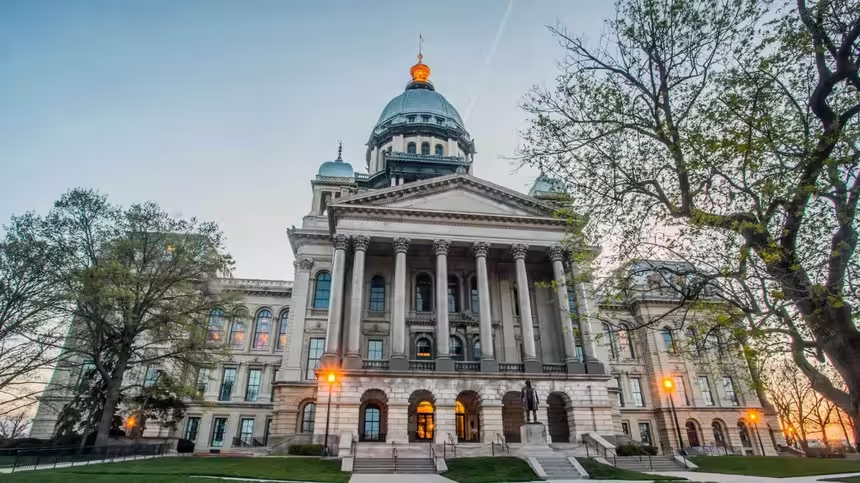
CapitolView is a weekly discussion of politics and government inside the Capitol, and around the state, with the Statehouse press corps. CapitolView is a production of WSIU Public Broadcasting.Providing Support for PBS.org
Learn Moreabout PBS online sponsorship(upbeat music) (camera beeps) (dramatic music) - Thanks for joining us on "CapitolView", I'm Fred Martino.
A powerful Chicago politician is sentenced to prison in a corruption case, a US Supreme Court ruling could revive hopes for an Illinois gun safety law, and the Dobbs decision by the Supreme Court has resulted in many more out of state patients seeking care in Illinois.
Those stories and more this week with Brenden Moore, State House Reporter for Lee Enterprises, and Charlie Wheeler, Emeritus Director of the Public Affairs Reporting Program at the University of Illinois Springfield.
Brenden, let's start with you this week.
The "Chicago Tribune" headline calls him a political titan, former Chicago alderman Edward Burke was sentenced this week to two years in prison in a corruption case.
The story says he could have gotten a lot more time in jail, and an old Illinois law will allow him to pay a $2 million fine with campaign funds if he chooses.
Tell us more about this.
- Yeah, Fred, I mean, political titan might even be underselling it.
I mean, Ed Burke was really one of the last vestiges of the old Chicago Democratic political machine.
He came in under the old Mayor Daley, he was one of the ringleaders of the Vrdolyak 29, took on Mayor Washington in the '80s during Council Wars, and then under second Mayor Daley and Mayor Emanuel, he was the chairman of the powerful Finance Committee, arguably the second most powerful person in city government after the mayor.
So, this guy was a powerhouse, and his downfall was really kind of stunning.
On the side, he was a property tax appeals lawyer, and that was part of the trouble, was he was accused by prosecutors of trying to use that city hall clout to win business for his property tax appeals firm, and he was found guilty.
And, you know, I think the big surprise earlier this week was the length of the sentence.
Prosecutors had asked for 10 years sentencing guidelines and called for up to eight years in federal prison.
The judge ultimately gave former alderman Burke two years.
She judged the mountain of letters that came in basically citing the alderman's character and good works, and basically weighed that to lower his sentence.
But it came with a hefty $2 million fine as well, as the judge tried to weigh the cost of corruption.
But as you said, Fred, that will not be a problem for former alderman Burke.
He benefits from a state law, being in power before a state law went into effect in 1998, that basically allows for him to use his campaign funds that were in his account before 1998 to pay down that fine.
I believe the number that was in his account for then was like 2.45 million.
It's more than enough to cover this fine, and obviously, his net worth is quite a lot as well.
Still, it's a heftier fine than you usually see in these cases, but I think the judge wanted to send a message about the financial cost of some of these acts that he was found guilty of.
But yes, truly a dramatic decision, a dramatic day in city politics and government.
You know, one of the true titans of the last half century in Chicago finally goes down.
- Very interesting to read about this and learn about how he also could benefit from the fact of being able to use political funds to pay this fine.
And as you said, that is because he's sort of grandfathered?
- Mm-hm.
- Okay.
- Yeah, so he's grandfathered in, and there's only a few, a handful of lawmakers or legislators and political officials that have that benefit.
One of them faces a trial later this year, and that's house speaker, former House Speaker Michael Madigan, so perhaps we'll see that play out again if there is any type of financial fine associated with any guilty verdict in that case, so stay tuned on that.
- Okay, very interesting.
Charlie, we move to another interesting story now.
Capitol News Illinois reported on an issue we have been following for some time.
An Illinois law that has failed in the General Assembly several times, an attempt to make it a law, may be back now that the US Supreme Court says it is lawful to remove guns from those accused of domestic abuse.
Tell us about this.
- Well, I would say, I would amend what you said, "May be back," it will be back, there's no doubt about that.
And this decision that came down, and it was the US Supreme Court, I guess, a week or so ago, and it was, I believe, an eight to one decision.
Justice Clarence Thomas was the only dissenter.
And basically, they said that guns can be taken away from someone if they pose a direct threat to someone else and if there's an opportunity for due process, I think would be a way to summarize it.
And so the advocates are saying, yes, we're gonna press ahead with this.
And the legislation in Illinois has been dubbed the Karina's bill, and that's in honor of a...
Excuse me.
Of a woman named Karina Gonzalez, who, along with her 15-year-old daughter, Daniela, was shot to death by her estranged husband less than two weeks after a judge issued an order of protection for her.
This happened last year.
And the advocates are saying now that we have the Supreme Court decision, there's nothing that can stop us from moving ahead with this.
There were some concerns about the timeline for the firearms to be confiscated, I believe it's a four day window, and the Association of Chiefs of Police was concerned because in some rural areas, small cities, being able to put together, you don't wanna send one cop to get the guns, you wanna send the whole contingent, because the probably reasonable suspicion is that, you know, Charlie Wheeler, you have this order of protection, so come to the door and just give us all your guns.
That's probably not gonna happen.
But they think that that can be modified, maybe tweaked a little bit.
But as I said initially, I would bet money that when the fall session happens in... Basically, I think it's the two weeks between the election and Thanksgiving.
When that ends, Karina's bill will be on its way to the governor to be signed into law.
And the governor's indicated that he will sign it.
He agrees.
- Okay.
Yeah, very interesting.
We've covered this a number of times, and the last time we did cover it, there was a mention of great concern by some law enforcement folks that they do need the funding necessary in order to put this into effect if it is passed into law.
So, we will be watching in the veto session.
Brenden, lots of news organizations are covering the fallout from another US Supreme Court decision that paved the way for abortion restrictions throughout the country.
This has led to many more women seeking care in Illinois, where women's health is protected, their ability to access services.
Tell us more about this.
- Yeah, so this week was the two year anniversary of the Dobbs versus Jackson decision, which overturned Roe versus Wade, the nearly 50 year precedent that allowed for constitutional right for an abortion, and basically returned that decision to the states.
And it's had a huge impact on Illinois because Illinois is, quite frankly, an island in the Midwest when it comes to reproductive health access.
I mean, Illinois has, you know, three states that it borders, you know, between Indiana, Kentucky, and Missouri, that have total bans, abortion bans, on the books.
And even beyond that, Illinois is the closest state for a lot of other states, especially in the Deep South, that have total abortion bans.
So, it has become a destination for women that are seeking an abortion but cannot get it in their home state.
And the numbers bear it out.
I don't have 'em directly in front of me, but I know that there has been a massive, massive increase in the number of out-of-state abortions that have been done in Illinois in the past few years since the Dobbs decision came down.
And you've seen providers here really try to expand their capabilities, you know, to meet the moment, if you will, you know, knowing that, you know, this is the new reality, you know, unless, you know, there's an act of Congress or other states change their policies.
But, you know, state lawmakers have been looking at, you know, ways to further expand access to abortion and I guess react to what's happening in other states.
You know, and we'll see what happens in the coming session.
There's been talk about a constitutional amendment perhaps that would enshrine abortion further into Illinois law, into the Constitution.
You know, we'll see if that does happen.
And obviously, Governor Pritzker has made this one of his signature issues, not just here, but around the country.
He formed his Think Big political action group that basically funds referendums on the pro-abortion rights side in several states, and, you know, he was involved last cycle and he's involved in this cycle, and it'll be interesting to see the results of some of those referendums in some of those other states.
So, Illinois is, I guess, having an impact, you know, as a place where there is access for abortion if folks need it, you know, obviously, residents here or in surrounding states, but then also, you know, Illinois's governor is, you know, bringing this fight national in states where maybe access has been, I guess, revoked, and trying to bring it back, you know, with some of these ballot initiatives.
So, there's been a huge impact in Illinois from our policies, and also from some of our policymakers.
- Absolutely, and we will hear a lot more about this, of course, on the national level, as Democrats get ready for the November election.
And just in the last week, of course, Vice President Kamala Harris holding an event and speaking out about protecting reproductive health, and of course, President Joe Biden talking about one of the stakes in the November election will be who will be appointing additional folks, nominating additional folks, who may serve on the US Supreme Court.
So, very important issue, and one that we will continue to hear about.
Charlie, speaking of the governor, Illinois Governor J.
B. Pritzker balked, as you know, at a proposal to spend public money on a new stadium for the Chicago Bears.
And now a new poll indicates that the public is wary of this idea as well.
Tell us more.
- Yeah, and in a sense, it is a new poll, but all it does is confirm what other polling and comments that have kind of told us ever since the Bears unveiled this plan earlier in the spring, and it was kind of roundly turned down by Governor Pritzker and by the legislative leaders, both House Speaker Emanuel Chris Welch, Senate President Don Harmon.
And the latest poll which was conducted, I believe, on the behalf of the...
Hang on a second here, I gotta... - I believe it was 65% opposition, if I recall.
- Who did it and who they did it for.
- I think it was Crain's that... - Crain's had the story.
Okay, yeah.
And this was a poll that was reported by Crain's Chicago Business, and it was a poll of 381 likely voters, which strikes me as being not a whole lot to get an accurate representation.
But yeah, the idea of any public money for the Bears was rejected by 65% of the respondents.
And some of the follow ups I thought were interesting.
The people who were strongly opposed were 51%, and the people who favored it either strongly or somewhat were only 28%.
So there was very strong opposition.
And the idea of even using money for infrastructure, that was also rejected, narrowly, 49% to 45%.
And people said that even if the new facility would make it possible for Chicago to host a Super Bowl, 42% said, "That doesn't make any difference to me."
And whether you could have other events there, music events, festivals, things like that, 47% said, "That wouldn't change my mind."
- Yeah.
- So the bottom line is that things have not changed.
There's still strong opposition to spending public money for a new Bears stadium.
And I might add as kind of a footnote, earlier this spring, in April, the voters in Kansas City, Missouri, rejected a plan that would've levied a small sales tax to help fund new downtown ballpark for the Kansas City Chiefs and for the Kansas City Royals.
And at the time, the people who were pushing for Chicago said, "Well, that's in Kansas City," but some of the commenters pointed out that how can the Bears expect to get anything when the Kansas City Chiefs, who won three Super Bowl titles in the last five years, didn't get voters to be on their side?
- Good, good point.
Good point.
That puts it into perspective a bit, Charlie, that's for sure.
We have about nine minutes left in the show.
I wanna move on.
Brenden, House Speaker Chris Welch's attorneys are rebuffing a lawsuit from a would-be staff union as forum shopping.
Tell us about this.
- Yeah, so if you remember from last year, there was a group of legislative employees that sought to unionize in the House, and they went to the Illinois Labor Relations Board seeking to be recognized.
But obviously, within state law, legislative employees, people that are employed by the General Assembly are exempt from being covered by that body.
But obviously, we have a workers' rights amendment in Illinois now, which kind of puts it in a legal gray area, and trying to basically resolve it, House Speaker Chris Welch filed a bill, passed it out of the House, that would allow for a legislative staff union to form.
But it has not moved an inch in the Senate, so the result was the folks that are trying to form this union filing a lawsuit in Cook County Circuit Court last month, basically trying to force the issue, basically accusing the house speaker of basically depriving them of their right to form a union because- - Yeah.
And Brenden, would you agree that we are gonna hear about this for quite a while, until this is resolved, don't you think?
- Yeah, I mean, I think that it's gonna be an issue that the speaker's gonna have to deal with until it is resolved.
I mean, you know.
Obviously, in the brief to dismiss the lawsuit, motion dismiss, basically, you know, the speaker's lawyers had had a bunch of arguments, you know, that are, you know, kind of not related.
I mean, one says that the plaintiffs did not exhaust all their options before filing the lawsuit.
Another one said that the speaker has legislative immunity, he can basically run his office the way he wants.
He has a lot of leeway.
There's, you know, a number of other legal arguments they use.
But obviously, I mean, there's the legal battle, but then there's also the battle in the public relations, if you will.
Obviously, this is a speaker that has strong relationships with the state's labor unions, likes to think of himself as a champion of organized labor, and it doesn't necessarily look great when you're fighting against your own employees' ability to unionize.
Now, he will say that, you know, he supported the bill and brought the bill to allow them to unionize, but obviously, you know, we've seen that game in the past, where, you know, one of the legislative leaders passes a bill out knowing that it's not gonna be taken up in the other chamber.
So, that's kind of where some of the staffers are, that's saying, you know, you got the benefit of all these great headlines, but you didn't actually get this done, because you'd not use your influence with the Senate President to get this across the finish line.
So, it's gonna continue, and, you know, this only impacts probably a few dozen people that work for the speaker, but, you know, I think especially as the spotlight is on Illinois over the next few months with the Democratic National Convention being here, I think that the speaker is gonna have to face some tough questions about, you know, about this effort and the lack of the ability for staffers to unionize, and the ability to get that bill across the finish line.
- Absolutely, yeah.
I think, definitely, there will be a lot more that we will be hearing about this.
Whether it's decided by courts or through legislation, this one is definitely not over.
Charlie, this program is going to be preempted on July 18th, because that week, WSIU will present live coverage of the Republican National Convention.
We're doing the same, of course, in August, for the Democratic National Convention.
At this critical time, some may be surprised that the Illinois GOP chair has announced he is resigning, citing party infighting.
Charlie, I have to ask you, you've worked in this field for a long time, done a lot of analysis of so many things.
At this particular time, with all that's going on and the convention coming up, and then hearing that the Illinois GOP chair is resigning, where do you see the Illinois Republican Party going amidst this news and all of this controversy?
- I don't think the future looks very good for the Illinois Republican Party.
And I say that because the party is sort of almost like a non-entity or not a factor at all in policymaking in Illinois.
They're...
Excuse me, I have a cold.
Pardon me.
- You're allergic to this news.
- No, no.
(Fred chuckles) - The weather, I think.
When Don Tracy, who is the chair, in his resigning, resigned, in his letter, he said that he thought that he would be able to unite Republicans to fight Democrats, and instead, he's presiding over inner party fight.
And it's kind of, it goes back to the traditional Republicans at the time, that I covered them in the General Assembly.
They were folks who tended to be fiscal conservatives, but they were moderates on social issues.
- Yeah, and we were reminded of this, Charlie, today, as a matter of fact, as we're taping this on Wednesday, because news came out from the Associated Press that former Illinois Congressman Adam Kinzinger has announced he is endorsing President Joe Biden.
Says that he cannot, of course, after all of the controversy and serving the Congress, and in particular with the controversy over January 6th and other things, he cannot endorse the Republican nominee, former President Donald Trump.
And really, Charlie, as we conclude in the last minute and a half here, would it be your assessment that as long as president, former President Trump, is considered the leader of the Republican Party nationally, will we see, in your view, more of this kind of infighting, not only in Illinois, but really, in other places across the country as well?
- Yeah, and I think Illinois would be kind of the example just because of the fact that when I started covering government, the suburbs, Chicago suburbs, were solely Republican.
Now they're basically solely Democrat, and it's because the party has changed under the influence of former President Trump.
And when Tracy wrote his resignation letter, he pointed out he was concerned about what he called the current infatuation with certain individuals who are called, quote, "Grassroots leaders."
Well, in response, one of those, quote, "Grassroots leaders," former gubernatorial candidate, Darren Bailey, commented, and I'll quote him here, in a media post, "The problem that Don, Mark, and many others simply don't comprehend and refuse to understand is that they simply are failing to uphold the party platform.
They believe that supporting liberal candidates who will work closely with Democrats is the answer.
It's not," Bailey said.
"Fake Republicans got us into this mess."
- Interesting.
- "Real Republicans standing firm will get us out."
And I'm thinking the people who he's thinking about, the MAGA Republicans, they may do well in Texas, they may do well in Mississippi, Alabama, but they ain't gonna do well in Illinois.
- Okay.
Well, that puts it in perspective, Charlie.
We're out of time.
Charlie and Brenden, thank you for being with us.
- Thank you, Fred.
- Thank you for being with us at home as well.
For everyone at WSIU, I'm Fred Martino.
Have a great week.
(dramatic music)

- News and Public Affairs

Top journalists deliver compelling original analysis of the hour's headlines.

- News and Public Affairs

FRONTLINE is investigative journalism that questions, explains and changes our world.












Support for PBS provided by:
CapitolView is a local public television program presented by WSIU
CapitolView is a production of WSIU Public Broadcasting.