
Capitol View - June 30, 2023
6/30/2023 | 26m 46sVideo has Closed Captions
Capitol View - June 30, 2023
President Joe Biden visits Illinois, Gov. JB Pritzker signs a new law that’ll make big changes to insurance coverage, Illinois’ Assault Weapons Ban goes to court, and the Chicago Bears are still looking for a new home. All those issues and more round out the week’s news and politics for June 30, 2023.
Problems playing video? | Closed Captioning Feedback
Problems playing video? | Closed Captioning Feedback
CapitolView is a local public television program presented by WSIU
CapitolView is a production of WSIU Public Broadcasting.
Capitol View - June 30, 2023
6/30/2023 | 26m 46sVideo has Closed Captions
President Joe Biden visits Illinois, Gov. JB Pritzker signs a new law that’ll make big changes to insurance coverage, Illinois’ Assault Weapons Ban goes to court, and the Chicago Bears are still looking for a new home. All those issues and more round out the week’s news and politics for June 30, 2023.
Problems playing video? | Closed Captioning Feedback
How to Watch CapitolView
CapitolView is available to stream on pbs.org and the free PBS App, available on iPhone, Apple TV, Android TV, Android smartphones, Amazon Fire TV, Amazon Fire Tablet, Roku, Samsung Smart TV, and Vizio.
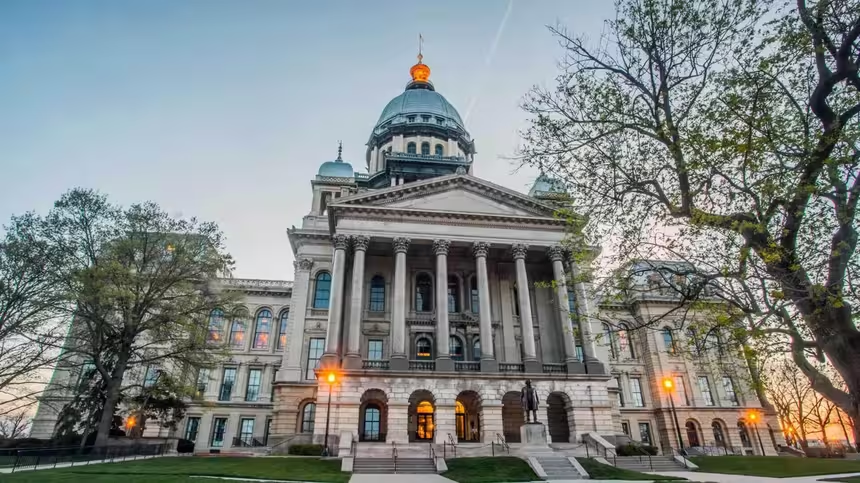
CapitolView
CapitolView is a weekly discussion of politics and government inside the Capitol, and around the state, with the Statehouse press corps. CapitolView is a production of WSIU Public Broadcasting.Providing Support for PBS.org
Learn Moreabout PBS online sponsorship(uplifting music) (camera shutter beeps) (dramatic inspiring music) - Welcome to "Capitol View," your weekly look at the happenings inside and outside the Illinois State Capitol.
I'm your host, Jennifer Fuller.
Along with us this week are Peter Hancock, of "Capitol News Illinois," and Alex Degman of Illinois Public Radio and WBEZ Chicago.
Gentlemen, we're glad you're here with us.
Let's start with perhaps the most famous visitor to Illinois this week as President Biden visited Chicago to talk about his economic accomplishments halfway through his presidency, and to talk about the support that he has for Governor JB Pritzker.
Peter, just to kind of launch with this, outside of the economic statements that the President made, how important is it to see someone like Joe Biden in Illinois right before the Presidential election season kicks off?
- Well, I think it was important to Joe Biden to get access to Illinois's billionaires who showed up at a couple of fundraisers while he was here.
But in terms of his economic message, which I think is kind of important, he's got a big job ahead of him right now because, even though the economy is objectively performing very, very well, there's a big gap between the objective reality of it and what people think of it.
Consumer confidence is not matching what's really happening in the economy, and people are still feeling kind of glum about it, even though he's, you know, pushed through the infrastructure bill and, you know, all kinds of other things, the economic stimulus that he wants to claim credit for, he just isn't getting credit for it in the public.
And so he needs to turn that around to improve his chances in 2024.
- For better, for worse, there are still problems with the pocketbook.
There are still people who are saying, I can't afford food, I can't afford gas, I can't afford my medicine.
Those sorts of big issues that really matter to voters come election time.
There was a little discussion this week as we move towards state issues with Governor JB Pritzker being asked about, not the reinstatement, but there was a holiday of sorts on the sales tax on gasoline and on the sales tax on groceries across the state.
And Alex, that's going to go back into effect as of July 1st.
Do you expect backlash from this?
- Well, I don't expect backlash necessarily because people have been expecting this for a long time.
When these tax incentives or these, I guess these holidays were put into effect, people knew they were temporary and they were temporary for, you know, potentially the reason that this was an election year and the state had some money, the state had some money coming in.
We were in a COVID emergency and there were some relief dollars flowing in.
So let's see how we can, let's see how we can parlay this into a little bit of relief.
Now, the grocery tax that lasted for a year, it's coming to an end on June 30th that was put into place as another way to give this relief.
Now, it was relatively easy to do, and I don't necessarily think that it's going to be a permanent thing.
People are talking about, well, should we maybe take a look at some of these things and make them more permanent?
But at this point we can see what is happening with the state budget.
The COVID relief dollars, they're starting to dry up.
We're starting to have a lot of, we're starting to have a lot of internal fights over how this money's going to be used.
There's no longer enough money to go around anywhere.
And the thing about the grocery tax is that the 1% that is generated from this, it typically goes to local governments.
So that money isn't just going to disappear from local governments.
So the state's gonna step in and say, well, we're gonna replace that because that's how this works.
And so far through, you know, March, through the end of March, that's already been $185 million that shoppers have saved.
And you know, when you start throwing around a hundred million here, a hundred million there, pretty soon, that adds up to real money.
So I don't think there's going to be an appetite to extend this anymore or for that matter, the gas tax holiday, but you know, we'll see what happens.
- Alex brings up a good point, and there were a lot of people talking about the local impact.
Every action in government has an equal and opposite reaction, sometimes a more than equal and opposite reaction.
Peter, how are local governments talking with state leaders about the impact of sales tax holidays like these?
- Well, I don't know that they're talking to lawmakers about that.
One of the big issues that came up during the session was, it's got a long string of initials, but it's revenue sharing from income tax that goes back to local governments.
Used to be that, I think somewhere around 10% of the money collected from that went back to cities and counties.
That has got trimmed down quite a bit and they're trying to get that amount of money back up.
You know, local governments are really kind of limited in terms of what sorts of revenue they can raise.
And so anytime the state steps in and restricts it even more, like imposing this holiday on the 1% grocery tax, they get very concerned about that.
And you know, to Alex's point, yeah, I mean, the state stepped in and made local governments hold this time, but I don't think that's sustainable.
That's, you know, it was a one-time thing that they did to give people some relief when inflation was running very high and we were still coming out of the pandemic.
But that's not something the state can keep up.
- Sure, Governor JB Pritzker, of course even said this week that, look, inflation, inflation isn't exactly where we'd like it to be, but it is better than it was a year ago.
And so his point is that, you know, it's time to let these things sunset.
Now, as Peter mentioned, the local government distributive fund, which as you said, used to be about 10% of those gross tax receipts, and the local governments would get that back.
That was dropped during the budget impasse several years ago.
It's come back up, but not back to its original level.
And we're still worrying about that big R word, Alex, recession, and lawmakers spent a good amount of time this spring talking about, is the state prepared to weather a recession?
And so people are still asking that question.
Do you think that the state is ready if and when something like that arrives?
- Well, that's a very, very tough call to make.
I think they've been preparing though, because as we saw during a lot of the budget negotiations this last spring session, you're right that our word did come up a lot and it came up in terms of the big ticket items that the state's trying to fund, for example, healthcare for undocumented immigrants.
That's a big hole in the budget that people are trying to figure out.
We had ratings agencies just recently within the last couple of weeks, say, Illinois is doing better when it comes to pensions, but it's still not doing enough.
So there's going to have to be some sort of a reckoning with that over the next few years.
And I just, I think that the state is like, they're trying to put themselves on a more sound footing, but with so many things that have come into play, especially over the last few years, budgeting has been better, but there are just a lot more pressures on the state budget now than there were.
And some of those pressures might be exacerbated by the fact that more people are gonna need more services if there is in fact a recession.
So are they prepared for one now?
I'm gonna say as probably as best as they can be, but it's really hard for me to make that, for me to make that determination right now.
- Sure.
Illinois controller Susanna Mendoza spends a lot of time talking about a rainy day fund for this very reason so that the state can handle a little bit of a downturn in the economy.
And I know that she is talking a lot more about the money that needs to be put into that fund, and in fact, saying that, you know, we're on the right track, that that's headed in the right direction.
A lot of information in the first part of this episode of Capital View.
But I wanted to drill down a little bit more on a bill that governor JB Pritzker signed this week.
It was legislation that, among other things, stets sets up a state marketplace for health insurance.
It's all a part of the Federal Affordable Care Act.
And when that was first put in place, Illinois was not one of the states that opted in to have its own healthcare marketplace.
It took the lead and let the federal government handle it.
But Peter, this is a big change.
There will be people in Illinois that perhaps get access to healthcare that maybe they didn't have in the past.
- Yeah, I think the major impetus behind that bill was the fact that they want it as a backstop to future administrations in Washington or future administrations here in Illinois that may not be supportive of the Affordable Care Act.
You know, Donald Trump was elected in 2016 on a pledge to repeal Obamacare as it was called then.
He never got that through, but he did do a lot of things to slow down in enrollment.
He reduced the enrollment period, cut the number of days in half, cut funding for what are called navigators, the people who help you navigate through the process of getting insurance.
And so the concern is if there is another administration like that that starts messing around with access to the subsidized policies you get on the Exchange Marketplace, at least in Illinois, if we have our own marketplace, then they won't be able to do that.
- Another piece of this, Peter, is that the state will have its own agency, an agency that already exists in the Department of Insurance, taking look at rates approving or denying rate increases and becoming kind of a watchdog for the people who are purchasing policies or looking at policies through this exchange.
Is this a, you know, are people going to claim this as an overreach or is this something that advocates are saying is really going to work out in the best interest?
- Well, it has a lot of support behind it even though it got no Republican support, but 41 other states have state insurance regulators with the authority to review, modify, or reject proposed rate changes.
And for whatever reason, Illinois is one of these, one of the few, I think it's called a file and use state, where the insurance companies just file their rates and then they get to use them, don't have to wait for state approval.
Doesn't happen in most of the country.
And so I think it was State Senator Laura Fine, who said she'd been working on this for like 10 years now, when she was in the house, she got it through the house a couple of times, could never get it through the Senate.
Now she's in the Senate and she got it all the way through this year.
So it was a big win for her and probably, I don't know, we'll have to see whether or not rates go down or if the size of the rate increases starts to come into control.
I can tell you the small business community was really behind this too, because they have seen huge rate increases, which very hard for them to keep up with.
And so they're hoping that by putting, you know, a stronger watchdog over it at the Department of Insurance, that they might be able to bring that under control.
- Do you expect the rollout for this to be smooth?
Are there some big changes that have to be made?
I mean, you know, you see a big program like this and there are always challenges when you see state agencies having to take things over.
How quickly is this going to go and do you think it's gonna be smooth?
- You know, I remember I was interviewed Dana Popish Severinghaus, who's the Director of the Department of Insurance, and I asked her, you know, are you ready for this?
Because when HHS at the federal level rolled out their website, we might, everybody remember it was, did not go smoothly.
And Secretary Kathleen Sebelius took a lot of flack over the fact that their website didn't work right off the bat.
She assured me that their website is going to work and they've got a couple of years, actually, it's doesn't have to be fully operational, I think until 2026.
- As we record this, we should mention that the Illinois, excuse me, the Federal Seventh Circuit Court of Appeals is hearing an appeal on the state's assault weapons ban.
We spent a little bit of time on the assault weapons ban last week on this show, but not so much the status of it.
And Peter, I'm gonna hang with you for just a little bit longer, Alex, I promise I'll get back to you.
But what do you think that the appeals court is going to hear, and I think everyone thinks it's foregone conclusion, this case will end up before the US Supreme Court.
Am I right?
- Oh yeah, definitely.
And that's why you see the list of friend of the court briefs that have been filed by 22 Republicans, state attorneys general, national gun control advocacy groups, national gun rights organizations.
I mean, this is drawing a lot of national attention right now.
And the legal standards by which these are judged has been shifting.
But the latest standard, and you know, it was just last year, the Supreme Court handed down this decision where they said, in order for gun regulations to be constitutional, they have to be consistent with the historical tradition of gun regulation in the United States dating back to 1791 when the Second Amendment was ratified, which is a very high bar to cross.
And so you're gonna see the people challenging the law, and these are many consolidated cases that all ask the same question.
The challengers of the law are going to say there is no historical tradition for banning an entire category of weapons.
And by the way, millions of Americans own these guns and use them for lawful purposes.
The state is going to argue that yes, there is historical tradition of regulating extremely dangerous weapons like machine guns, and therefore this is constitutional.
And they're gonna say the public safety interest in getting these guns out of circulation outweighs the Second Amendment right concerns because those people still have access to lots of other guns that they can use for self-defense.
- And we've mentioned in the past, you know, this issue, this assault weapons ban, which was passed just a little less than six or seven months ago if my math is correct, is making its way through two different court systems, both the state court and the federal court.
So we will of course, stay tuned and one of the reasons that the ban was actually put into place is reaching its one year anniversary in the next week or so, and I think it was the Highland Park shooting that called on the Illinois lawmakers or that caused Illinois lawmakers to pass this restriction, this legislation.
Alex, I know that you have had some experience in talking with people in Highland Park about their experience one year later.
Do you think that things have changed there?
Do you think that the 4th of July holiday will be different for them this year?
- Well, the 4th of July in Highland Park is going to be just functionally very different this year, just solely because if not there, there are many reasons, but there are a lot of events that were planned with trauma-informed response in mind.
So for example, their parade is not going to be a parade necessarily, but it's going to be a community march to take back the routes that was taken for them down Central Avenue and downtown.
And then in addition to returning with the community picnics and the concerts at the high school football field, they're not having a fireworks show at night, they're having a drone show.
It's like a a 10 to 12-minute drone show that is called, "We Are Highland Park."
And I kind of wanna see it because I've never seen a 4th of July drone show like that.
It sounds like a really cool thing.
But overall, the community is still, they're getting through it as best they can.
There have been some changes made, but just generally the sense of community, the sense of togetherness never really left the feeling that they're gonna take their town back, they're gonna take their celebration back.
That has not changed.
That resolve has always been there.
- As with so many communities, we see a tragedy like this one.
And while the nation and even the world moves on from that incident, there are still people in that community who are suffering the effects of what happened on the 4th of July.
Whether it's people who lost, what loved ones, people who were injured who continue to recover from those injuries, and others who you mentioned trauma-informed response, who were traumatized by what they saw and heard, both that day and in the days after.
Do you see that the people in Highland Park are getting the support that they need from outside the community as well?
- I think so, and I think part of that is because they have somebody at the helm who is really working to make sure that those resources are available.
I spent a little bit of time with Nancy Rotary over the past week and just talking to her about what it's been like trying to lead the community through this over the past year, and what resources are available and things like that.
And she seems to be just very committed to making sure that that's there because as she told me, she's committed to being in Highland Park.
She's committed to being or being with her family and being with her community.
Because as she mentioned to me, the community is what really got her through her herself.
Because as you can imagine, if you're a leader of a city that's going through a tragedy like this, how much time do you actually have to sit by yourself and process what has happened?
No, you can't because you're just going from place to place to place trying to make sure that everybody else has what they need, and to her, being somebody who has been in the community for as long as she has, that was a form of therapy for her.
So I think with somebody like that and with the support of City Council, I think they're gonna be okay.
I think they're gonna be, they're gonna continue to move forward and it's gonna be hard, but I think that they are commemorating this the way that it should be respectfully and just making sure that everybody can get involved in some way.
- Certainly our thoughts are with the people of Highland Park as they get to get ready to mark this anniversary.
Let's lighten the mood just a little bit on this edition of "Capitol View."
And Alex, I wanted to ask you if we can stay with you for just a moment about this conversation involving the Chicago Bears.
Perhaps people are unfamiliar, there's some talk that the Bears would like to leave their downtown stadium at Soldier Field downtown in Chicago and perhaps move to one of the suburbs.
And several have been mentioned, perhaps the most prominent would be Arlington Heights, but what is the status of this, and what's the endgame here?
Is this just a bidding war for which city is going to build the biggest and best stadium as we see sometimes?
Or is there more to it than that?
- Well, it certainly seems that way.
It, at least now, Kevin Warren, the CEO of the Bears held a community meeting in Arlington Heights not too long ago where they talked about this, there has been a little bit of a snag, and well, a little bit that's putting it nicely, but there's been a snag in Arlington Heights.
The latest is that the Bears and some school districts that surround the former Arlington International Race course cannot come to terms on what an annual property tax payment should be on that property.
They're more than $3 million apart.
And Kevin Warren, in his discussion with the community in Arlington Heights, said, you know, we were over a million dollars, our offer is a million dollars more, over a million dollars more than what Churchill Downs was paying in property taxes.
But then the school districts turn around and say, well, yeah, but you're the Chicago Bears.
Like, come on.
So Arlington Heights is still in play, but as you mentioned, or as he would put it, as Kevin Warren would put it, this is just how business is going.
This is how you do business.
This is not necessarily, you know, a bidding war or anything like that.
But if we are having some issues negotiating with our, our preferred location, then we're gonna see what else is out there.
So for example, you mentioned a couple of other suburbs you mentioned Naperville is in play, Waukegan has also has also mentioned some interest.
Aurora also has come into the picture, and I think that there was a there was a letter from Murphysboro, I hear Murphysboro is also interested.
They wanted, they wanted, they're not trying to offer any sort of a mega project legislation or anything like that, but I think, what was the offer barbecue and $500 in tax rebates.
So everybody's getting into it, everybody's getting into it at this point.
But on a more serious note, this seems like it could be mainly a, like a Chicago suburb thing, like an infighting between the counties up there, but it actually could have, as the mayor of Murfreesboro mentioned, it could have some statewide implications.
- Sure.
And I wanted to get to that.
You know, Peter, we've seen this not just with the Chicago Bears, we saw it not all that long ago for people who are familiar with the St. Louis Rams when they left St. Louis and went back to California, back to Los Angeles.
And the impact that it has, not just on the city as a whole, but on the region and and on in individual states.
So I guess that kind of begs the question, if people are not from the Chicago area, if they're from downstate Southern Illinois, why should they care about where the Bears play?
- Well, I'm not sure that they do care all that much.
And I'll tell you as it died in the wool Kansas City Chiefs fan, I would like to see a time when the Bears are competitive again.
It's been quite a number of years since that happened, and I think maybe a new modern stadium with more seating capacity would help them do that.
But you know, I mean, it would be good for the, I think the interest is in keeping them in Illinois and keeping them in the Chicago metropolitan area.
Whether or not they stay within the confines of the city of Chicago is, you know, that that's gonna be a business decision for the Bears to make.
And you know, the property tax situation in Arlington Heights really kind of amused me.
I can't believe that the Bears didn't know when you pay $200 million for a piece of property that the county appraiser is then going to assign a $200 million value to it, and you'll be taxed accordingly.
But whatever, maybe they can get a deal worked out, maybe not, but I, you know, I think it's likely the Bears are going to stay in the Chicago metropolitan area.
They're just, they're embedded in the DNA of that city.
- Sure.
And we've mentioned Chicago, people from Chicago into Springfield, even parts of Southern Illinois, we're dealing with the impact this week of those Canadian wildfires, air quality advisories in some areas, warnings in some areas, all of that coupled with the fact that there have been excessive heat warnings and other issues this week across the state of Illinois, and farmers are talking about, hey, don't forget, we haven't seen rain of any substantial amount in quite a while, and they're starting to use the word drought, and worrying that the crop yield this year could be impacted in the same way that it was back in 2012.
That was when the worst drought in quite a while had hit the state.
Peter, we've got just a couple of minutes left, but how worried should state leaders be if the crop yield is not as good this year?
- Well, it is a concern, but you know, you go back to, you know, Mark Twain's old saying is that everybody complains about the weather, but nobody does anything about it.
There's not a whole lot anybody can do.
But you know, it is a concern, and especially as the climate continues to change in very dramatic ways, I think the agriculture industry in Illinois really needs to start bracing itself for a lot of different scenarios, maybe different kinds of crop rotation, different kinds of crops.
They're gonna have to do something to deal with the fact that the rain and the temperatures just are not as consistent and predictable as they used to be.
- Sure.
As we sit here, we're just about six weeks away from the big agricultural showcase, which would be the Illinois State Fair in Springfield, as well as the Du Quoin State Fair in downstate Du Quoin in Perry County.
Alex, how important is it for the politicians that'll be running next year to have a backdrop of good agricultural news coming up in August and early September?
- Well, it's gonna be incredibly important, especially because the state fair showcases or is supposed to showcase agriculture and politicians, especially if they're going to be in the spotlight on that day, they're gonna wanna have something to show for it.
And typically the political days in the state fair are the most important for them to get out in front of voters potentially.
- Sure.
That'll do it For this week's edition of "Capital View," I'd like to thank Peter Hancock and Alex Degman for joining us.
I'm Jennifer Fuller.
You can find more episodes of "Capital View" online at wsiu.org.
Thanks for joining us.
(upbeat music)

- News and Public Affairs

Top journalists deliver compelling original analysis of the hour's headlines.

- News and Public Affairs

FRONTLINE is investigative journalism that questions, explains and changes our world.












Support for PBS provided by:
CapitolView is a local public television program presented by WSIU
CapitolView is a production of WSIU Public Broadcasting.