
Capitol View - June 9, 2023
6/9/2023 | 26m 25sVideo has Closed Captions
Capitol View - June 9, 2023
Governor JB Pritzker signed Illinois’ FY 2024 budget into law in early June, ushering in increases in spending for education from pre-k through higher education. In this episode, a conversation with Gov. Pritzker, and analysis from statehouse journalists on the Spring 2023 Session.
Problems playing video? | Closed Captioning Feedback
Problems playing video? | Closed Captioning Feedback
CapitolView is a local public television program presented by WSIU
CapitolView is a production of WSIU Public Broadcasting.
Capitol View - June 9, 2023
6/9/2023 | 26m 25sVideo has Closed Captions
Governor JB Pritzker signed Illinois’ FY 2024 budget into law in early June, ushering in increases in spending for education from pre-k through higher education. In this episode, a conversation with Gov. Pritzker, and analysis from statehouse journalists on the Spring 2023 Session.
Problems playing video? | Closed Captioning Feedback
How to Watch CapitolView
CapitolView is available to stream on pbs.org and the free PBS App, available on iPhone, Apple TV, Android TV, Android smartphones, Amazon Fire TV, Amazon Fire Tablet, Roku, Samsung Smart TV, and Vizio.
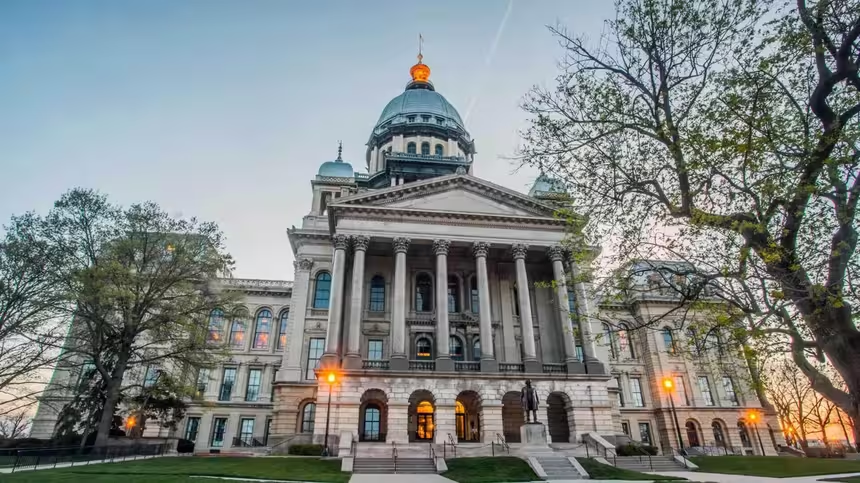
CapitolView
CapitolView is a weekly discussion of politics and government inside the Capitol, and around the state, with the Statehouse press corps. CapitolView is a production of WSIU Public Broadcasting.Providing Support for PBS.org
Learn Moreabout PBS online sponsorship(bright upbeat music) (bright upbeat music) (bright upbeat music) - Welcome to another edition of "Capitol View", your weekly look at the happenings inside and outside the Illinois State Capitol.
A bit of a special episode as we're joined with "Illinois Lawmakers" host Jak Tichenor this week.
Jak, thanks for joining us.
- Good to be here.
- And we're also joined with a special guest this week here on "Capitol View".
We'll start things off taking a closer look at the Illinois state budget with governor J.
B. Pritzker.
Governor, thanks for joining us.
- Great to meet with you.
- Governor, we'd like to start obviously, with the victory Tour that you're taking on the Illinois state budget.
This was one that you laid out earlier in the year and it appears that you really got a lot of what you wanted from the legislature.
What do you think are the high points there?
- Well, you're right, I'm very fortunate.
You know we put together a proposal back in February that we put to the general assembly and almost all of it remained intact going into the final days of the legislature.
And of course, we passed a budget that was very close to what I proposed.
I'm really proud of what we achieved in that budget.
It does a lot of very important things to carry Illinois forward.
Let's start with focusing on lifting up people who often are left out and left behind.
We have a program that increases support for people who are unhoused, services for homeless people and in addition to that, a grocery initiative which is hugely impactful I think for areas of the state, rural areas, in southern Illinois in particular.
As you know, Senator Dale Fowler is one of the members of that commission that we put together, the Grocery Initiative, which was initially put together by former senator and now Deputy Governor Andy Manar will benefit southern Illinois but also areas of Chicago like the south and west sides.
So we have a lot more work to do in that regard but proud of those.
And then I was with you and Jak yesterday at the Southern Illinois University at Carbondale and we were talking about higher education funding.
But education funding broadly was a big portion of this budget.
We significantly increased the MAP grants, the support for students who wanna go to college who couldn't otherwise afford it.
And then higher education and moving down the scale, K-12 education, 570 million more in K-12 education including a teacher pipeline effort to fill teacher vacancies.
And then going even further down the scale, something I'm really passionate about and that's early childhood education and childcare.
- How does the Smart Start Program for preschool children and when you look at the other end of the scale, the increased money for higher education, how do those things kind of bookend each other to make sure that we have good student outcomes and keep the state's best and brightest here back in Illinois?
- I'm so glad you asked that question because sometimes people don't really understand the relationship between these things.
But you know, in the earliest years of life, what's been proven time and time again by the researchers is when we put dollars into supporting those kids with home visiting, with quality childcare, with quality preschool, the outcomes that we've seen over longitudinal studies that have been 40 and 60 years now is that kids who get those services early on, who go to school earlier actually end up more likely to graduate from high school, more likely to go to college and graduate from college, more likely to get a job, a lot less likely to end up in prison or even needing a lot of the services that government can offer including healthcare or Medicaid, et cetera.
So the savings to taxpayers and the benefit to those kids is enormous.
And it's something I've been involved with for more than 20 years before I became governor and now as governor I'm able to effectuate.
- Governor, you've brought up a couple of these programs already but when you talk about the poverty programs; increases in funding for health and human services, Medicaid reimbursements, there was a lot of talk about compassionate governing in this spring session, you brought it up yourself when you were introducing the budget and talking about your initiatives.
How critical is it that the people in this state see the government as something that is helping them or there for them when they need it?
- Well, look, there are people who don't need much from government, that's for sure.
And they tend to be people at the higher end of earners but they're an awful lot of people, middle income taxpayers, workers who are working class and the working poor.
And then people who just need some help.
They don't have a job, they're not able to get one maybe, maybe they're developmentally disabled and they really need services from the government.
Those are all areas that we need to be looking at.
For example, in order for us to operate the government, we need to grow the economy.
So we need to make sure we're putting dollars into helping businesses grow and hire more people and raising wages.
One of the reasons that I was so much in favor of raising the minimum wage when I came into office.
And then the services that we talk about, the compassionate services that people need.
Sometimes people just need a little bit of a helping hand to make a better life for themselves and their families.
We need great education, if you wanna have a great future for our economy and for our people, we need people to get a great education.
Illinois ranked sixth in K-12 education throughout the nation, among the 50 states.
I'm proud of that.
And then our universities are some of the best in the world.
We need to keep investing in those.
- I wanna ask you a question about the spring session.
Republicans took part in the budget negotiations this year in both the House and Senate unlike previous years.
And while they agree with some of your funding priorities, particularly in the higher education area, they say the Democrats crowded too much into this budget, it's a record breaking budget and you spent too much on things like undocumented residents, healthcare and things like that.
How do you respond to that criticism?
- Well, it's not the first time that Republicans have been involved since I became governor.
When I first became governor my first year, our budget was a bipartisan supported budget but for some reason Republicans decided to really drop out of that process for the three years in between.
And then this year I made a real effort to reach out to Republicans, particularly in the house 'cause I think the Senate was doing a reasonably good job of having bipartisan discussions.
But we tried to bring people together on a bunch of issues and there are a bunch of Republican priorities that are in the budget.
I really don't understand why Republicans didn't vote for this budget.
It was good for Republicans and for their voters and for their constituents.
Putting money into higher education, most of our public universities are in Republican districts.
They didn't vote for that.
Most of the help that we're giving to people who are in poverty is going to people in their districts.
You know, some of the poorest districts in the state are in southern Illinois and we're making sure to make investments there.
So I'm disappointed Republicans didn't ultimately, vote for it but there were priorities of theirs, there were also priorities of mine like cutting the franchise tax on businesses and making sure that we're helping to grow jobs across the state.
- You and I had a chance to talk a few weeks ago about the potential impact of passing another balanced budget on the state's credit rating.
We've had eight upgrades as far as I can tell at this point in your administration.
It's a lot different than the previous administration when it comes to dealing with Wall Street, when our credit rating was hovering just above the junk bond status.
You've been talking with Wall Street, what do you think the message will be when this budget is finally signed as far as Fitch and Moody's and Standards & Poors go?
- Well, it's hard to predict what the credit rating agencies are going to do.
They don't tell you ahead of time but we know what matters to bond investors.
We know what matters to credit rating agencies and frankly, we know what matters to those of us who are fiscally responsible.
When I came into office, one of the very first things I did was went to Wall Street and met with those bond investors, met with the credit rating agencies and listened to them.
And by the way, our reputation as a state was terrible with them.
And I listened and I also told them what we were gonna do to put the state on the best fiscal foundation we could.
And then I delivered on those things with the general assembly and while Republicans didn't vote for it, for most of the time, they were benefiting from the fact that our credit rating has improved so much.
Now Republicans, for some reason, they don't seem to care about credit ratings.
They did when they thought things were really awful and they said so but then when we started getting improvements and Democrats were the ones doing it, Republicans were nowhere to be found and they really criticized us anyway.
Well, they would say, "Gee, even though we got credit rating improvements, "we didn't get far beyond "being in the bottom tier of states."
Well, you know what?
As you know a journey of 1,000 miles begins with the first step and we made eight big giant leaps by getting credit rating upgrades.
I intend to keep working to get more.
I think this balanced budget sends a message that even when we think there's a mild recession that might come, we in Illinois are prepared for that and balance the budget anyway.
- Thank you so much for taking the time out of your busy schedule, we certainly appreciate it.
- Great to be with you both.
- Our special thanks to governor J.
B. Pritzker for the interview in this edition of "Capital View".
We bring more analysis to "Capitol View" with Amanda Vinicky of WTTW's "Chicago Tonight".
Amanda, thanks for joining us.
- I'm glad to be here, thanks for having me.
- So the governor took a bit of a victory tour with the budget that the legislature passed.
This week, he official officially signs the document.
Obviously, a bit of a celebration for him but Amanda, I'd like to start with you, who are the winners and losers here?
- So there are a heck of a lot of winners and first among them is Governor Pritzker.
He by and large got what he wanted with this budget including that signature program that over the course of several years, and this is the first one, really begins to fund early childhood programs.
He wanted that to be his signature, the Smart Start, and he got that and he's able to say that he's putting more money toward education, that he's funding the rainy day fund, lifting up pensions more than is called for by law.
It wasn't all that long ago that Pritzker introduced a budget that would've essentially had the state skipping the pension payment, now overpaying.
Although, I would say that you have actuaries that say Illinois is still not making enough of a dent there and plenty of critics saying that that does not mean the pension problem is solved.
So he's really a big winner.
And again, education, particularly higher education is an area that had been long neglected, not anymore.
There are some Medicaid wins in terms of higher reimbursements after a very long wait.
You could however also put some of those same winners in the camp of losing.
For example, you look at healthcare and both workers as well as those requesting Medicaid reimbursements rates not as much as they had wanted.
Not going into effect right away and nowhere near the rate increases that they had hoped for.
Again, localities, you put them in the winner camp, they got an increase in terms of the share they received but not anywhere near as much as they wanted.
The Coalition for Sexual Assault Services took a big cut from the federal government and had hoped that the state would help to make that up.
Not so.
So you're looking at rape crisis centers and hotlines, that was a big loser.
And then I think we can't really talk about the budget much as the elected officials perhaps might like us to without talking about the notion of a pay raise because the governor did sign- - Right, right.
- Really like 99.9% of the budget into law.
But he did have to use his veto pen to make a couple of reductions when it comes to pay raises for the constitutional officers and legislators.
- Certainly.
Jak, I wanna stick with you.
When we talk about the Smart Start Program, we've seen a lot of governors bring out early childhood programs and they get off to a good start and then something happens and they fade away.
What does the future hold for Smart Start?
- I think it's pretty good based on what I've seen thus far.
The governor has had a passion for early childhood education for the last 20 some odd years or more.
He and the First Lady have invested heavily in it personally through the Pritzker Children's Initiative.
The goal of having a country where three and four year olds are all ready to start school when it's time for them to do that.
As governor, he's been committed to increasing the amount of money for both higher and early childhood education.
This budget particularly sets forth another $250 million for the Smart Start Program.
The idea is to try to get rid of childcare deserts around the state so working families can go to work, and their young ones can go to preschool.
In this case, there's also money for new childcare facilities on the physical side of that.
The goal is to add another 5,000 seats for preschoolers in the coming year and eventually for every three to four year old to be able to enroll in a preschool program.
So this is not by any stretch of fly by night kind of thing.
This is something that the governor feels very strongly about and however things play out fiscally over the next few years, I think you can expect him to make sure that this is one of the cornerstones of his administration's spending priorities.
- Still there's a specter of what comes next, what's looming on the horizon, and there's that big word that financial planners don't always like to talk about and that's recession.
Amanda, how recession-proof is this budget?
What happens if the bottom drops out halfway through the year?
- I mean, it's difficult to sort of speculate what legislators will do.
You also have one of the elements that had held up an agreement on this budget was funding for a program that provides healthcare to undocumented immigrants.
And so, that's an area that I'm bringing up at this point to answer your question because it's unclear really right now whether the governor is going to be able to keep the spending lid on that program as per the funding allocated to him.
He had predicted it would cost somewhere in the neighborhood of $1 billion and basically received half that much, albeit with powers to change the program that he says is a way that will allow him to save money.
Is he gonna be able to do that?
Period.
What happens if the bottom drops out?
Again, I think as Jak noted, there's a lot of support for early childhood and frankly, the governor has really put a lot of attention toward this.
He's not going to let that get touched but what does happen?
There are other unknowns as Republicans bring up in terms of does this budget have enough to account for money that will be negotiated with the state's largest public employees union, AFSCME?
There are a lot of question marks.
And so not just this year, but also down the road, you have programs that sort of become enmeshed in the budget and yet we saw in part of the negotiations this year as legislators had less wiggle room than they had expected.
There was a time early on that there was talk about, are we going to be giving tax decreases and money back in the current budget year that we're in that ends July 1st?
And that all faded as you saw economic projections turn.
So the governor and his backers say that they were fiscally responsible, that they were conservative in making their choices, that all of these fears of the R word were taken into account but certainly it could bode for tougher negotiations down the road and budget that does overspend should things really go into the toilet and tank.
- Amanda, if I could follow up, one of the things we were talking about, you're talking about revenue estimates and the like.
We took a big drop back in April because tax receipts were down.
Well, way down between this April and last April.
The new numbers are out from the commission on governmental forecasting and accountability, coming back up a little bit but at the end of the day, this is what?
About a $50.4 billion budget and the estimated revenues for the new fiscal year was something like 50.7 billion.
So that's about 200 to $300 million cushion in there.
And as you've correctly pointed out, you have the AFSCME negotiations that are going on.
We don't know where things could go if the national economy takes a nose dive.
One big bullet we dodged of course though, was the national debt ceiling agreement that was passed out and signed by the president over the weekend.
That would've caused unheralded havoc for the Illinois economy.
- We'll continue to watch the budget and how it lives and breathes through the next fiscal year but as with so many general assemblies, the focus stays on the budget, there were a lot of bills passed this spring.
The governor is now working his way through a lot of those, signing, pledging to veto and perhaps vetoing some others.
Amanda, let's see what we can get through this week as we talk about what the legislature did, specifically a utilities bill, a lot of people are calling it the Ameren Bill.
Advocates say it's going to give that utility more control over the infrastructure.
Things like power lines and power poles and things like that.
But the consumer advocates say it's too big a burden on the customers.
Governor Pritzker has vowed to veto that bill.
Do you think he's going to hold onto that vow?
- Yeah, I mean, I think it would be strange for him to break his word after he publicly said that he is going to veto it.
Something that of course, he hasn't had to do much of.
I noted that legislative pay increase, they still got their pay increases.
Let's be clear, the governor didn't start a fight with the legislature.
They're still getting 5%, just not 5.5% additional so that wasn't picking a bone with the legislature, that was reducing it in order to fit in line with some constitutional concerns.
So there isn't perhaps a lawsuit that would've allowed legislators to forego making $89,000 going forward.
So in this case he is sort of picking a bit of a fight because this is a measure that, when you talk to some folks, it was done to help Ameren even though Illinois has such a reputation of sort of cozy relationships with utilities as we saw play out during that ComEd trial, of course.
But more really pushed by unions and IBEW, a close ally of Pritzker and all other Democrats.
The question is going to be whether the unions are going to be able to override that veto.
And as you noted Jen, this is something that would benefit the unions hence they're behind it, jobs, but also would presumably benefit Ameren's bottom line by giving them the right of first refusal, as there's this big transmission expansion project.
Something that I think you saw the governor interfere with because as I brought up, all of the questions about corruption ethics surrounding utilities.
So the fact that that was passed, critics are seizing on it and saying, "Hey wait, you did this," but not any ethics legislation specifically to address what we learned about in the ComEd trial.
So that's one that is certainly interesting and we will be watching for I think both of those reasons.
And a quick add, critics also will say that something the budget did not do was fund any program that will help boost for those who are in Ameren service territory and are concerned about high bills because of, again, the questions in terms of why and what is causing it.
Some point to that Siege Law, others say it is just the economy and how utilities are working but for anybody that was looking for help with their rates, that was not a program that was funded.
- And there's still a big question mark on that, Amanda, because in talking to Senate President Don Harmon last week on the "Illinois Lawmakers" show, I asked him specifically about whether that Ameren Bill would withstand a legislative override.
And he said at this point he wasn't sure that it would actually be brought up in the house come the veto session in October.
- Just let the veto stand.
- Right, a final decision is not always a final decision.
And of course, we continue to watch things like that here on "Capitol View".
Jak, I wanted to move to another bill that the governor signed this week and it has to do with constitutional lawsuits.
If a lawsuit is filed against a piece of legislation or a new law on constitutional grounds, this new law says that that has to be filed in either Sangamon County, which is where Springfield is of course, or Cook County, which is where Chicago is, a lot of state government offices and business done in the windy city.
So Jak, what ramifications does this have and what do you expect to see in terms of perhaps, constitutional challenges?
- Well, it's an interesting question 'cause based on the number of lawsuits we've seen over the last couple of years like on gun control and the executive orders during the COVID pandemic, the thinking appears to be to bring these cases to trial in places like Sangamon County and Chicago.
Opponents say that it gives the democratic interest to leg up when it comes to heavily democratic Chicago.
But as our friend Rich Miller pointed out this week, all the judges in Sangamon County are Republicans at the circuit level.
So it's interesting to see how this one will play out, no doubt there will be a challenge though.
- Another thing that I wanted to get to before we get done with this week's episode and that was social justice initiatives.
There were a lot of bills that took a closer look at the changing landscape that we're seeing not just here in Illinois but across the nation.
Amanda, did Illinois move the needle on any of these issues or do you expect that they're going to continue to be top bill?
- Oh yeah, Illinois did definitely move the needle on some of these issues.
And in fact, going sort of the opposite of some of the legislation that you noted is, for example, those who may come to the state seeking an abortion or other reproductive care measure that will not allow for license plate readers to be used in those cases.
There are protections across the board.
You look at an expansion of education where a new requirement in schools for learning about Native Americans and protections for students who would want to wear culturally sensitive regalia when they walk across their graduation stage.
So a lot done on the front here that you can see.
I think we have huge democratic super majorities and they used them to get many of these social justice issues passed.
- One quick question as we close things out for you, Amanda, and there's always this thought at the end of a spring session where people are saying, "Well, what about a special session?
"What are we going to see in veto session?"
It seems calmer this year, am I reading things correctly?
- You know, I think that part of it was just, in general, you're right, it was calmer despite the fact that so many bills passed.
There are still, I think a lot of two dos left on the agenda as I noted earlier.
I think there's going to continually be questions about, "Hey, wait, what about ethics?"
There are certainly, those who are frustrated that Illinois did not tackle continuing concerns with the legal marijuana program, particularly as you have those who were promised social equity licenses.
They say that they are not getting all that they were promised and so there are frustrations about that.
And then here in Chicago, questions about the Chicago Elected School board that was put off but it is not forgotten.
- We're gonna have to close things out there.
I'd like to thank Amanda Vinicky of "Chicago Tonight" at WTTW and "Illinois Lawmakers" host Jak Tichenor for joining us on this week's episode, I should say, of "Capitol View".
I'm Jennifer Fuller, we'll see you next time.
(bright upbeat music) (bright upbeat music) (bright upbeat music)

- News and Public Affairs

Top journalists deliver compelling original analysis of the hour's headlines.

- News and Public Affairs

FRONTLINE is investigative journalism that questions, explains and changes our world.












Support for PBS provided by:
CapitolView is a local public television program presented by WSIU
CapitolView is a production of WSIU Public Broadcasting.