
Capitol View - March 10, 2023
3/10/2023 | 26m 46sVideo has Closed Captions
WSIU's Jennifer Fuller talks with John Jackson and John O’Connor.
From a dramatic transition for one state-operated center to plans for big changes in mental healthcare across the state, Gov. JB Pritzker’s administration had several big announcements this week. We’ll explore those issues, plus deadlines for bill passage in legislative committees, and more in this episode.
Problems playing video? | Closed Captioning Feedback
Problems playing video? | Closed Captioning Feedback
CapitolView is a local public television program presented by WSIU
CapitolView is a production of WSIU Public Broadcasting.
Capitol View - March 10, 2023
3/10/2023 | 26m 46sVideo has Closed Captions
From a dramatic transition for one state-operated center to plans for big changes in mental healthcare across the state, Gov. JB Pritzker’s administration had several big announcements this week. We’ll explore those issues, plus deadlines for bill passage in legislative committees, and more in this episode.
Problems playing video? | Closed Captioning Feedback
How to Watch CapitolView
CapitolView is available to stream on pbs.org and the free PBS App, available on iPhone, Apple TV, Android TV, Android smartphones, Amazon Fire TV, Amazon Fire Tablet, Roku, Samsung Smart TV, and Vizio.
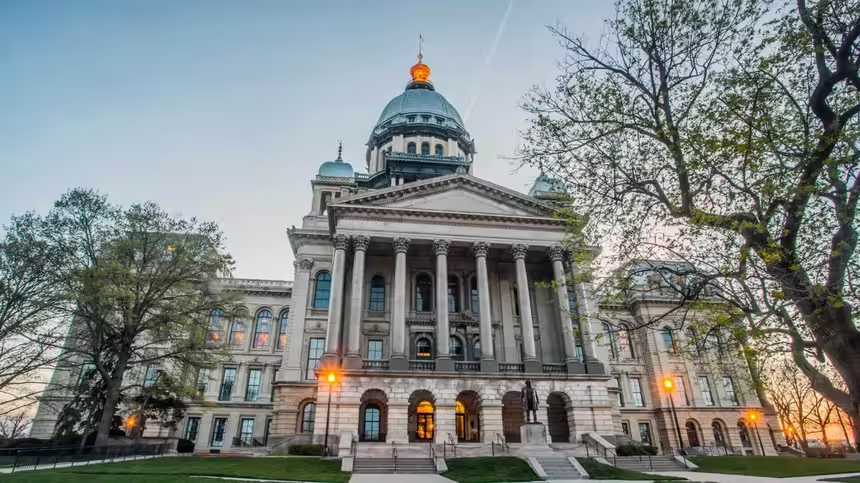
CapitolView
CapitolView is a weekly discussion of politics and government inside the Capitol, and around the state, with the Statehouse press corps. CapitolView is a production of WSIU Public Broadcasting.Providing Support for PBS.org
Learn Moreabout PBS online sponsorship(upbeat music) - Welcome to "Capital View", our weekly look at the happenings inside and outside the Illinois State Capitol.
I'm Jennifer Fuller.
Our guests this week are John Jackson of the Paul Simon Public Policy Institute at SIU Carbon dale and John O'Connor of the Associated Press.
Thank you both for joining us this week.
- Thanks Jen.
- Good to be here.
- Let's start with something that is outside the Illinois State Capitol but very important to state government as a whole.
And that is a transformation or a transition that was announced this week including the SHO Mental Health and Rehabilitation Center in far southern Illinois in Anna that also impacts the Illinois Department of Human Services.
John Jackson, I'm gonna start with you since at SIU this would be in your backyard a big change for the SHO Center.
- Yes, it is.
This story comes from yesterday's press release on the governor's office, of course entitled repurposing and Restructuring the Show Center.
I would like to start with recognition for Molly Parker and her colleagues at Lee Enterprises Public Service Team Capital News Ellen, Illinois, and Pro (indistinct) Investigative reporting because they really started this story and they are I think, do some credit for where it's come to.
Even the governor in the press conference yesterday as I understand it, recognized that their story to some serious extent had been driving this policy change in this program development.
This can, I think, be a creative and transformational change in what has been a long, troubled facility as that series of investigative reporting news stories has, I think convinced legislators, the governor and at least much of the public, that something needed to be done there.
As I understand it, they want to reduce the number of patients with developmental disabilities and move them to these community based living facilities.
They're much smaller, much more decentralized and that's become really the model and the norm for most of the country even though it sometimes has its own troubled problems.
And the idea is the least restrictive setting possible as I understand it.
However, the psychiatric hospital will stay there.
They also announced a new partnership with the SIU School of Medicine and the Illinois Council for Developmental Disabilities.
They, I think, put real stress on safety and announced that there would be improved safety 10 new staff members for the Office of Inspector General the appointment of Lion Thomas as the first ever IDHE, chief Resident Safety Officer and a new emphasis on family liaison teams.
This stress on community based initiatives is not going to be cheap, and it does not come free.
And if you announce a grandiose program and don't announce a budget and source of funding you've really just really whistling in the wind to some extent.
But they put a budget behind it 800 million new dollars that brings to 1.7 billion the total in this commitment.
And I think that's crucial.
Cause that says where you really are getting serious.
- John O'Connor, you were at the Governor's Press Conference this week where he talked about these changes as well as some others, but how important is it that this happens in the way that it does?
In terms of making changes that showed to protect patient safety and add some accountability after what appears to be years of neglect and allegations of abuse?
- Well, as John pointed out, the institutionalization of residents has showed is really anachronistic.
Illinois is lagging behind the rest of the nation in terms of decentralizing these residents.
They ports the size.
The US Supreme Court has said all people should be able to live in the least restrictive environment, live in the community.
And Illinois has done a lot of that but there's a lot yet to be done.
And and as is his practice, governor Pritzker when he faces questions or about his reaction his response to problems often and often rightly blames his predecessor who was engaged with Democrats in the legislature for years over a conservative agenda, which led to no budget being passed.
So yes, under, under his predecessor a lot of services, especially social services were hollowed out as the governor said.
And his contention is he knew that when he came in in in 2019 and started making changes and the reporting by the Southern and Capital News Illinois and Publica accelerated that and I think helped push things along.
But I asked him what the reporting pointed out and the specific thing I said was 49 people have faced felony charges since 2015.
And what we're talking about one of the major problems is this what the reporters called a culture of abuse.
And we had a lot of instances many before Pritzker took office, but some that happened while he was in office of residents being beaten by staff members and a conspiracy to cover up that and to bring new employees on and intimidate them into complying either going along or at least keep their mouth shut about it.
And my question was, if you knew that these are pretty public, felony charges are public things.
Why didn't we intervene?
Why didn't you intervene more quickly and sooner?
And his answer was, a lot of things were done behind the scenes.
Some things failed and that you can't snap your fingers and fix these things.
And he did have a point in that one of the problems along with under funding of course is the inability to recruit and retain skilled people.
The people needed for these jobs do require a certain amount of skill and let alone the the compassion and conscientiousness that you need to be in these jobs.
And when you're having trouble recruiting staff, you're not going to get the best staff and you're not gonna be able to replace staff as easily - To that end some of the things that you've asked John have garnered a lot of reaction, as you would expect from any state agency or a large facility in any part of the state.
The Shote center houses, I believe more than 200 patients both developmentally and intellectually disabled but also what they call forensic patients.
Some of them found not guilty by reason of insanity and other convictions or diagnoses that make them a danger to themselves or a danger to the public perhaps.
So they have to be kept somewhere.
Now, as those with developmental disabilities and intellectual disabilities are transferred to more community-based settings, there is some talk that the number of people at Shote will not be diminished.
That they'll be able to house even more people who have criminal convictions or other issues that would cause them to need to be out of the public.
When you take a look at reactions and John O'Connor, I'll start with you.
Anywhere from the Nurses Association the American Federation of State County and municipal employees, lawmakers, and others it seemed to be a bit mixed supporting, pledging support for the Shote Center and the workers there and the families and the residents but then others who were saying, maybe this went too far, maybe this is too fast.
Did you expect to see that sort of thing in an announcement like this?
- Yes, absolutely.
The, the plan to move those those who are voluntarily residents there are the ones that will be moved 123 of them more a little more than half.
And that's gonna take place over one to three years.
So we'll only see a few moves a month.
And the reason for that is because people with these sorts of disabilities are very grounded where they are and they're very, you know.
And to a certain extent and reluctant to change, it's gonna be difficult for them.
You also have many families who have only known Shote for their loved ones to reside there and they're happy with the placement there.
There are 600 employees there and not every one of them is a bad person.
And so yeah, there are gonna be people, both residents and their families who are reluctant to change.
Ask me represents probably most of the employees there.
And they're going to protect, they want to protect jobs, but they also want to make sure that the residents aren't just kind of thrown out willy-nilly.
And the forensic residents there will probably we'll never be able to completely decentralize these institutions.
And the governor pointed out yesterday that a lot of what will happen going forward will be up to SIU School of Medicine.
They're going to be the people determining the future of Shote and they'll determine what that use will be.
And I think there will always be an institutional setting for some people of our society.
- John Jackson, John O'Connor brings up the collaboration between the state as well as other agencies and other entities throughout Illinois notably the SIU School of Medicine which will be working to help evaluate people before they're moved, perhaps whether or not they should be moved.
These sorts of things don't change overnight as the governor has said but what do you think the benchmarks ought to be?
How far down the road do you start looking at whether or not this change was a success?
- Well, I have a great deal of confidence in the School of Medicine and their expertise and their commitment and SIU in general, the system particularly in this kind of outreach.
So I thought that was a really great news item and the kind of thing that the university I think wants to do and can do well.
And the emphasis nationally is on this behavioral health movement and this work ambition to have this workforce center and the training of more and more professionals.
Clearly that's needed and clearly something that School of Medicine knows how to do.
And the earlier announcement on children's mental health fits right into this as well.
And as the governor says the ambition is to make Illinois model.
He does talk about that in a lot of different areas and it's part of his agenda certainly as well.
But I want to come back to the note that the psychiatric forensic side will stay there and perhaps probably expand because there'll be expanded capacity there.
And I think the critics should keep in mind that one of the major proposals at the beginning of this conversation was to close show.
So instead it's going to survive it's going to be repurposed.
And at least so far they're promising that they're not gonna be staff losses.
So I think it's natural for people to fear change particularly if their jobs and their loved ones are involved with it.
But going forward, they will make these changes.
I'm confident and they will develop the necessary indicators of whether or not those new approaches are working.
- Certainly something we're going to keep an eye on.
And you know, John O'Connor you brought up earlier that Governor Pritzker made a lot of his comments about showed during an announcement for a new behavioral workforce center a partnership with the SIU School of Medicine that aims to recruit, train, and help retain some of those specialized workers that are so difficult to come by, not just in Illinois but really across the country.
There is a shortage across the country of specialized workers like this.
When you look at a partnership like this how do you gauge success in that?
And are there benchmarks or numbers that you think the state will be looking for in terms of bringing people in and being able to fill some of those vacancies - Whether there are, there's probably above my pay grade.
I mean there are but interpreting them would be difficult for me.
Certainly numbers will be a big determinate factor in terms of success.
It's greater and greater need.
As John mentioned, there's the announcement yesterday about the Workforce Development Center and a couple of weeks ago, a new initiative for mental health for youth.
And I was staggered to learn that the Centers for Disease Control and Prevention have done studies that determine that more than 40% of young people have depressive episodes lasting two weeks or more.
And half of those have experienced suicidal ideation.
So it's a crisis and it's been exacerbated by the pandemic.
It was a crisis probably it's probably been a crisis for decades.
But the one thing that we hear again and again is that the stigma is being relieved.
The, the idea that mental health problems are a weakness or something to just snap out of is being replaced by the idea that that's a biological disease.
So congratulations to the governor and to some of the legislators who have pushed him along this line.
Senator Laura fine and Representative Lindsey LaPointe who both have backgrounds in mental health treatment who have pushed him on this and will probably see a lot more to come.
- John Jackson, we hear from the governor in both of the announcements about the Children's Mental Health initiative as well as the Behavioral Health Workforce Center that he wants to create a national model when it comes to the way that the state tackles mental healthcare throughout Illinois.
How important is it for the state to be a leader in this?
And does this play into anything perhaps politically?
- Well, I think a big state with a major commitment to all kinds of programs.
We have a generous state government in terms of the number of programs and things that we do and think are public in this state.
I think it's natural and desirable that we have an ambition to be state leaders in the national scene and that we as a state and we as citizens and certainly the government have that ambition.
He has touched on that theme a number of times before and naturally one's mind turns to politics.
And if the governor has national aspirations toting up a number of places where Illinois has improved and even become national leaders it's not a bad platform for national ambition.
So certainly good government is good politics as Mayor Richard J. Daley used to say.
- Sure.
We've spent a lot of time on one particular agency really the Illinois Department of Human Services taking a look at showed and others in this program.
But another agency saw a big change at the top or what will be a big change at the top.
That's the Illinois Department of Corrections.
It was announced this week that director Rob Jeffries will be stepping down at the end of this month.
That's after four years as head of the IDOC John O'Connor.
This is not an easy agency to lead.
And a lot of challenges remain both for the interim the former chief of staff Latoya Hughes, as well as the next director - Without question, it's a job that's around the clock.
It's a thankless job.
Rob Jeffries has benefited from a reduction in the number of inmates.
We have a system that was designed for 32,000 inmates and 10 years ago, we were close to 48,000, I think 49,000 inmates.
And it was a nutty, nutty time.
And now we're below the 32,000 I think we're around 29,000 inmates.
But it was an agency that expanded greatly in the eighties and nineties when we were in the midst of the drug war and building new prisons at all times.
We'd have sweepstakes as cities would vie for the new prison and so forth.
But even just the running an agency where you're locking people up and the personnel that it involves and the trouble that can start at a moment's notice I would say that, the news release didn't say where Mr. Jeffries is going, what his new opportunities might be.
But four years is probably quite long enough to to run an agency like that.
- Certainly John Jackson, John O'Connor mentions the lotteries that were held over a couple of decades where communities would line up hoping to get this new state prison.
As a result, you see a lot of those prisons now aging at the same time.
Mr. Jeffries dealt with crumbling infrastructure issues with problems with heating, problems with water plot problems with roofing.
Those things have not yet gone away as there's lots of deferred maintenance maintenance that has to be done on these facilities.
There are also questions now, if the capacity is down or the number of prisoners is down, should some of those facilities be transitioned or even closed?
So what should Governor Pritzker be looking for in terms of new leadership at the IDOC?
- Well, I think what he should be looking for and the new leadership should look for is fewer prisoners and fewer prisons and reduction in all of that.
It's very hard to accomplish in a time when the pendulum seems at least to some extent swinging back toward fear of crime and kind of lock 'em up and throw away the key mentality when you have politicians running on the crime issue very, very heavily.
Again, for a bit of history I remember Jim Thompson and Class X as a response to a similar circumstance back in the middle seventies.
We built prisons, we expanded prisons, we locked them up and threw away the key as John indicated especially driven by the war on drugs.
And it turned out that didn't work out very well and particularly for nonviolent prisoners we need to do better on that.
And I think there is a possibility because over this ensuing years almost 50 now since Jim Thompson and Class X there is something of a consensus on both the left and the right that we need to do differently there and the right because of the costs which have been astronomical and the left because of the social justice issues.
So that should be the mantra and we dock up more people than any other country in the world.
We are number one there nationally.
And it's not something to be proud of nor is it something for the state to aspire to.
We ought to aspire to do the opposite.
To the extent that safety demands of course that we've obviously got to have the violent and those who are irretrievable off the streets.
- We have a short amount of time remaining.
But John, I wanna stay with you because you've mentioned now twice the cost of doing business in the state whether it's the changes that we see in the Department of Human Services or the cost that it takes to put someone behind bars and keep them behind bars this week new estimates are out from the Commission on Government forecasting and accountability known as COGFA the this fiscal year and next fiscal year.
The revenues may actually be upwards of a half a billion dollars more than were estimated even a month ago.
Obviously those numbers are subject to change.
They are predictions, but how important is it that we see new money like this and what do you think lawmakers will say when they see it?
Is this a spend more money into new programs or a cut taxes sort of situation?
- Well, it is extraordinary.
I think Cog and the Governor's Office of Management and Budget have routinely been very conservative in these estimates.
And I think they made estimates in good faith but I think they did not totally take into account the drivers, which are the numbers of people employed, the numbers of people getting new jobs and consumer spending, all of which is driving the economy.
And it is unusual in that they underestimated because the old way was for governors to demand and get it at least from the governor's office and of management and budget the optimistic scenario that there's gonna be all kinds of money and we can do things.
This government, this governor, and both agencies involved have been very careful on that.
They don't want the legislature to go off and create a whole bunch of new programs although they've got some of their own and they know it's important that we stay with the budget discipline that we've had.
And the proof of the pudding is the ratings changes by the New York bond houses that have rewarded Illinois for the way they've been doing this even though they've marked but in a positive direction in a real sense.
- And of course, we have to remind folks that these are projections, estimates as we say, and it's certainly something that the legislature will be keeping an eye on.
And so will we here at "Capital View".
That's it for this edition of "Capital View".
I'd like to thank John Jackson and John O'Connor for joining us this week.
I'm Jennifer Fuller.
A reminder you can find all of our episodes at wsiu.org and subscribe at our YouTube channel.
We'll catch you next time.
(upbeat music)

- News and Public Affairs

Top journalists deliver compelling original analysis of the hour's headlines.

- News and Public Affairs

FRONTLINE is investigative journalism that questions, explains and changes our world.












Support for PBS provided by:
CapitolView is a local public television program presented by WSIU
CapitolView is a production of WSIU Public Broadcasting.