
Capitol View - March 14, 2024
3/14/2024 | 26m 46sVideo has Closed Captions
Capitol View - March 14, 2024
This week, in-depth coverage of the major issues being debated in the current session. This includes a variety of proposals from Governor JB Pritzker, such as elimination of the one percent tax on grocery items. Analysts include Kent Redfield, emeritus professor of political science at the University of Illinois and Brenden Moore, statehouse reporter for Lee Enterprises.
Problems playing video? | Closed Captioning Feedback
Problems playing video? | Closed Captioning Feedback
CapitolView is a local public television program presented by WSIU
CapitolView is a production of WSIU Public Broadcasting.
Capitol View - March 14, 2024
3/14/2024 | 26m 46sVideo has Closed Captions
This week, in-depth coverage of the major issues being debated in the current session. This includes a variety of proposals from Governor JB Pritzker, such as elimination of the one percent tax on grocery items. Analysts include Kent Redfield, emeritus professor of political science at the University of Illinois and Brenden Moore, statehouse reporter for Lee Enterprises.
Problems playing video? | Closed Captioning Feedback
How to Watch CapitolView
CapitolView is available to stream on pbs.org and the free PBS App, available on iPhone, Apple TV, Android TV, Android smartphones, Amazon Fire TV, Amazon Fire Tablet, Roku, Samsung Smart TV, and Vizio.
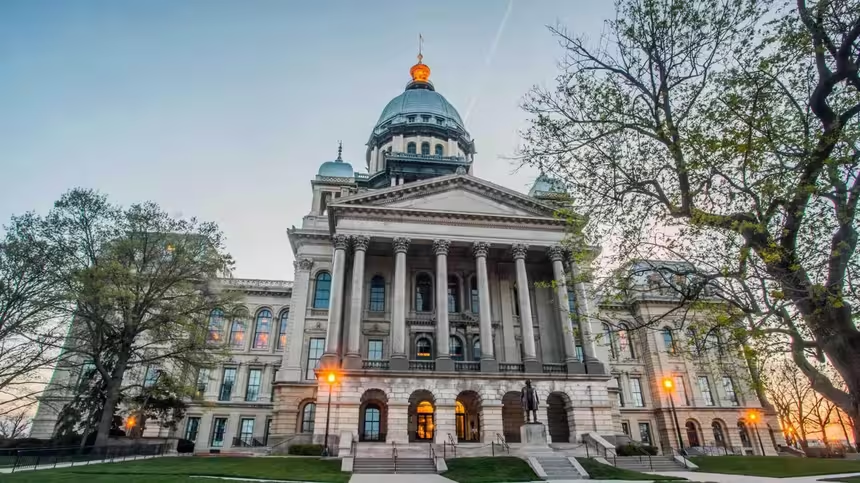
CapitolView
CapitolView is a weekly discussion of politics and government inside the Capitol, and around the state, with the Statehouse press corps. CapitolView is a production of WSIU Public Broadcasting.Providing Support for PBS.org
Learn Moreabout PBS online sponsorship(gentle upbeat music begins) (graphic blipping) (logo whooshing) (theme music) - Thanks for joining us on Capital View.
I'm Fred Martino.
It is a very busy week on this program because there is a lot of activity in Springfield as the session begins for the Illinois General Assembly.
Welcome to my guests, Kent Redfield.
He's Emeritus Political Science Professor at the University of Illinois Springfield, and Brenden Moore, State House Reporter for Lee Enterprises.
Kent, I want to start with you.
This week we are reading President Biden's budget proposal, which he previewed in last week's State of the Union.
And there is something in common with Illinois Governor J.B. Pritzker's budget proposal.
It's a focus on new corporate taxes and less burden for low and middle income families.
How important, Kent, would you say this is, this approach for Democrats in 2024?
- Well, yeah, they want the narrative to be that they're addressing problems and that there's a need for revenue and we're going to go about it in an equitable manner, which for Democrats almost always means a heavy concentration on taxing corporations and syntax or kinds of things, gambling, alcohol, cannabis.
And so there is certainly a similarity in terms of, of kind of what the message is.
Governor Pritzker is in a much better position, obviously being in a, a state that has an overwhelming democratic majority in his legislature.
Then he can...
He is likely to get a lot of what he is asking for.
Whereas at the federal level, we're trying to figure out this year's budget, in addition to supposedly starting a new fiscal year in October with a, a pretty dysfunctional congress.
And so there are some, there's some real differences in terms of the context.
To the specifics, the governor would like to increase what we're getting out of sports betting from 15% to I think 35%, which this is a new market.
There's a lot of sports gambling going on.
We're kind of looking for the sweet spot, and that's a couple of hundred million dollars.
And then it's a little bit of a sleight of hand in terms of what we're doing with corporate taxes.
There is a cap on the amount of losses that corporations can subtract against their bottom line in terms of the state corporate tax.
It's a hundred thousand dollars, the governor is, and it's supposed to expire at the end of the year.
The governor's proposing to raise the cap to 500,000, but then continue it.
And so if you leave things alone, then that's a reduction on what's happening on the burden that's on corporations.
If you adopt the governor's plan, it captures more than 800 mil, err, I'm sorry, more than $500 million.
And in terms of accounting, since you can't count a tax that's expiring against balancing the next budget, whether it's an increase or a decrease depends on how you want to frame it.
But it's a way that the governor is trying to ease into what are going to be some really difficult budget years because of - Yes.
losing a lot of federal funding involving COVID.
- Absolutely.
And Brenden, one key proposal in Governor Pritzker's budget is the elimination of the 1% grocery tax.
This would reduce local revenues, but in a news conference, the governor said, "You want a grocery tax, create a local tax."
What do you make of this?
And will this undoubtedly popular proposal to eliminate the state grocery tax pass in the general assembly?
- Yeah, this was a, politically, it was a great proposal from the governor because it eliminates, would eliminate a tax, which as you said is always popular.
And it kind of puts the opponents in a bind because it puts them against a popular political position of basically a tax deduction, or tax decrease of a tax.
But it remains to be seen if it will happen.
I think that there are gonna be, there's gonna be a debate about obviously the revenue that goes to municipalities and how to replenish that.
I think the governor's office would argue that municipalities can make up for it in other ways.
Obviously, they would say that this is essentially gonna be a backdoor tax increase because they're gonna have to find the revenue somewhere else.
But it kind of goes with the governor's, what he's been trying to do over the past few years in the sense of trying to eliminate some of these regressive taxes that disproportionately impact working people, poor people, because everybody pays the 1% grocery tax.
- Yeah.
- Few states that still has it so I think that in an election year, it'd be politically popular to eliminate it, but obviously the devil's gonna be in the details.
- And right after the State of the State, we talked with the Republican Senate Leader, John Kern, and he said he thought that this would pass.
Of course, the governor has said, "Look, when I temporarily eliminated the 1% grocery tax, Republicans told me, 'you should permanently eliminate this.'"
So here he, here is what he's proposing to do.
And like all of these proposals, I think they have to be seen in context.
Illinois has one of the highest sales tax rates in many places around the state because of the local tax on top of the state tax in the country.
Here in Southern Illinois we're talking about, in some places, 9.5% on the sales tax and 9.75% in some places.
So very high sales tax, very high property taxes.
So to eliminate a 1% tax, that as you pointed out, Brenden, is very rare to tax groceries, a necessity.
Something that we would expect would pass, looking at this from, regardless of how you feel about it, looking at this as a analyst, correct?
- Yeah.
If you put it up on the board, it's gonna pass.
I don't think there'll be any opposition because nobody wants to be on the record of supporting, or opposing a decrease, a removal of a tax.
But I do think there are gonna be discussions about, do we have to make municipalities whole?
Because last time that they passed the grocery tax, the temporary, the holiday on it in 2022, municipalities did get revenue to replace the lost revenue for that year.
- Mm-hmm (affirmative).
That's just not in the proposal right now.
And it'll be interesting to see if there is an effort to do that because certainly, every legislator's hearing from their mayors and their city managers right now.
- Yeah, and a lot of talk about this, and certainly we'll be covering it all the way through the session.
One of the things that, as you point out, affects everybody, Kent, proposals on the budget do come at what may be a very perilous time.
Moody Analytics recently issued its 2024 State Economic Forecast and said, quote, "Illinois is more vulnerable than other states to a negative shift in the national or global economy because of its lean financial reserves and heavy fixed cost burdens."
Tell us about this.
- Well, if you've been around since the mid seventies, which is when I got here, this is an old story.
The state budget has always been perilous in terms of trying to match expenditures with revenues.
Part of it has to do with our tax structure.
Part of it has to do with some, in retrospect, incredibly stupid decisions having to do with pensions and tax holidays and a bunch of other things.
And so from one perspective, if you look back to 2017, when we were spending a billion dollars a year paying interest on unpaid bills, we have come a long way.
But when we talk about having a couple of days worth of operating expenses in a rainy day fund, that doesn't look too good compared to states that have literally years of reserves in terms of their rainy day fund.
And so, you know, this is, we're gonna have about at least three really tough budgets.
And then, and I suspect the one after this will really be the one where we're going to make some hard choices.
It'll be a year before statewide elections for governor and we have to address a bunch of things.
The sales tax could be smoothed out if we were willing to tax services, like lots of other states around us do.
You could say, "Well, I'm gonna reduce the basic sales tax, but I'm gonna extend it to lots of things that involve, not retail purchases and services."
So there are ways out, but these are terribly hard choices.
And so it's, you're doing fine so far compared to where you were.
There are tough choices.
Again, the governor and the Democrats are fortunate to have large majorities.
They can do something and you hope for prudent, long-term solutions rather than getting to the next election.
- And if we do have a downturn in the economy, certainly there will be enormous pressure on everyone in government to look at reducing expenditures as opposed to increasing taxes as you know.
This really is still the story of the 2024 election in the fall, in that even though many folks have seen an increase in their wages, they are not feeling good about the economy.
Polls show that people feel, largely, many people feel negatively about the economy, and we're not even in what you traditionally will call a downturn in terms of economics, so this is perilous.
- Yeah, we really don't have a safety net and we have a revenue structure that doesn't respond well to recessions and downturns.
And so, you know, - Yeah.
we have the capacity to make good choices, but whether we'll do that or not because the good choices - Mm-hmm (affirmative).
involve a lot of pain and so we'll see.
- Yeah.
Yeah.
All right, very interesting.
Brenden, Governor Pritzker not only took a populist approach with some budget items, but also spent a lot of time talking about what he quote calls, "Predatory Practices," by health insurance companies.
This was a big part of the State of the State address.
A State House bill would address a variety of insurance practices and eliminate stripped down health insurance plans that do not meet the standards set in the Affordable Care Act.
Tell us more about this legislation and where you think it will go.
- Yeah, so the governor really did make that big part of his speech a few weeks ago, basically, as you said, going after some of these insurance company practices that are kind of meant to control costs.
One thing that he's targeting is basically, these methods that insurance companies use to steer their customers towards lower cost options.
One of them is going after what's called, "Prior Authorization Requirements," which basically means you must get permission in advance from the insurance company to receive a certain treatment recommended by a doctor.
The governor specifically proposed banning it for inpatient mental health care for both children and adults.
Illinois would be the first state in the nation to do that.
And the governor in his speech, I believe, referred to a patient who needed open heart surgery that was denied a prior authorization, just as an example of just how, I guess, awful some of these decisions can be.
And then he's also looking to end another one of these practices called, "Step Therapy," for prescription drugs, which is basically, a patient would have to try kind of a lower cost option before they get the medicine that was prescribed by their doctor that might be a little bit more expensive.
So those are a couple of the things.
Another thing I should mention too is, he's really trying to go after some of these so-called, "Ghost Networks," which are basically these insurance companies that have a whole list of doctors and specialists that are in their coverage area that can be, you know, patients can utilize, but oftentimes, it's not accurate.
And you've seen them, - Yeah.
especially down here in Central Illinois, with Blue Cross and Blue Shield, they've been fined a few times for not keeping an up to date network.
So those are a few of the options the governor in the capitol this week is pushing some of those proposals.
There's been some subject matter hearings on them, so... And again, as you said Fred, they're very populist, so he'll have a big fight from the insurance companies, no doubt.
But some of these are pretty easy to explain to voters and I think he'll probably have a sympathetic ear among legislators in the Democratic super majority on this.
- Sure.
And have directly affected a lot of voters.
They've been, they've experienced this firsthand, where you're questioned or denied a certain drug when you go to pick up what your doctor has prescribed at the drug store, or you need to get prior authorization for something your doctor says, "You need this."
It's very interesting stuff.
Wanna move on.
We're quickly running through our time today.
Kent, we are getting ready for the state's primary election, of course next week.
And voters in Southern Illinois have seen lots of TV ads by Republican Congressman Mike Bost, who is facing a primary challenge from former state lawmaker and GOP candidate for governor, Darren Bailey.
One poll shows that that race is fairly tight with Bost up by six points.
What do you make of this race and really the national effort to challenge Republicans in primaries?
- Well, as to the specific race, the polling at this point doesn't reflect completely the fact that former President Trump gave an endorsement to the incumbent Mike Bost.
And Darren Bailey, the challenger, had worked very hard to try and get, if not the endorsement, then a neutral stance from the former president.
So this is going to boost Bost.
The other advantage that he has is incumbency.
And he has represented a large part of that area, one in the district under the new map.
Now Darren Bailey has high name recognition from running for governor, and is certainly popular in that part of the state.
But if the dynamics, the result of all of that, is that Bost is able to raise money and Bailey is not.
And so I suspect that Bost is going to be fine because he's going to be on the air.
He's going to be able to spend the money and whatever percentage of the people had they in the poll who didn't know that the president had endorsed the campaign, will make a huge effort to make sure that those people become aware... - Real quickly, Kent, the national impact on this movement.
A lot of Republicans not even running for reelection, some really high profile ones around the country who said, "I'm out, I'm done," don't want to be primary, don't want to go through this.
Does it push our politics more and more to the extremes?
- No, absolutely.
With the redistricting, - Yeah.
one state favors the Democrats, the other state would favor the Republicans that drive...
Whenever you do redistricting from partisan standpoint, you drive, you lower the amount of competition that makes the primary, the election.
And so Democrats get primaried from the left.
Republicans get primaried from the right.
Illinois, - Yeah.
we're replacing one Republican potentially with another.
This doesn't affect the overall picture, but the overall dynamic absolutely leads to more polarization, less competition.
- Yeah.
It's really interesting and something that we'll probably spend after the election, an entire show on talking about 'cause there's so many great examples.
Brenden, I wanna move on now to this.
It seems that everyone agrees that Democrats nationwide should focus on reproductive rights, that it is a losing issue for Republicans.
Now, democratic Illinois lawmakers are proposing ways to protect or expand IVF, in vitro fertilization.
Tell us more about this.
- Yeah, so obviously, post Dobbs, the decision that ended the constitutional right to an abortion, the Supreme Court decision in 2022, we've seen a lot of these cases where some of these rights people thought they had are getting stripped away.
We saw that at Alabama Supreme Court, ruled that a realized egg is a person, and that threw IVF into the chaos there.
And it's just kind of the latest in this national effort to really make, for Democrats to make abortion rights a issue in the 2024 campaign.
Just kind of highlighting that this could happen in other places and probably not in Illinois because Illinois has very strong protections for reproductive rights.
But I do think you'll see an effort in the State House to further codify that.
There is a reproductive working group in the state capitol that's working on some more, I guess, some legislative options for perhaps protecting the right to IVF in Illinois.
But obviously, it's not in any danger here of being taken away.
- [Fred] Yeah, but it may not hurt in terms of activating voter turnout for sure.
- Right.
Well, look what we saw in 2022 that abortion and reproductive rights in general were a huge driver to the polls for Democrats, and they are doubling down on it.
President Biden dedicated a very significant part of his speech to reproductive rights in the State of the Union a few weeks ago, or last week.
And obviously, it's been a big issue for Democrats all across.
Look at Governor Pritzker, who's going around the country right now as part of his, his action group to promote reproductive rights.
They think this is a winning issue.
And quite frankly in this post Dobbs political environment, we haven't seen any evidence to the contrary that it won't drive out Democrats.
- Yeah.
And unlike so many issues where it is just speculation, with this one, we actually have elections to turn to where in so-called, "Red states," when voters are asked about this issue in various ways, they support reproductive rights.
I've only got two minutes left, and Kent, I wanted to get to this topic.
Free speech is always a hot button political issue.
And unions are backing a measure to protect Illinois employees who skip religious or political work meetings.
Probably a lot of people didn't even know such a thing was occurring, but it is, I guess.
So what did you learn about this bill?
- Well, it's, and on the face it's fairly narrow.
We're talking about, if your employer has a meeting that isn't really work related and then you don't go and you get penalized for not being a team player.
But it reflects the post 2022 environment in Illinois where we passed a workers' rights amendment dominant democratic legislature.
And so you're gonna find labor being very, very aggressive.
And so this isn't the biggest deep issue in the world, but they are going to be very aggressive to press the advantage that they got out of the last election.
- And we should be fair about this.
If this happens to you in your work, where as part of your work you're forced to go to a meeting that you would say is not essential or even possibly connected in any way to your work, that is something you don't forget.
If you've ever experienced that, and many workers experience this when there's a vote coming up on authorizing a union.
So that they're forced to go to some sort of meeting that unions would call propaganda.
Interesting stuff.
We are out of time.
Kent and Brenden, thank you for joining us.
And thank you as well for being with us at home.
For everyone at WSIU, I am Fred Martino.
Thanks for being here.
Have a great week.
(theme music) (theme music continues) (theme music fades)

- News and Public Affairs

Top journalists deliver compelling original analysis of the hour's headlines.

- News and Public Affairs

FRONTLINE is investigative journalism that questions, explains and changes our world.












Support for PBS provided by:
CapitolView is a local public television program presented by WSIU
CapitolView is a production of WSIU Public Broadcasting.