
Capitol View - March 21, 2024
3/21/2024 | 26m 46sVideo has Closed Captions
Capitol View - March 21, 2024
CapitolView Thursdays at 7:00pm. It’s the only weekly prime time broadcast television program devoted to the Illinois General Assembly. This week, in-depth coverage of the primary election. Plus: Changes could result in thousands of immigrants losing health insurance in Illinois. Analysts include Peter Hancock of Capitol News Illinois and Jeremy Gorner from the Chicago Tribune.
Problems playing video? | Closed Captioning Feedback
Problems playing video? | Closed Captioning Feedback
CapitolView is a local public television program presented by WSIU
CapitolView is a production of WSIU Public Broadcasting.
Capitol View - March 21, 2024
3/21/2024 | 26m 46sVideo has Closed Captions
CapitolView Thursdays at 7:00pm. It’s the only weekly prime time broadcast television program devoted to the Illinois General Assembly. This week, in-depth coverage of the primary election. Plus: Changes could result in thousands of immigrants losing health insurance in Illinois. Analysts include Peter Hancock of Capitol News Illinois and Jeremy Gorner from the Chicago Tribune.
Problems playing video? | Closed Captioning Feedback
How to Watch CapitolView
CapitolView is available to stream on pbs.org and the free PBS App, available on iPhone, Apple TV, Android TV, Android smartphones, Amazon Fire TV, Amazon Fire Tablet, Roku, Samsung Smart TV, and Vizio.
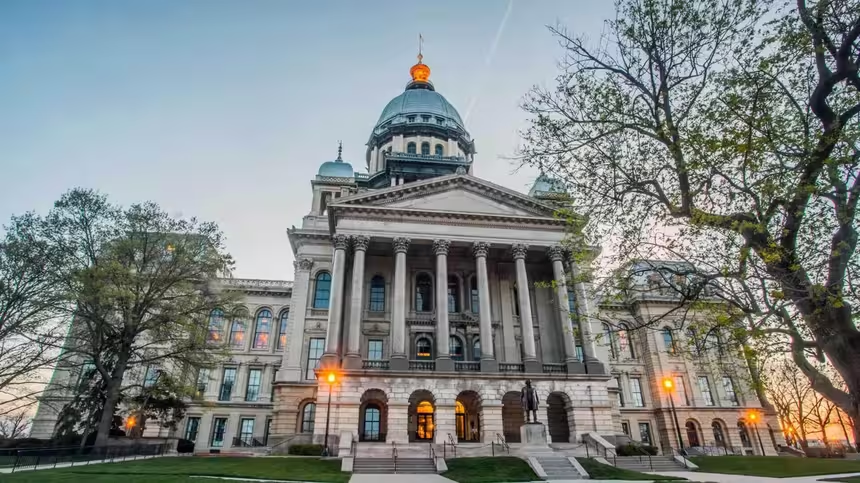
CapitolView
CapitolView is a weekly discussion of politics and government inside the Capitol, and around the state, with the Statehouse press corps. CapitolView is a production of WSIU Public Broadcasting.Providing Support for PBS.org
Learn Moreabout PBS online sponsorship(lively music) (electronic beeps) (whooshing graphics) (lively music) - Thanks for joining us on "Capitol View."
I'm Fred Martino.
It's another extremely busy week in Illinois politics.
We'll have all the highlights from this week's primary election, plus a variety of other stories including two major developments in the immigration crisis, evictions from shelters in Chicago, and it is estimated that thousands could be removed from a special Illinois healthcare program for some immigrants.
Welcome to my guests, Peter Hancock of "Capitol News Illinois," and Jeremy Garner from the "Chicago Tribune."
Peter, you covered the race between Darren Bailey and incumbent representative, Mike Bost, for the Republican nomination in the 12th congressional district.
Let's start there and then talk about the other federal races in Tuesday's election.
- Okay, this is the Southern Illinois District where during redistricting a couple of years ago, two districts were merged into one because of the population loss in Southern Illinois.
So you have Mike Bost, which is kind of on the west side of the southern tip of Illinois, and you have this district on the east side that used to be held by Mary Miller.
And you have these two pro-Trump Republican candidates, Mike Bost, who's kind of a longtime incumbent, and Darren Bailey, a former state legislator.
And this drew a lot of attention because they're both pro-Trump Republicans.
Trump did endorse Mike Bost during this campaign, but he endorsed Darren Bailey a couple of years ago when Bailey ran unsuccessfully for governor.
And it looks as though Mike Bost is going to edge out Darren Bailey, although the vote seems to have split right down that line between his old district and Mary Miller's old district.
Bailey seems to have carried the counties on the eastern side of the district.
Bailey may be one of those candidates who kind of let his ambition and his ego get ahead of him.
This is a guy who served one term in the House, he served two terms in the Illinois Senate.
Before his seat in the Senate was even warm, he was already announcing for governor.
He was suing JB Pritzker in court over his COVID-19 mitigation orders, really kind of making a name for himself in that libertarian conservative Republican sort of space.
And he may have peaked out in the Republican primary a couple of years ago.
He did win the nomination in a pretty crowded field of candidates, but then he lost, really got beat pretty soundly by JB Pritzker in the governor's race and now appears to have lost this congressional race.
- Absolutely.
Other federal races you want to highlight there, Peter?
- Yeah, up in the Chicago area, a long time incumbent, Danny Davis, in the 7th District, he appears to have survived from challenges from two up and comers.
And I thought what was interesting about this is the parallels between his race and the problems that President Joe Biden is having in the Democratic party.
Danny Davis is like 82 years old.
He has been in elective office since the Carter administration.
If you look at his voting record and his position on issues, he is probably perfectly aligned with the sentiments of the district he represents.
But he's 82 years old and there are a lot of people who are thinking, you know, it's time for some new blood.
So he seems to have won that, won reelection against these two challengers.
Melissa Conyears-Ervin, who's the City Treasurer of Chicago, and Kina Collins who describes herself as an activist (audio cutting out) and community organizer, but he only got about 53% of the vote, which means nearly half of the Democratic voters in his district are thinking it's time for a change over there.
And I think that shows you also kind of the dilemma that President Joe Biden is in right now.
- Very interesting stuff.
And as you can tell by Peter's answer there, we are taping this program on Wednesday, that's required because we send it out for closed captioning to air on television on Thursday nights.
Jeremy, you previewed primary races in the General Assembly.
Let's talk about the results that you want to highlight from Tuesday's election.
- So, the story of the General Assembly races is you have Speaker Chris Welch who is putting in, you know, he's leading an effort for all this money to be put into an opponent, to Mary Flowers, who is the Dean of the General Assembly.
She's been in the state legislature since 1985.
She's been on the outs with Welch.
Welch had accused her of some inappropriate behavior during caucus, as well as, you know, saying that a staffer in the House Democrats whose head resembled Adolf Hitler.
Obviously, that had really, you know, disappointed Welch, really upset him.
And he'd put in a lot of money into Mary Flowers as a opponent, who won pretty convincingly.
Michael Crawford, he's the Dean of the Chicago School, which is a private college in Chicago.
And on the other side of that, you have Senate President Don Harmon, who poured in a lot of money to incumbent Natalie Toro so that she could try to keep her seat.
And she ended up losing to Graciela Guzman who was a healthcare advocate.
She was a former staffer for Toro's predecessor in the Senate, Cristina Pacione-Zayas, who ended up moving on to work for Mayor Brandon Johnson as his Deputy Chief of Staff.
So the real story is, would the money that Welch and Harmon are pouring into the races make a difference?
Well, for Welch it clearly did.
I mean especially up here in Chicago, there were, you know, Mary Flowers was just inundated with commercials against her, you know, in favor of her opponent, Michael Crawford.
Whereas, you know, as far as all this money, these Harmon-led efforts to, you know, to contribute to Toro's campaign, really did not make a difference.
And Guzman ended up winning there.
So those are really the two main races that we saw last night.
And then you also have on the southwest side of the city, Kelly Burke who has been in the House for more than a decade, is stepping down.
Rick Ryan, an Evergreen Park attorney, defeated Sonia Khalil in that race.
Rick Ryan was backed by Kelly Burke.
So that was really, you know, another big race.
- Okay.
Very interesting stuff.
And, you know, we should point out as well that the "Chicago Sun-Times" is saying that turnout in the primary election was historically low, even looking at maybe going back to World War Two.
And so as we talk about the pending results here, we also need to put that context in mind that turnout is always, almost always, low in primaries.
Maybe with this primary, extremely low.
Peter, I want to move on to you now for a non-election related story.
Governor Pritzker making history this week.
He announced that a person of color will lead the Illinois National Guard for the first time.
There was also a retirement announcement connected to that.
Bring us up to date.
- Okay, yeah.
This is one of the prerogatives of being a governor is that you get to pick the commanding officer of the National Guard.
And, you know, when Pritzker first came into office, he chose General Richard Neely.
And Neely is now retiring, I believe.
And so he has made a new pick and it's the first person of color.
And, you know, I just think this is kind of emblematic of the changes that are happening in the military generally.
You know, in Washington right now, we have the first African American Defense Secretary.
You know, ever since Harry Truman desegregated the military back in the, what was it, 1940s, African Americans and people of, you know, other minorities, women, Hispanics, have been moving up in the ranks.
And I just think, you know, it's the kind of thing we probably should have seen many years ago, but we're just now seeing it now.
- Okay, again, a very historic announcement and something that we will continue to highlight as we see those come about.
Jeremy, this past weekend, this is a story we talked about at the beginning of the show that we would be telling folks about.
Evictions were scheduled to begin this past weekend at Chicago shelters housing immigrants.
Of course, tens of thousands of immigrants have been sent to Chicago over the last year, mostly from Texas.
This also, it comes with the knowledge from this week's primary election that at this time on Wednesday, it appears that a ballot measure in Chicago to help folks who are unhoused, it appears that it failed.
It would have been a one-time tax on real estate valued at more than $1 million.
So thoughts on this, Jeremy, both the evictions beginning now and the failure, it appears, of a measure to address homelessness in Chicago.
- Yeah, so basically you're talking about the Bring Chicago Home referendum.
As of right now, we're seeing about 54% of voters against the referendum.
It needs over 50% to pass.
So this does not, so basically this looks like a pretty stinging defeat for Mayor Johnson.
This was, you know, one of the cornerstones of, you know, his agenda as mayor for his grassroots base.
You know, basically, you know, seeking to persuade voters to grant this new tax increase to address the homelessness crisis.
And basically what this tax would do is that you would, you know, like you said, you would see a tax hike on commercial properties.
I believe it was over a million dollars.
And, you know, where if it's under a million dollars, you would see it would be slightly less.
But in the end, you would see around a hundred million, this pot of money of a hundred million dollars that would go towards affordable housing and to address the homelessness crisis.
But, you know, obviously opponents of it were worried about how this would, you know, affect commercial properties, especially since we've seen a lot of them take a hit with vacancies and whatnot, you know, ever since the COVID-19 pandemic.
So that's- - Sure!
The hybrid and the remote work arrangements are not going away and less office space needed.
So it will be interesting to see when we look at the final vote on this, how that shaped up and any kind of exit polling, if any, occurred on why people voted the way they did quickly.
Evictions scheduled to begin this past weekend.
- Yeah.
- This has to be very worrying for Democrats and the governor with us looking at the Democratic National Convention this summer and this continuing problem in Chicago.
- Yeah, so we were supposed to see, you know, so obviously Sunday was this, this past Sunday, there was gonna be a 60 day limit for migrants to stay in temporary shelter.
And Brandon Johnson basically had doubled down on that deadline last week.
But in the end what we saw is that, you know, 34 migrants were scheduled to leave on Sunday and this was supposed to happen at three different shelters.
But what ended up happening is we only saw something like three out of- (audio cutting out) - Okay, I think there is an internet issue with the feed for Jeremy there.
Hopefully we can get him back.
Jeremy, we were having some problems hearing you.
So it turns out that the evictions were less than expected.
- Because of disability and pregnancy from the state for housing and, yeah, for housing and other protections.
And Cristina Pacione-Zayas, Johnson's Deputy Chief of Staff, had basically explained that this is a ever-evolving fluid situation.
And this seems to be the story of, you know, this whole situation.
(audio cutting out) - Yeah, very interesting.
We will certainly keep watch on it and hopefully we'll get a better signal there for you.
We did have some breakup in your answer there, but the bottom line is, not as many evictions yet as expected in Chicago.
Peter, I want to move to you now.
Governor Pritzker spent a good deal of time during his State of the State Address on proposed health insurance reforms.
You recently covered the first legislative hearing on those reforms.
Tell us about it.
- Yeah, the governor is proposing a couple of changes to the state's health insurance laws.
And he's packaging these and kind of selling them as consumer protection issues.
And they're the kind of issues that I think almost anybody who has health insurance has probably dealt with at some point.
One is called Step Therapy and he wants to do away with this entirely in the state of Illinois.
And that's the practice of your insurance company.
You know, if your doctor prescribes a certain medication, your insurance company might say, "Well we want you to try this lower cost generic first.
Let's make sure that that's an ineffective treatment.
Then, you know, we want you to try all these other lower cost alternative medications before we go to the one that your doctor actually prescribed."
And this gets to be a real problem for people who change jobs, who change insurance coverage.
You know, you go to a new insurance company and then all of a sudden they make you start all over again.
And a lot of times, you know, these are maintenance drugs, they're the medications that people have to take their entire lives.
It sometimes takes a considerable amount of time for somebody to get the medication that they need.
And so it's a big inconvenience.
The other one is called Prior Authorization.
And this is where your insurance company says, "We won't cover a particular treatment or a particular therapy unless you call us in advance and get prior authorization."
And they want to do that, get rid of that for inpatient psychiatric care.
There have been some horror stories of people trying to get into a hospital or trying to get their loved one into a hospital because of a mental health crisis and the insurance company is saying, "No, we don't think that's acute.
We think you can treat that with outpatient therapy" or whatever.
So, that's something else that the governor wants to get rid of in Illinois.
And so I think, you know, the insurance companies are gonna be pushing back on this, but the healthcare, you know, the provider sector, the doctors, the hospitals, the clinics are very much in favor of it, it would seem, you know, for right now.
So we'll see how far this gets.
- It will be interesting to watch because anyone who saw the State of the State Address, which you can see on WSIU's YouTube channel or on the PBS portal, including analysis that I did with John Jackson of the Paul Simon Public Policy Institute, that Governor Pritzker was really fired up about this.
And he spent a great deal of time talking about these health insurance reforms, which we were learning about real-time during the speech because we didn't have a lot of advanced notice on this.
And then we now see it playing out in the General Assembly.
So it'll be fascinating to see what passes, if anything, during this session.
Jeremy, speaking of health insurance, Republicans, as you know, have called for Governor Pritzker to end the health insurance program for some immigrants.
You recently reported that new guidelines on that program could cause about 6,000 immigrants to lose coverage.
Tell us about that.
- Yeah, so beginning in May, we could see as many as 6,000 recipients from the state-funded immigrant healthcare programs lose coverage.
But this is a group of individuals who are legal permanent residents.
So they have Green Cards.
They have not been in the country for quite five years yet.
After five years they're, you know, obviously eligible for other subsidized health insurance.
But that 6,000 group, obviously it's a measure by Pritzker to cut costs with the program.
We saw that this was a divisive issue for Pritzker in the General Assembly during the waning days of the spring session, right?
Where last year, Pritzker had projected $220 million to go to this program.
And then there were projections that it would cost over $1 billion.
And then the compromise to end, you know, to adjourn session last year, you know, pegged that program at $550 million.
So it was a program that proved to be a real financial liability for the governor and it's really a way to reign in costs.
Now from the General Revenue Fund next year, he's proposed less money than he has last year, although there could be more, there could end up being more money because of a federal match on emergency services and whatnot.
But still, you know, for this current budget, you know, the governor is really trying to do anything he can do to kinda cut costs for this program.
And basically what you're gonna see is that this program's gonna be subject to redeterminations, which has, they've never been, this program's never been, which obviously is when every year there's the evaluation period on who's eligible for certain healthcare benefits.
This program has never been subject to that before.
So this is gonna be the first year for that.
So obviously we're seeing, and, of course, we're seeing a lot of uncertainty from healthcare advocates.
Also in the Latino Caucus, there's a lot of uncertainty because this is affecting their constituents from, or, you know, and their community greatly, so it's- - And just another reminder of the larger issue, which is that not just in Illinois but all around the country, healthcare remains an extremely difficult issue for state, local, and federal government.
And it will continue to be part of our political discussion, as on one side, folks are looking at promoting something like Medicare for all, as it's called, and then on the other side, other folks who want to increase privatization, which means restrictions on care and higher cost, much higher than the increase in inflation in many, many cases.
So something that just will not end.
- Right, and one thing I'd like to add to that too is because of just the, you know, the tension that this issue has caused.
This program is separate from any kind of benefits going to asylum seekers coming to Chicago from the southern, being sent here from the southern border.
You know for that effort, which includes, you know, housing, job training, what have you, you know, job authorization and healthcare, that's a $182 million effort that Pritzker is proposing for the next budget.
So clearly, I just wanted to say that to illustrate that there's a lot of, you know, spending pressures here, you know, a lot of budgetary pressures rather that the governor is feeling here.
And this, you know, cutting the 6,000 from the immigrant healthcare program is just one way of trying to ease that pressure.
- Yes, and we should say 6,000 people.
Up to 6,000 people.
- 6,000 people.
I apologize.
Yes.
- Right.
Very interesting.
All right, I know we have time for at least one more story.
Peter, a former Democratic Illinois governor has endorsed a Republican proposal that would allow citizens to petition for ethics-related constitutional amendments.
You have information on this, tell us about it.
- Yeah, former Governor Pat Quinn, who was known for being kind of an independent voice, that just little bit of a maverick on all kinds of issues, has gotten behind a Republican plan that would change the Constitution.
You know, it's kinda, it's a populist tool that sort of dates back to the turn of the last century, allowing citizens to bypass their legislature to enact constitutional amendments or legislation on their own.
Illinois has a very limited avenue for that.
Citizens can initiate a constitutional amendment in very limited areas.
And this would kind of expand that so that they could propose constitutional amendments dealing with ethics issues.
Governor Quinn, who proposed ethics legislation when he was governor but was kind of blocked by the legislature at that time, has gotten behind this Republican proposal.
But as we've seen, you know, really since Republicans have had supermajorities in both chambers or since Democrats have had supermajorities in both chambers for the last several years, Republican ethics proposals don't tend to go very far.
- (chuckling) And so you, it sounds like this is probably dead on arrival, is what you're saying?
- Probably so, but it allows Governor Quinn to keep his name out there in the public view.
He's still kind of an elder statesman of the Democratic party and I think is still a relevant voice in a lot of ways.
- Yeah.
Interesting stuff.
All right, well always fun talking to both of you, Peter, Jeremy, thank you both for being with us.
And get some sleep now that the election is over, right?
- That's right.
- Yeah, pretty much right.
(panelists chuckling) - Have a good one.
Thank you for being with us at home.
For everyone at WSIU, I'm Fred Martino.
Have a great week.
(lively music) (lively music continues) (lively music continues) (lively music continues) (lively music continues)

- News and Public Affairs

Top journalists deliver compelling original analysis of the hour's headlines.

- News and Public Affairs

FRONTLINE is investigative journalism that questions, explains and changes our world.












Support for PBS provided by:
CapitolView is a local public television program presented by WSIU
CapitolView is a production of WSIU Public Broadcasting.