
Capitol View - March 24, 2023
3/24/2023 | 26m 46sVideo has Closed Captions
Capitol View - March 24, 2023
Illinois lawmakers are working feverishly towards their scheduled Spring Break, so bills are passing out of each chamber at a rapid pace. A look at the action, along with updates on the federal corruption trial that’s bringing Michael Madigan back into the headlines, and more.
Problems playing video? | Closed Captioning Feedback
Problems playing video? | Closed Captioning Feedback
CapitolView is a local public television program presented by WSIU
CapitolView is a production of WSIU Public Broadcasting.
Capitol View - March 24, 2023
3/24/2023 | 26m 46sVideo has Closed Captions
Illinois lawmakers are working feverishly towards their scheduled Spring Break, so bills are passing out of each chamber at a rapid pace. A look at the action, along with updates on the federal corruption trial that’s bringing Michael Madigan back into the headlines, and more.
Problems playing video? | Closed Captioning Feedback
How to Watch CapitolView
CapitolView is available to stream on pbs.org and the free PBS App, available on iPhone, Apple TV, Android TV, Android smartphones, Amazon Fire TV, Amazon Fire Tablet, Roku, Samsung Smart TV, and Vizio.
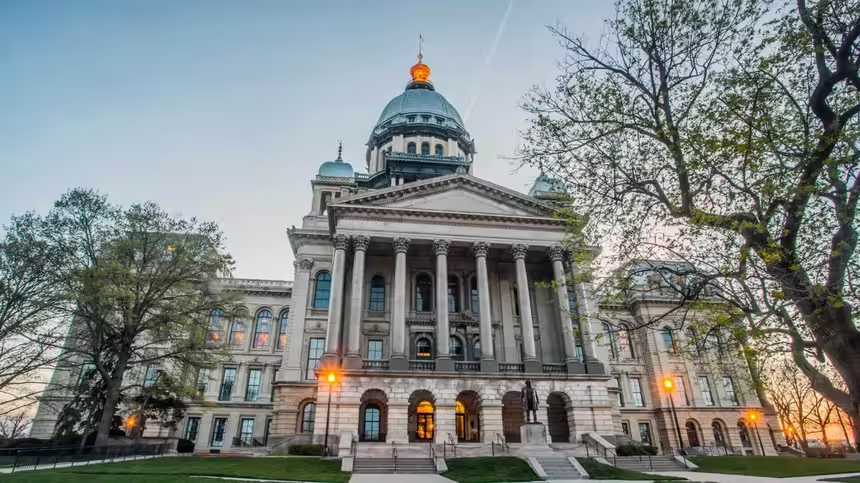
CapitolView
CapitolView is a weekly discussion of politics and government inside the Capitol, and around the state, with the Statehouse press corps. CapitolView is a production of WSIU Public Broadcasting.Providing Support for PBS.org
Learn Moreabout PBS online sponsorship(poignant music) (serious music) - Welcome to another edition of Capitol View, our weekly look at the happenings inside and outside the Illinois State Capitol.
Our guests this week are Peter Hancock of Capitol News Illinois, and Brenden Moore from Lee Enterprises.
Gentlemen, thanks for joining us during a very busy week.
- Good to see you, Jen.
- Glad to be here, Jen.
- You know, we spend a lot of time watching the legislature, but a lot of the news over the last week or two and what we expect over the next several weeks is coming out of the city of Chicago, and particularly the Federal CourtHouse there.
Lots of revelations in the trial of what's being called the CommEd four, four executives of Commonwealth Edison that are accused in a bribery scheme that includes former House speaker Michael Madigan.
Now, he has been indicted, but is not a part of this particular trial.
His trial is set for some time, probably next year.
But you know, Peter, what are we hearing so far from this trial and what are your big takeaways?
- Well, it's been very confusing.
There are a lot of characters involved in this but basically has to do with what we've been talking about now for months and years, is the idea that Commonwealth Edison was giving jobs, internships sometimes no work jobs or little work jobs to associates of Michael Madigan in order to curry his favor for legislation that would benefit Commonwealth Edison.
The way the case is being presented right now, I mean, I'm on the outside, I'm not in the courtroom every day.
It's hard to tell if they're trying to make the case that Commonwealth Edison was bribing Mike Madigan or if Mike Madigan was shaking down Commonwealth Edison.
There seems, and of course Madigan goes on trial himself about a year from now, next spring.
So they are related cases, but it really kind of paints a very unseemly picture of how the lobbying business and the legislating business in Springfield was being conducted under Madigan's regime.
- Brenden, what are you seeing in and around the capitol as in terms of reaction to what's being said in the courtroom?
We actually heard this week about a couple of, well a former state lawmaker and a current state lawmaker former state representative Art Turner, current state senator Elgie Sims.
Does this change at all the work that's being done or cast appall over the work that has been done.
- So far, it really hasn't.
It's been a very busy week down here in Springfield.
It's deadline week in the House so they've just been getting bills out.
You don't really hear people talking about the CommEd or trial down here, but it is a bit of a cloud because as you said, Jen, I mean you have, as Peter alluded to, there's this whole cast of characters that have been brought in over the past couple of weeks that this trial has gone on.
We heard from, you know, former state reps Scott Dreary and Carol Santi, and earlier this week we heard from current state rep Bob Rita, who was on Madigan's leadership team, is still on speaker Chris Welch's leadership team.
He was presiding over the chamber last week, and so he does that and then he goes up to Chicago and he testifies.
So there are a lot of those connections there, and what they really did was kind of paint a picture of, again, how things worked under Madigan's tenure as House speaker, both in terms of obviously the lobbying aspect and the CommEd side, but also just how Madigan ruled his House Democratic caucus.
The phrase that Representative Rita used was "Through fear and intimidation," and obviously this is not really news to any of us who have been around the capitol for any small period of time.
I think it was kind of known, but for it to be said in public and open court I think really kind of crystallizes that and really kind of adds some significance that you know, these are the people that work closest to the former House speaker and they're not painting a very flattering picture of him or how things worked under this building when he was ruling it.
- Well, let's drill down on this just a little bit more.
You know, you both bring up the fact that Speaker Madigan, former Speaker Madigan, I should say, is not on trial in this particular trial, still a year away, but he's front and center in what's being said in terms of how the legislation, how the legislative process worked and how in in particular some of these other agreements and in some cases bribes may have worked.
Peter, Illinoisans are no stranger to corruption, to accusations of corruption, to accusations like this, and to federal trials like this involving leaders throughout the state of Illinois.
But we've talked about this in the past.
Is there a numbness?
Do people now just see this as the cost of doing business in Illinois?
- You know, that's an interesting question.
I was gonna say, I kind of agree with Brenden in the fact that you don't hear a lot of talk about it in the State House, and I just get the sense that people have moved on.
Mike Madigan has gone, you know, if you were here in 2020 and early 2021, that's all people were talking about because he was seeking another term as speaker.
All the while these revelations were coming out, documents were coming out in other cases in which Madigan was being implicated, and it got to the point where his own Democratic caucus in the House couldn't support him anymore.
He couldn't win another term.
And so that's all you heard about in like the fall of 2020, winter of 2021, was getting Mike Madigan out of the House.
Well, he's gone now and so are a lot of other people who were around him at the time and I think new people have moved in.
It's kinda like the old saying, you know if you pull your fist out of a bucket of water there's no hole in the water where your fist used to be.
You know, it just closes in and people move on and I think that's kind of what's happened in the State House.
What's happening among the general population, I couldn't really tell you.
I know Republicans certainly try to make an issue out of it at every turn, but it just never seems to really catch fire.
I just think really in terms of the current state of politics in Illinois, people have just moved on from it.
- And Madigan was- oh, please go ahead.
- Oh, I'm sorry, Jen.
Just to add on what Peter was saying though, I mean to his point, we had an election in November where House Democrats gained seats.
I mean, they gained a net of five seats despite the looming trial, despite Madigan being indicted last year despite republicans trying to make an issue of it.
So it clearly has not resonated in the way that maybe some thought it would, some people, you know say that people moved on and now we have a House where you, quite frankly there's been a lot of turnover over the past, even just the past couple of years, there are a lot of members that never served when when Mike Madigan was the speaker, which is crazy to think about because he was speaker not that long ago.
But, you know, speaker Welch likes to say "It's a new day in Springfield," you know whether it is or isn't is up for debate.
I mean, I guess it is in some ways.
Still the same in some other ways.
But yeah, I mean, (stuttering) there's not a lot of reflection on tenure former speaker.
People have moved on in the building.
- Well, before we move on from this particular thing I wanted to have you each kind of gaze into that crystal ball because as we have said, Mike Madigan is expected to go to trial around this time next year, and if you check your calendar, that's around the time of the primary and it'll be a presidential primary, so great turnout.
Do the Republicans have any ground to stand on in saying, "I told you so.
Mike Madigan was a problem.
Look, here he is on trial."
Do you think that'll impact the 24 election?
Brenden, I'll start with you on that one.
- You know, I'm skeptical because we saw this last year where the Republicans tried to make an issue out of, they tried to make an issue out of Mike Madigan for years and years and years and it never really resonated, or at least it never hurt the Democrats in terms of them losing control of the House or losing elections because it may be on the periphery, but it never became the issue that some of these other issues, whether it's crime or economy inflation are.
Perhaps it, maybe it'll be different if some of the tapes come out and people hear Mike Madigan's voice, maybe a similar effect to say when Rob Blagojevich was arrested and they played the tapes verbatim, on a loop, and that may have had an impact.
So maybe that has an impact.
- Peter, what say you?
- I would agree with that.
I think a presidential election, especially if there are contested primaries in both parties that's really gonna drown out a lot of state news.
It's gonna be hard to get, that's just gonna suck all the oxygen out of the room.
And you know, I think to Brenden's point, how this issue has never really resonated in terms of elections, of course Democrats have been in charge of redistricting for a long time, and so they've drawn the districts that they want.
But you know, you just don't see that many competitive races in Illinois anymore.
Chicago and much of the suburban area is solidly democratic.
Big swaths of downstate Illinois are solidly Republican and you know, I think the public has just kind of, they've picked their sides and given the population of Illinois at least, you know unless something dramatically changes in the next few years, it's gonna stay that way for a while.
- Well, let's talk a little bit Peter about how things have changed with a new speaker in the Illinois House, new leadership across the board in both chambers.
In the past, speaking of Michael Madigan, we would've seen him quietly guiding legislation whether it was through committee into passage into the Senate, or perhaps to a rather obscure committee where it would languish through the rest of that general assembly session.
How are things different now with Chris Welch?
What are you seeing in terms of teamwork across the aisle or bills being allowed to get a hearing, maybe without him having full support?
- You know, things are a little bit different.
I think that Speaker Welch is still trying to get his footing a little bit.
Mike Madigan, you know, for all of his faults and whatever you wanna say about him, he really had this knack for knowing when to let the horses run and when to pull back on the reigns.
And that is an art of leadership that takes a long time to develop.
I wasn't around during most of Madigan's tenure but what I'm told is he had some pretty strict rules.
If you were a freshman legislator for example, he might let you introduce three bills and that was your limit.
Speaker Welch doesn't believe in that.
He's letting people introduce as many bills as they want and as a result, we've had over 6,500 bills introduced, and they're moving through them just as fast as they can.
This week is a deadline week in the House when most bills theoretically have to, House bills have to leave the House, and then next week there's a deadline for Senate bills to leave the Senate.
There are lots of ways to get around that, but for the most part, if you just have kind of a run of a mill bill, if you don't get it out this week then it's probably not ever going to get out unless, you know, they give it an extension or you manage to get it put on as an amendment to some other bill.
So, you know, they're just, the House I think yesterday they met for like five or six hours.
They're just working through, you know bill after bill after bill, moving 'em out.
And so it's just kind of the assembly line process of legislating right now.
- Sure.
Brenden, what stands out to you of those 6,500 bills?
And I'm sure you know, you've not read all 6,500, but quite a few that have passed.
What stands out having passed or that's perhaps sitting and waiting for a vote?
- Yeah, so there were, yeah, I would, I guess 6,500, I haven't checked lately to see all the bills that were filed, but we had a few weeks ago committee deadlines where you had to get the bills out of committee in the House and the Senate, and now as Peter said, there's a deadline next week to get them out of the House and then next week out of the the Senate into the other chamber.
And so we saw kind of the whittling down, if you will, of some of those bills.
You know, previous question was about how things have changed under Speaker Welch versus Speaker Madigan.
Well, speaker Madigan would bottle a lot of things up in the rules committee.
Speaker Welch has let a lot of other things get out and get into committee, which, you know, is, you could say maybe more democratic process, but they still have to whittle down bills 'cause there's only so much bandwidth they have to deal with so many bills.
So I believe maybe three or 400 House bills got out, something like that.
And so that's kinda what they're working, the playing field they're working with right now.
So yesterday alone the House passed out 101 bills.
Previous day, I think it was like 41.
So they're really working through it.
There are some interesting ones there.
There're some silly ones.
There's one that would establish the black walnut as the official state nut of Illinois, which, you know got a little bit of attention yesterday, but there's also some serious ones.
There's one bill that would basically allow people that have been doxxed to sue the perpetrators of that.
There's legislation that would basically give ride share companies, make 'em common carriers, basically regulating them like taxi cabs, making them liable.
Things happen when people are in their care.
And you have a lot of carryover from the discussions last year following the overturning of Roe versus Wade.
A lot of bills that came out of the so-called DOB working group that they formed after.
So kind of following up on that.
So, and I guess yesterday another big one I should mention too is initiative of the Secretary of State's office that would basically ban or prevent state grants from going to libraries that ban books, which has been kind of a hot topic obviously nationally, especially in a lot of conservative places that's kind of been a flashpoint in the culture war, if you will.
So there there's been a whole menu of of bills that have gotten out.
Perhaps there are some that are still waiting, but there's quite a few that are still waiting.
But there's, I would say probably not a lot this year in terms of like must pass bills that that have to go through.
I know there's one issue that might get some play later this spring on carbon capture and sequestration, regulating that new industry.
Illinois can consider ground center ground zero for that.
Hasn't moved yet, so perhaps there could be action on that, but now this year it's kind of a, there's a lot of interesting bills, but it's not like past years where there's like a a bunch of must pass legislation like the Clean Energy Bill and some other years where, you know, or the re-map a few years ago.
- Sure, sure.
Peter, before we move on to, Brenden mentioned the bill that would allow the Secretary of State to withhold grants from libraries that ban books.
I wanted to ask you about the issue that the republican side of the aisle is bringing up, which is, look, it's great that you're passing all this legislation but you're still not allowing us to have a seat at the table.
The GOP says that there are lots of bills that they'd like to see a vote on, whether it comes to a limited government and other issues that they have a top their platform.
Do you think that there will be any opportunity for republicans to get those bills passed or is that still a, "Look, there's a super majority, you're just gonna have to sit back."
- Well, yeah, I think you're talking about one faction within the Republican party that's called the Freedom Caucus and there's an equivalent version in Washington DC.
This is really a subset within a super minority who want to bring these issues forward.
The Democrats don't have to listen to it.
One thing I've noticed is that there actually are quite a number of Republican bills moving along.
There're not real substantive bills, they might just have to do with somebody's district or you know, maybe some kind of business regulation or something that nobody really objects to.
There have been Republican bills moving, but as far as the Freedom Caucus goes, it's just, you know Democrats feel like they were given a super majority for a reason and that was to push through their agenda and they don't owe a whole lot to the Freedom Caucus to allow them to have their agenda.
- Certainly.
Let's take a little moment to talk about your reporting Brenden, I wanna give you an opportunity as well on this bill.
It came from Secretary of State of Alexi Giannoulias who is new in the office, and it would allow him as the state librarian to withhold state grants from school libraries and public libraries if they ban books.
Talk a little bit, Peter, if you could, about the debate here and what you think might come from it.
- This really in terms of Illinois, it came from Representative Anne Stava-Murray who is from Naperville, I think, but her district includes a school district in Downers Grove, I think it's community high school district 99 or something like that.
And there was a book called "Gender Queer," which is kind of it's written like a graphic novel, sort of like comic book style, but it's an autobiography of a non-binary individual who had to grapple with the issues of sexuality and gender identity as this person was a teenager and then young adult, and it has some fairly graphic imagery in it and some conservative parents objected to it.
This went on for quite a number of months, and apparently at public meetings, several representatives of the far right group the Proud Boys showed up and were very disruptive, and the school board ended up voting unanimously to keep the book on the shelf in large part because students and moderate parents banded together to push back.
And I think you're seeing this kind of nationwide.
So anyway, representative Stava-Murray brought this bill forward at the request of Alexi Giannoulias to say, "Hey if you're gonna engage in that kind of censorship, then you're not going to qualify for grants."
The Secretary of State in Illinois is also the state librarian and administers these grant programs to public libraries and school libraries.
I think there was, they told me last year it was just a little over 62 million dollars.
So there is a chunk of change in there, and so it's one of these strange cases where conservatives have kind of glommed onto this hot button social issue and now there is so much pushback against it that you're seeing legislation like this.
We are told that this would, this is like a first in the nation kind of bill.
We'll see whether or not it gets through the Senate.
My guess is that it probably will.
This seems to have a lot of support, especially among progressives and moderates who like libraries and don't want your public library or their school library to be, you know battle grounds for these kinds of culture wars.
- Peter mentioned, Brenden, that, you know this is a national issue that's spilling into state and local politics.
We've also seen that the Democratic Party and the Republican Party as a state organization are getting involved in some local elections.
The April 4th municipal elections are coming up.
They may include school board elections, public library boards, things like that.
Do you think that this is the trend that we're going to see?
A national issue spilling into what is a typically nonpartisan election, or is this perhaps a one-off and they're testing the waters?
- Yes, absolutely.
I think we're seeing a nationalization of some of these local elections.
You're seeing, it's kind of an extension of these culture wars.
You know, you're seeing both sides really worry about the, especially I would say, the conservative side worried about the content of what children are learning in schools.
And so I think you're seeing a lot more attention on some of these school board races, which have historically been nonpartisan, have been about local issues, but they've kind of almost flown under the radar a little bit.
I think the joke is that, I mean the local elections matter more, are the closest to people's everyday lives, but people know the least about them versus national elections.
And so you're seeing a push from conservatives to get onto some of these school boards and perhaps influence the curriculum a little bit.
But you're seeing pushback from some democrats, especially in Illinois.
Governor Pritzker and the State Democratic Party have been funding some school board races, but funding candidates that, you know, pushing back against candidates they view as extreme.
And so we're not, it's not a lot of money, but it's enough to do some mailers and perhaps provide some structural support for some of these candidates.
A lot of school board candidates are first time candidates.
They haven't run for office before, so they're not necessarily polished elected officials.
But yes, it is an extension of some of these larger issues that we've been talking about in the national discourse.
- And this is an opportunity to let people know and remind them that there is an election coming up on April 4th in Illinois.
Check your local county election officials or if you have a local city election official, and see if you can get a hold of a sample ballot.
Take a look at the issues that will be in front of you this April.
I wanna thank Peter and Brenden for their time this week on Capitol View.
I'm Jennifer Fuller, we'll catch you next time.
(serious music)

- News and Public Affairs

Top journalists deliver compelling original analysis of the hour's headlines.

- News and Public Affairs

FRONTLINE is investigative journalism that questions, explains and changes our world.












Support for PBS provided by:
CapitolView is a local public television program presented by WSIU
CapitolView is a production of WSIU Public Broadcasting.