
Capitol View | March 26, 2026
3/26/2026 | 26m 46sVideo has Closed Captions
Jeff Williams host this week’s top stories with analysis from Jeremy Gorner and Charlie Wheeler.
Jeff Williams host this week’s top stories with analysis from Jeremy Gorner of the Chicago Tribune and Charlie Wheeler from the University of Illinois, Springfield.
Problems playing video? | Closed Captioning Feedback
Problems playing video? | Closed Captioning Feedback
CapitolView is a local public television program presented by WSIU
CapitolView is a production of WSIU Public Broadcasting.
Capitol View | March 26, 2026
3/26/2026 | 26m 46sVideo has Closed Captions
Jeff Williams host this week’s top stories with analysis from Jeremy Gorner of the Chicago Tribune and Charlie Wheeler from the University of Illinois, Springfield.
Problems playing video? | Closed Captioning Feedback
How to Watch CapitolView
CapitolView is available to stream on pbs.org and the free PBS App, available on iPhone, Apple TV, Android TV, Android smartphones, Amazon Fire TV, Amazon Fire Tablet, Roku, Samsung Smart TV, and Vizio.
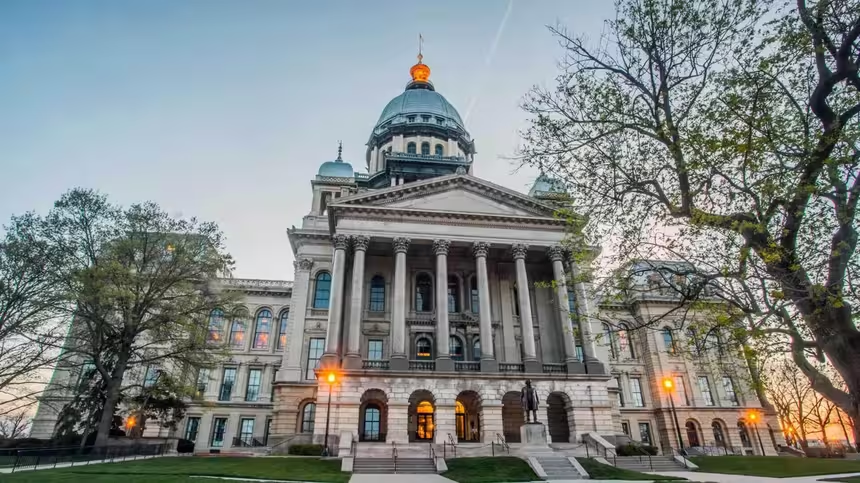
CapitolView
CapitolView is a weekly discussion of politics and government inside the Capitol, and around the state, with the Statehouse press corps. CapitolView is a production of WSIU Public Broadcasting.Providing Support for PBS.org
Learn Moreabout PBS online sponsorship[MUSIC] >> Welcome to Capitol View on WSIU.
I'm Jeff Williams sitting in this week as we take a look at what's making news around the state in Illinois politics.
Well, this week the Illinois House and Senate are in session at the same time for the first time during this spring legislative session.
Plus, US immigration policy is kind of back in the forefront in Illinois.
We'll take a closer look at those stories and likely some others this week on Capitol View to help guide our discussion this week.
Our Jeremy Gorner, a reporter for the Chicago Tribune, and Charlie Wheeler, director emeritus of the public affairs reporting program at the University of Illinois, Springfield, and a longtime statehouse reporter.
Gentlemen, welcome back to the program.
>> It's good to be here.
>> Good to be here.
>> So we'll dive into the legislative session shortly.
But first, I wanted to take a closer look at a tragic story that.
Jeremy, I know you've covered this week involving the shooting death of a Loyola University student that has brought the focus of U.S.
immigration policy and even recent ice enforcement efforts in Chicago back to the forefront.
Um, kind of fill us in on the story of 18 year old Sheridan Gorman.
>> Yeah.
Uh, so Sheridan Gorman, she was a she was a freshman at Loyola University Chicago and Rogers Park.
That's the far north side of the city.
Um, she was out with friends on the lakefront, um, really early in the morning, probably around 130 in the morning.
This was last Thursday, um, you know, with a group and, you know, according to prosecutors, um, you know, uh, the suspect in the case, uh, was, I guess somewhere in the area, uh, and, you know, apparently, um, You know, totally unprovoked as far as we could tell so far.
Um.
Shot and killed.
Um, Sheridan, you know, with her friends present.
Um, and, uh, this person was later arrested, um, several days later, uh, this was somebody who lived in the neighborhood, uh, a couple blocks away.
Um, obviously it turned it's become a very politically charged case, obviously, because what has come out is that this person was a Venezuelan national who was in the country without legal permission.
This.
So really, um, this horrible tragedy of Sheridan's death has been, um, in a way, you know, there's that story, but, you know, hovering over it is the, are the political ramifications for governor JB Pritzker and Democrats.
Um, this has really opened the door for Republicans to criticize Pritzker For sanctuary in Chicago, Mayor Brandon Johnson for its sanctuary policies.
Basically, um, you know, in Illinois, there's the Trust Act, which generally prohibits, um, uh, local and state law enforcement from assisting federal immigration enforcement and, um, deportation matters.
So in this case, um, you have Jose Medina as the suspect, again, a Venezuelan national.
He was brought here.
Um, he arrived here in 2023, I believe, um, uh, border Patrol had arrested him and then released him.
This was under President Joe Biden's administration.
And then, um, shortly after that, uh, he was arrested for shoplifting in Chicago at the Macy's down on State Street in downtown.
Um, and it was just a misdemeanor shopping, shoplifting, arrest, I believe it was $132 worth of merchandise.
Um, so for a case like that, generally you're going to be locked into a city lockup.
You're going to be booked into a city lockup and you could get, you know, get out on a recognizance bond.
Keep in mind, this was before the Safety Act went into effect.
Um, and he just never showed up in court.
So there had been a warrant out for his arrest for two plus years, um, leading up to his murder arrest.
Um, but still, what we've seen is, you know, Republicans just mercilessly criticizing Governor Pritzker, um, for sanctuary policies that allowed this to happen, of course, saying, um, you know, he shouldn't have been in this country in the first place.
This is because of the Democrats.
And it's prompted Pritzker to basically say, yeah, you know, there have there have been real failures.
That was his quotes yesterday, real failures in the immigration system in this country.
Um, you know, extending beyond Illinois's borders.
And, um, we need to fix that.
And, you know, and then he pretty much, you know, blamed President Trump by saying that, um, they're national failures, a failure to have comprehensive immigration reform, a failure of the president to follow his own edict to go after the worst of the worst.
So their Pritzker is referencing, um, Trump's stepped up efforts under operation midway blitz last year where, um, he, they made a vow to go after, um, non-citizens in the country illegally with criminal records.
Um, and, uh, so, so that's what, um, Pritzker was referencing.
So there's been a lot of back and forth, a lot of finger pointing Republicans pointing fingers at Pritzker, both locally and nationally, and then Pritzker basically blaming the Trump administration.
Although in all fairness, you know, Pritzker in the past has criticized the Biden administration too, um, for its border policies.
But obviously yesterday, um, he was referring to a failure of the president.
He was referring to President Trump.
So we're seeing a lot of back and political back and forth right now, that's likely overshadowing, you know, the underlying tragedy itself of Sheridan Gorman's murder.
>> Yeah.
>> You you mentioned the the kind of the expected partisan debate over who was who or what is ultimately responsible for this.
Do you think this is a case where Jose Medina just slipped through the cracks in the system and that there's probably some responsibility, accountability, maybe both on Republicans and Democrats as well as as Illinois sanctuary policies.
>> Yeah.
I mean, I don't want to make a judgment call to that, Jeff.
I mean, what I'll say is this, um, you know, you know, having covered these criminal justice issues before, this was a misdemeanor shoplifting arrest that he had been arrested for.
This is small potatoes in the grand scheme of things, of crimes that happen in the city of Chicago or really anywhere.
Um, you know, Chicago has become a poster child nationally for its crime and violence.
President Trump loves to criticize Chicago, as do other Republicans, for its crime and violence.
But this was a this this crime, this crime that he had previously been arrested for was not a serious case.
So is it possible of, you know, among the thousands or however many are hundreds of thousands arrests.
Chicago police make every year.
Could this have fallen through the cracks?
Yes.
Um, the other thing too, is that, um.
Um.
Yeah, I mean, there's, you know, obviously you have the trust act, but you also have Chicago's welcoming city ordinance, which also prohibits cooperation between Chicago police, city of Chicago employees and federal immigration enforcement.
And that's been in place for I mean, that's a that's an ordinance that's been in place since Harold Washington was mayor, you know, going back to when he was mayor in the 80s.
So there's that.
But but at the same time, again, even with if those laws weren't in place, could he have still fallen through the cracks?
I mean, we've seen it before.
It's, it's it is very possible.
Like I said, this was a small potatoes case.
So it's not like this is somebody who would have been on law enforcement's radar compared to somebody who was wanted for something more serious, like murder or a sex crime or robbery or something like that.
>> Yeah.
>> Yeah.
Uh, Charlie, you've, you've, you've observed Illinois policy over, over, over many years and have kind of watched the state's, um, various sanctuary policies and positions develop over time.
Is this going to warrant?
Do you think the state or the city officials in Chicago taking another another look at things?
Or is this just one of those incidents that happened?
It's going to go on and state will continue its course.
>> Yeah, I would be surprised if the city backs off of as as Jeremy mentioned, a law that's been around since Harold Washington's day, which is what, 40 some years ago.
And as Jeremy said, this really is not a major crime.
And this is not one of the worst of the worst.
This is a guy who, if he were had he been born in Chicago and he gets picked up for shoplifting, he would have basically got the equivalent of a slap on the wrist.
And if he had no prior record, he would be let go on his own recognizance.
Or if he didn't have any money, he'd be held if he couldn't post bail.
So it's but it's an opportunity for the Republicans to go after Pritzker, and they are in a position where they would like anything that they could do, uh, to try and discredit Pritzker.
As a matter of fact, in Jeremy's story this morning, he quoted, uh.
Darren Bailey, who is the Republican candidate for governor, saying that the unfortunate killing of this young lady was preventable.
And he decried Pritzker's soft on crime policies.
And then during a conference, apparently legislative Republicans also did.
And I thought this was a pretty strong quote from Steve McClure, Senator Steve McClure, who's a Republican from Springfield.
He says Governor Pritzker has gone out of his way to impede federal authorities.
This man who just murdered this innocent college student, that's one of Pritzker's people.
That's who he's trying to protect.
You know who we're trying to protect?
That poor Carleton College girl who got murdered.
And so this is the kind of attacks that are going to continue.
And Pritzker is is just going to have to say, well.
It's it's.
He basically was saying it's the federal officials that they should have caught the guy in the first place.
But I think this was a horrible tragedy.
And it I don't think it was really preventable unless you have the ability to see into the future and say, oh, yeah, the shoplifter some years later is going to for no reason, murder this college girl.
>> Well, as we as mentioned at the top of the program, the spring session is going on and I think this is a red letter week and that I think this is the first week that both chambers have, have been under the under the Capitol Dome at the same time.
I think the House deadline on acting a major bills is the end of this week, although I think the Senate already extended their deadline on.
I think what, 700 some odd, odd bills.
So what seems to be Jeremy or Charlie?
The what seems to be the focus now that the primary election is in the in the rear view mirror, I notice we've had some action on, on, on some fairly major bills that are starting to shape up.
>> Well, um.
So like, so for example, I mean, one of the things that we're watching is if the, if the Illinois House takes up a proposal that would, um, aid the Chicago Bears in their move to Arlington Heights, um, that is a bill that actually has gone through committee, um, a couple of weeks ago.
Of course, the house, the committee deadline is this week.
Um, but so far it's got to go through the full house before going through the full Senate, you know, committee, committee hearings in the Senate and then the, you know, the full Senate.
Um, but, uh, the House and Senate are off next week.
And, you know, there is some, you know, apprehension, I think on one or both sides.
And is this a deal that's going to get done?
Basically what you have here is, um, a bill that would it's called payment in lieu of taxes.
It would allow the bears to negotiate a property tax rate with the local taxing bodies in the Arlington Heights area.
The school district, the parks library board, whatever.
Um, and these are for so-called mega project developments.
I'm sure that we've talked about this on your show for a long time.
Um, but you know, Democrats still have problems with it.
I know that a couple of weeks ago in committee, um, I believe that there were, you know, there were concerns that, um, whatever costs, you know, whatever exemptions the bears get or, or, or any of these corporations that want to do these mega projects, there could still somehow, um, it could still somehow cause municipalities to lose out on revenue.
Um, for, you know, for one example, um, and, you know, there was also concern, I know that, um, Americans for prosperity testified and was concerned that this could have basically a ripple effect of raising property taxes exponentially for, um, neighboring areas, residential areas.
Um, you know, and I know that last week the Democrats caucused, um, you know, to where, uh, Cam Buckner, the, um, state rep who is really kind of leading the charge in the House on negotiations with the bears over this pilot bill.
Um, you know, he was trying to test everyone's temperature in caucus over this bill and it to see if they have 60 votes, 60 Democratic votes to get it out of the House.
It looks like he's still working on it obviously.
Um, and this all comes under the backdrop of the fact that the Indiana state legislature passed its own bill that would make it that would create a finance authority to aid the bears if they were to move to, um, Hammond, Indiana, just over the border from Chicago.
Um, so now the question is, is, you know, are the bears, are the bears sitting this out?
Are they, you know, they've been in negotiations for three years with Illinois lawmakers.
And, you know, we've heard a lot of strong rhetoric from Governor Pritzker and legislative leaders saying, we don't want taxpayer funds to go to a bears stadium where it's been, you know, kind of heated it, you know, kind of strong rhetoric at times.
You know, stern rhetoric at times to the public for the bears.
The bears still have patience for that or, you know, what are they going to do?
Um, but, um, you know, the governor basically was asked about this yesterday.
Um, and, uh, he, he said that, um, you know, really it's up to the legislature, up to the legislature at this point.
Um, you know, he's, he was asked if he feels pressure to get a deal done and he says it's up to the legislature at this point.
And it's like, well, you know, we have committee deadline week for the House.
Of course, as Charlie knows, that's kind of an artificial deadline.
They can do pretty much whatever they want in Springfield.
They could attach a bill to a shell bill later on, um, to pass it at the end of spring.
But, um, the clock is ticking because next week the House and Senate are not in.
So the process for the bears, you know, on what their future is in the you know, with respect to legislative policy is going to be delayed again if they don't get anything done this week.
Um, so that's kind of a big thing that people are watching.
Another thing too is, you know, um, there was a bill that would basically make it easier for the state to have oversight over car and homeowners car insurance and homeowners insurance.
Uh, this was something that passed the house last week.
It passed the house after in veto session.
It failed on the House floor because it only included provisions for homeowners insurance and not car insurance.
This all comes under the backdrop of State Farm, um, increasing its homeowners insurance rates of 27% last summer, prompting Governor Pritzker, House Speaker Chris Welch, Don Harmon, the Senate president.
They each penned.
They collected well altogether, penned an op ed in the Tribune urging the legislature to act on this.
So this has been kind of the solution.
So we're, um, um, I don't want to run out of time here.
You know, I'll go through the details, but that.
>> Is this.
>> One.
>> Is this one also include the, the junk fees that that.
>> It does not.
No, no, no, that's.
>> Is that.
>> A.
>> That, that's going to, that's going to be something else.
>> Um Jeremy, I'm pretty sure that the junk fees are, are included in it because the, the bill, the underlying bill, I think had the junk fees and the, the House amendments.
Included the, uh, the terms of the original bill.
I could be mistaken.
I maybe misread the bill.
Okay.
>> Okay, yeah, I didn't okay.
Okay.
I do know that that is something that they're taking up because yeah, basically there is a separate.
Well, there is a separate bill.
Charlie.
Actually, yeah.
Related to, um, to junk fees.
It's it's coming from Bob Morgan and Speaker Welch.
It's a separate bill number, um, which is also being, um, which is also under consideration.
Um, that is actually, um, um, assigned to the consumer protection committee and, you know, basically what that bill would do, um, you know, basically basically what that bill would do is that, um, you know, it's, it includes like, yeah, you know, it's, it's really calls for the removal of these hidden fees under certain transaction.
Calling it an unlawful practice, you know, saying that it would be an unlawful practice, um, for a person to advertise, display or offer a price for goods or services that does not include all mandatory fees and surcharges.
So yeah, that's a separate bill.
Um, um, that, uh, is also making the motions through committee um, this week and in the next few weeks.
>> Mhm.
Yeah.
>> Charlie, you mentioned something before we started taping about the, um.
Around the state that may draw attention to the, to the legislature.
And that's the.
Proliferation of, of data centers and the interest to build those, those data centers.
And we've had some municipalities that have have said no and some that have.
Have said yes.
Is this something that we might turn up in, in, uh, not necessarily maybe in this session or something that the state may take a closer, closer look at?
>> I think, I think it still could turn up this session because there's been a lot of attention being paid to the the impact of these data centers on local communities because of their demands for electricity and the demands for water for cooling purposes.
And so this particular legislation, uh, it's being called the power act, protect our water, energy and ratepayers.
It wants to shift the costs related to the growth of these things from consumers to the data centers themselves.
And it wants to emphasize clean energy sourcing.
Put a limit on how much water can be drawn for cooling.
And they're trying to target the hyperscale.
They call them data centers of any facility.
The bill says.
It has a peak energy demand surpassing 50MW, which is a whole lot of electricity.
Now, the data center industry industry is opposed to any regulation.
Uh, and I'm pretty sure there's an effort going on in Congress by the industry to get the Congress to say, no states, you can't do anything about this AI and data center stuff.
Uh, you have to let them go unless we in Congress say something about it.
But there's been studies done that show the demand for energy is going to grow dramatically.
It was one analysis, uh, that by the Union of Concerned Scientists, which projected data centers would account for 72% of Illinois's overall electricity growth by 2030.
So that's a heck of a lot.
And the and as I say, the concern is chiefly it's the draw on electricity and will ratepayers, ratepayers, us individually see our rates go up to provide the power needed for these things?
And also what's going to happen to the water, the amount of water that's being drawn and in different communities.
The idea of having one of these data centers has been rejected.
Naperville rejected one for one, for example.
Um, here in Springfield.
There was an effort to build one on the southwest corner of Sangamon County.
And that motion to approve the zoning change was tabled the other day after it appeared that it was going to slide through, and it was because of public opposition at this one hearing.
So this is an issue.
I think that's very important, and it'll become more important as we move forward.
And I expect the legislature is likely to do something on this still this session.
And like we were saying, the session isn't going to end in theory until the end of May.
And as Jeremy knows, and as I saw many, many times, and Jeff, you know.
The bill is, is, is like an empty box car.
It starts in one chamber or another, and it stops at many stations.
And right before the end of the line suddenly and his amendment and all this stuff gets dumped in the box car, and then it gets passed.
And it's it's the way the process works.
But it has a lot of critics because the general public really doesn't get a chance to understand what's going in the box car before it's gone.
So anyway, I think there's a good chance that, yeah, this legislation will move forward still this spring.
>> Mhm.
>> There's we've got about three minutes or so left.
And I wanted to just to toss this out here and get your, um, get your thoughts on this.
The, the US Supreme Court has looked at the issue of mail in ballots.
They seem to be taking a a skeptical view of, of having those ballots arrive or have a grace period for those ballots to arrive after the date of, of, of the election.
At this point, we're not certain what the court will rule or when the court will rule, but if it does, it could potentially have an impact on the on the November election.
Just what do you if if that does happen, what what impact do you think that might have on on on on Illinois in our, in our current, uh, current laws that we have for voting and for, for mail in balloting.
>> Well, it occurs to me that it would give impetus for political committees and party organizations to make sure they get their voters to the polls early, or if they're not going to be able to go there in person, that they get their ballots mailed in well ahead of time.
Like in my case, I no longer go to the polls in person.
I am on the list to always get a mail ballot, and I fill it out, and I take it down to the county building and drop it in the drop box.
And I did it like a week before the election.
I'm close enough.
I could even walk if I weren't so lazy.
But I think the danger is particularly in rural areas.
The ability to get the mail delivered so that the the ballots are actually there in the in the what would you say in the voting headquarters by 7:00 or by midnight on the election Day?
So I think it could have an impact, but we'll just have to see.
And as I say, it would be on the party organizations to make sure that they encourage people to do this early and not wait till the last minute.
>> Jeremy, in the minute or so we've got left.
Anything on your radar that you're keeping an eye on as the rest of the session unfolds?
>> Yeah.
I mean, you know, I think pretty much so far.
Um, you know, we're looking at to see if there's going to be any movement on, uh, proposed, um, millionaires tax.
Um, there's a house resolution that's on the schedule in committee today that's going to be discussed.
Um, uh, and, uh, so that's obviously something that, um, you know, you have a lot of progressive Democrats calling for.
They want to bring more revenue in the state to ease the tax burden, um, for lower income folks.
Um, that's something that, you know, a lot of advocates are pushing for.
This is something that, um, by referendum voters have been in favor of in Illinois, going back to when Pat Quinn was governor, but it just hasn't made it through, um, the legislature to actually be codified.
>> All right, Jeremy, I'm going to let you have the last word.
Gentleman, we are out of time.
For Jeremy Gorner and Charlie Wheeler, I'm Jeff Williams.
Thank you all for joining us for this edition of Capitol View.
Have a good week.
[MUSIC]

- News and Public Affairs

Top journalists deliver compelling original analysis of the hour's headlines.

- News and Public Affairs

FRONTLINE is investigative journalism that questions, explains and changes our world.












Support for PBS provided by:
CapitolView is a local public television program presented by WSIU
CapitolView is a production of WSIU Public Broadcasting.