
Capitol View - March 28, 2024
3/28/2024 | 26m 46sVideo has Closed Captions
Capitol View - March 28, 2024
Fred Martino speaks with Daniel F. Mahony, Ph.D., Southern Illinois University System President; plus: the latest on the immigration crisis in Chicago and new insights into the primary election results.
Problems playing video? | Closed Captioning Feedback
Problems playing video? | Closed Captioning Feedback
CapitolView is a local public television program presented by WSIU
CapitolView is a production of WSIU Public Broadcasting.
Capitol View - March 28, 2024
3/28/2024 | 26m 46sVideo has Closed Captions
Fred Martino speaks with Daniel F. Mahony, Ph.D., Southern Illinois University System President; plus: the latest on the immigration crisis in Chicago and new insights into the primary election results.
Problems playing video? | Closed Captioning Feedback
How to Watch CapitolView
CapitolView is available to stream on pbs.org and the free PBS App, available on iPhone, Apple TV, Android TV, Android smartphones, Amazon Fire TV, Amazon Fire Tablet, Roku, Samsung Smart TV, and Vizio.
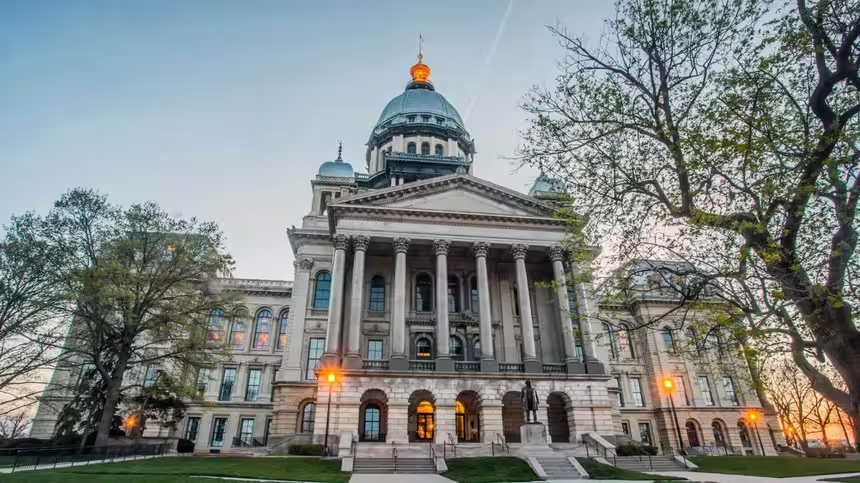
CapitolView
CapitolView is a weekly discussion of politics and government inside the Capitol, and around the state, with the Statehouse press corps. CapitolView is a production of WSIU Public Broadcasting.Providing Support for PBS.org
Learn Moreabout PBS online sponsorship(bright music) (rousing music) - Thanks for joining us on "Capital View."
I'm Fred Martino.
Higher education is in the spotlight in Illinois and across the country.
Universities everywhere are preparing for changes in the number of high school graduates and the increasing cost of education.
Full disclosure, WSIU is licensed by Southern Illinois University.
Today on the program, I am very pleased to welcome SIU System President Dan Mahoney.
President Mahoney, thank you so much for being with us.
Good to have you here.
And you know, I do wanna begin with how SIU is preparing for something that many of our viewers have heard about.
In a recent article, "The Chronicle of Higher Education" wrote, "The consensus view is that America will hit a peak of around three and a half million high school graduates sometime near 2025.
After that, the college going population is expected to shrink across the next five to 10 years by as many as 15 percentage points."
So the question of course is how is SIU preparing for that and what is already been done at campuses that have already seen some large declines in enrollment?
- Yeah, and that's the one thing I would kind of start with is we've already seen nationally declines even before the enrollment cliff.
So even before we get to that point, we've seen that kind of decrease and we knew this was coming for a long time.
You look at birth rates 18 years ago and you can kind of figure out the trends.
And so it's not that hard to see what was coming.
And so we've been doing a lot of different things.
We actually have a white paper that I worked on with the chancellors and then we presented to the campuses this year talking about different strategies that we could use to grow enrollment in an environment which is actually probably working against that and a number of different things.
Certainly focusing on increasing retention rates for students.
So rather than just focusing on recruiting new students, retaining the students we have, there's certainly some ability to do better on that.
We actually just had a retention retreat recently sponsored by the Lumina Foundation and then we're gonna do a lot of work with our faculty on some things we can do on that.
Improving transfers and the ease of transfer is something that I've really been passionate about for a while.
I think SIU Carbondale really led the way with the SALUKI Step Ahead program, which makes it very easy for community college students to move to the universities.
We're looking at things we can do with our financial aid and different scholarship programs.
I will say that's one of the things that's probably the greatest myth out there in higher education, that it's getting more expensive.
Actually, if you look at what students pay, it's actually getting less expensive over the last 10 years.
And a lot of that has to do with the competitive marketplace and the financial aid packaging but we need to be a little bit better about how we do that in order to meet the needs of our students.
Focusing more on the fact that the demographics of our students are different.
They're increasingly not white, they're increasingly international students and that takes a whole lot of different recruitment strategies than traditionally have done.
We're also focused on kind of growing and expanding some of our destination programs, the programs actually pull students in specifically for that program.
When you look at Carbondale aviation, automotive technology, mortuary science, or those types of programs so what can we do to expand those?
And also really looking at new populations and particularly adult learners and adult working learners.
Right now we're focusing on developing the SIU system online, which will allow students to take classes from either campus much easier.
We've actually been doing this for a while.
I actually teach a class that has students both from Edwardsville and Carbondale.
So we've been doing it some, but really expanding that with the idea that some of the people coming back will want to be able to find online classes at one of our campuses as easy as possible in order to move forward to graduation.
So a lot of different strategies that we can use that will counteract and not that we're gonna stop focusing on high school seniors, we certainly will do that and there's a whole lot of strategies we've been using with them, but really we need to expand who we're going after and how we're kind of building those enrollment numbers.
- Sure and we'll delve into online education a little more coming up.
Of course, funding for higher education is a major issue.
A state commission, as you know, says that public universities in Illinois are underfunded by about $1.4 billion.
The Commission on Equitable Public University Funding includes legislators and representatives from public universities and advocacy organizations.
What did you make of their report which also addresses equity in funding?
- Yeah, and I was involved not only on the commission, but I was on the technical working group.
So I was involved in the weeds, really, of make putting together this funding formula so I'm pretty familiar with it.
I also spent a lot of time looking at the history of higher education funding in Illinois, in part because of the controversies over how Edwardsville and Carbondale were funded and went back.
And really historically, the funding model we have today was based more or less on enrollment back in the 1970s.
And then we just went up or down a certain percentage every year without really looking at what has changed and certainly not focusing on equity.
So I think one of the things that's interesting is I think all the universities agree that there's a need for a new formula.
That the current formula, the historical based model has not worked well for a bunch of different reasons.
The second thing that we're all focused on is that it should address equity.
And in my mind, that's really closing equity gaps, improving college going rates, which back to what we just talked about, it's not just that you have a certain number of high school graduates, but what percentage of them are going on to college and which percentage of them are not, even though they're qualified and may even have a desire to so how do we actually pull them in to higher education better?
And then once they're there, retaining and graduating those students.
So how do we close equity gaps and how does the funding model actually help us do that?
The model that they developed is still a work in progress and even in the report, they identify a couple outstanding issues.
So I think it'll take us still some time to get to a final model, but I'm optimistic in the next year or so that we will get to a different model that will focus again on closing those equity gaps and really tie funding to the realities of higher education today.
- Sounds like we may have a follow up interview maybe in the year to come and we can talk about that if it is indeed accomplished.
Recently, SIU Day at the Assembly highlighted a number of efforts in Springfield.
I wanna start with something that folks should be aware of.
The Illinois Tutoring Initiative.
Tell us about that.
- Yeah, and that came out during the pandemic.
So there was federal funding that came to states to basically help improve student learning in a variety of different ways.
And one of the ways that Illinois chose to do that was to work with universities and both of our universities were part of it, but several universities, Illinois State and others were part of it as well.
In fact, Illinois State really took the lead on it.
And what we did was we trained a bunch of tutors to work with students who were identified in their school districts and it's usually school districts that had probably more impact from the lost learning.
And they identified students who really needed the most support, particularly in areas like math and reading.
And what we have found is it was highly successful.
So in math, I think it was 90% of the students reached their goals.
Reading was 80% of those who participated in the tutoring program.
The problem is the money for that runs out.
That was all based on COVID relief money that came from the federal government.
So a lot of us, I think would like to see the program continue, but we'd had to find the funding to support that.
So that's part of what they were talking about yesterday is where that additional funding may come to keep that program going.
But it's been successful.
School districts are very happy with it and it's been, I think, great for our students, many of whom were the tutors who worked with those students in the K-12 environment.
- Okay, well, another thing we wanna make some more time for now, you addressed this, SIU in Carbondale and in Edwardsville both have programs for online education and the extended campus at Carbondale also includes programs located in other places other than the main campus.
Where do you see online education going as part of the services offered by SIU?
- Yeah, I think what we're seeing now in higher education in general, but certainly for us at SIU is this expansion of how we provide classes.
So not that we're abandoning the traditional classroom, we'll still have those.
And certainly as you look at some of the programs we have, as I often say, you don't want to train a pilot online, that's not gonna be very successful.
So there's certain programs where we're still gonna be face-to-face and almost need to be.
But there's a lot of programs where there's more flexibility and we now are expanding our online offerings in a lot of different ways.
I actually teach online myself.
And I will say before COVID, myself included, very few of us had that experience.
And right now a lot of our faculty now, one of the upsides of that experience was we all learned to teach online and got more comfortable with it.
And so now a lot of what we're doing is saying, "Okay, what do these students need?
What fits their life and how do we provide the education that they need and the ways that they can attain it?"
And as I mentioned earlier, with the SIU system online, that's a way of really collaborating across the system and providing those online students with as many opportunities as possible.
But again, we still have the extended campus options too and that's a big part of what we're trying to do.
- Yeah, absolutely.
Well, of course some things are better in person rather than online, and many would argue that the eclipse is one of those things.
SIU Carbondale is once again hosting a major event for the April 8th eclipse.
This was a big event in 2017 too.
Tell us about Eclipse Day at Saluki Stadium, which will also be broadcast on the WSIU stations.
- Yeah, it's not even just Eclipse Day, it's Eclipse Weekend.
There's things going on in Carbondale, I know at least from Friday on, and we're heading there on Saturday and a lot of different activities to choose from.
But Eclipse Day will still be at the stadium as we were last time.
Tickets are still available for that and there's a lot of information available at eclipse.siu.edu for people who are interested either in the tickets or other activities going on.
But we're in a very unique position being that in the path of totality and really one of the best places that you could view the eclipse will be in Carbondale.
And I think it's about four minutes that that experience will take place, but it'll be a pretty amazing experience for those of us who are there.
And it's interesting, I always say sometimes you do things and you have something happen because you were smart or sometimes you just get lucky.
We're just lucky that we happen to be in the path and that we've become kind of a center of attention for a lot of people.
So we'll expect a lot of news media, not just locally, but nationally to be coming to Carbondale.
A lot of visitors, again, coming to Carbondale, all of which is good for the city, it's good for the university.
It will give us attention that frankly we wouldn't get it in another way.
But it's also gonna be a really exciting event to be part of.
I wasn't there last time, that was before I arrived at SIU, but everything I heard from the last experience, it was pretty amazing and I think this one's gonna be even better.
- [Fred] And join WSIU for live coverage of the eclipse from Saluki Stadium Monday, April 8th.
Our special eclipse programming starts at 11 o'clock in the morning.
Of course, the total eclipse starting just before two o'clock Central Time in Carbondale.
Another program note, you can watch my entire interview with SIU System President Dan Mahoney on the WSIU YouTube channel.
Subscribe to WSIU on YouTube so you never miss a local segment.
More news and analysis now, I'm very pleased to welcome Dan Petrella of "The Chicago Tribune" and Alex Degman from WBEZ.
Dan, starting this weekend, Chicago says that it will begin removing nearly 800 immigrants being housed inside five Chicago Park District facilities.
And WBEZ reports that Chicago has spent more than $31 million to feed immigrants since August of 2022.
Let's talk about this situation for the city, both in terms of the budget problems and the challenge of now evicting people who may have nowhere else to go.
- Sure.
So these 800 folks who are currently being housed in Chicago Park District field houses and things in parks, first of all, it's been one of the more controversial moves that City Hall made during the migrant crisis because essentially, obviously these are people who need housing and shelter, but for folks who live in those neighborhoods and for the alderman who represent those areas, it's taking away a service and amenity from their neighborhood.
Kids weren't able to have their sports activities and things like that at these facilities while they were housing migrants.
So there are people who are happy with this move from that regard.
Those folks will be moved into other city run shelters is my understanding, folks who are still within their time window of being able to stay in the city, the city shelters, they're trying to make it so that it's not disruptive for kids who are in public schools so they don't have to move to a different school or things like that.
But it really is evidence more of the city sort of trying to slowly wind it down or at least reduce sort of the footprint of the operation of housing migrants in the city.
And yeah, the budget constraints continue.
City Hall is now saying that the predictions that they would run out of funding for the migrant operation by April are no longer accurate but they haven't given a real clear picture of how they're going to pay for the rest of the year because when they passed their budget last year, they only budgeted about half of what it was expected to cost to house and feed all these folks who have arrived from the southern border.
- And from your understanding, it sounds like the folks who are being evicted from these Park District locations may have other temporary shelter, but we're not talking about long-term housing.
- Correct.
Yeah.
And this is coming right as the city has also finally started enforcing its 60 day shelter stay policy, which was originally announced back in November, I believe it was, and has been pushed off several times because of weather and other factors.
They started just recently.
There's only about a couple dozen folks who were removed or asked to leave the shelters 'cause their time was up essentially.
But as time goes on, there are more and more of those folks who will be turned out.
Part of the problem is that people who have arrived since November are no longer eligible for state rental assistance.
So the big question becomes if they're not able to find housing on their own, haven't gotten their their work permits yet, where do they go?
And is this policy gonna end up exacerbating the problem with homelessness that we see in the city of Chicago and elsewhere?
- Okay, very interesting and something we're going to continue to follow.
Appreciate you keeping up to date on all of this.
It's important to everyone in the state as state funds are also going to this and of course, grave concern over health and safety issues for immigrants and for our communities.
Alex, speaking of difficult situations, some areas in Illinois are food deserts, don't even have a grocery store in some cases.
And there is an effort to reduce this problem.
Capital News Illinois reports that the state has awarded local food infrastructure grants that we've talked about on this program before.
And there is a senate bill now that would extend that program.
- Yeah, this was a really popular program and there were I think nearly 250 people that applied for it.
And the ask was around $23 million and there wasn't really that much available.
This was only designed to offer $1.8 million and 19 people out of those nearly 250 ended up getting some help.
Now the idea behind the program as we've talked about here before is to bolster the ability of small farmers and small producers to get quality local produce, meats and other things that people need to people who need it.
Food deserts, like you mentioned, places that don't have quick access or in some cases, really any access at all to fresh food and produce.
And the idea is to help these folks build out the infrastructure needed, you know, things like grain storage, cold storage, packing facilities to ramp up their production to be able to meet this need, things like that.
The Illinois Stewardship Alliance is running everything and they're managing the program.
When they announced these grants a little bit ago, they mentioned that this was a really crucial step toward getting people the stuff that they need to live more healthy lives.
But the number of people who wanna participate and help in that is just way too much to handle the current demand.
So there's a senate bill that would appropriate $2 million a year toward this effort every year.
But here's the issue though, we're starting to talk a lot about budget constraints.
$2 million in the grand scheme of things, not that much really, but it's something the state might not see as a high priority given all the other budget pressures that we're seeing elsewhere.
Especially and to be clear, other than this bill making it through a Senate committee, I have not read it yet so I'm not sure if it's one of those subject to appropriations bills, which means that even if they do pass it, which they could, it would be up to lawmakers and the governor to fund it every year.
And as we've seen with some of those bills, that doesn't always happen.
- Okay.
We will be watching and certainly a difficult context for legislators when there are not only so many other expenses, but there are expenses that are occurring that some would call expenses that should not be the responsibility of the state of Illinois or the city of Chicago in the case of the immigrant relief.
And there have been requests for more help from the federal government but you know, it is as we all know, challenging and often slow in coming.
Dan, we have more context now on the March primary election results turnout, one of the lowest in a presidential primary since the 1940s.
And now we have learned that about 14% of democratic voters left the race for president blank or entered a write in candidate.
How troubling is this situation for Democrats?
- Well, I think obviously Democrats who are already concerned about President Biden being at the top of the ticket and whether there's gonna be voter enthusiasm for him are going to take this as another data point to sort of exacerbate those worries.
There are a lot of factors at play here.
Obviously there's a lot of discontent among folks who are opposed to Israel's ongoing military actions in Gaza with the President's support so far for Israel and obviously things have changed in recent days with the US letting a ceasefire resolution go through the United Nation Security Council and so it seems as though the administration is maybe starting to heed some of those concerns from some of their constituents about what Israel has been doing in Gaza.
And obviously, there's lower risk of registering that sort of protest vote in a primary where there's no real viable opponent on the ballot opposing the incumbent president.
So you know, I think now would be the time for Democrats who have concerns to make their voices heard in a nominating contest where the sitting president has already secured enough delegates to get the nomination when he comes to Chicago for the Democratic National Convention in August.
But I do think there are concerns and concerns on the Republican side as well when you look at the percentage of voters in the collar counties and in suburban Cook County who didn't vote for Donald Trump in the Republican presidential primary.
So I think there are concerns for both parties about who's at the top of their tickets and voter turnout and enthusiasm and particularly not so much here in Illinois 'cause I think it's almost a fate accompli that Biden will win the state.
But if you are in the Trump campaign and you're looking at soft suburban support for the Republican nominee, that could be a problem in some of the swing states where Trump does have to do better among suburban voters if he wants to win this year.
- Concern all around and I wanna move on now because the related thing here, Alex, there are also more worries that are related to the election, all eyes on Chicago this summer.
Chicago facing a federal lawsuit over plans to block protests near the Democratic National Convention.
The executive director of the US Palestinian Community Network says they will be marching on Chicago with or without a permit.
- Yeah and Hatem Abudayyeh of the USPCN, he's not the only one who's vowing to march without a permit because the city's denied protest permits for almost everybody who's applied for one except for one.
It turns out the Poor People's Army, they're gonna be marching through the west side from I believe Humboldt Park to the actual United Center where the convention is being held.
So for everybody else, the city of Chicago is offering essentially what amounts to a two block route in the middle of Grant Park.
Which if you know Chicago, that's not close.
Grant Park and the United Center are in two completely different areas.
And USPCN says that runs afoul of their rights to assemble within the sight and sound of the convention.
Plus, USPCN isn't really a stranger to demonstrating in Chicago.
They've been doing it a lot since this conflict came about in October.
It seems like multiple times a week I'm getting emails, texts that they're taking action somewhere, whether that is confronting Jan Schakowsky at her office, confronting Dick Durbin at his Chicago office, blocking traffic.
They've been a definite force in Chicago and they are planning to turn up the heat.
They're making that very clear to pretty much everybody and they don't typically get permits for the actions that they have already been doing throughout the course of the year.
And I don't expect that this is gonna stop them.
And one thing that I've learned about covering protests like this, I came to Springfield from St. Louis most recently where we had the adjacent Stockley protests and we had the St. Louis version of the George Floyd riots.
And the city of St. Louis did the same thing.
They tried to set up free speech areas close to City Hall and it was really bizarre to me to watch all these folks on live TV just incredulous, like, "I can't believe they're not using these free speech areas, what are they doing?"
And the whole point of the protest is to disrupt, it's to make people pay attention, it's to make people pay attention who otherwise wouldn't be and you don't do that by marching two blocks away or marching in a two block area miles away from the actual convention.
So I don't have any thought in my mind that the lack of permits is going to make there be fewer protests at the DNC this summer.
- Yeah.
Dialogue on the streets, dialogue in the studio.
A huge issue not only in Illinois, all around the country with of course, this week's big controversy over NBC News and hiring the former RNC director as a political analyst and then promptly she was removed from that post after outrage by journalists at NBC News.
So we're gonna be hearing lots more, I think about free speech and other things related to the election, and I know you both will be covering it all.
Dan and Alex, thank you for being with us today and starting this conversation with us today.
- My pleasure.
- Good to be here.
- Thank you for joining us at home as well.
For everyone at WSIU, I'm Fred Martino.
Have a great week.
(rousing music) (rousing music continues)

- News and Public Affairs

Top journalists deliver compelling original analysis of the hour's headlines.

- News and Public Affairs

FRONTLINE is investigative journalism that questions, explains and changes our world.












Support for PBS provided by:
CapitolView is a local public television program presented by WSIU
CapitolView is a production of WSIU Public Broadcasting.