
Capitol View - March 3, 2023
3/3/2023 | 26m 46sVideo has Closed Captions
Capitol View - March 3, 2023
A look at the ramifications of the Chicago Mayoral Primary, impacts of the criminal case against Michael Madigan, and lawmaker priorities as legislation begins coming up for crucial votes – all topics for this episode of CapitolView.
Problems playing video? | Closed Captioning Feedback
Problems playing video? | Closed Captioning Feedback
CapitolView is a local public television program presented by WSIU
CapitolView is a production of WSIU Public Broadcasting.
Capitol View - March 3, 2023
3/3/2023 | 26m 46sVideo has Closed Captions
A look at the ramifications of the Chicago Mayoral Primary, impacts of the criminal case against Michael Madigan, and lawmaker priorities as legislation begins coming up for crucial votes – all topics for this episode of CapitolView.
Problems playing video? | Closed Captioning Feedback
How to Watch CapitolView
CapitolView is available to stream on pbs.org and the free PBS App, available on iPhone, Apple TV, Android TV, Android smartphones, Amazon Fire TV, Amazon Fire Tablet, Roku, Samsung Smart TV, and Vizio.
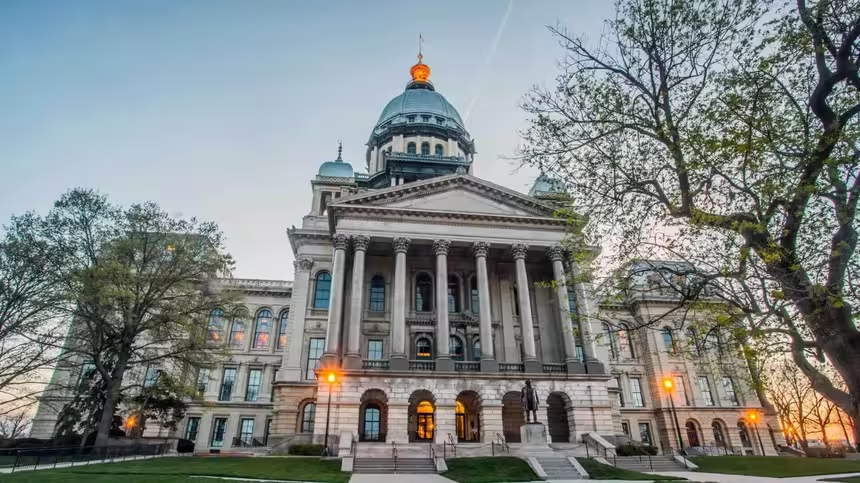
CapitolView
CapitolView is a weekly discussion of politics and government inside the Capitol, and around the state, with the Statehouse press corps. CapitolView is a production of WSIU Public Broadcasting.Providing Support for PBS.org
Learn Moreabout PBS online sponsorship(bright music) (camera beeping) (dramatic music) (dramatic music continues) - Welcome to another edition of "Capitol View," our weekly look at the happenings inside and outside the Illinois State Capitol.
I'm Jennifer Fuller.
Our guests this week are Jerry Nowicki of "Capitol News Illinois," and Dave Dahl of "News Radio WTAX" in Springfield.
Gentlemen, thanks for joining us.
- Thank you.
- Thanks for having us.
- We'll talk about something that perhaps doesn't have statewide implications, but it actually does, and that is the result of the mayoral election in the city of Chicago.
Now, this was just the primary.
There will be a runoff election, because none of the candidates secured more than 50% of the vote.
Perhaps surprising, and this is something I'd like for each of you to talk about, is that the incumbent, Lori Lightfoot, will not be reelected.
She did not garner one of the top two vote totals.
The two people running in the runoff election will be Paul Vallas and Brandon Johnson.
Jerry, I'll start with you.
Are you surprised by these election results, or is this how you thought it might play out?
- You know, I couldn't say it's too surprising.
I mean, with Mayor Lightfoot, as the Governor said, it was a challenging four years, certainly.
But you saw her tenure as governor start with a sort of smack down of Alderman Ed Burke in the middle of a city council meeting.
And she said, "Excuse me, Alderman, "it's not your turn to speak," or whatever she said, and she sort of put him in his place, and you think, wow, here's a mayor that's really sticking up for herself.
But then, almost every interaction with every person from that point had the same level of confrontation go with it.
It made sense for this alderman who's been indicted, who's involved in scandal, who's really just fallen far from where he was, but then to take that sort of approach with everyone is, I think there was maybe a lack of diplomacy from her part.
And as Governor Pritzker said yesterday, when Dave and I were there questioning him in light of the results, he said, "It was a hard four years.
"It's a hard job to do," but he didn't go too much beyond that.
So is that an indicator of the relationship that he had with the mayor?
Maybe it is, but yeah, I think all in all, not super surprising.
And the polling indicated that Paul Vallas, the former CEO of public schools, and then Brandon Johnson, who is a CTU, Chicago Teacher's Union organizer, had been the front runner, really.
So you really have a bit of a conservative choice in Vallas and a bit of a liberal choice in Brandon Johnson.
- Dave, there are a lot of people throughout the state of Illinois that are probably asking, "Why are we talking about this one mayoral election?"
Why is the leader of the city of Chicago so important to Illinois politics?
- Well, it's the largest city in the state, economic engine, et cetera, et cetera.
And, you know, downstate, if you want to regionalize everything, downstate is becoming less and less of a factor in things.
And, as the Governor said on Wednesday, it's incredibly important that the governor and the mayor of the largest city in the state have a close and good working relationship.
And he drew a distinction between what's going on now, what might be going on in the next four years with Mayor Rahm Emanuel and Governor Bruce Rauner.
He said those guys didn't get along, and it was to the detriment of the state and to the city of Chicago.
So it's something that absolutely cannot be ignored.
And when the mayor comes to Springfield to ask for things or to talk about things with the governor, there's a lot riding on it.
So yeah, it's a huge deal.
- Still, the governor has not made any endorsements in this race, even before the primary and now- - Well, why would he?
- Do you think that he should?
- No, if he picks the wrong horse, then that might spoil the relationship.
Maybe if it's close, and he thinks one of the candidates is a doofus, maybe he'll endorse the other one.
But no, I'm not surprised that the Governor on Wednesday said so little of substance about Mayor Lightfoot or about the other two candidates.
The Governor gets nothing from making an endorsement in that race, and I guess I'd be a little surprised if he did make an endorsement leading up to April 4th in that race.
I know he did endorse some aldermanic candidates, and he's getting involved, I guess, in some school board races.
But as I said, why needlessly tick off someone you're gonna have to try to work with?
I interrupted you, Jen, I'm sorry.
- No, you answered the question just fine, thanks Dave.
Jerry, Chicago has become, even on a national stage, something of a punching bag for some candidates.
We saw Ron DeSantis, the Governor of Florida, who may be a Republican candidate for president next year, poking at the crime rate in the city of Chicago, for example.
He was in the Chicago area last week.
How will the results of this election, do you think, affect that national political dialogue?
- Well, it's a bit of a challenging question, because no matter who gets elected, certainly the crime rate's not gonna spike or plunge overnight.
There's still going to be those challenges facing the city for a long list of reasons.
But when you say, "DeSantis might be a Republican governor for president," there's a lot of speculation that Pritzker could be angling for a Democratic nomination.
He, of course, has denied that over and over again.
We, in the press corps, seem to ask it at least once a week.
But to Dave's point about the endorsement, it's kind of interesting in the way that the primary played out.
You have, as I said earlier, a fairly conservative guy in Paul Vallas and a fairly liberal guy.
So, the fact that the Governor would not want to endorse there makes total sense from the aspect of him being governor, but if you're talking about his broader political aspirations, it might raise some eyebrows to say, "Well, he was okay with Paul Vallas," this conservative guy who's going to do X, Y, Z, with crime and with whatever else, with schools, becoming the next mayor of Chicago, and he didn't do anything to help the other guy, who would've been a more liberal guy, who may be lined up more with the policies he's trying to pass at a statewide level.
But, we don't know if he's going to endorse in the future.
He didn't directly tell us he's not going to eventually endorse, but he said, "The candidates have to articulate their positions.
"They have to say more about what their plan is "for education, for crime, and whatever else."
- And we all, in Illinois, have to listen to them and really, scrutinize what they're all about.
- We do, and Dave, you and I have to read probably about eight emails a day with their press releases as well.
- Oh yeah.
- Certainly, well, as both Jerry and Dave mentioned, the next election will be April 4th, not just in the city of Chicago, that's across the state.
So check your local election authority and make sure that you're up to date on the candidates that may be running in municipal school board and other elections across the state of Illinois.
Moving on to other news, we've been keeping an eye on proceedings and status hearings for the case against former Illinois House Speaker Michael Madigan.
And the most recent court filings have his attorneys asking a judge to suppress or exclude certain recordings that he was captured on in this corruption case that involves utility giant ComEd, as well as others.
But, Jerry, how important is this filing and how important are those recordings?
- I think the recordings, in many ways, will provide a backbone for the case.
Now, what we've seen in the unsealed filings have been just maybe one-line characterizations of what was said, so if there's surrounding context that hasn't been in an indictment, but the jury's going to hear, that's going to be a big deal, the fact that they're trying to move to suppress them, I think is a big deal in and of itself.
Is it just another attempt to maybe prolong the proceedings?
I'd say Madigan's gonna do whatever he can to, and his lawyers will do whatever they can to prolong this thing.
I think he's pushing 80, if he's not 80.
So, I don't know, there's no real reason to hurry to court on that, so I think the...
But what's gonna be interesting to watch is how the ComEd things play out, the fact that if we see convictions or whatever for Madigan's associates, then he's gonna be really sweating as it gets to his trial sometime next year.
And I will say, to point to a little self publicity here, Hannah Meisel, our colleague, a friend of this show, is going to have a long story on the one-year retrospective since Madigan's indictment coming out at capitolnewsillinois.com that you'll be able to read there as well.
- And we'll be keeping an eye out for that.
Dave, when it comes to these court filings and new information that seems to come out at times, weekly, and sometimes we have to wait a little longer, maybe it's a monthly update, how does this cast a shadow over the work that has to be done at the Illinois State Capitol?
Mike Madigan has not been in office for more than a year now, but he still has this shadow over the Capitol Building.
People still wonder how things are working now that he's not there.
- People are connected to him, and people who wanna run against him or throw mud at people can say, "Oh, well there's Madigan's person," but it's been more than two years.
We're in the second general assembly now with Chris Welch's speaker, and people have worked with Madigan, but it's not dissimilar to Rod Blagojevich.
The defense in the Blagojevich case was, "This is simply politics, people talking to people, "people trying to help people, and what's wrong with that?"
And I think that if they actually do have to get in court, that would be similar to the Madigan defense.
And one thing against Governor Pritzker was we heard him on tape with the Governor.
Well, Blagojevich was governor.
He talked to a lot of people.
And so, of course people are on tape with him.
Of course people are, well, I guess people are on tape with Mike Madigan.
Speaker Madigan wasn't recording us, but for 50 years people were dealing with Mike Madigan.
What are you gonna do, dredge up everybody who talked to him?
I don't think so.
And I agree with Jerry's point, it's just gonna be delay, delay, delay, delay, delay.
And, I'll be interested to see if they have anything on 'em.
I think it'll be just like Aaron Schock.
The best they can do is a guilty plea for jaywalking, if that.
In fact, I texted the former congressman when Madigan was indicted, as Mike Madigan called you to ask for your lawyer's phone number.
And he thought that was a pretty good one.
I did too, but nevertheless, I think that's what's going on here.
- As we were recording last week, Republican lawmakers were in Springfield detailing a lot of information that they want to have answered and some information that they'd like to see moved forward when it comes to the Choate Mental Health and Developmental Center in Anna in far Southern Illinois.
Jerry, this all comes out from a project that your organization had in partnership with ProPublica and Lee Enterprises Midwest Bureau that brought about some pretty enlightening, to say the least, information about things that have gone on or have alleged to have gone on over the last 10 to 15 years.
Can you talk through what the Republicans are asking for and some of the information that's been found out through your reporter, Beth Hundsdorfer, as well as Molly Parker?
- Yeah, enlightening, enraging, appalling, a lot of words you could use for the reporting they've come to.
And I've been an editor on that, so every story I've read, it's sort of like, you're more taken aback by the level of abuse there at that facility.
One of the cases where a worker at the facility, they were abusing a young patient there, I think, 19-years-old, or something at the time, and their Apple watch accidentally called 911, so it has audio of the person saying to this patient, "You want me to break your other hand?"
And sort of ridiculing and whatever this patient is, as they're clearly in distress and saying, "Help me, help me, you're hurting me."
And then, that ended in no one facing charges, because nobody would speak to the inspector general, the state police, whichever entity was investigating it, they all protected each other.
So there's a level of abuse that's systemic at this facility, and there's a level of protection for abusers that's systemic at this facility.
It's atrocious, and the Republicans, and we're not coming at this reporting from an angle that says, "You must close this facility," or whatever.
We're just plainly stating what's happening there.
We're making readers aware of it.
The solutions, they're gonna have to come up with IDHS, with the Governor, with the Republicans maybe, but what the Republicans wanna do is they want to add staff, which might be easier said than done.
I think there's maybe a shortage of at least 50 workers at that facility as well.
They want to have upgrades at the facility.
There's a couple other things they want to do, but I think the most important thing on their list would be a legislative hearing at which Grace Hou, the Director of the Department of Human Services, would be called to testify and answer questions as to what's happening at that facility, what's being done.
I think they want more cameras in common areas, which is a pretty simple thing that's already on the list of things to do.
But, there's some fairly straightforward requests, but I haven't heard anything of a hearing being scheduled just yet.
- This is just the latest in a string of reports of problems at state run facilities, not the same for sure, as what happened at the LaSalle Veterans Home, what happened at the Quincy Veterans Home with disease outbreaks.
But is there a problem within DHS or other state agencies where the front lines are not getting the support or the information that they need, or the accountability that needs to be there to make sure that the state's most vulnerable residents are being cared for?
- I'd say there's truth to the line that the Governor uses over and over again, that, "State government has been hollowed out for years."
I think there have been, especially in the case of the veterans' homes, some real failures of leadership there, which is why we've seen Director Chapa LaVia fired under Pritzker's leadership, and someone with more maybe managerial experience for homes coming in to run those facilities.
And Quincy, I think that was from the Rauner years.
There was some real problems as to how they approached, I guess, sanitizing the water there that had led to the Legionnaires disease outbreaks.
So, there were failures in leadership in those circumstances.
State government as a whole certainly isn't probably doing well enough with the resources it has and probably is underfunded and has inadequate resources in many areas for making the things.
But as far as Choate goes, there is a culture of just protection at that facility that goes above and beyond what we see in other places though.
- Dave, what about some of the requests that the Republicans are making?
And they point out that there are a lot of residents in the Choate Mental Health and Rehabilitation Center whose families can't afford or can't make longer trips if, for example, the facility were closed, and that the Choate Center is the only home that they've known for so many years and that there are workers doing their best to provide the care necessary.
How are the Republicans taking those claims and making those a part of what they're hoping to see in terms of rehabilitation of the rehabilitation center?
- Well, there are a number of problems here, Jen.
They don't want it closed, because it's a big employer.
They want it to run properly.
But, Representative Meyer said, "We need to hire 50 people immediately."
Well, where are you gonna get 50 people who are qualified, and these are jobs that they're gonna get that I presume are more than minimum wage.
They're not gonna be people who say, "Well, heck, I could just go to McDonald's "and make more money."
I don't think those are the kind of people they need.
Where are you gonna find 50 qualified people within a reasonable drive of Anna who are gonna come work there?
And I asked, "How are you gonna pay for it?
"Are you gonna support the budget that's required for that?"
And I was told that, "It's already in the budget, "we just haven't spent it on those people, "and we're understaffed."
And so, by all measures, closing it and having a home somewhere else isn't really a great option.
And then the idea of hearings, I mean what, will there be a blue ribbon or something?
We've all seen it.
The lawmakers sit in their chairs with their big feet on their big desk.
They put some mope at the witness table whose head they want on a stick.
"Why do you do such a bad job?"
And like the governor in "Blazing Saddles," "Harrumph, harrumph, harrumph!"
And the lawmakers look good on their hometown TV stations, and it ends there!
Again, we've all seen it on all manner of subjects, so it's not gonna be solved easily.
Again, you're not gonna staff up.
Well, and in addition to staffing up, you're gonna have to get rid of all the bad people, so they're really in a tight spot.
And if all they're gonna do is say, "Harrumph, harrumph, harrumph," you might as well bring in Governor Lepetomane.
- We'll certainly keep an eye on this, as well as the reporting from "Capitol News Illinois," "ProPublica," and the "Lee Enterprises" Midwest Bureau and bring updates as we find them.
Now, the lawmakers are also busy taking care of legislation that has to be passed.
We're coming up on one of the first deadlines in the legislative calendar, and that's to get bills out of committee in the chamber where they were introduced, and just a few that I wanted to go over.
One of these, perhaps in some ways related, a pair of bills, House Bill 1460 and 1461, would increase the penalties for anyone who is found guilty of assaulting a DCFS worker, a member from the Illinois Department on Aging, or an ombudsman that is working on a case for either of those two agencies.
Jerry, this leads back to a case from last year, if I'm correct, where a case worker was brutally attacked, and there were a lot of calls then for legislation like this.
What does this bill, or this pair of bills, have in its future?
- So, I haven't checked the committee vote, but generally the challenge you run into in the Illinois General Assembly with sentence enhancements is that the more liberal members and the members of the Black Caucus, specifically, will oppose generally all of them, because they don't believe that incarceration is what solves or rehabilitates people who are committing those types of crimes.
But of course, the other side argues that if you are going to worry about X amount of years in prison when you strike the DCFS worker that comes to your home, you might be less likely to do it.
That's just the general conversation that surrounds all bills like this, and probably, I would say, the reason that something like this hasn't moved sooner.
- Another piece of legislation that's getting actually, some positive votes comes from the Illinois Comptroller's Office, that's House Bill 2515, creates new mechanisms that would help shore up the state's Rainy Day Fund, perhaps even put a little more money into the state's Unfunded Pension Liability.
Dave, good news for that legislation this week.
- Jen, the one woman dynamo, who is Comptroller Susana A. Mendoza, pulled it off again.
She seems to have a way about her of generating enthusiasm.
It was a 9-0 vote Wednesday in a House committee, so all the Republicans and all the Democrats got on board.
Rainy Day Fund, hard to be against, putting money in the Rainy Day Fund, hard to be against, putting money toward pension, again, hard to be against.
Illinois' Rainy Day Fund is not as robust as that in other states, but it's improving, and you'd have to think that people are gonna want to get involved and be a green vote on it.
- And as the Comptroller points out, the additional money into the rainy day fund, earlier this year, helped contribute to credit upgrades that we saw last month for the state.
Jerry, another bill would ban single-use, plastic polystyrene foam food ware starting next year.
This is just going to more policies attempting to attack climate change and look a little more green.
Does this bill, do you think, have as much momentum as some of the others we've already talked about?
- I think you're always going to see pushback for something like this.
There was a tax on plastic bags that the Governor proposed during his first year in office, but that quickly went by the wayside.
It seems like it might be cut and dry, but I'm probably going to eat lunch in an hour here at the cafeteria in the Hollad Building, and they'll hand me a styrofoam container with my food and a styrofoam cup for my Pepsi.
So, this stuff is still widely used.
It feels a little bad when you're putting it in the garbage can.
Here's something that's just going to fester in a landfill for the rest of my life and my daughter's life.
But, we'll see if the legislative will it there to get it to work.
- You gotta think there's a styrofoam lobby, but seriously, folks, there's a gonna be a cost in having these compostable things.
There is a news conference, at which Restorator here in Springfield said, "If everybody uses it," that is the more expensive compostable stuff, "then everybody's gonna be paying the same price, "and maybe the demand will push the costs down."
We'll see about that, and we'll see if enough lawmakers get on board.
- Dave, another bill that has to do with green energy is one that would lift a ban on construction of new nuclear power reactors for the state of Illinois.
I mean, obviously, this has a lot of conversation to be had around it.
Do you think this has a lot of movement this year?
- Boy, oh boy, I mean, we don't like fossil fuels around the Capital unless you're a downstate Republican.
I don't know, that would be...
I'm not sure I'd want to touch that one.
I might take a walk on it.
- Jerry, there's a lot of of talk every year about the future of nuclear power in the state of Illinois.
Does this add to that conversation or does this change the conversation at all?
- Sure, well, the existing nuclear plants in Illinois have had general lifespans that some of them, many of them might be nearing their end.
So there's real questions as to whether wind and solar can replace the rapid pace at which fossil fuels are going offline.
Nuclear's another carbon-free emission.
There are many people who tell you, "That's not a clean energy," but it's carbon-free.
So, if you're getting rid of fossil fuels, seems like you gotta do something with nuclear at this point.
- Those are just a few of the thousands of bills before lawmakers this session.
We'll continue to keep an eye on what's happening right here on "Capitol View."
I'd like to thank Jerry Nowicki and Dave Dahl for their time on this week's episode.
I'm Jennifer Fuller, and you can find us online at wsiu.org and at our YouTube channel.
Thanks for joining us, we'll see you next time.
(dramatic music) (dramatic music continues)

- News and Public Affairs

Top journalists deliver compelling original analysis of the hour's headlines.

- News and Public Affairs

FRONTLINE is investigative journalism that questions, explains and changes our world.












Support for PBS provided by:
CapitolView is a local public television program presented by WSIU
CapitolView is a production of WSIU Public Broadcasting.