
Capitol View - March 31, 2023
3/31/2023 | 26m 46sVideo has Closed Captions
Capitol View - March 31, 2023
A week before Illinois lawmakers take their annual Spring Break, a flurry of activity as the Senate reaches its deadline to pass legislation. Plus, the impact of the “ComEd 4” bribery trial, and a look at the April 4 municipal elections.
Problems playing video? | Closed Captioning Feedback
Problems playing video? | Closed Captioning Feedback
CapitolView is a local public television program presented by WSIU
CapitolView is a production of WSIU Public Broadcasting.
Capitol View - March 31, 2023
3/31/2023 | 26m 46sVideo has Closed Captions
A week before Illinois lawmakers take their annual Spring Break, a flurry of activity as the Senate reaches its deadline to pass legislation. Plus, the impact of the “ComEd 4” bribery trial, and a look at the April 4 municipal elections.
Problems playing video? | Closed Captioning Feedback
How to Watch CapitolView
CapitolView is available to stream on pbs.org and the free PBS App, available on iPhone, Apple TV, Android TV, Android smartphones, Amazon Fire TV, Amazon Fire Tablet, Roku, Samsung Smart TV, and Vizio.
CapitolView
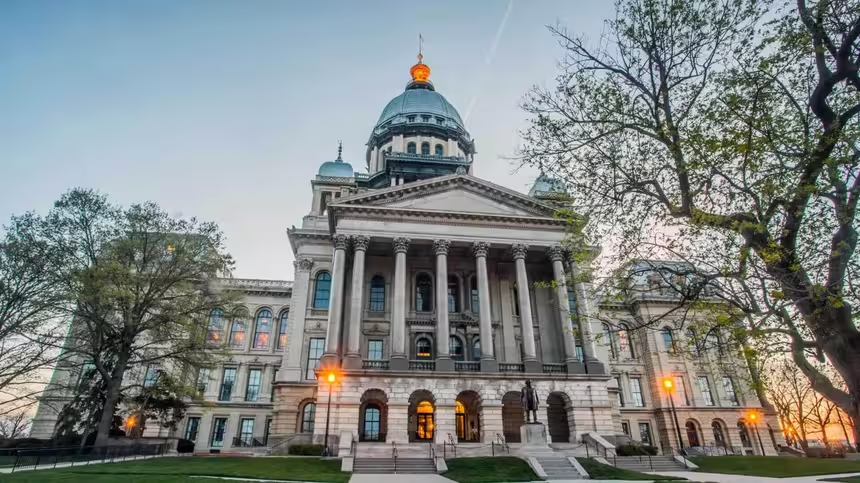
CapitolView is a weekly discussion of politics and government inside the Capitol, and around the state, with the Statehouse press corps. CapitolView is a production of WSIU Public Broadcasting.Providing Support for PBS.org
Learn Moreabout PBS online sponsorship(bright music) (camera beeping) (dramatic music) - Welcome to another edition of "Capitol View," our weekly look at the things happening inside and outside the Illinois State Capitol.
I'm Jennifer Fuller.
Our guests this week are Kent Redfield, Emeritus Political Science Professor at the University of Illinois Springfield and Jeremy Gorner of the "Chicago Tribune."
Gentlemen, thanks for taking the time.
- Good to be here.
- Good to be here.
- We've spent a couple of weeks talking about this, and I know a lot of people are paying attention.
Let's get caught up on the ComEd 4 trial, that bribery trial in federal court in the city in Chicago that really involves not just lobbyists and former executives at ComEd, but also potentially, former Illinois House Speaker Michael Madigan.
Jeremy, I know you've paid quite a bit of attention to this.
In the testimony that we've heard this week, have you been surprised at all?
Has anything stood out as, oh dear, this really does not bode well for one side or the other?
- I think it's hard to say and not to sound cliched, I know it's gonna be for a jury to decide, but as someone like myself who is an outsider, I think what was very telling is that we actually got a real glimpse of what it looked like, a little snapshot of how business is done in Springfield.
From time to time, it has been done over the years from time to time under, under former Speaker Madigan.
Some of these recordings revealed, just nonchalantly, defendants, including one individual, who flipped for the government, just talking routinely about swapping one subcontractor to do work for another and talking up questioning the competence of one and why another one is incompetent and we need to do something about that.
And we're also seeing, as we saw in court filings before the trial, that these were individuals who were getting paid a lot of money each month, in at least one case, $5,000 a month, to not really do a lot of work at all.
I think that what you're gonna... And some of this was discussed on recordings obviously between one or all the defendants, and Fidel Marquez, who was a former senior VP for ComEd, who the FBI approached in 2019, and himself was charged in this bribery scheme, pleaded guilty, but in exchange for his cooperation with the government and testifying truthfully, he won't face any prison time most likely.
So, but the question is, does one plus one equal two?
Is this just merely an example of political lobbying at its finest and was there anything illegal about it?
That again, is for a jury to decide, and we haven't really seen the defense present its case yet.
We've just heard, in opening arguments, what they plan to prove or disprove with the lack of evidence.
The only thing I will say is that, this case being tried in the northern district of Illinois, they historically have a historically high conviction rate, especially when it comes to public corruption cases.
But still, not to say these defendants have very good lawyers themselves, so we'll see.
- Kent, this is certainly not your first rodeo when it comes to watching public corruption cases come before a federal judge or a federal jury.
Is anything standing out to you as different this time around?
Or what are you watching for when it comes to not just this trial, but potentially the trial that's scheduled for next year of the former Illinois House Speaker?
- I'm kind of struck by two things.
One of 'em, just to date myself a little bit, I go back to '75 and when I came to Illinois, and so that was really the start of a transition away from political corruption based in patronage that was based in government jobs.
And so, you had jobs in the Department of Transportation or the Secretary of State's Office or back in the city of Chicago in the various agencies, and you didn't deal a lot with government contractors and certainly, you were exchanging money with lobbyists and with companies.
But, there were plenty of jobs sitting around to take care of people in terms of... And when patronage was the basis of you getting elected and not because they would go out and run the campaigns, rather than having to have a lot of money to run TV and those kinds of things.
And so, we switched to what we used to call this back in the 80s and 90s would've been pinstripe patronage, where you went to the contractors and the jobs and you were raising money and dealing with favors partially because we had Supreme Court decisions and other things that made it much more difficult.
And eventually, we got with the Rotan decision, you really are not supposed to use political affiliation for hiring, promoting, transferring, those sorts of things.
So, this is a different...
I mean, this is the way things are done, but it is a different iteration from the way that political patronage and lobbying operated at different times in Illinois' history.
There's a strain of corruption there, absolutely, but the mechanics of it have changed pretty dramatically.
The other thing is, again, we connect the dots, and right now we have the prosecution's case, and we can get right to Madigan.
The question is, what exactly can you prove when you get past the defense and however this trial turns out.
Obviously, if a number, one or more of these people get convicted, you might get a cooperating witness.
But, there certainly is a case that the people who work for powerful people often go into business themselves.
And so, whether or not you can actually make those connections, I think Jeremy's exactly right, it's what can you sell a jury.
And I've seen cases in Springfield where you got the people that were bribing the agency people and the agency people, and then when you got up into the top of the agency and headed for the Governor's Office, and it just became about power, and there's nothing tangible.
Did somebody make money off of this?
What did they get out of this?
That was hard to sell to a Springfield jury in one particular case, and so I don't think, you know, you shouldn't make assumptions.
I think the amount of tape and recordings and stuff at this point is overwhelming.
It's much greater than what you had in terms of the Blagojevich trial.
And so, those things have, I've been really surprised at how much they got on tape, and obviously, you get to a point when you've done this enough that you start to feel like it's routine, and you're bulletproof.
And so, that may be part of why we're sitting here is if people got lazy and let their guard down.
- We'll continue to keep an eye on this trial, and of course, looking ahead to next year when the indicted former house speaker is scheduled to go on trial also in the city of Chicago and federal court.
Now, last week we talked about the fact that it was deadline week for the Illinois House for bills to be passed out of that chamber to the Senate.
This week it's the Senate's turn.
Senate bills have to be passed out of that chamber into the House in order to really have a good chance of getting to the Governor's desk sometime this spring or early summer.
Now, of course, legislation can still pass at any time.
The leadership can call a bill at any time that they want.
But I wonder, Jeremy, if things seem different this year or if there are issues that you think aren't being addressed or perhaps are being addressed in a different way than you expected?
- Yeah, Jen, there really haven't been any issues that have been highlighted so vigorously that we've seen in past years.
It's not like 2021 where the Safety Act was to the forefront of everything.
I think that a lot of what, for example, something of that magnitude.
I think that a lot of the bills that were super significant that we have seen passed this year, and I'm not talking about this session, I'm talking about this year, happened in lame duck, I mean, stuff like that.
I believe that the paid work leave, and I believe that passed- - [Jen] The assault weapons ban.
- Yeah, yeah, yeah, and then of course, in the last six months with the assault weapon, and then the assault weapons ban of course, was the big thing.
I think that it's really kind of hard to top such a monumental bill, like the assault weapons ban.
And I think part of the reason that we just haven't seen a lot of bills get attention is because they've been overshadowed, and I think, myself in the media has something to do with it, but it is what it is, is that this assault weapons ban is tied up in the courts.
It's tied up in federal court.
You have people questioning, a lot of gun rights advocates questioning its constitutionality at the Second Amendment and on the state level with whether it violates the Equal Protection clause of the Illinois Constitution.
So you have a bunch of lawsuits that are really dominating the news cycle when it comes to anything related to Springfield, where I think a lot of these other bills, yeah, they're not getting as much attention, because they haven't had as much, we just haven't seen the magnitude of importance yet.
But, not to say a lot of these bills really are very important and are getting some attention.
Like last week, we saw a bill that would allow for the creation of gender-neutral bathroom, multi occupancy, gender neutral bathrooms.
That passed through the House.
It passed narrowly, but that's a bill that has been tried before and failed, but we'll see what happens in the Senate with that.
And then when you talk about the culture, that's something that's been a big issue with the culture wars that we have seen nationally.
And also, Secretary Giannoulias' push for a bill that would allow for his office to deny grants to public and school libraries that ban books.
That's something else that passed through the House that's gotten a lot of attention, but really because of the issue itself.
Because anything dealing with censorship and book bans has become a national issue, and it's only become more, it's only highlighted more of the divide between Democrats like Giannoulias and Republicans on the local and national levels.
So those are the types of bills we're seeing that have gotten the most attention.
But with the Senate, it's kind of early, they, obviously, it's my understanding, and Kent back me up, Senate doesn't have as many bills as the House does.
So yeah, so again, it's only Thursday, and we'll see what happens by the end of tomorrow night if they get through third readings.
Kent would know better that obviously doesn't happen all the time, but yeah.
- Sure, Kent, I'm going to move on to you, because that's an interesting point.
The Senate has fewer bills that it's taking a look at.
A lot of times it waits for those issues to come out of the House to consider rather than sending original legislation from the Senate to the House.
Does it look different this year to you?
- It does a little bit.
It's always a management issue in terms of leadership and Harmon has been there for a couple of cycles now that Welsh is getting through, this is his second cycle.
And you're coming out of an era where there was tremendous control over the amount of legislation, got out of the committee and on the floor.
And again, to put on the gray beard, Madigan became speaker after Bill Redmond became speaker Bill Redmond was a back bencher who allowed, really felt like the average member didn't get his bills heard, and he opened up the process.
And when I worked there, it was chaos, and if you know one thing about Mike Madigan, he likes order and control.
And so, Madigan's rules were about exercising control and discipline over the legislature.
To get to the posture of where we got last week in the House, where we had members that have left town, the Democrats had a big majority, but they didn't have enough people who were still there to get over, essentially a quorum, and the Republicans to call them on it.
For better or worse, that never would've happened under Speaker Madigan.
Now I think obviously, there's an in between there where you need to be able to allow ideas and members to get their bills out there, but you have to manage the flow of information, I mean, the flow of business.
Because if you let everybody get their bill out and debate every bill, you have chaos, and you're here, we used to routinely go into overtime, into past July and sometimes into August.
And so, part of this is just working it out, but I think the most important point is we handled the heavy stuff early, and the big things got done early in the session rather than waiting happens.
So Jeremy was exactly right in terms of that's a different pattern that we've seen for two cycles, the old cycle, the previous cycle, and this one was not the case of how we did business in the previous regimes.
- Still, you both mentioned the fact that we have these super majorities, both in the House and the Senate, and the leadership there is obviously controlling the process.
We're hearing from Republicans, both in the House and the Senate saying, "Wait a minute, "you're not talking about issues that are important to us "and important to our constituents," whether it's a geographic issue or a political issue, because as people are well aware, most of the Republicans are in the downstate area.
Most of the Democratic leadership and representation is in the city of Chicago and its surrounding counties.
So do you think that that talk of bipartisanship, as we saw new leadership moving into each chamber, has melted away, or is that still something that Leader Curran and Leader McCombie are still hoping to get back to, more of a conversation and more of a seat at the table for their party?
Jeremy, I'll start with you on that one.
- Okay, okay, well I think that that's a goal obviously.
Everybody was singing Kumbaya at the inauguration.
That was kind of the overarching theme for the most part, is that we're gonna work together, and then what we've seen in past sessions is that within a few months, things fizzle out, and then the Democrats do their own thing, and the Republicans do their own thing.
But you have two new leaders in the Republican caucuses in the House and the Senate, and you'd think that it would be in their best interest to obviously wanna work more closely with the Democrats, because if they have any hope of getting anything done on their side, they're going to need democratic support, and they've accepted that, I would think.
They're the ones with the super majorities, and that only became stronger in the last election.
And what you also see with the Tony McCombie and John Curran is that they are pretty moderate, and they have shown signs and willingness to work with the other side of the aisle and have respect from the other side of the aisle.
But I also think that they understand too that because the super majorities have only weakened the GOP even further, then if there's anything that they're gonna want to accomplish, they're going to need that blessing from Welch's side for sure and from Harmon's side.
- Certainly, as we move on to another topic, Jeremy, you brought up the issue of the assault weapons ban that is still being moved through the Illinois court system, the Illinois Supreme Court has heard some, both on the Safety Act and on the Assault Weapons Ban.
Of course, we'll watch this constitutional question go through the federal courts.
This week, the Illinois gun lobby had its annual advocacy day at the Capitol.
This happens every year.
It was not a new protest or demonstration.
The Illinois Gun Owners Lobby Day comes up each spring.
Do you think that the message was changed in any way because of these lawsuits and because of this potential new assault weapons ban that could go into effect here?
- I don't think it changed, but I think it gave gun rights supporters more of an excuse to get riled up, for sure, whatever that's worth, and not just that, but anytime we also see a national tragedy like we did in Nashville earlier this week, of course, with the six horrible deaths at the school in Nashville, whenever you see tragedies like that on a national scale involving gun violence, that's when gun rights advocates come out and feel like whoever is in power, especially feel like the Democrats who are in power on the national level, are gonna try to do whatever they can to take their guns away.
That's always been like a rallying cry whenever something like this happens.
I think it would be a little difficult for any meaningful, at least a meaningful meaning for the Democrats to pass anything gun control-related the way that Congress is made up these days.
But definitely, this was probably something that maybe riled up the gun rights advocates more because of what happened in Nashville, and also because of these looming lawsuits in the court system, because this wouldn't...
When that law passed in January, when Pritzker signed it into law, Illinois was, what, the 9th state to pass an assault weapons ban, I mean, nine out of 50?
Yeah, if I was a gun rights advocate in Illinois, I would probably be upset about that too, and I'm gonna do whatever I can to try to preserve my rights.
So I think that the message though was different.
The message was more intensified because of what I just said, but I think that it wasn't different in that some of the rhetoric you heard outside the Lincoln statue yesterday from some of the GOP lawmakers is well, we need to do something about criminals and mental health and supporting law enforcement as opposed to taking guns away from law abiding citizens.
This is the same kind of message you hear from gun rights advocates.
So yeah, and just to clarify, when I said Democrats are gonna take Republicans guns away, obviously, there are Democrats who are gun rights advocates too.
But back to what happened yesterday, I think a lot of the same messaging that you hear come out of gun rights advocates, come from gun rights advocates, you heard yesterday on the Lincoln steps.
It's just that they really had more, I think of a mission, more of a purpose to carry out that message because of what happened in Nashville and because of what the state legislature did by passing the assault weapons ban.
- Kent, there's been some reporting, both at the state and the national level that it makes it appear that the two sides, a gun rights lobby and an assault weapons ban advocacy side of things are dug in and not willing to really move much on their stances.
What's it gonna take to move the needle on this, both at the state or the federal level?
- There's some clarification from the US Supreme Court in terms of what the parameters are, and that's not clear.
We don't know exactly how they will or will not deal with the assault weapons ban, and that's a couple year process in order to get stuff through the federal courts up to the Supreme Court level, so that's an issue.
Whether or not you continue to have an escalation so that there is more and more shootings, more and more deaths, there may be a tipping point there.
And then, there are significant differences between being in a pro-gun state in terms of the legislature versus a gun control state in terms of the legislature.
And there's a management issue for if you're the head of a gun rights organization, and you're in Illinois, and you've been able to say, "Give me money, join the cause, and we beat back "all of this gun control legislation, "and so you need to be strong, "and we'll keep the legislature from doing bad things."
Now all of a sudden with the Democratic supermajority, we have an assault weapons ban.
And so, that makes it a little harder to say, make us more effective on the state level, it shifts attention nationally.
And so, the gun rights groups in Illinois have to think about, how do I get my message across and keep my membership when I can't promise my membership that I can stop bad things from happening in Springfield?
'Cause they can't, bad things from their perspective, 'cause they can't do that anymore.
So, it's a complex situation depending on what states you're in and how you look at it.
- Finally, when we're looking at next week's elections, Jeremy, I wanted to give you a little bit of time.
I know you've done some reporting on some influence that you're seeing in downstate elections, things that normally wouldn't get a lot of attention.
- Well, right, particularly with school board elections.
These are elections that we really didn't see get too much attention over the years.
We're seeing that a lot more now just because of what's happening nationally with the so-called culture wars.
There's conversations about censorship in schools and what curriculum is good, what is bad, and what books should be banned and sex education standards.
Are they too extreme for some parents or not?
This is all coming to a head, and we're seeing a lot of money being poured in to some of these school board races, representing slates of candidates who probably identify more on the conservative side of things.
And then you have candidates who are endorsed by teachers unions, and obviously, conservatives and teachers unions have really been duking it out, not just in school board elections, that's been kind of a theme in municipal elections, especially in Chicago, so we're seeing that come to a head.
- We'll have to cut you there, Jeremy, and remind people that the election is coming up on April 4th.
Get out and vote, do your homework, and we'll talk a little bit more about those results coming up on the next "Capitol View."
Until then, I'm Jennifer Fuller.
You can find us online at wsiu.org, and we'll catch you next time.

- News and Public Affairs

Top journalists deliver compelling original analysis of the hour's headlines.

- News and Public Affairs

FRONTLINE is investigative journalism that questions, explains and changes our world.












Support for PBS provided by:
CapitolView is a local public television program presented by WSIU
CapitolView is a production of WSIU Public Broadcasting.