
Capitol View - May 16, 2024
5/16/2024 | 27m 4sVideo has Closed Captions
Capitol View - May 16, 2024
Jeff Williams talks with Charlie Wheeler and Peter Hancock about current events
Problems playing video? | Closed Captioning Feedback
Problems playing video? | Closed Captioning Feedback
CapitolView is a local public television program presented by WSIU
CapitolView is a production of WSIU Public Broadcasting.
Capitol View - May 16, 2024
5/16/2024 | 27m 4sVideo has Closed Captions
Jeff Williams talks with Charlie Wheeler and Peter Hancock about current events
Problems playing video? | Closed Captioning Feedback
How to Watch CapitolView
CapitolView is available to stream on pbs.org and the free PBS App, available on iPhone, Apple TV, Android TV, Android smartphones, Amazon Fire TV, Amazon Fire Tablet, Roku, Samsung Smart TV, and Vizio.
CapitolView
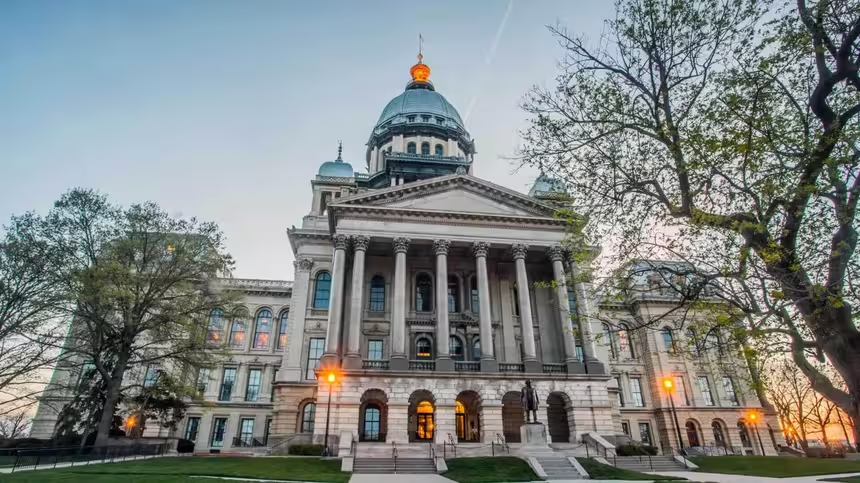
CapitolView is a weekly discussion of politics and government inside the Capitol, and around the state, with the Statehouse press corps. CapitolView is a production of WSIU Public Broadcasting.Providing Support for PBS.org
Learn Moreabout PBS online sponsorship(calm music) (camera beeping) (calm music continues) (powerful music) - Welcome to "CapitolView."
I'm Jeff Williams sitting again this week for Fred Martino.
Yeah, it is that time of year when the pace becomes frantic at the state capitol as we loom toward the end of the spring legislative session.
And of course, the dance of legislation goes round and round and round again some more.
So to help us keep from getting dizzy and to understand and give us some insight into where things are heading, our guest this week, the, well, the dean of State House, Charlie Wheeler, professor emeritus of the Public Affairs Reporting Program at the University of Illinois Springfield.
Welcome, Charlie.
Thank you for being here.
- [Charlie] Thank you.
It's always nice to be here with you guys.
- And last but definitely not least, Peter Hancock, State House reporter for "Capitol News Illinois."
Peter, welcome back.
- Thanks, Jeff.
Good to be here.
- Okay, let's jump right in, both feet, the budget.
It is probably the one piece of legislation that touches every corner of the state, and this time of year, I'm sure the usual negotiations are going on in the hallways behind closed doors, maybe at a couple local restaurants in the Springfield area, but there's a kind of a different wrinkle, or at least seemingly unique wrinkle this legislative session.
Last week, Deputy Governor Andy Manar sends a letter to state agency heads, and I guess effectively to the entire general assembly, that warning of a potential $800 million budget cut if lawmakers don't get on board with the governor's budget plan and a few revenue enhancements that he has built into this plan.
Charlie, I wanna start with you.
You've watched the budget process for many years.
This letter from Deputy Governor Manar almost seems like a shot across the bow.
How significant is this particular move in the legislative chess board that's going on right now?
- Part of it is the last several years has had pretty good revenue returns, and there hasn't been all that much pressure.
And now the governor's proposed a budget that includes increased spending in certain areas, but he says it depends on getting slightly more than a billion dollars in new revenues through different changes in the tax laws.
And apparently there is some reluctance on the part of some lawmakers, and I've suggested in other venues that it's maybe people who haven't been there long enough to know what it was like sort of back in the days.
But what Manar is saying, and it was sent to the agency directors, (no audio) I think was lawmakers is, "Well, if we we're not gonna be able to increase in some of the areas we'd like to, we're gonna actually have to go down," because the governor's like number one priority is to have a balanced budget and to continue the string of credit upgrades that we've been getting, oh, for the last three or four years.
As a matter of fact, the governor himself, I think it was yesterday, stressed that, that that's the bottom line for him.
He wants a balanced budget.
- One of the things I think that the governor may have mentioned in defending this letter to, Manar's letter in that, just that, he didn't want to have to rely on some of the budget gimmicks of the past where they come in and sweep accounts in order to fund the budget, do you- - Well, one of the funny things was, and this was years ago when I was still a reporter, there was a difference of like 50 million or a hundred million between what the general assembly wanted to spend and what Governor Thompson said is available.
So they decided, "Well, we'll just jack the revenue estimate by a hundred million, and everything's fine."
And we're not going back to those days, the governor, Governor Pritzker has made pretty clear.
- Peter, "Capitol News Illinois" last week was one of the news organizations that that broke the news on Manar's letter.
It's been out there a week now.
Are you seeing, what kind of impact has that had on the talks going on at this capitol on the budget?
- Well, there are still talks going on sort of behind the scenes.
These are not the conversations that they have out in the open where people can actually hear what they're saying.
But there obviously are some concerns.
Anytime you're raising taxes, or enhancing revenues as they like to say, there's going to be pushback.
In this case, there is pushback from the business community because one of the proposals he has concerns what's, a complicated thing called the net loss carryover, net operating loss carryforward.
It's a way of making sure businesses are taxed according to their average profits as opposed to the profits they see for any one year.
So if they lose money in one year, they can kind of spread that loss out over future years.
There was a, has been a cap on that.
He wants to extend the cap a little bit longer, so that has a fiscal impact.
He also wants to drastically increase the tax that the state levies on sportsbooks, sports gambling operators such as FanDuel and those kinds of businesses.
And he emphasizes we're not increasing the tax on the people who bet on sports games, only the companies that operate, you know, essentially the bookies.
And so without those two things, he says we're gonna have to cut 800 million.
Of course, you know, the other option is lawmakers could come up with their own ideas for how they wanna increase revenues, or they could start trimming the budget.
And this is kind of what you see in state government.
You know, it's not really complicated.
You have revenues on one side.
You have expenses on the other.
They've gotta balance.
If you don't wanna raise the revenues, then you've gotta cut the expenses.
If you wanna increase the expenses, you gotta find the revenue to pay for it somewhere.
So this is kind of normal bargaining that goes on as we're getting close to the final vote on the budget, and these are the decisions that have to be made.
- So these tax increases, enhancements, whatever you want to call them, the ones specifically that were referenced at least in the letter, if you put 'em on the scale and you're balancing public good for the citizens of the state of Illinois versus the potential negative impact for those individuals or businesses that are impacted, which way does the scale tip on this one, do you think?
- Well, that depends on who you ask.
You know, in the business community, the ability to carry forward your net losses from one year to the next, it makes a difference whether you're the mom and pop hardware store down on the corner or if you're Commonwealth Edison, you're gonna have a different sort of view on that.
The sportsbook, this brings up kind of an interesting philosophical argument because it amounts to what's called a surtax.
It's a tax, you know, a sin tax, a tax on one particular thing.
And usually there is some sort of nexus between the thing that you're taxing and what you're going to do with the revenue.
States, local governments often tax the gaming industry in order to fund programs to help treat people with a gambling addiction, for example.
We tax the liquor industry in order to fund alcohol abuse treatment programs.
In this case, there's really no nexus between taxing the sportsbooks and the revenue that the governor, he just wants to bring in general revenue and put it on the backs of this one particular industry.
And so that industry naturally is going to push back.
But it brings up, you know, there's an old saying in politics, "Don't tax me, don't tax thee.
Tax that other guy behind the tree."
Everybody wants to tax somebody else, just not me, and of course I don't wanna tax you.
So they find some other thing that hopefully everybody can get around besides the person being taxed.
- Sure, I wanted to ask too, specifically in the letter, Deputy Governor Manar, he really kind of highlighted, or suggested perhaps, look at cutting grants.
What is significant about in the, 'cause that seemed targeted.
He specifically said, "Let's look at, potentially look at grants collectively to come up with this 800 million if the budget doesn't go through."
What's the significance of targeting or at least suggesting that maybe that needs to come out of some grant money?
- I was gonna say, the state, this is the way the State of Illinois distributes a lot of money is in the form of grants.
The Department of Commerce and Economic Opportunity distributes grants to businesses, community organizations to perform certain things that the state needs to have done.
The Illinois Environmental Protection Agency gives grants to communities to do things that the state needs to have done.
And one of the ways you can trim the state budget is to trim back the grants that the state awards.
- [Charlie] I was gonna add also that oftentimes grants are things that are (no audio) one legislative district or one law.
If you go through the budget, there's, oh, there's hundreds and hundreds of items that are what back in the day used to be called legislative initiatives or more, what would you say, less elegantly, pork barrel projects.
And these are the things I think that Manar was also suggesting.
It's maybe not gonna be grants that go to local school districts to pay for transportation, but it could be the grant, Charlie Wheeler, that's going to your local community service agency to build a new building, that kind of thing.
- This is an election year.
Is there more pressure on lawmakers to not lose money that they're bringing home to their districts?
- I think there's pressure on 'em to stay out of the headlines as much as anything else.
You know, "Don't create bad news.
Don't get people upset."
More than anything else, they wanna end the legislative session as early as possible, get outta town, have a simple budget that doesn't stir any controversy.
And that's their primary goal in an election year is to not make news.
- So if something doesn't, well, we don't know what will happen exactly, but if something doesn't work out and there is soon to be some sort of mix of cuts in here, any idea yet as to who may be most impacted?
I know, I think the IEA or at least teachers, I think, have already gone on record as saying that these grants are important to aspects of what they do in education in the state of Illinois.
Who's potentially a loser?
- [Charlie] Well, there are a lot of asks on the table beyond what the governor's proposed.
Just, I think it was just yesterday, the House approved a plan that would provide $10,000-per-semester stipends to student teachers for them to have some (no audio).
- Charlie- - Teaching.
But it was noted, of course, oh, there's no more, the Chicago Public Schools, and Mayor Johnson won a billion dollars more for themselves, and the legislature is looking at maybe upping the 350 million that goes to the main education funding program, upping it to maybe 550 million.
There is a plan to provide child tax credits, $300 per child.
- Sure, and one of the other things that as this process does play out the Democrats, I think, have set, they have their deadline, and then of, course, there's the drop-dead kind of deadline that they have to make in order to pass the budget without having some sort of a, you know, a supermajority.
Is this one gonna go down to the wire, do you think?
- You know, at this point, I think it's really hard to tell.
We have one more full week left on the schedule, going through, I think, Friday, May 24th.
But then if you look at the calendar, it's all the rest of the days in the month of May.
You know, they said, "Yeah, we wanna try and get out by the 24th, but don't book any airline tickets for the 25th or 26th," 'cause those days are still penciled in.
So, you know, according to the constitution, they need to get things wrapped up by May 31st.
After May 31st, then it takes a supermajority to pass any legislation with an immediate effective date, such as a budget.
So there's a little bit of pressure on 'em from that respect, but you know, I think they're pretty much on schedule right now.
The hiccups that they're experiencing are just sort of normal, you know, it's part of the ebb and flow of any legislative session.
- Sure, there are a few other things going on besides the budget.
This week, the governor celebrated the state's Medicaid redetermination.
I believe he said about three million Medicaid recipients in the state have been re-certified.
We know the federal government put a pause on the annual recertification during the pandemic but notified states last year to resume those annual certifications.
How big of a deal is that?
What does that mean for the state of Illinois?
- Well, if you look at the state budget, there are really basically three things, three big things, K through 12 education, higher education, and healthcare, and that includes healthcare for state employees and retirees.
But Medicaid is one of the huge expenses in state government, and so yeah, it is a big deal.
The state was trying to keep as many people on the rolls as it possibly could, and for those who were taken off the rolls because they were no longer eligible, their goal was to find them something else, either find them employer-based insurance, find them Obamacare, marketplace insurance, find some other kind of coverage other than Medicaid.
And so, yeah, this was a huge deal when they lifted what was called the continuous enrollment rule during the pandemic, they lifted that last year.
And so on your anniversary date, whenever you were deemed eligible, you have to basically re-certify to make sure you're still eligible.
And yeah, quite a few people came off the rolls, probably because they got jobs, maybe because they just didn't answer the letters or the emails or whatever saying you need to get re-certified.
But because of what they're saying is because of the efforts the state took, there were fewer people coming off the rolls than you might've seen in a lot of other states that didn't put forth that kind of effort.
- Yeah, Charlie, you've watched this for several years.
Illinois has always been fairly progressive, at least under Democratic administrations, where Medicaid is concerned, maybe more so than some of our surrounding neighbors.
Is this a kind of continuation of the state's philosophy, or has this been a major issue for the governor on getting this to this point?
(no audio) Charlie, sorry, having problems with your audio right now.
Peter, is this a significant continuation for what the state has been doing?
Or is this, like I say, is this something that the governor's just has deemed a priority to make sure the state is leading the nation when it comes to Medicaid and his, what he said, the closest thing he could get to universal healthcare?
- Yeah, I think this is one of the priorities of Governor Pritzker and of a lot of other governors.
His goal, if he had his preference, everybody in the state of Illinois would have some sort of coverage.
There would be universal coverage.
Of course, that was sort of the goal of Obamacare, which is now a decade old, was to get everybody covered either through Medicaid or through employer-based insurance or through subsidized insurance you could buy on the new marketplaces.
So yeah, this has been his priority, and so it was because of that that, you know, he ordered the Department of Healthcare and Family Services and other state agencies to put forth every effort to keep people on Medicaid if they could, and if they couldn't, if they were no longer eligible, which is kind of a good thing because their income has gone up or their circumstances have changed, just to make sure that they were covered somewhere else.
So yeah, this is a high priority.
And you know, the state of Illinois probably came out ahead of a lot of other states.
There were states like, you know, and in particular some Republican-led states like Florida and Texas that didn't put out that effort, and they saw their Medicaid rolls drop by a much larger percentage than Illinois did.
And I think in Republican-led states, those governors would also be cheering, saying, you know, "Look what we did to reduce the cost of state government."
So but yeah, in a blue state like Illinois, this was a priority of the governor, and so we, you know, this is how it came out.
- Sure, this is an election year, and there has been a, there was a change in the election law that I think was initiated by the governor.
And for those on the outside looking in that may not be familiar with all the minutiae of state election laws, this one's generated a little bit of controversy.
In fact, I think there, even this week there was a legal challenge filed against it.
Give us an idea of what it is that this is actually doing or will do and why it's creating such a controversy.
- Well, there was a little quirk in Illinois election law, and the more I, the longer I live in Illinois, the more I realize how many quirks there are.
But leading up to the primary, if nobody from, let's say, the Republican Party files to run in the primary in a particular district, a Democrat gets nominated, it will look like there's no, the Democrat is running unopposed.
So in those cases, under Illinois law, the Republican Party could then slate a candidate to fill that spot.
In other words, you could nominate a candidate without going through the trouble of running them in a primary.
And both parties have done this.
The new law says you can no longer do that.
If there's no candidate from a particular party by the time of the primary, then whoever jumps into the race after that has to run as an independent or as a write-in candidate, no more slating of candidates.
This appears to have had been prompted by one particular race in the Metro East area.
State Representative Katie Stuart, a Democrat from Edwardsville, I believe, was going to run unopposed, but the Republicans were slating a candidate to run against her because there was no Republican in the primary.
Now, it happens on both sides.
So yeah, both parties have been guilty of this.
And you know, if you wanna take an objective view of it, it's kind of undemocratic.
It's a way of getting around a primary.
If the party bosses have a candidate they wanna run but they don't wanna put him on the ballot 'cause he might draw opposition, just leave them off the ballot, let it go blank, and then you can slate that candidate later.
Like I said, both parties have done this, and so the new law says you can't do that anymore.
The problem was that they're changing the rules in the middle of an election cycle while, you know, there are races going on, there were people out there, you know, going through the process of getting slated, talking to their employers, talking to their families, and playing by the rules that existed at the time.
And so that looks a little bit weird, and it looks like, you know, they're trying to help this one particular candidate in one kind of swing-ish district in the Metro East area.
But anyway, you know, so it has been challenged.
We'll see, you know, what the courts have to say about it, yeah.
- And sort of the irony of the whole situation is that the candidate that the Democrats were worried about was gonna run against Katie Stuart, a guy named Jay Keeven, also of Edwardsville, he actually managed to file his petitions just a few hours before the law became officially active.
So the attempt to freeze him out didn't work, but there were a number of others.
There was a suit that was filed by four of these would-be Republican candidates who are charging that this is in an illegal attempt to block access to the ballot.
And the thing is, from watching this over the years, both parties have done it.
Former House speaker Mike Madigan was notorious, if you will, for waiting until the primaries were over and then looking and seeing which Republican candidates might be weak in which they could slate a Democrat to run against them.
So, and Republicans did the same thing back in the day.
So it's, and sort of an irony of it is that it was a quirk in Illinois law, not an accidental quirk, I would say.
And when Pritzker signed this, he suggested that this is kind of an ethics reform.
We can't have these backdoor deals going forward anymore.
So as I say, the person that they wanted to keep off the ballot managed to get his things filed.
Interestingly enough, the State Board of Elections has said they're still accepting nominating petitions for slated candidates until June 3rd, which was the deadline under the old law.
And they're gonna go ahead with the petition challenge process afterwards.
They're going to, in essence, kind of ignore the status of this law because it's now being challenged in court.
- Gentlemen, we've just a couple minutes or so left.
I wanted to give you both an opportunity, what's something you're looking for or expect to see in the next week or two as this session winds down?
What are you looking for?
- I'm looking for finalization of the budget.
I mean, that's the big thing that lawmakers have to get done before the end of the month.
And once again, we'll be looking at healthcare spending and K through 12 education spending in particular.
Public schools account for about 1/5 of the state budget, and we probably don't spend enough time talking about how much money that is and where it goes and what it does.
So that's gonna be the thing I'm paying the most attention to.
- Charlie?
- Well, I think I would agree with Peter that the main thing is the budget and getting it finalized, and I guess the deadline for getting it done, there's like three different deadlines, the one that Peter mentioned in theory, end of next week, then by the end of this month.
In reality, I guess the hard and fast budget would be when the new fiscal year starts on July 1st, although there've been times when we've run past that.
When I was a reporter, routinely, we would not finish up by June 30th.
We'd always run to July 1st or July 2nd.
And a few years ago, under Governor Bruce Rauner, there was a whole fiscal year we went without a budget, period.
But that's the number one thing.
I think education funding, to see where the, whether or not the advocates for increased school funding will be able to get additional money put into the formula.
I think another thing to watch, which probably won't happen, but there's ongoing talks about having to adjust, well, what's called the Tier 2 pensions.
A decade or so ago, the legislature made some changes in the state pension laws so that new hires after I believe it was January 1st of 2011 get fewer benefits and have to work longer than state employees who've been there a while.
So I'm retired now, and I'm under Tier 1, so I have a very generous benefit.
Folks who were hired after me, it's not quite so good.
And as a matter of fact, there's some concern that because the pensions are not as good as they used to be, they may not meet the requirements that private pension plans have to give benefits at least equal to social security, and if we don't, then we get problems.
And that's an issue going forward.
I think that's something to watch.
- Gentlemen, thank you very much for joining us this week on "CapitolView."
We are out of time.
Charlie Wheeler, Peter Hancock, "Capitol News Illinois," thank you both for joining us, and thank you at home for watching.
For Fred Martino, I'm Jeff Williams.
Have a good evening.
(inspiring music)

- News and Public Affairs

Top journalists deliver compelling original analysis of the hour's headlines.

- News and Public Affairs

FRONTLINE is investigative journalism that questions, explains and changes our world.












Support for PBS provided by:
CapitolView is a local public television program presented by WSIU
CapitolView is a production of WSIU Public Broadcasting.