
Capitol View - May 23, 2024
5/23/2024 | 26m 46sVideo has Closed Captions
Capitol View - May 23, 2024
Analysis of the week’s top stories with John Jackson of the Paul Simon Public Policy Institute and Hannah Meisel from Capitol News Illinois.
Problems playing video? | Closed Captioning Feedback
Problems playing video? | Closed Captioning Feedback
CapitolView is a local public television program presented by WSIU
CapitolView is a production of WSIU Public Broadcasting.
Capitol View - May 23, 2024
5/23/2024 | 26m 46sVideo has Closed Captions
Analysis of the week’s top stories with John Jackson of the Paul Simon Public Policy Institute and Hannah Meisel from Capitol News Illinois.
Problems playing video? | Closed Captioning Feedback
How to Watch CapitolView
CapitolView is available to stream on pbs.org and the free PBS App, available on iPhone, Apple TV, Android TV, Android smartphones, Amazon Fire TV, Amazon Fire Tablet, Roku, Samsung Smart TV, and Vizio.
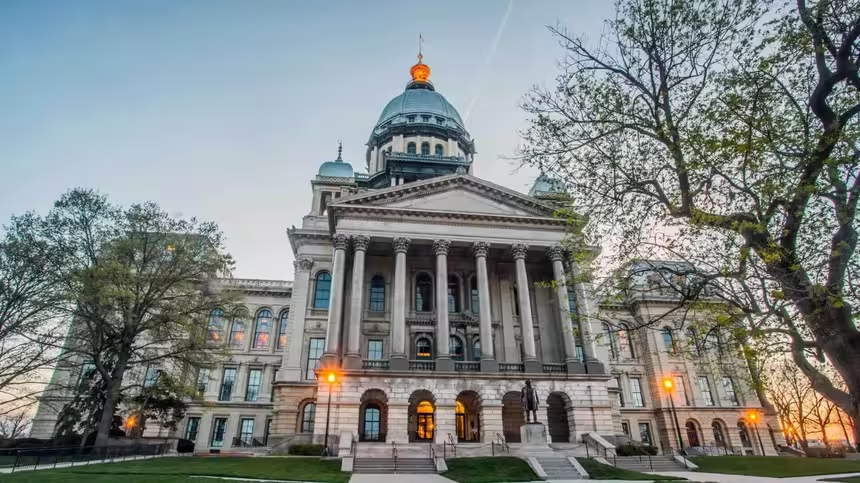
CapitolView
CapitolView is a weekly discussion of politics and government inside the Capitol, and around the state, with the Statehouse press corps. CapitolView is a production of WSIU Public Broadcasting.Providing Support for PBS.org
Learn Moreabout PBS online sponsorship(upbeat music) (camera clicking) (dramatic upbeat music) (dramatic upbeat music continues) - Thanks for joining us on "Capitol View."
I'm Fred Martino.
The Illinois General Assembly is supposed to adjourn this week, but as we record this on a Wednesday, there is no budget agreement.
Despite that, lots of bills have passed.
We're gonna have some highlights for you.
Plus, will Illinois pass incentives to help journalism in the state?
Those are just three of the topics that we will have for you with John Jackson of the Paul Simon Public Policy Institute at Southern Illinois University, Carbondale, and Hannah Meisel of "Capitol News Illinois."
John, the final week of the session and disagreements, of course, over tax policy and insurance reforms among other things.
What is your take on this and where is all of this going?
- Well, Fred, it's always hectic.
It's always stressful.
And occasionally it gets chaotic, as I'm sure Hannah can report up close and personal.
I'm sure there are all-nighters pulled by journalists and all kinds of legislators and staff.
And it's just a pressure cooker from now until the end.
And in the past, it has gotten to be really messy at the end.
One of the ways that's a classic legendary thing that they used to try to get out by the official deadline was they would come to the end of that day and they would stop the clock at midnight and pretend that time had stopped and that they really were not doing this in the next day, which of course they were.
And that just shows you the extreme.
The three tops, as they're called, are in charge.
The governor, the president of the Senate, and the Speaker of the House are trying to coordinate all of this and sometimes there are disagreements between those three players.
Sometimes there's disagreements within the Democratic party and the various factions that are pushing and shoving within the dominant party.
And so it's absolutely guaranteed to come down to the end.
This is especially true in the budget area because it was a couple of days ago that the governor announced that all of the revenue questions are still on the table.
And that question is a big one.
There are all kinds of proposals to spend money or to cut taxes, and the governor's pretty consistently insisted that they find some new money or they find a source if they're going to add to the budget, because he, above everything else, has been trying to protect the balanced budget and Illinois' credit rating, so.
- Yeah, and John, a lot of it is about that, right?
I mean, to get new revenue to balance the budget.
But one of the things that the governor proposed would probably be extremely popular with most voters.
Republicans have said this is something that they could support, some Republicans.
Getting rid of this 1% tax on groceries, something that is extraordinarily rare to tax, groceries.
Illinois does this.
Is this gonna die?
Do you think this will not make it?
- Well, it was extraordinarily popular when it was announced, but not surprisingly, the Illinois Municipal League weighed in against it and has been working very heavily against it.
And lots of mayors and lots of city managers have gotten on board with that because they're going to lose that revenue.
And the only way they can keep that revenue is then to pass it locally as a local ordinance.
So it's extremely unpopular in those local jurisdictions, where they've got to do something about that possible loss of revenue.
- Well, let me ask you, as a political analyst here, in a presidential election year, where turnout is very, a very big concern, is this a mistake for Democrats if they allow this to die?
This very, conceivably, very, very popular idea to get rid of the tax on groceries?
- Well, I'm not quite clear where it is right now.
I'm sure- - But is it a mistake politically, is what I'm asking?
Is that a mistake, if it does die, is that a mistake?
- Well, it would be something that the governor would very much like to do because if you assume that he's getting ready to run for president in '28, among progressives particularly, it's extremely popular.
There's no question about it.
But it's like everything else, it's gonna have pushback when you get the right interest involved.
And the mayors and the city managers and all of that are a formal group in the Illinois Municipal Association.
- Yes, yes, and of course, there's a proposal by the governor.
One of the biggest revenue increases is an increase on sports betting.
The tax on that, that would again, sin taxes, as they're called, are often very popular with voters.
Where do you think that's going to go?
- Well, sin taxes have always been popular, and this one is the industry that is just massively generating money, mostly for themselves, but also for states that can tax them, as we were just discussing before we went on the air, it's just exploded in terms of where it's available and the temptations that one has to gamble.
And this one's undoubtedly gonna be popular except with the Sports Betting Association, which is not going to be amused and not going to go quietly.
- And has a lot of money.
One final question for you before we move on.
Governor Pritzker also has proposed a variety of health insurance reforms.
There's been a lot of disagreement on these, controversy on these.
Where do you think that's all going?
Because he made that, you and I watched it together, John, his State of the State Address, he made that a really central, and some would argue, a powerful narrative in his speech.
- Well, again, if the governor's got ambition, this is a good side to be on because we're all aggravated with all kinds of the issues regarding how the insurance company treats us, the consumer and the patient, and so it was initially very popular, no doubt about it.
- Yeah.
Very interesting stuff.
Well, we will be watching and we'll see if this even wraps up this week.
Of course, the last time they had to extend the session.
Hannah, despite the troubles passing a budget, again, hundreds of bills have passed, including changes to the state's biometric data privacy law.
Tell us about that and the other highlights that you want to bring to us this week.
- All right, so just to rewind.
Back in 2008, before we lived in the world that we live in now with things like facial recognition, other, you know, voice recognition, Alexa, anything like that, was reality, back in 2008, the legislature passed this Biometric Information Privacy Act that said companies can't sell, you know, can't collect your data without it being, you know, you having given explicit permission.
But of course, back then, it was just kind of science fiction.
It was forward looking.
But now, we live in a world where, indeed, these tech companies especially collect data from us every day, every minute of the day it seems, as consumers, but also in private industry, a lot of companies collect biometric information from their employees.
Things like in hospitals, you have to unlock medicine cabinets with a fingerprint.
Other sorts of companies, you know, you might be accessing a cash register dozens of times a day and some companies have adopted some sort of biometric locks on there.
- Right.
- And so, increasingly, the business community has been very worried with a series of decisions by the Illinois Supreme Court in the last, I think, six years.
And finally last year, a pair of decisions from the Illinois Supreme Court really, really got the business community worried to a point where their concerns finally caught the ear of Democratic leaders in the legislature, who had been kind of swatting them aside for many years, saying, "You just wanna weaken this law."
But there was a clear conflict that came up last winter when the court said that, yes, in fact, every time a company collects a fingerprint, say voice print, anything else that's considered biometric data, that could constitute a separate violation, which under Illinois law could mean $1,000 fine if it was a negligent violation or even $5,000 if it was willful, which is very rare.
- So Hannah, what changes did they make?
What changes did the assembly make in what they just passed?
- Right, so the General Assembly passed a bill that's gonna make its way to the governor's desk that would clarify that it's not every time someone, you know, puts their fingerprint in, say, if I am at a job where I need fingerprint access to a cash register, it's the initial time that the fingerprint is collected.
And it also made it easier to get someone's signature, permission, rather, expanding the definition of digital signature to mean, you know, lots of things that you can agree to.
Business community is still divided over the law.
Some groups thought that it didn't go far enough.
They were concerned about things like data centers, which has become bigger business in Illinois, being liable.
Some wanted the law to be retroactive, but by and large, even the groups that are publicly opposed, they tell me that they're happy with this forward progress.
- Okay, any other bills that have passed that you wanna highlight quickly?
- Yeah, so there, I had written about this a couple months ago.
It was very interesting, the Prairie Band Potawatomi tribe, which back, you know, 170 years ago, had been effectively kicked out of Illinois, had their land stolen, taken, sold out from under them by the federal government.
There is a bill that's moving forward that would give them a state park up in DeKalb County.
This is one of several things that the tribe has aimed for.
Recently, last month, the federal government recognized them as a federally recognized tribe after many, many years of them spending money to get this land back.
And effectively, you know, having to join it together, do a lot of paperwork, and now the land is theirs.
This would give them even more land on top of that.
They say they would like to keep the state park as it is.
Other people have some suspicions that they would put, you know, do something like a casino there.
But the tribe's leader has said that in Illinois, casino, gaming, it's oversaturated.
- Okay, we will be watching.
Time moving quick this week.
About half of our time together has gone by, believe it or not.
Wanna move on to this.
New York recently passed tax credits to encourage more hiring of journalists.
John, probably a tough sell in a challenging budget year here, but Illinois lawmakers were also presented with a measure for journalism tax breaks and also scholarships.
Tell us about this.
- Well, for starters, I doubt any of us here on this broadcast would be opposed to encouraging journalists and the hiring of more journalists.
And probably much of our audience for this broadcast would be in favor of anything we can do.
The context is, of course, that journalism has been in dire straits for most of this century, and particularly, the print media have been stressed out, loss of subscribers, loss of advertising, competition, particularly from the social media.
The Medill School had a study recently that was quoted in one of those articles.
They found that one third of local outlets, print outlets, had closed in Illinois since 2005.
This is an 86% decline in newspaper jobs.
That is what's going on, not only in Illinois, but nationally, and it means that local news coverage and state news coverage have been the ones that have suffered and somebody's got to do something.
And there are some positive things being done, but as you said, the budget is tight and there's some questions about finding this money and where's it going to come from, one objection.
I want to add another though, that critics are saying, and this would be some industry journalism people, maybe we'll get to be too dependent on the state and state funding and maybe that will compromise us.
I will add on the other side of that argument, this is a great tradition in American politics and history, going back to Benjamin Franklin.
As you may know, he jealously guarded his access to the advertising that the state had to do to keep his little newspaper going.
And that's back to Ben Franklin.
(laughs) So official state announcements are still a big part of revenue for all kinds of local newspapers.
Those of us that are attuned to NPR and PBS and the Corporation for Public Broadcasting know just how important that can be.
And certainly, if you're watching this program, would probably support all of that.
But there are people who don't like any of those.
- Yeah, well, as is always the case, it seems, John, New York and California lead the way.
In this case, New York passing a bill for tax breaks for journalism.
We'll see if Illinois, if they don't do it this year, if they come up with this bill or another bill like it.
And we should point out that in New York, there's some controversy because nonprofit organizations were left out according to the way that it's in being interpreted, the way that the bill was put together.
So they're already talking about changes in New York, so we'll be watching here.
But you gave a good kind of overview of the national situation, which some would argue is even much worse than it appears with some of the numbers, because you have newspapers that still exist that may have one reporter.
That was the case in the town where I used to live.
The entire staff was gutted.
It has one reporter and that town is not small.
It's got about 115,000 people.
So very interesting situation and very alarming for those who care about journalism.
Very, very interesting stuff.
Hannah, we're gonna move to a story you wrote for "Capitol News Illinois."
You say that the nursing home industry is unlikely to see much help from Springfield right now.
Tell us about that.
- Well, we're in the midst of a tough budget year.
And also two years ago, the general assembly gave nursing homes kind of a leg up with, I should say, a lift, with a Medicaid redetermination that gave nursing homes more money than they were previously getting.
Of course, the industry argues, "Thank you, but that only brings us up to 2017 levels.
And after the pandemic, we are still struggling."
A couple of things happened in the pandemic that have left the industry still grappling and kind of at a loss what to do.
You know, the first one is that, patient censuses have actually dropped.
In the old days, when it used to be kind of more normal for folks to go to live out their final years in nursing homes, regardless of their health level, you would have a mix of private payers and Medicare, Medicaid.
But as wealthier people are opting to stay in their homes, you have nursing homes that are more reliant on Medicaid.
So that's one.
Number two, we've seen inflation soar, especially in these last few years since 2022.
That's no exception on the healthcare front.
And so the homes are still grappling with those costs, even as inflation has slowed and come down.
And number three, you have seen like a mass exodus of folks leaving the healthcare industry, but especially from nursing homes.
These are the hardest jobs in healthcare.
RNs, CNAs, doctors, especially in nursing homes, this is just, the level of care that's needed for these patients, 'cause as I mentioned, the census is now sicker and poorer and they haven't had the level of care throughout their life, and so their symptoms are just more acute.
And so you have this significant staffing shortage.
To fill in the gaps, a lot of nursing homes have needed to depend on, you know, contract workers that these agencies that dole out these RNs and CNAs, they charge exorbitant costs.
Not all the money is going to the RNs and CNAs.
You could be paying almost double what you have, what you'd be paying if you had someone on staff, if you have to go through an agency.
And so the nursing homes are asking for, of course, more money.
They're asking for quicker payment.
The state, a couple years ago, along with that more money from Medicaid, they did set up a fund to have providers educate CNAs so they would have a stronger pipeline of workers.
But you know, they say that, "Well, thank you, but we're being paid six months late."
And so, but it really is unlikely that in a tough budget year, the industry is gonna get a ton of help from the state, especially given that two years ago, they were given this, you know, $700 million more, but their needs are just so great.
Now, one area that might help is the General Assembly is looking at a bit of property tax relief.
In Cook County especially, some of these, they're not classified the same way as other residential healthcare facilities.
And so they would like to be classified that way.
The governor last year vetoed a bill that would do just that, calling it kind of special care for the industry.
But there might be some property tax relief on the horizon.
And also there is a bill that, you know, we see these kinds of bills come up every year in Springfield that would kind of give some folks in healthcare who don't have as high certifications as, say, a full doctor or an anesthetist, give them a bit more responsibility to ease the burden on folks who are rare.
So in this case, it would be, CNAs could give out some medication that is more routine, doesn't have to be as closely monitored, to free up RNs to do more of their care work.
So we'll see where that- - Well, I'm sure you will be watching this, Hannah, and hopefully we'll have an update for folks once the session concludes as to whether any of the ideas have gone forward.
And we should mention, in our final minutes, before we get to our last story, some context.
Some of this is also self-inflicted, folks would argue, because Illinois does not participate in a compact that allows folks who move to Illinois and have an RN license from another state, it does not allow you to get an Illinois license immediately.
You have to take the boards in Illinois.
So that's another measure that has come up in the past.
John, three minutes left.
We move now to a column by Rich Miller.
He wrote about efforts to tackle a difficult problem.
The Illinois Department of Financial and Professional Regulation backlog in approving first time licenses and renewals in a timely fashion for nurses and social workers.
What is going on?
- Well, Rich's column is based on research by his associate, Isabel Miller.
And she found that this Department of the Financial and Professional Regulations had a backlog of up to one year and even 18 months for both certification of nurses and social workers.
And obviously, there is a real shortage in both fields.
And the people who are concerned about this are also pointing out though that they're going to have to have more personnel.
Her research found that there were currently only eight people statewide doing this.
And what they said they need is at least 28, which the governor has supported.
And the question is, can they get this and the money to fund that, to address this continuing shortage in nurses and in social workers?
One more need for more money.
- And there are so many, but John, you know, as Hannah just detailed in the nursing home industry, many people are arguing this is a crisis that's only going to get worse and worse with an aging population.
And perhaps the failure to make it easier for people to work here in certain healthcare fields.
Do you think action will be taken on this, despite the budget issue?
- Well, I think sooner or later it absolutely has to be because you just can't have people moving to another state or choosing to make their first time home after getting a very expensive education in nursing, for example.
So I think sooner or later, the legislature's got to act on it.
- Very interesting stories this week and we will continue to be watching.
We appreciate both of your insights.
John and Hannah, thank you both for being with us.
- I'm glad to be here.
- Thank you.
- Thank you, and be sure to join us for "Illinois Lawmakers" Friday night at 7:30 for much more on the latest from the Illinois General Assembly.
Thank you so much for being with us at home.
For everyone at WSIU, I'm Fred Martino.
Have a great week.
(dramatic upbeat music) (dramatic upbeat music continues)

- News and Public Affairs

Top journalists deliver compelling original analysis of the hour's headlines.

- News and Public Affairs

FRONTLINE is investigative journalism that questions, explains and changes our world.












Support for PBS provided by:
CapitolView is a local public television program presented by WSIU
CapitolView is a production of WSIU Public Broadcasting.