
Capitol View - May 30, 2024
5/30/2024 | 26m 46sVideo has Closed Captions
Capitol View - May 30, 2024
Analysis of the week’s top stories with Dan Petrella of the Chicago Tribune and Andrew Adams of Capitol News Illinois.
Problems playing video? | Closed Captioning Feedback
Problems playing video? | Closed Captioning Feedback
CapitolView is a local public television program presented by WSIU
CapitolView is a production of WSIU Public Broadcasting.
Capitol View - May 30, 2024
5/30/2024 | 26m 46sVideo has Closed Captions
Analysis of the week’s top stories with Dan Petrella of the Chicago Tribune and Andrew Adams of Capitol News Illinois.
Problems playing video? | Closed Captioning Feedback
How to Watch CapitolView
CapitolView is available to stream on pbs.org and the free PBS App, available on iPhone, Apple TV, Android TV, Android smartphones, Amazon Fire TV, Amazon Fire Tablet, Roku, Samsung Smart TV, and Vizio.
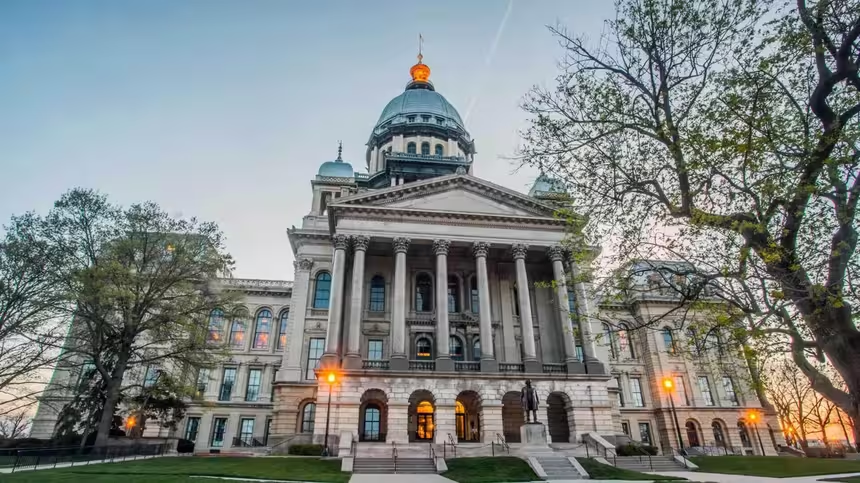
CapitolView
CapitolView is a weekly discussion of politics and government inside the Capitol, and around the state, with the Statehouse press corps. CapitolView is a production of WSIU Public Broadcasting.Providing Support for PBS.org
Learn Moreabout PBS online sponsorship(bright music) - Thanks for joining us on "CapitolView", I'm Fred Martino.
The Illinois General Assembly wrapped up its work with a budget agreement, we'll have more including the agreement to eliminate the state's 1% tax on groceries starting in 2026.
And we will tell you about some tax increases, including a higher tax on sports betting.
Plus, Governor J.B. Pritzker is still clashing with the state senate over the parole board, we'll take a closer look at that.
Those are some of the topics we are covering with Dan Petrella of the Chicago Tribune and Andrew Adams of Capitol News Illinois.
Andrew, I wanna start with you and the tax implications for the budget.
As I said, the grocery tax will be eliminated in 2026, but some other taxes are going up, tell us more.
- Sure, and one note on the grocery tax, there is a provision in this budget that does allow for cities to reimpose that grocery tax.
And if it's a home rule city, they could even increase it up to 2% from 1%.
So for folks following that, make sure to watch your local city council to see if you'll end up with a grocery tax after all.
But in terms of the state's revenue, the state's taxes, there are several new provisions that the budget's proponents hope or say will help balance this year's budget.
Now, none of this really affects individuals, so your income tax, my income tax, those won't be going up.
But for certain companies and particularly certain kinds of companies, their taxes are likely to be affected.
The biggest slice of this pie is an extension of the corporation's net loss deduction.
So a company that loses money in a given year can basically carry that over to a future year where they'll be profitable and count that as a deduction.
That was capped during the pandemic and state lawmakers have extended that in order to maintain that revenue.
Another big slice that has caused controversy in Springfield is a new tax on sports betting.
So this is not a tax on the better, but rather on the company.
So think FanDuels or DraftKings, they will be paying higher tax on their revenue.
Currently, Illinois tax is about 15%, that will go up to between 20 and 40% in a progressive tax scheme.
So the more money a company makes, the higher tax rate they'll pay and that's expected to generate several hundred million dollars in revenue for the state as well.
There are a few other provisions all generating slightly smaller amounts summing up to about a billion dollars of new revenue, depending on how you count.
Worth noting, one element that caused kind of partisan fighting this week has been transfers between state funds that democrats in the legislative super majority have called revenue enhancements to relieve budgeting pressures, but Republicans have criticized as being gimmicks in order to make an unbalanced budget look balanced in their view.
That includes a transfer from the road fund to pay for public transit agencies and a transfer from a fund meant for remediating polluted storage tanks at places like gas stations to the General Revenue Fund to relieve some pressure there.
And that's been criticized, but these are just high level top line items from a $53 billion budget, there is plenty more to talk about.
- Yes, big money, big money, another record when it comes to the total that the state of Illinois is spending.
Dan, I wanna move to some other items in the budget, including the healthcare debt relief that was mentioned in Governor J.B. Pritzker's State of the State address a few months back.
And for that matter, some health insurance changes as well that the governor promoted in his State of the State address and promoted vigorously, I mean, that was a real centerpiece of his speech, and he was, for the most part, it looks like successful in convincing the general assembly these were good ideas.
- Yeah, that's right, and, you know, he not only promoted those insurance changes he would call reforms in the speech, but throughout the spring, kind of took the show on the road and made lots of stops at hospitals and healthcare centers and places all around the state promoting this plan.
So let's start with the medical debt relief plan, which is sort of modeled on something that was done in Cook County previously with some of the COVID relief money that the county got.
Basically, they used federal funds, which is what the state is planning to do as well, to pay off folks' medical debt, which they say the state will spend about $10 million and will save with folks a billion dollars over time in medical debts, this is done through a nonprofit.
Worth noting, The New York Times had a story a couple months ago about a study that was done on this nonprofit that they're using to do this, that sort of questioned how much of an impact this sort of relief really has in individuals' lives.
So it'll be interesting to see sort of if it delivers the relief to folks that the governor's promising.
- Yeah, and, Dan, just to say again.
you said this is the state is using federal money for this debt relief, correct?
Is that what you said?
- That is my understanding, yes.
- Okay, all right.
- Yes, and then on the insurance front, the governor really is trying to crack down on some what they see as sort of nefarious practices in the health insurance industry.
This received a lot of pushback from insurance companies throughout the spring legislative session, but sort of the marquee items are an end to what's referred to as step therapy, which is basically like, you know, say you injure your shoulder and your orthopedic doctor tells you, "Oh, you should really get surgery," but your insurance company says, "Well, no, why don't you try some physical therapy first?"
Or, you know, your doctor prescribes a certain medication but your insurance company says, "Well, why don't you try this other cheaper medication first?"
And that had a little bit broader support in the legislature, and then they broke out one part of it into a separate bill, and that is eliminating what are referred to sort of derisively as junk insurance plans, these are short-term insurance plans that have, you know, low copays, I mean, low deductibles, low premiums, that's the word I'm looking for, but also don't offer a lot of coverage, they are exempt from a lot of the requirements of other long-term health insurance plans that are part of the Affordable Care Act.
And the argument against these is that people, you know, who are between jobs and maybe don't wanna pay for the COBRA coverage from their former employer that can be very expensive, get these lower cost plans, but then find out when they have some sort of medical emergency that things that they thought were covered really aren't, and they end up with huge hospital bills anyway.
These are both, you know, good progressive election year kind of things that I'm sure we will be hearing a lot about from the governor and other Democrats between now and November, even though the governor is not on the ballot this year, but I'm sure as he is, you know, promoting other democratic candidates around the state between now and election day, we will hear a lot about both of these items.
- Yeah, super interesting.
And for anyone who's ever been in the situation that you described where your doctor recommends a certain therapy, but your insurance company disagrees, or a doctor recommends a certain drug and you go to the pharmacy and have to get an alternative drug for something because of money, it's a powerful and one would wonder and maybe part of this political calculation as well, in terms of looking at these issues and certainly advocating for change.
- Absolutely, and, you know, there's picking insurance companies as a political foil is a pretty savvy move.
I think, you know, you're not gonna get a lot of sympathy for insurance companies from most folks, regardless of where they fall on the political spectrum.
- Okay, very interesting.
Andrew, you reported for Capital News Illinois on efforts to regulate the carbon capture industry.
Bring us an update on that.
- Absolutely, and thank you for asking the question, I've been covering this for a little over a year now and I could go on for an hour, but I'll try to be brief.
- [Fred] Not an hour.
(all laughing) - For the uninitiated, carbon capture is a process, a technology where you take carbon dioxide, usually from some kind of industrial plant, like an ethanol processing plant, put it through a pipeline and then bury it deep underground, usually more than a mile underground in the bedrock of Illinois.
And Illinois has uniquely good geography for this, or geology for this, rather.
So there's been a lot of interest from private companies in developing these carbon capture projects over the past few years.
The only issue is that there's been a lot of pushback from large landowners, people who live in the areas where these pipelines and sequestration sites would be, and environmentalists, but lawmakers at the general assembly and an unusual group of advocates backed one bill that would institute a new set of regulations for this, you know, emerging industry and put in place a two year kind of pause on the development of these projects while the federal government finalizes some safety regulations around this.
And safety's a huge issue, a few years ago, a pipeline carrying carbon dioxide burst and unfortunately hospitalized about four dozen people and required evacuations from hundreds more.
Carbon dioxide, when it's released, can be lethal and, you know, an odorless invisible gas so it's very hard to deal with.
But proponents of this bill, which passed with both bipartisan support and bipartisan opposition.
Proponents say that the stringent testing and monitoring requirements that it lays out should mitigate a bunch of this risk and a new series of funds for the state paid into by the companies that do these projects will provide training and equipment for first responders.
And this can be a uniquely tricky situation to deal with if a pipeline like this were to burst because, you know, carbon dioxide is heavier than air and does not burn in internal combustion engines.
Meaning that if the carbon dioxide is thick enough or close enough to the site of a leak, you can't drive an ambulance there, which, you know, has many people concerned.
One thing I'll note about this debate over carbon dioxide storage is that some of the most heated opposition in the legislature came from folks representing the area that has the Mahomet Aquifer.
That's a source of groundwater in east central Illinois.
It serves, depending on the month, between 500 to 800,000 people as the sole source of water.
And there are no specific protections for the Mahomet Aquifer in this bill.
And that has some concerned because other gas injection technologies have in the past polluted portions of the aquifer, which has people who represent that area very concerned that if we inject carbon dioxide into that area, it could have adverse effects on that drinking water source.
Now, proponents of the bill say that the moderating is enough to mitigate the risk, but that's really a we will see kind of situation.
- Yes, we will see, and I'm sure you'll keep watching that and seeing how that oversight plays out as it begins.
Dan, in a story in The Chicago Tribune this week, you reported Governor J.B. Pritzker is still clashing with some officials over the Illinois Parole Board.
What is this about?
- That's right, this is sort of a long running dispute between the governor and mainly the Illinois Senate, Republicans and Democrats in the Senate.
And it goes back to the last election year 2022 when republicans were really hammering Democrats both here in Illinois and across the country on issues of crime, you know, there was this large crime spike during the pandemic and one of their election year lines of attack for the GOP was Democrats are soft on crime, we needed to do more to hold people accountable, et cetera.
And this sort of came to a head in the Senate when a few of Governor Pritzker's appointees to the prisoner review board were up for confirmation in the Senate, and some Democrats joined with Republicans to reject them over concerns about votes that they had made to release people who were serving time in prison for murders, including a couple murders of police officers.
Fast forward to this year, and the parole board made a decision to release a man named Corsetti Brand who then went on to allegedly kill an 11-year-old child in Chicago and injure the child's mother who he had had a relationship with.
And there was alleged, you know, domestic violence involved in that situation.
It ended up causing the chairman of the board to resign, the board member who drafted the order that led to Brand's release also resigned, and the legislature had been trying to push for some changes.
Part of the problem was that the alleged victim didn't know that he had been released from prison.
And so, trying to create some better notification, more transparency about board meetings and processes and more domestic violence training for board members so they sort of weigh that evidence when considering whether or not somebody should be released from prison.
And there was a bill that started in the House that had the support of the governor's office.
It moved over to the Senate, which amended it to include some provisions, such as requiring live streaming of many of the board's meetings and archiving those on the board's website for up to 18 months, and some other provisions that the governor's office dug in its heels and opposed, the Senate went ahead and passed it anyway and kicked it over to the House, which looked like it was going to also pass it before it adjourned at just around five o'clock here Wednesday morning, the House passed out of a committee late, well, it was either late Tuesday or early Wednesday, (laughs) I've sort of lost track at this point, on a unanimous committee vote.
It had, I believe, 76 co-sponsors signed onto the measure so a bipartisan veto-proof majority there among co-sponsors, but the bill was never called to the floor before the House adjourned.
So could be something that gets taken up in the fall veto session, could be something where, you know, the governor's office and the leadership of the House and Senate try to sort of work out an agreement over the summer on how to proceed here with this very important board that really, you know, sort of operated without a lot of attention until recent years.
And it's been an interesting dynamic, you know, there have been a few issues over recent years where there's been a little strain between the senate and the governor's office on a variety of things.
But this one involving the prisoner review board is really one that has reared its head again and again.
- Yes, very interesting, and the details were interesting there, wondering about the specific reasons for objecting to certain things that you mentioned, like live streaming and archiving of meetings is one of the things you mentioned, so.
- Yeah, you know, and I understand there's a large cost associated with that and there's some technological hurdles, you know, some of these meetings are conducted in prisons where there's issues with the, you know, wifi and internet access and things like that.
But, you know, one would think, you know, the budget also includes like $500 million for quantum computing so if we can, you know, work on figuring that out, one would think that we might be able to also figure out how to stream some of these meetings on the internet, but.
- Yes.
- Anyone who's interacted with state IT knows that it can have some issues from time to time.
- Yeah, and transparency, I mean, that's in government very often a core issue.
And I have worked in many places where even when there was live streaming available, there was no archiving of the meeting, so very, very interesting, it happens elsewhere too.
So we'll be watching and we know where most reporters stand on this, so very interesting stuff.
Andrew, earlier this month, you reported lawmakers were pitching sweeping changes to the energy industry and the Chicagoland Transit System.
Bring us an update on that.
- So these proposals came from a advocacy group, the Illinois Clean Jobs Coalition, it's a group of environmentalists and labor organizations that, you know, in recent years, has had some big legislative wins, they were one of the major backers of the state's big energy reform back in 2021, the results of that we're still dealing with, and they unveiled their kind of policy platform for the next few years.
And in that platform were three big things, one was, you know, a massive reform to the Chicagoland Transit Agency, so that's Chicago and its suburbs.
So these systems serve, you know, back of the envelope, three quarters of the state's population.
And those systems are set to face a $730 million budget gap starting next fiscal year, so 2026.
So they're in, you know, they're facing a lot of criticism from that, they're facing criticism from their service.
So there's been a lot of interest in reforming how those agencies are governed and funded.
The other two pieces would be a requirement for gas companies, natural gas utilities to offset or reduce all of their carbon emissions over the next 30 something years.
And a new rule for electric utilities to lay out plans to reduce their carbon emissions and to reduce consumer rates, which, you know, I've covered a lot in the past year, consumer rates for the electric utilities, both ComEd and Ameren are set to increase potentially more than a hundred dollars a year over the next few years.
So there's a lot of interest in the legislature stepping into this space.
Now, these proposals are huge and they were introduced very late into the session without a lot of kind of back room negotiations between the different parties.
So they were never going to move in a big way this year.
But these are the issues that are likely to come up over the next few years.
So for, you know, the politics nerds of the world, you know, energy prices, carbon reduction transit, these are gonna be huge parts of the conversation moving forward.
- Yeah, and I'm sure you'll be watching, Andrew, that's very interesting stuff and important stuff to folks at home.
We only have about four minutes left, Dan, I think we can get to this final story in four minutes.
One of the first bills in the session added some voter initiatives to the November ballot and would've prevented candidates who were not in a primary from appearing on the ballot.
But that second change has been halted by a judge, tell us about this.
- That's right, this was a move by Democrats to make it so that spots that are empty on the primary ballot remain empty on the general election ballot in November.
So the way it had worked prior to this is, you know, party candidates might collect signatures and get on their party primary ballot, but if it's, you know, a district where, you know, you're not sure whether as a Democrat you might have a good shot or a Republican you might have a good shot, you might wait and see sort of how the primary on the other side shakes out before deciding whether to run.
And then, or party officials would get together and see, oh, we think, you know, the Democrats nominated kind of a weak candidate here in this district so let's find somebody who we think is a good matchup there, and they would nominate them to be on the ballot.
The person would then have to go out and collect enough signatures to be on the ballot.
And it's a process that both parties have used over the years, you know, the Democrats under the leadership of former House speaker Mike Madigan used it quite often to sort of, you know, save money running candidates and primaries and things like that and sort of pick their spots where they thought they might be able to pick up a seat here or there from Republicans.
Democrats decided this year to change the rules of the game, sort of midway through the game.
It was after the primary that they passed this in just a few days in Springfield, and there were candidates who were already out collecting signatures, and a few of those candidates with the backing of the Liberty Justice Center, which is a sort of conservative libertarian legal organization that has sued the state over a variety of issues over the years, sued and convinced a judge in Springfield to temporarily halt this change, there's going to be a hearing on Monday, I believe, that will determine whether the law will be permanently blocked or whether it will go forward.
Democrats have sort of tried to cast this as, you know, something that they've been wanting to do for a long time, sort of getting rid of the candidates who are handpicked in the proverbial smoke-filled room, rather than giving voters a say during primary elections.
Interesting of note on those three referendum questions as well, they're all advisory questions, but they fill up the maximum number of spots for referendum questions that are allowed to be on the ballot in a given election year.
So some folks were out collecting signatures for a so-called parental rights referendum question, which is, you know, a political goal of folks on the right side of the political spectrum, and the legislature sort of swooped in and used its power to put these three questions on the ballot and hog all the spots, essentially.
- Yes, and one of them that we talked about extensively on this show is asking voters if we should tax the wealthy to help reduce property taxes.
So that will be interesting, the theory being that that may drive voter turnout.
So we'll see.
But all interesting stuff, Dan and Andrew, thank you for being with us this week.
- Good to be here.
- Thank you.
- Thank you for being with us at home, much more on "The Session" coming your way Friday night at 7:30 on "Illinois Lawmakers".
And coming up next, "Exploring the Heartland" has a summer preview of events in St. Louis, it is a very fun half hour, I hope you will stay tuned for that.
For everyone at WSIU, I'm Fred Martino, have a great week.

- News and Public Affairs

Top journalists deliver compelling original analysis of the hour's headlines.

- News and Public Affairs

FRONTLINE is investigative journalism that questions, explains and changes our world.












Support for PBS provided by:
CapitolView is a local public television program presented by WSIU
CapitolView is a production of WSIU Public Broadcasting.