
Capitol View - May 9, 2024
5/10/2024 | 26m 46sVideo has Closed Captions
Capitol View - May 9, 2024
Analysis of the week’s top stories with Alex Degman of WBEZ and Jeremy Gorner of the Chicago Tribune.
Problems playing video? | Closed Captioning Feedback
Problems playing video? | Closed Captioning Feedback
CapitolView is a local public television program presented by WSIU
CapitolView is a production of WSIU Public Broadcasting.
Capitol View - May 9, 2024
5/10/2024 | 26m 46sVideo has Closed Captions
Analysis of the week’s top stories with Alex Degman of WBEZ and Jeremy Gorner of the Chicago Tribune.
Problems playing video? | Closed Captioning Feedback
How to Watch CapitolView
CapitolView is available to stream on pbs.org and the free PBS App, available on iPhone, Apple TV, Android TV, Android smartphones, Amazon Fire TV, Amazon Fire Tablet, Roku, Samsung Smart TV, and Vizio.
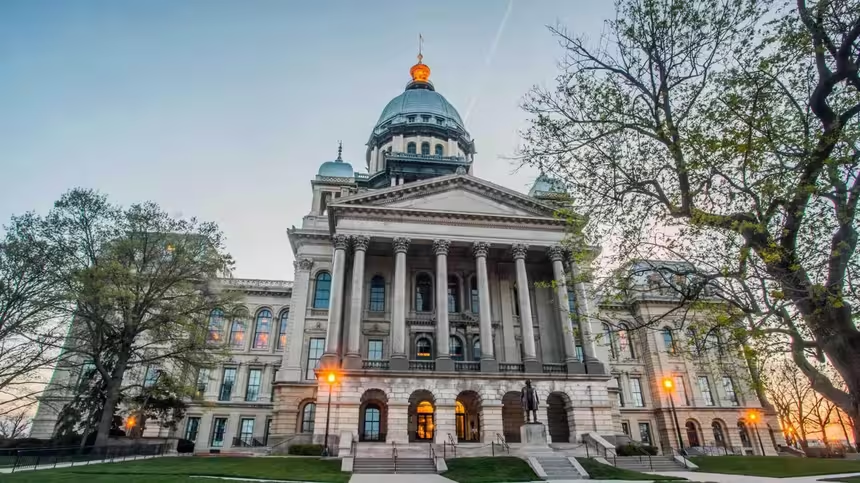
CapitolView
CapitolView is a weekly discussion of politics and government inside the Capitol, and around the state, with the Statehouse press corps. CapitolView is a production of WSIU Public Broadcasting.Providing Support for PBS.org
Learn Moreabout PBS online sponsorship(bright upbeat music) (bright upbeat music) - Thanks for joining us on "Capitol View", I'm Fred Martino.
Democrats in the Illinois General Assembly approved three major questions for voters in the November election.
New weight loss drugs will be covered for Illinois State employees but it's expected to cost hundreds of millions of dollars each year.
And there is an effort to stop mandatory driving tests for seniors in Illinois.
Those are just three of the top stories we are covering with Alex Degman of WBEZ and Jeremy Gorner of the Chicago Tribune.
They both join us from the state capitol today.
Thank you for being here, guys.
- Thanks for having me.
- Thank you.
- Jeremy, I wanna start with the ballot questions, you reported on these for the Chicago Tribune, what are the ballot questions?
And your headline says that Democrats hope that this effort will drive voter turnout.
Tell us about that.
- Yeah, that's right.
So you see these are called non-binding advisory questions.
You know they're often used during presidential election years to boost voter turnout.
And you know, these are questions that are posed to voters really as a way of gauging public opinion and they don't really have any impact on public policy unless like the General Assembly were to take action on that voter feedback.
So in this case, you know Democrats in the super majority passed legislation that would offer these three advisory questions for the November election and they include a question about whether insurers who cover pregnancy benefits should extend that coverage to in vitro fertilization without any kind of limited number of treatments there.
This obviously comes after the Alabama Supreme Court recently effectively banned IVF in the state.
And that ruling was nullified by their state legislature.
But, you know, Democrats are still kinda using that decision against Republicans as an example of how Republicans are trying to curb reproductive rights.
And Illinois has become really this safe haven for reproductive rights.
So obviously, Democrats felt that this was one of the questions they felt was absolutely appropriate to pose to voters.
A second question is whether there would be the so-called millionaires tax, whether that should be imposed to raise dedicated funds for property tax relief.
There's obviously a lot of, Illinoisans have lamented high property taxes throughout the state.
And this is something we kinda saw before 10 years ago where there was a similar ballot question on this millionaire's tax, which is, it's basically a 3% surcharge on anyone who makes a million dollars or more.
And 10 years ago, this same question was posed to provide more funding for public schools.
So back then, 68% of voters basically said that they would like to see a constitutional amendment adopting this.
This was in 2014, applying that millionaires tax to this pool of funds for public schools but it failed- - So a 3% income tax surcharge if a household makes a million dollars or more and this would be used to reduce property taxes in Illinois.
- Right, right, it would be- - Most vexing problems for the state because we have one of the highest property tax rates in the country.
Do you know how that amount was chosen?
Because as you know, on the federal level, for instance, President Biden has pledged not to raise taxes on households that make less than $400,000 a year.
Do you know how the million dollar number was chosen for this ballot question?
- Not sure exactly But you know, just could say that, clearly there's been some familiarity in applying this to voters.
You know 10 years ago, like I said, a similar ballot question for this millionaires tax was applied to a dedicated fund to help public schools.
So they obviously wanted to apply this to something else that's a hot button issue like property taxes.
- Sure, and I guess we don't know either yet how much money this would raise if the General Assembly saw the vote and said, "Well, this is a way we can address "this longstanding problem."
- Right, right, right.
- Okay.
- Yeah.
- Interesting.
- Yeah, and then the third question is meant to protect election workers.
Basically this question would, this is over whether a candidate for office for federal, state or local office should be subject to civil penalties if they interfere with an election worker's duties.
This is obviously because of what happened during January 6th and of course, reports of efforts to impede election workers' duties in other states that ultimately certified Joe Biden as president.
So obviously, this was another question but again, just wanna stress, I mean, these are questions that don't necessarily have an impact on public policy unless they're voted on by the legislature but clearly this is upsetting Republicans who feel like they have their own questions that they would like to see, you know these advisory questions that they would like to see related to term limits and I believe another one had to do with how voters feel about Illinois' status as a welcoming state or a sanctuary state, stuff like that.
So Republicans have basically complained that this legislation's gonna disenfranchise voters and eliminate competition in elections.
- And you're saying that because there's a limit of three statewide questions, is that correct?
- I think it was more so that Republicans wanted, you know, yeah, yeah, because of that limit and also because Republicans wanted other questions of their own that are issues that are more near and dear to them than what Democrats in the super majority chose, basically.
- Well, certainly, it will be fascinating to see where all this goes, particularly with the property tax question because as you know better than I working in Illinois much longer, this is a longstanding public policy question, how do we reduce property taxes?
Illinois much higher than surrounding states and a big issue for many voters, for sure.
- Absolutely, yeah.
And if I could add one more thing that's also been a big part of this legislation too, it also gives protections to incumbents in the general assembly by preventing political party committees from appointing challengers to fill out ballots in the general election.
So basically- - Yes, and we're gonna get to that with Alex actually, Jeremy, because that has been covered and I wanted to get to that separately 'cause it's such a huge issue.
Alex, in addition to the ballot questions, the legislation would require legislative candidates to run in primaries.
And Republicans, according to a headline call that stealing an election.
Tell us about this and the change to the challenge to this law.
- Well, this is actually another part of the bill that Jeremy was just talking about with all of the ballot initiatives that are gonna be on in November, and they called it an Election Omnibus Bill because that's basically what it is and everything that it does Republicans say disenfranchises not only their voters but also the party themselves.
And the reason that they say that this is stealing the election is because they're essentially Democrats who approve this legislation, most of them anyway, it didn't get unanimous Democrat support but they're saying that you're essentially changing the rules in the middle of the game while you're playing it.
Because after the primary, the primary was weeks and weeks ago, these political parties have already started slating their candidates, they were already out gathering petition signatures to get on the ballot.
They were doing all the things that they needed to do, now all of a sudden, here comes this bill that says, no, wait a minute, you can't do that anymore.
And republicans are saying, "No, wait a minute, "yes we can because we've been doing it.
"How can you just drop this bill on us in 24 hours "and just expect us to go along with this?"
Well- - So they may have a good case?
We will see.
- Yeah, and to be fair, this was kind of a hectic day at the State House because I don't really think anybody saw this coming.
There were a couple of people that might have been able to read the tea leaves but this just kinda snowballed throughout the day and all of a sudden by the end of the day, we're like, "Oh, there's this big elections bill "that's going through the house."
So it kind of rubbed Republicans the wrong way in that aspect as well because here again, we have another thing that is probably going to affect a lot of people more than they're saying it is and we're not having time to digest it.
Granted, this is not the same as like a 900 page budget bill, it wasn't that long, I mean, I was able to read it myself but the point still stands, you gotta have time to vet this.
You gotta have time to suss it out, as they say, and they didn't have time to do that.
- Okay, well, we'll be watching, we'll see how this all goes and of course, the clock is ticking 'cause we'll in November and the ballots have to be sent out early for folks who vote by mail, et cetera.
So, fascinating stuff.
Jeremy, another story that you covered for the Chicago Tribune, Governor J.B. Pritzker's office calls the Bears Stadium proposal a non-starter after a meeting.
Tell us about the idea and why the Governor's office, it's not on board.
- Yeah, so the Bears, their latest proposal would call for building a stadium just south of where present day Soldier Field is.
And I say Present day Soldier Field because part of this plan calls for demolishing most of Soldier Field except preserving the Colonnades but taking out the stadium seating for more public space, basically, for athletic fields, youth programming, what have you.
They really turn this site around Soldier Field as kind of a little like village for bars and restaurants and a hotel and change Soldier Field to this big open space.
And then to the south, you have this big stadium, big dome stadium that combined, the Bears had felt would based on their initial calculations would be around $4.7 billion of which they had pledged $2.3 billion, two billion from the team, 300 million from the NFL.
And you know, the argument there from the Bears is like, "Look, $2.3 billion from a team is pretty unprecedented."
I mean, that's a lot of money for a private entity to be pledging for a project of this magnitude but that would still leave taxpayers on the hook for the other half of that.
And plus that $4.7 billion figure, there's interests and there's other costs that can spring up along the way.
Of course, we're also talking about infrastructure in and around the stadium.
And so, basically, Pritzker has called this a non-starter because, you know, just look at the other budgetary priorities he has.
He needs to fund schools, he needs to fund the migrant crisis in Chicago.
So far he's proposed another 180 million, $182 million for that- - Public transportation cost as well going up.
- Public transportation, yes.
Yes.
- Everything's going up.
- Everything's going up.
And he just feels like, and he's pretty much stood his ground on this issue, Fred, that he's just doesn't support public financing for stadiums.
And we've seen that, you know when Soldier Field was renovated in the early 2000s, I mean, there's still debt being paid off on that.
I mean, so part of this plan would call for the Illinois Sports Facilities Authority to basically refinance the debt on Soldier Field.
I think it comes out to more than $400 million that needs to be paid off for that.
And then just to kind of put it in perspective, one of my colleagues wrote a great article this weekend where if you look at just like other government agencies of the, you know, think about it, like Chicago Police Department, $2 billion a year on spending for a big massive police department like that.
Chicago public schools $9 billion.
So you're talking about a Bear stadium that would be more than the CPD budget.
And if you think about the Chicago Public Schools, a Bear stadium could be about a third of that, you know, and that's a lot of money.
So I just bring those up as examples of, you know, that's on the city level.
But, you know, on the state level, obviously, Pritzker has said that this money that the state has needs to be used for other pressing needs and not another sports stadium.
And- - And there are, yeah, go ahead.
- And the other thing too, the other wrinkle is that the Bears have already spent close to $200 million on the old Arlington racetrack in Arlington Heights.
That was where everybody thought, this is where the Bears are gonna build their new stadium.
But we don't know if they've abandoned that idea, that kinda goes back and forth.
I think I talked to one lawmaker in the northwest suburbs who, she didn't wanna say she was disappointed, she says this latest plan is another step in the process.
I think people, proponents of the Arlington Heights site are still holding out hope that might happen but I've also heard that if it doesn't happen, that land could still be redeveloped in some way so we'll see what happens.
But yes, I mean, Pritzker's opposition to this, it's directly opposite of Mayor Brandon Johnson who supports it.
He thinks a stadium like this would be great for Chicago, a great investment for the city.
So you know, we'll see what happens.
- All right, we have about 10 minutes left.
Our next story reminds us of why projects like that stadium are so tough in this budget environment, and really perhaps any budget environment.
Because in our world today, particularly in the United States, with for-profit healthcare, even one drug, one type of drug can have an enormous impact on a budget.
Alex, weight loss drug coverage for Illinois state workers could cost hundreds of millions of dollars.
The governor's office says 210 million in the first year, but others say that that number could be much higher.
- Yeah, so Governor Pritzker wants to expand insurance coverage of these drugs starting in July.
It's for state-run insurance plans for state workers, like you mentioned.
And the reason being it's good health outcomes.
The administration says people can have a chance earlier to tackle long-term health problems caused by obesity a lot earlier if they have access to these drugs.
Drugs like Wegovy, Ozempic, they would be available to people with pre-diabetes, gestational diabetes, obesity also in consultation with their doctor.
Their doctor has to say it's the right treatment.
And they also have to do a lifestyle management program to go along with, to make sure it sticks.
And also to be clear, this isn't something that would apply to every plan that operates in the state, so this isn't a mandate for all insurance companies, this is just state run health insurance plans.
But the governor's staff said they wanted to do this because they wanted some parity along all their insurance plans.
Some cover this type of treatment, some don't.
So this would provide some parity.
And the number that you mentioned, 210 million, that is the high end of what the governor thinks that these would cost during the next session.
And that's because they're relatively new, we don't know exactly how many people are going to use them and what they're gonna be used for.
Basically, we don't know what the output's gonna be.
But my colleague, Dave McKinney talked with an economist named Ryan Cummings, he thinks that if half of the people that are eligible to use these drugs in the state were to get them and be insured for them, it would cost anywhere between 300 and $500 million.
And the governor's office, when my co when Dave asked about that, they just kinda shrugged it off saying, that's a back of the napkin analysis, I'm not gonna take those numbers from people who don't really understand how the state insurance plans work here.
And you expect that, you expect people to react that way from an outside analysis.
But here again, is another example of something that just kinda, I wouldn't say it breezed through because it went through the budget process kinda like we normally see it, it shows up in a 900-page document as a four or five lines that, yeah, it's there.
It outlines what it does, and like we know what's there now.
But a lot of people, myself included, and a lot of people in the news media, we don't have time to parse through all of that necessarily and lawmakers certainly when they're sitting trying to pass a budget.
So it's another example of this is something that a lot of people wish they had known more about and maybe there could have been more robust debate on it.
- Absolutely.
Jeremy, the Chicago Sun Times editorial board says, and I quote the headline, "Stop Mandatory Driving Tests for Illinois Seniors."
Tell us more about that.
- Yeah, so basically, in the last couple of years, the mandatory road tests were pushed from age 75 to 79.
This was something that happened during the, this was initially a policy that happened during the pandemic, obviously, as a way to help seniors you know, to kinda ease the stress of actually going to a DMV and trying to apply for a road test and so on and so forth.
But, you know, the groups like AARP believe that for seniors to take road tests from 79 on, making it mandatory is discriminatory.
And you know, obviously, drivers who are 79 and 80 years old, I mean, you know, you're 81 to 86 years old, you have to take a road every two years.
After age 87, it's every year.
The thing Is that this age group is among the least-prone statistically to getting into traffic crashes, which is basically, one reason why proponents of this legislation wanna see it go away.
- And do you think this will pass, Jeremy?
Because obviously, there are voters who are older also vote much more frequently.
- Right, right, and it's interesting though because right now, you know, and I have to try to get more information to find out why but it's stalled in the legislature.
- Interesting.
- Yeah, it has, but there's, you know it passed overwhelmingly in committee.
I know that there was some debate about it, there was a lot of debate about it.
But, you know, so we'll see what happens with a couple weeks left.
- When we covered this long ago, we got a lot of feedback, you know, stay on this Fred.
So we'll be on it throughout the session for sure.
Got about four minutes left, Alex, and I wanted to get to this story fascinating.
A column in the Chicago Sun-Times endorses a bill that would give Illinois residents access to waterways, that's access currently provided by federal and state law.
But the column says the State Department of Natural Resources has opposed the bill claiming that it would interfere with private property rights and violate the Constitution.
Tell us more.
- Yeah, so Maggie Bruns wrote this op-ed, she's the executive director of the Prairie Rivers Network, that's a nonprofit that really, it's one of those nonprofits that advocates for clean water, access to water and things like that.
And the bill that she's supporting is from Democratic State Representative Janet Yang Rohr.
And basically, it says what you just said, Illinois should be able to use the free range of waterways provided by state and federal law.
federal law says navigable rivers and it said this since the 1700s, they're common highways and forever free.
And state law says residents need to have the fullest possible enjoyment free of the quote, slightest improper encroachment or invasion.
That's what it says.
And Yang Rohr's bill just kinda reemphasizes what's in state law.
DNR has usually sided with private landowners because private land, obviously, a lot of it backs right up to some of these waterways.
People have private vistas and they don't want people to come on their land thinking that it's public.
So they usually sign with landowners and disputes.
But this bill would basically codify in state law what is actually the process.
But with a couple of weeks to go, this is still, I believe it's still in Rules Committee.
It was introduced in April and it was introduced but it didn't get a deadline extension.
So I guess, we'll have to see what happens with that bill.
- If it doesn't pass, I mean, is there any indication that this could be a matter that would end up in a court of law?
Because we're talking about what some people view as a right to be able to be on the water and then other folks who are saying they don't want folks on the water near their private property.
- Well, it very well could because obviously as a state agency, DNR is bound by state law and obviously, federal law, the federal law is stronger than the state law.
But part of the issue is that a lot of people with these problems, with private landowners, they're probably just fishermen, they're recreational boaters.
Do they have the resources to take the DNR to court?
It would probably be something that they would need a little bit more, I guess, a little bit more backing in order for them to make that successful.
Because, you know, I as an individual, I can't even imagine taking on the DNR in court if I wanna go voting.
It seems like a lot.
- Well, we'll be watching.
That's one of the reasons that we cover stories like this that may not get all of the big headlines but are really important to a lot of people.
Gentlemen, good luck as you can continue to cover the Illinois General Assembly.
Do you think it's gonna end on time this year?
(Jeremy laughs) - Not gonna bet on that.
- I'll say maybe, I gave up prognosticating the end of session a long time ago because I'm always wrong.
I'm wrong every single year, so.
- Okay, you won't vote.
Jeremy, are you gonna vote?
- I mean, no.
- Okay.
- I mean, a lot of this stuff springs up at the last minute in Springfield, people have learned, so who knows.
- All right.
- I'm gonna be a no vote right now.
- Well, good luck with your continuing coverage and thanks for helping us out very much, we appreciate it.
We are out of time.
Alex and Jeremy, thank you for being with us.
Thank you for being with us at home as well.
We have much more on the Illinois General Assembly scheduled for 7:30 Friday night with Illinois lawmakers.
And next on WSIU, it's "Eye on education", we'll be talking with two SIU scholarship winners, a timely special during this teacher appreciation week.
Congratulations to the scholarship winners who are coming up and thank you to all of our educators.
For all of us at WSIU, I'm Fred Martino.
Have a great week.
(bright upbeat music)

- News and Public Affairs

Top journalists deliver compelling original analysis of the hour's headlines.

- News and Public Affairs

FRONTLINE is investigative journalism that questions, explains and changes our world.












Support for PBS provided by:
CapitolView is a local public television program presented by WSIU
CapitolView is a production of WSIU Public Broadcasting.