
Capitol View - November 11, 2022
11/11/2022 | 26m 46sVideo has Closed Captions
Capitol View - November 11, 2022
In the days following the 2022 General Election, some races and issues remain undecided. Join Host Jennifer Fuller and Guests Kent Redfield and Hannah Meisel as they recap the election, and take a closer look at what may come next.
Problems playing video? | Closed Captioning Feedback
Problems playing video? | Closed Captioning Feedback
CapitolView is a local public television program presented by WSIU
CapitolView is a production of WSIU Public Broadcasting.
Capitol View - November 11, 2022
11/11/2022 | 26m 46sVideo has Closed Captions
In the days following the 2022 General Election, some races and issues remain undecided. Join Host Jennifer Fuller and Guests Kent Redfield and Hannah Meisel as they recap the election, and take a closer look at what may come next.
Problems playing video? | Closed Captioning Feedback
How to Watch CapitolView
CapitolView is available to stream on pbs.org and the free PBS App, available on iPhone, Apple TV, Android TV, Android smartphones, Amazon Fire TV, Amazon Fire Tablet, Roku, Samsung Smart TV, and Vizio.
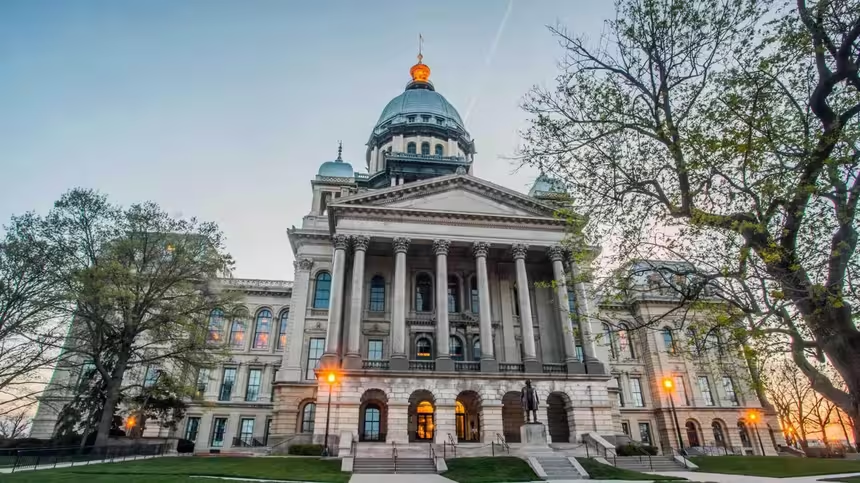
CapitolView
CapitolView is a weekly discussion of politics and government inside the Capitol, and around the state, with the Statehouse press corps. CapitolView is a production of WSIU Public Broadcasting.Providing Support for PBS.org
Learn Moreabout PBS online sponsorship(news music) (news music) - Welcome to another edition of Capitol View, our weekly look at the happenings inside and outside the Illinois State Capitol.
I'm Jennifer Fuller.
Our guests this week are Kent Redfield, Emeritus Political Science Professor of the University of Illinois at Springfield, and Hannah Meisel of NPR Illinois.
Thank you both for joining us.
- Good to be here.
- Great to see you again.
And as we've said, we've made it through the election of 2022.
Now, the furthest we'll be from the next election, but still keeping an eye on just a few issues and races here and there across Illinois.
Kent, I'll start with you.
Any big takeaways from this election?
Did things go as you expected?
- I think the biggest surprise from this election is there were no surprises.
I mean, it pretty much confirmed everything that we thought we knew about voting patterns, what are the things that move voters, the role that money, organization, all of those things played out in ways that were pretty predictable in terms of just a, I mean, this two cycles in a row, the Democrats have all the congressional officers, they increased or held their super margins in the legislature.
We changed the balance of the Supreme Court instead of it being a four to three majority, it's a five to two majority for the Democrats.
And so, there was a lot of good news for the Democrats and a lot of bad news for the Republicans.
- Hannah, I know that you were at the GOP Watch Party in Springfield Tuesday night.
What do you think that people took away from that?
Was the mood surprised at all at the turnout and the way the election fell?
- So it was Darren Bailey's election night party, and I think true believers will always be a bit surprised, especially if they're people who are in their own bubble and they don't know anyone, for example, who would ever consider voting Democrat, and they just don't understand that at all.
I don't know that they were surprised by the result, whether they, in their minds think that it was some sort of fraud or just Chicago being Chicago.
But no, I mean, for the most part, people are bound to reality.
They know that in Illinois, it's an uphill battle for a Republican to win statewide.
Obviously we haven't seen that since what, 1990 or well, of course, - Bruce Rauner.
- Bruce Rauner.
But he is more of a Libertarian and this plays into the way that the Republican party has changed.
Of course, before 2014, when Rauner defeated hugely unpopular Democrat, Pat Quinn, we had 1998, and string of Republican governors who were, these days would barely qualify as a Republican.
And I think that, there was more hope for Republicans winning other races down the ballot.
Illinois 17, even Illinois 13, those two congressional districts were somewhat in play.
And I think that people were surprised that, especially in 17, Republican Esther Joy King couldn't pull it out against Eric Sorensen.
And, but as Kent said, just looking at Illinois history, Illinois voting patterns, and the fact that Democrats were able to draw their own maps for both the legislature and congressional maps and of course, remap, the Illinois Supreme Court, as you alluded to, Kent, that nothing on Tuesday was actually that surprising.
- Kent, in Governor Pritzker's victory speech Tuesday night, instead of talking a lot about state issues, he went directly to the national and criticized the National Republican Party and really went after a lot of national issues.
How does that quash in any way this rumor or this speculation that Pritzker may be looking to a presidential run in two years?
- No, it fueled it obviously, and that would be unfortunate because if you look at the arc of Illinois politics, J.B. Pritzker is the first governor to win a second term since Rod Blagojevich, who didn't get to finish his second term.
And then you have to go all the way back to Governor Jim Edgar in the nineties.
And one of the problems with making state government work in Illinois is that you need continuity.
You need to be able to develop programs, agencies, and if you keep changing directors and keep changing emphasis, and so, there are lots of people will tell you the last time state government worked really worked was during the Thompson, end of the Thompson administration, the beginning of the Edgar administration, that you had serious people that wanted to make government work and had time and resources and the power to do that.
Pritzker is in a position now where he can do that.
But as somebody once said, there's not a big state governor or a US senator from a big state that doesn't get up in the morning every once in a while, look in the mirror and say, hello, Madam President or Hello, Mr. President.
And so, he may have the buck, but if you're concerned about Illinois growing, improving, and the governor has to be the one that bridges the gap.
You don't expect downstate Republican legislators to abandon their constituents.
And you don't expect Chicago legislators to abandon their constituents.
So if we're gonna solve problems, the governor has to be the one that bridges the gap and brings people together.
And so, and the other thing I just to, if four years from now state government doesn't work, Pritzker will not be able to blame it on Bruce Rauner or on Rod Blagojevich or whoever.
He will own it.
And he will have had eight years, even though his first term was interrupted by a pandemic and he had horrendous fiscal problems, which now have been smoothed out a little bit.
But the problems are still there.
And so, I hope that we're gonna focus on Illinois and about leadership and governing for the state as a whole.
- Talking about bringing things back together and leadership.
There may be some coming back together that has to happen within each party.
And we saw already this week that there probably needs to be some conversation within the Republican party.
We saw that House Republican leader, Jim Durkin, announced he will not run for that position in the legislature when the new session begins in January.
And so, now, there's a question mark over who will be the Republican leader of the Illinois House.
There are, as you might imagine, some front runners in that.
But Hannah, what does that race look like and and how does that bring the Republican party back under one umbrella after this bitter election?
- Well, I mean, this isn't unexpected.
There had been speculation for more than a year about whether Jim Durkin would continue on as Republican leader for another term.
And even then, even if he did, there was speculation on whether he would retire and make that his kind of feather in his cap if he gained some Republican seats like he was hoping.
Of course, Republicans recruited like crazy for this election cycle, House Republicans specifically, which is very impressive.
I mean, they blew outta the water the record that Lee Daniels had set in the nineties for Republican recruitment to run for seats.
And yeah, of course, you recruit people who run for seats that they know that they're probably not gonna win.
You're asking them to give up months of their lives to kind of go out in public and take arrows, especially in districts where Democrats have won for decades.
But it should be said like, there should be giving credit there (audio cut out) Republican.
I guess they changed their name in the last year.
It used to be House Republican Organization, now it's House Republican Majority reflecting their aspirations one day.
But yeah, I mean, it's not a surprise that Durkin is stepping down.
It is kind of a shame.
He's just one more long-term legislator who is stepping away.
Springfield is a vastly different place than it was, nine years ago when I came here, even five years ago, you started to see the acceleration of members leaving after the budget impasse finally broke in 2017, especially Republicans who are just so frustrated with their own Republican, Governor Bruce Rauner.
And, but you've seen the acceleration of these long-term legislators even long-term staffers, even lobbyists leaving Springfield.
It's a wholly different building.
But in terms of who might replace Jim Durkin, there have been several names spread around, but really, the one who rises to the top is Tim Ozinga.
He is a Republican from, you could say like the south suburbs of Chicago.
He is definitely more in the moderate camp, of course, those who were with Darren Bailey, those who became close allies of Darren Bailey on the floor of these far right, a lot of 'em from southeastern Illinois.
They're the ones who of course, were most vocal about disappointment with Jim Durkin.
But that was to be expected.
It's more of the more moderate Republicans who were disappointed with Jim Durkin that matter because they are, even with the numbers of far right Republicans you could say, who have come into the legislature in the last couple of years, they're still far in the minority among their caucus.
And so, - Sure.
- Tim Ozinga, he's the scion of this construction materials company, he's got a lot of money and he has spent this cycle of making calls and kind of showing off, kind of doing a trial run, showing his colleagues what he can do with fundraising and- - And we'll get to Tim Ozinga in a little bit and the fundraising there, I did wanna spend some time too, Kent, on the constitutional amendment, which as we record this, appears to be still a little too close to call.
The answer is really unclear, and that's partially because of the complex nature of how an amendment has to be passed in Illinois.
Can you talk a little bit about, for people who are unfamiliar, what that vote total needs to be, the percentages anyway, and how things are looking now?
- Sure, and it needs to be 60% of those voting on the question, but a lot of people will skip.
And so, that's one way to go about it.
The other way is to vote, the S vote needs to be 50% of all votes pass.
Normally, there's not a little bit of difference, but there is some math there that makes sense that, and depending on the nature of the question and who votes on it, those sorts of things.
But, so those are the two numbers you're looking for.
60% of those that voted on the question, or 50% of those that voted overall that participated in the election.
That's normally the total votes cast for governors usually, the one you're looking at.
And that issue, that doesn't in terms of immediate impact, it's not gonna, it would not have changed anything, 'cause it basically deals with right to work and then some other language that might or might not expand collective bargaining.
What he did do was drive turnout.
And that's one of the things that helped the Democrats in this election is that you had the Workers Rights Amendment, and so, you had labor out there who also were concerned about who was gonna be on the Supreme Court interpreting it.
Same time, you had reproductive rights and a lot of concern about that.
And so, you had groups like Personal PAC that were spending independent expenditures in those Supreme Court races, but that generally drove turnout again.
And those two issues advantaged the Democrats and that muted or blunted somewhat concerns about inflation and concerns about crime.
And so the Democrats were fortunate to have both a couple of issues and some really organized groups that really know how to work elections out there, pushing those issues, which then help with overall turnout.
So, and if the BIC Labor wants to run that again in two years, if it fails, they can get it on the ballot in two years from now and drive turnout during the presidential election.
So it's not a big loss if it does go down and it does illustrate both money and issues and enthusiasm are things that move people.
- Hannah, is there a big message from voters here or is this just a picture of apathy that the question is still too close to call a couple of days after the election?
Of course, we should remind people that the votes are not certified for two weeks after the general election, but still with it being this close, still unknown.
- I mean, I think that, like Kent mentioned, of course, in Illinois, you need 60% to get a constitutional amendment passed.
I think that we need to measure questions that need 60% in a wholly different manner than just a regular election that needs a simple majority.
And so, I don't think it's voter apathy.
Of course, this is an issue that's a little bit less easy to understand.
It's a lot more esoteric.
I think it will, I guess, purposely leave a lot up to the courts because this will, if it does indeed pass, I'm pretty sure it will end up in a court challenge, which will be a whole nother can of worms.
But it's a lot less easy to understand, a lot less digestible than, for example, say, in 2020 when, on the ballot we had this question of whether Illinois should adopt a progressive income tax.
And of course, that was one of Pritzker's signature campaign issue.
It didn't pass.
There was a whole lot more money funding the opposition there.
But, one of the tactics that I think people should pay attention to is opponents of the Workers Rights Amendment, Amendment 1, though they didn't have the money that the opponents had of the progressive income tax in 2020.
They used things like push polling or direct text messaging to reach voters.
That kind of cuts through a lot of things when of course, there's campaign ads blanketing every TV, radio station and not that many people watch broadcast TV as part as the regular like, especially younger voters, they don't, it's not certainly not part of my life very much anymore.
And so, some of the tactics to reach voters, like those direct text messages that opponents used, I think people should pay attention to.
But no, I don't think it's about apathy.
I just think it's hard to reach that 60% threshold on a question that is kinda esoteric.
- Sure.
Kent, we've talked around this a couple of times, but it's time to get to the money.
If you look at opensecrets.org, they talk about the amount of money that was spent in this election nationwide, and it's an astronomical number and particularly when it comes to what some people might call dark money in Illinois, we call them independent expenditure committees, not quite as dark as perhaps some other states, but how important is it for people to be able to understand where the money comes from and how much is being spent in which direction?
- Oh, I think it's critical.
And so, if you're an independent expenditure committee, you can as long as you coordinate with a campaign, you can engage in an election, support someone, oppose someone, you have no contribution limits.
So, people like them because they can give big amounts of money to these committees.
What they are required to do, however, is to disclose.
And so, those are the features of Illinois law that are really good that really help if you have the news media keeping track, if you've got citizen's groups keeping track.
'Cause if I get a thousand dollars or more in a contribution outside of my quarterly report period, I have to file a quarterly report every three months.
But if I get a contribution more than a thousand, I have to file electronically a report.
And we get close to election, it's within three days.
Similarly, if I'm an independent expenditure group and I spend more than a thousand dollars supporting or opposing a candidate, I have to file that report with the State Board of Elections electronically.
And so, this is almost real-time data that you've got.
And you can go and you can see that, the independent expenditure group that's involved with the governor's race, people who play by the rules.
You can look and you can see that yesterday they bought, they reported spending a million dollars on ads opposing the governor.
Or if the governor decides to write a couple of checks to the two (indistinct) Democratic candidates to the Supreme Court, those campaigns have to file an A1, this report of expenditures.
You go to the computer and you see that $500,000 went to the Democrat in the second and $500,000 went to the Democrat in the third district.
So we have really good reporting, but it is overwhelming.
I mean, of the maybe $11 million plus that were spent on the third district raised for the Supreme Court, probably 8 million of that was independent expenditures that are outside the campaign.
Problem with those independent expenditures is the candidate has no control.
And sometimes, the candidate is appalled by what these groups do, but most of the time, when you get a hard-hitting ad, their defense is, well, I didn't say that.
I didn't call my opponent a wife beater, or a husband beater.
It was this independent group.
And so, he gives the candidate deniability.
But it is, and that's again, just quickly in big picture then we're in, we've been in the era of billionaire politics since 2014.
One of the billionaires, Ken Griffin has left.
He left behind $6 million in a committee to spend on those Supreme Court races.
But he is gone.
Richard Uihlein spent $40 million in this race.
I don't know whether he's gonna continue to invest.
And so, but Pritzker and his billions are still here.
And if you take away the billions, my billionaire versus your billionaire, Democrats have a huge advantage, and so, in spending.
And so, one of the things about why the Democrats kept the legislature, not only their majority of the legislature, not only was it that they drew the map, but they massively outspent the Republicans in those contested races.
And the $6 million race in Springfield between Turner and Hanson, that was about a two to one advantage or a little less than that for the Democrat in the spending.
So it's not only would you have ideological fights about who wants to run the Republican party, but whoever's running the Republican party has to figure out how do we raise money, how do we compete with the Democrats, particularly the labor unions, How do we compete with a billionaire governor?
- Sure, and Hannah, you mentioned earlier, Representative Tim Ozinga pumped money into his own campaign as he's trying to become the next leader of the House GOP.
So let's kind of pivot in the few minutes that we have remaining and talk about what you expect from the veto session, which starts later this month.
And then as we head into the new session of the General Assembly in January.
- Well, of course, one of the big themes that Republicans tried to push this whole year in the primary too, was this issue of crime.
And of course, this is a perennial issue, and Republicans decided it was in their best interest strategy to poll it out this year in Illinois, of course, they had this ripe thing that they could use, which is the Safety Act, which just to remind viewers, part of the safety Act, which hasn't gone fully, hasn't been fully implemented yet, but on January 1st, Illinois will become a cashless bail state.
Other states have tried this, New York had tried it, then they went back.
But Illinois will be kind of in effect, the first state to have a fully cashless bail system.
This is an issue even though, we saw from poll after poll, it wasn't most voters number-one issue.
In fact, in the most recent poll that asked this question, only 9% of voters marked this crime as their number-one issue.
But still, I would say that the negative ads still did a number on the trust that Illinois have in this whole safety act.
And Republicans, opponents were able to shift voters' views on that.
And so, a lot of Illinois voters have a negative view of this.
Now, of course, the money is gone, the ads are gone, but what's left is this law that, Democrats who pushed it, they've known for months and more than a year that there would need to be specific fixes.
What they say is just like any other bill, which is true, it does, law rather, sorry, it needs to be to evolve.
It needs to have tweaks done to it.
And so, this law will need the tweaks that have been discussed behind closed doors.
Beyond that, though, we're gonna see a lot of more progressive legislation, I would say, come January and we'll see where that goes.
- Yeah, veto session is a game of chicken.
I mean, the Democrats have huge majorities.
They can do what they want.
They know there's a lot of concern and ambiguity, and the last thing they want to be doing is arguing about cashless bail and the Safety Act in the next election that's coming up in two years.
So, the people want it changed to have leverage.
And so, it's gonna be an interesting game of chicken about exactly how much change we're going to get in it.
And again, the governor has to lead.
You've gotta have some leadership that says, let's find some common ground.
And these are not irreconcilable.
We can fix the evils of cash bail and we can still protect public safety.
You can do both.
- It remains to be seen, and we'll keep an eye on that here on Capitol View.
I'd like to thank Hannah Meisel and Kent Redfield for joining us this week.
I'm Jennifer Fuller.
We'll see you again next time.
(news music)

- News and Public Affairs

Top journalists deliver compelling original analysis of the hour's headlines.

- News and Public Affairs

FRONTLINE is investigative journalism that questions, explains and changes our world.












Support for PBS provided by:
CapitolView is a local public television program presented by WSIU
CapitolView is a production of WSIU Public Broadcasting.