
Capitol View - November 16, 2023
11/16/2023 | 27m 47sVideo has Closed Captions
Capitol View - November 16, 2023
Recently, the Heartland Greenway pipeline was cancelled. Fred Martino speaks with Kathleen Campbell, Ph.D. She’s been involved in the Coalition to Stop CO2 Pipelines. We also put the major political news into context with Jason Piscia, Director of the Public Affairs Reporting Program at the University of Illinois Springfield and Jerry Nowicki of Capitol News Illinois.
Problems playing video? | Closed Captioning Feedback
Problems playing video? | Closed Captioning Feedback
CapitolView is a local public television program presented by WSIU
CapitolView is a production of WSIU Public Broadcasting.
Capitol View - November 16, 2023
11/16/2023 | 27m 47sVideo has Closed Captions
Recently, the Heartland Greenway pipeline was cancelled. Fred Martino speaks with Kathleen Campbell, Ph.D. She’s been involved in the Coalition to Stop CO2 Pipelines. We also put the major political news into context with Jason Piscia, Director of the Public Affairs Reporting Program at the University of Illinois Springfield and Jerry Nowicki of Capitol News Illinois.
Problems playing video? | Closed Captioning Feedback
How to Watch CapitolView
CapitolView is available to stream on pbs.org and the free PBS App, available on iPhone, Apple TV, Android TV, Android smartphones, Amazon Fire TV, Amazon Fire Tablet, Roku, Samsung Smart TV, and Vizio.
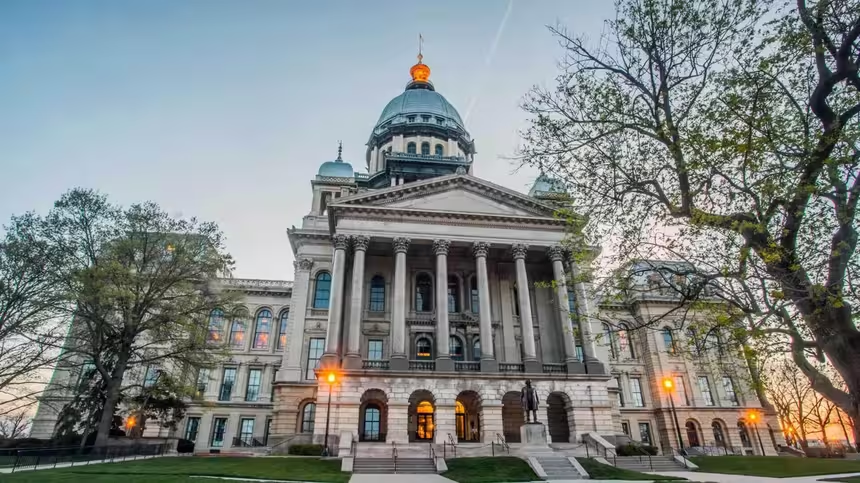
CapitolView
CapitolView is a weekly discussion of politics and government inside the Capitol, and around the state, with the Statehouse press corps. CapitolView is a production of WSIU Public Broadcasting.Providing Support for PBS.org
Learn Moreabout PBS online sponsorship(upbeat music) (lens beeping) (image whooshing) (dramatic music) - Thanks for joining us on "Capitol View."
I'm Fred Martino.
As we told you last month, a major pipeline project that was planned for Illinois and other states has been canceled.
The so-called Heartland Greenway pipeline was being planned by the Nebraska-based company Navigator CO2.
It would've carried carbon dioxide across 1,300 miles.
The idea?
Capture CO2, transport it, and store it underground.
Lots of federal money is available for projects like this.
The Department of Energy says $12 billion was allocated in the bipartisan infrastructure law for carbon management over a five-year period.
Before being canceled, the Heartland Greenway pipeline was opposed by residents, including my guest, Dr. Kathleen Campbell.
She is an emeritus professor at the Southern Illinois University School of Medicine and a founder of the Coalition to Stop CO2 Pipelines.
Kathleen, thank you for joining us today.
- Thank you for the opportunity.
- Good to have you here.
To start, I do wanna allow you to explain some context here.
While you have expressed a general concern about CO2 pipelines, the so-called Heartland Greenway pipeline would've passed through your backyard in Glenarm, Illinois, where you have lived since 1988.
Tell us about that, because many people may be surprised to learn that eminent domain was a threat, that your property might have been used without your permission.
- That's right.
When I first got my packet from Navigator, I was shortly retired from SIU.
I had kind of come back several times after retirement 'cause I enjoyed my research, but I got a packet out of the blue.
I had no idea this CO2 pipeline could possibly come through.
And on the very first package of information it said, "We may be coming through your property.
"We'll be asking you for a voluntary easement, "and if you refuse, "we will ask the Illinois Commerce Commission "to condemn your property "and take it through eminent domain."
That was my first introduction just before Christmas, December 17th, 2021.
I was shocked, I must admit.
My heart just sank.
I couldn't believe it.
We are in a housing subdivision.
We are not in a remote rural house or anything like that, and we have more housing in our subdivision of Wayside Meadows than the entire town of Satartia, which we might get to later.
But so I was stunned, so I started doing my homework.
My area of research had been auditory toxicology and pharmacology at the medical school.
I started reading the literature and I was terrified.
The pipeline was to go 1,000 feet from my house, but with the corridor and the angle of it could cut right through my backyard with our organic gardens, et cetera.
So I called Joyce Blumenshine from the Sierra Club and we started the Coalition to Stop CO2 Pipelines.
But we brought in, this is now 13 environmental groups in addition to a lot of landowners.
This has grown.
Pam Richart is our coordinator now.
And we started moving against this Navigator Heartland Greenway pipeline because it is so dangerous and so close to housing.
- And of course our short time together requires a summary, but let's talk about the key dangers of CO2 pipelines.
- It's an asphyxiant.
And so while we think of CO2 and soda pop or fire extinguishers, those are small amounts.
These are not small amounts.
If one of these ruptures, and according to the PHMSA database, Pipeline Hazardous Material Safety Administration, for every 1,000 miles of CO2 pipelines in the United States, there's 0.95 accidents every year.
And so for the 1,300, actually 1,350 by the time they added on a lateral mile of CO2 pipeline for Navigator, that would've meant that we could expect 1.3 accidents per year along that pipeline.
But it's Russian roulette as to where they hit.
This is an asphyxiant.
If you are within 1,000 feet of the pipeline at that volume, a 20-inch pipeline with 20-mile shutoffs, you will have a fatality rate of 50% within 10 minutes.
And your cars won't run, okay, because cars require oxygen.
So even if you have an all electric car, though, within one to two minutes you may be unconscious, you may be having seizures, foaming at the mouth.
And yet they still plan to run it 1,000 feet from housing.
- And I was so surprised when I heard not only that, but the fact that this is not hypothetical.
In your testimony to the Illinois Commerce Commission you noted a release from a CO2 pipeline in 2020, this wasn't long ago, in Mississippi, and I understand about 200 people were evacuated and 45 sought medical attention.
- That's correct, and they found even a mile away from that rupture that cars were stalled out, people were, quote, "Walking around like zombies," by the EMS reports.
Some of those people still have been unable to return to work because they have respiratory dysfunction.
- Oh my goodness.
I mean, that is, it's really frightening.
And in reviewing some federal documents on CO2 pipelines, a major challenge that may jump out for some people is that it's difficult to monitor and inspect these huge pipelines.
And compliance is not just a federal matter.
States are involved.
So you might have very different levels of oversight depending on the location of the pipeline.
- The oversight and preemption gets confusing for people.
PHMSA does regulate at the federal level the construction and installation of the pipeline, but the siting and routing is left to the states.
And so as a safety issue, your best safety protection is distance from that pipeline in case it ruptures.
And that's what they frequently don't want to give you.
Even in the Wolf pipeline now, they are running less than 1,000 feet from a school, an elementary school, grades K through eight.
They're running next to their Animal Protective League.
They're running next to housing districts for low income individuals.
They're running next to businesses.
And that's just the county of Tazewell where I have some data.
They're being very vague about their center line, but we do know that this is extremely dangerous.
So I started protesting because this is far too dangerous.
You really have to get out beyond 4,250 feet, according to Navigator's own plume model, before you get down to an allowable 15-minute exposure.
But you're not gonna be able to get out within 15 minutes, particularly if your car doesn't run.
And EMS services or rural services can't possibly reach you and evacuate within 15 minutes for everybody that could be exposed.
So that's why we are working with the ICC and educating.
Well, actually, ICC has been great, I must admit, very good people.
But we have been protesting and getting the public informed about how dangerous these are.
- So while the Heartland Greenway pipeline has been canceled, I understand that there are efforts to block another pipeline that's being planned near Peoria.
Tell us about that.
- That's correct.
That's the Wolf Pipeline.
It would have 260 miles within Illinois and it would start by picking up CO2 in Iowa.
Notice they're not picking up any CO2 in Illinois, just Iowa, and they don't even have those contracts signed, starting up by north of Cedar Rapids and running down to Decatur.
But again, they have the same issues.
And of course, as you mentioned before, eminent domain is an issue.
Right now, according to Illinois state law, the Navigator pipeline only had 14.8% sign on for voluntary easements.
If they had approved that, everybody else could have had eminent domain.
So this is not for the rare thing.
This is for a pipeline that is extremely dangerous.
The Wolf pipeline, by the way, is foreign owned.
So this is a foreign, it's owned by the Canada Pension Fund, and this could have eminent domain to take land from U.S. citizens not for a public utility, but for a private for-profit company carrying hazardous waste, and we could have no choice.
- That is so interesting.
And so you're saying the Heartland Greenway, less than 15% of people wanted to voluntarily offer an easement.
- After over a year.
- Wow.
- So people found out how dangerous it was and they refused.
But if the ICC had approved that, the other over 85% could have had their land taken through eminent domain, again, for a private company.
- Yeah, and I understand that these fights are gonna continue because there is a lot of federal money available for these projects.
Tell us about that.
- Well, the Q45 program for the federal government is incentivizing this.
And so the companies are going after these billions of dollars, and whether or not they place our lives at risk, they're looking at the dollar signs.
And these have a history of failure, the CO2 pipeline storage.
Usually they're used for enhanced oil recovery, similar to fracking, forcing out the last bits of gas and oil, but that releases even more CO2.
The sequestration may not be safe.
It can contaminate aquifers if it leaks.
So there's a lot of problems with these pipelines to begin with.
I do not think that these are the way to save the environment, although certainly we have to address global warming, but the safety factor is my primary concern.
- So, you know, there's a larger story here, and in our final minutes I wanna give you a chance to talk about that.
You helped found the Coalition to Stop CO2 Pipelines.
Tell us about that and the challenge in grassroots organizing.
- Well, I was very fortunate.
I mean, I called Joyce Blumenshine.
She knew all the environmental organizations, which I did not.
You know, I'd been busy in my research lab working many hours every week, so this was kind of getting my nose out of the ground.
I'd been a Sierra Club member for years, but I didn't know these people.
She did, so she pulled together the coalition, and then they got legs of their own, so to speak, very active, extensive coalition, again, with 13 environmental organizations, a lot of landowners.
Then from there, we also formed the Citizens Against Heartland Greenway Pipeline, which is a group of landowners, and that was to intervene at the ICC and hire a lawyer.
I would like to tell you too that the landowners, this is expensive for us to hire legal representation, to do the testing, gather the information.
And then it's extremely stressful as well, to be honest.
I do little else.
This is not my retirement plan, as I tell everybody, but they hijack people's lives for this, and I think that we... PHMSA itself, by the way, has said that the current regulations for CO2 pipelines are inadequate and they are upgrading them.
So why are we even reviewing these proposals right now at the ICC?
Why can they apply before those new safety regulations come out?
And why do we allow eminent domain?
We can have 100% eminent domain, if it gets approved, over the objections of landowners for companies that are private with hazardous waste, not a public utility.
I honestly don't understand it.
- Do you think after going through all of this in our last minute together that there needs to be some new legislation to deal with this?
Yeah.
- Yes, we have a team working on that.
I am not on that team.
Senator McClure has called for a moratorium, which is what we really, really need.
We need moratorium 'til those new PHMSA regulations come out, and then we need everybody to get educated about what a safe distance is.
Thank you.
- Well, thank you for beginning the education process for us here.
My guest was Dr. Kathleen Campbell.
She is an emeritus professor at the Southern Illinois University School of Medicine, and as I said, the founder, a founder, of the Coalition to Stop CO2 Pipelines.
Kathleen, thank you so much for joining us.
- And thank you for your time.
- And we'd love to hear from you.
Send us your comments and letters anytime.
The email address is contact@wsiu.org.
One additional piece of information.
Our guest at the top of the show, Kathleen Campbell, tells me that Pam and Lan Richart have taken the leadership role in the Coalition to Stop CO2 Pipelines since April of 2022.
Analysis now on the veto session that wrapped up last week.
Jason Piscia is director of the public affairs reporting program at the University of Illinois Springfield, and Jerry Nowicki is from "Capitol News Illinois," a WSIU partner.
Jerry, there was a lot of talk about some very high profile issues before the veto session, but in the end, lawmakers only came to agreement on one of those major issues, allowing small scale nuclear development.
What did they do?
And why so little action, in your view?
- Yeah, there were a couple things, smaller things beside that, but I think the nuclear one is the big one because it allows new nuclear construction for the first time since, like, the moratorium was put in place in the 1980s.
But at the same time, it's only smaller scale, what they call small modular reactors, which is, you know, might be used to power just, I don't know, a factory or something or a small city rather than these massive plants that you see, you know, in Clinton or other places.
But even so, you're probably looking into the 2030s just 'cause the federal permitting process and stuff like that, so it's not like you're gonna see nuclear popping up everywhere anytime soon.
There's still these federal rules and whatever else is needed to get reactors approved.
So that's kind of the big one that we were watching.
And then in terms of stuff not passing, I just don't think there was an appetite for the types of major legislation, or controversial legislation.
Everything was kind of had some bipartisan support to it that passed.
So I think, you know, it's an election year.
I don't know that the Democratic leadership was looking to make too many waves, you know, with overriding the governor, anything like that.
All the governor's vetoes stood, so I just don't think there was that appetite.
- All right, well, you know, as always, "Capitol News Illinois" is watching, and we'll continue to see, I'm sure, more reporting.
And in a moment we're gonna talk about one of those other issues, a smaller issue, if you will, that was decided in the veto session.
But now, Jason, I wanna move on to one of the most high profile issues that went nowhere.
It was an effort to extend a tax credit for private schools.
We know that school choice is popular with many voters.
What are the political ramifications of this?
And do you think this issue will be revisited?
- Short answer to your last question is yes, there have been some Republican lawmakers who have said already that they're gonna keep trying in the spring session to try to move this Invest in Kids Act forward which provided pretty generous tax breaks to people who donated money toward private school scholarships for low income students to use, to move from a public school that they didn't want to attend anymore to move to a private school with maybe some more opportunities.
So we've heard that already from the GOP lawmakers.
There's also been this issue of, as part of the current Invest in Kids law, those students who have moved to the private schools need to be taking the same standardized tests that the public schools' students take.
We haven't seen any results of how those students have done on those standardized tests.
Those results are expected to come out maybe later this year or early next.
So I think once those come out and we have a little bit of data that shows did these students do better or the same or worse in school, there'll be some political fodder, some political backup, to make that argument.
But yeah, it's a touchy political issue on both sides.
Republicans are, you know, generally in favor of school choice.
You know, getting this law in place was part of the compromise to, you know, get the evidence-based school funding formula passed several years ago under the Bruce Rauner administration.
But at the same time, you know, providing equitable education opportunities for low income students is a thing that's important to Democrats.
You know, you mentioned not much noise was made at the State House, but, you know, this issue in particular, you know, lots of students and adults every day in their bright blue T-shirts standing in front of the House Speaker's door, in front of the House chamber door, demanding that this bill be called.
You know, Democrats have voiced support for it.
The Speaker didn't call it, so I think there's some political cover there that the rank and file Democratic lawmakers can use to say, "Well, you know, the Speaker just didn't call it.
"I think this is a great idea."
So, you know, there's some momentum still lingering with this issue.
We'll have to see where it goes in 2024.
- It's really, I guess in your view, is this a real statement about the power of teacher unions in the state of Illinois?
- Oh yeah, definitely.
You know, I think, you know, Democrats and the General Assembly generally, it's a safe political place to be when you're keeping the teachers unions happening, especially the Chicago teachers unions.
And they were very loud about this as well that this plan was, you know, siphoning money away from the public school funding system.
There's questions on whether how much that's true and how much, you know, these scholarships were a drop in the bucket compared to the amount of money that the state puts toward public schools each year.
But yeah, definitely it's a safe spot for Democrats to be.
- Jerry, one other piece of legislation that was approved.
This was not as high profile as the education issue that we just talked about or the nuclear power issue, but it's important nonetheless.
We talked about it on this show with legislators.
It was approved.
It's described as a way to modernize professional licensing.
"Capitol News Illinois" reported on the legislation this week.
Let's talk about it.
What does this do?
- Yeah, so the licensing people might not realize just how many people need to be licensed in Illinois.
Hairdressers like all the way up to medical professionals need to have a license and they need to go through the, what's the, uh, Department of Financial and Professional Regulations.
And their systems are sort of antiquated to a case where some of the newer things they're licensing are hard to add to the system or impossible to add to the system.
So you have a lot of applications coming in via the U.S.
Postal Service, and then they're hard to track for the applicants who are trying to get them, and then some people are waiting months for this license that they need to be able to do their job.
So it was really problematic, especially for the medical field.
The medical field advocacy groups were behind it.
It ended up passing unanimously.
So, long story short, it allows the department to sort of approve some of the longest waiting applications in batches, and then it also aims to just create this new system in the next six months or so to just sort of overhaul the way the online system works for applications.
- Yeah, and we don't wanna mislead people here, Jerry, because on this show, and I'm sure in the news over the last few years from time to time, a separate piece of legislation that Republicans have advocated for has come up, and this is to allow Illinois to enter a nursing compact, which essentially is reciprocity for licensing.
You know, you move to Illinois, you don't have to take a driver's test again.
You can get an Illinois driver's license by showing your license from another state.
Same deal with most states, you have a nursing license, you move to Illinois, you would want to get an Illinois nursing license because you have a license somewhere else.
Illinois's not in that compact.
There's some union opposition to allowing it.
Have you heard any noise about that one coming up again in terms of modernizing licensing?
- I have not.
I know there was some level of that which was allowed during the pandemic via executive order, but I don't know where we stand at this point as to whether that'll be codified into law.
- Okay, another one we will be watching and looking at because it's a continuing issue particularly, and this is a national story, with the worsening nursing shortage, a very critical issue.
Jason, a federal appeals court ruling upholding the state's assault weapons ban could set up an appeal to the U.S. Supreme Court.
Tell us about that story.
- Sure, earlier this month, U.S. Federal Appeals Court, it's a three-judge panel based in Chicago, ruled two to one in favor of the state's assault weapons ban.
There was a challenge in two lower courts in the Chicago area that agreed with the ban, and then it was overturned in another court in southern Illinois.
Those three lawsuits were sort of pooled together and put forth to the appellate court, which ruled in the favor of the ban.
It's important to note that the judges made clear they didn't really rule on the constitutionality question of if this ban is a violation of the Second Amendment.
They just kind of just worried about, you know, this limited injunction right here on keeping the ban in place at this time.
But with the way the judges wrote about the decision, you know, they saw there is a clear line between, you know, firearms that are for personal use and then firearms that are used for law enforcement or military purposes, and that they felt that the, you know, state law does have the power to sort of regulate those higher capacity weapons.
On the other side of it though, the one judge that dissented, you know, mentioned that, you know, the AR-15 is a common everyday weapon in many households around the state and really can't be put into that category of, you know, a law enforcement military weapon.
You know, the process is gonna continue.
We have to see where it's gonna go.
I noted that yesterday another case may be going to the Supreme Court as well.
State lawmaker Dan Caulkins, a Republican from Decatur, filed an appeal with the U.S. Supreme Court trying to get them to hear one of the cases that the State Supreme Court threw out.
That's a long shot dealing with a state case in federal court, but, you know, these cases keep moving through.
- So in our final minute or so here, Jason, what are your thoughts on the courts being asked to rule on legislation when as a country we have less and less faith in the courts?
Perhaps this is most evident in the Supreme Court which just this week announced a code of ethics after the nonprofit news organization ProPublica revealed extraordinary gifts to Justice Clarence Thomas and other conduct by justices that would not be allowed by other courts or public employment for that matter.
- Yeah, when we think of the three branches of government, we, you know, tend to historically think the judicial branch is the one with the most integrity and the one maybe farthest away from the political gamesmanship that we see in the other two branches.
But we see, you know, increasingly as the country becomes more and more polarized that that isn't the case.
You know, even in this gun case we mentioned, it's a classic case of judge shopping.
You know, we have, you know, two Chicago courts ruling in favor, and then the southern Illinois court where it's more conservative votes against.
So it's something to watch out for.
And you know, it's important that we keep an eye on who's giving money to our justices.
- Very interesting stuff.
Thanks to my guests, Jason Piscia, director of the public affairs reporting program at the University of Illinois Springfield, and Jerry Nowicki from WSIU partner "Capitol News Illinois."
You are a partner in public media.
Your donations make the state's only weekly broadcast television program on the Illinois General Assembly possible.
Thank you for your contributions.
For everyone at WSIU, I'm Fred Martino.
Have a great week.
(dramatic music)

- News and Public Affairs

Top journalists deliver compelling original analysis of the hour's headlines.

- News and Public Affairs

FRONTLINE is investigative journalism that questions, explains and changes our world.












Support for PBS provided by:
CapitolView is a local public television program presented by WSIU
CapitolView is a production of WSIU Public Broadcasting.