
Capitol View - November 18, 2022
11/18/2022 | 26m 46sVideo has Closed Captions
Capitol View - November 18, 2022
Host Jennifer Fuller talks with Brenden Moore of Lee Enterprises and Retired PAR Program Director Charlie Wheeler about the first half of the Illinois Legislature’s Veto Session, along with analysis of tight races just being decided from the November 8 Election.
Problems playing video? | Closed Captioning Feedback
Problems playing video? | Closed Captioning Feedback
CapitolView is a local public television program presented by WSIU
CapitolView is a production of WSIU Public Broadcasting.
Capitol View - November 18, 2022
11/18/2022 | 26m 46sVideo has Closed Captions
Host Jennifer Fuller talks with Brenden Moore of Lee Enterprises and Retired PAR Program Director Charlie Wheeler about the first half of the Illinois Legislature’s Veto Session, along with analysis of tight races just being decided from the November 8 Election.
Problems playing video? | Closed Captioning Feedback
How to Watch CapitolView
CapitolView is available to stream on pbs.org and the free PBS App, available on iPhone, Apple TV, Android TV, Android smartphones, Amazon Fire TV, Amazon Fire Tablet, Roku, Samsung Smart TV, and Vizio.
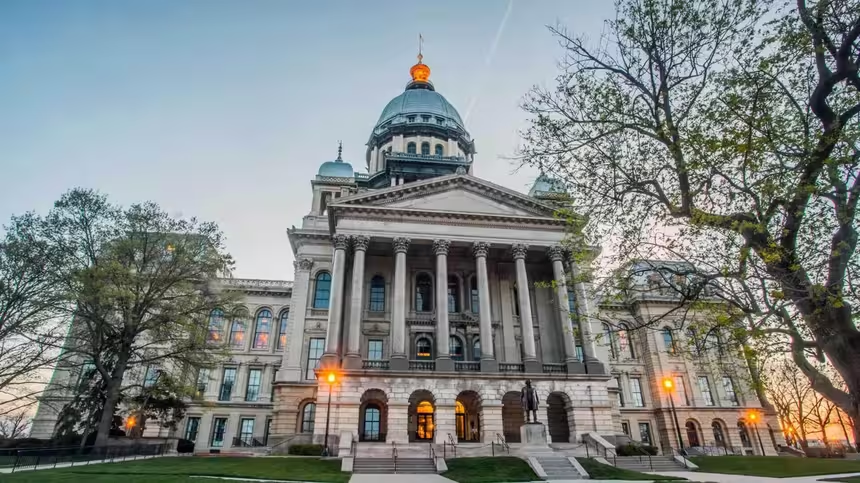
CapitolView
CapitolView is a weekly discussion of politics and government inside the Capitol, and around the state, with the Statehouse press corps. CapitolView is a production of WSIU Public Broadcasting.Providing Support for PBS.org
Learn Moreabout PBS online sponsorship(dramatic music) - Welcome to Capitol View, our weekly look at the happenings inside and outside the Illinois State Capital.
I'm Jennifer Fuller, our guests this week are Brenden Moore of Lee Enterprises and Charlie Wheeler, the Emeritus Director of the Public Affairs Reporting Program at the University of Illinois - Springfield.
Gentlemen, thanks for joining us.
- Glad to be here.
- Happy to be here.
- And as you can see, I'm on location this week at the Abraham Lincoln Presidential Library and Museum in Springfield.
We're very thankful to them for letting us have some space as we take a closer look and we'll have a segment on this later in the program on the display of the Gettysburg Address, which is going on display this weekend.
But first, let's get to what's happening this week in Illinois politics.
For most of the people in Springfield, they're well aware, veto session has happened.
The lawmakers have already headed home after the first half of the session.
Brenden, what are the highlights there?
What happened during veto session?
- Legislatively, not a whole lot.
There was a legislation that passed the Senate that would divest state funds from Russia and Belarus.
That's related to obviously the war between Russia and Ukraine.
Similar version of this bill passed the House in April, but didn't go anywhere.
This is an amendment, so it has to go back to the House and then it'll potentially go to the governor.
But the big story is what happened behind closed doors for the House Republicans and the Senate Republicans.
They both elected new leaders.
The House Republicans elected Tony McCombie to succeed Jim Durkin, and the Senate Republicans elected John Curran to replace Leader Dan McConchie.
So obviously last week Republicans had a pretty bad election night.
They lost four to five seats in the house.
They may pick one up in the Senate, but they're still in the super minority.
And so elections have consequences and consequence of that is new leadership for both of those caucuses.
And the new leaders have a lot of work to do because in the House, the Republicans are staring down their largest deficit ever since the Cutback Amendment in the early 1980s, the smallest caucus they've ever had.
And obviously they still have an uphill battle in the Senate.
So that was the big thing.
Obviously on the Democratic side, both those caucuses had pretty good nights and Speaker Welch and President Harmon both had no problems getting the nod from their caucuses to continue to (incoherent).
- Charlie, let's talk about strategy here.
We heard from House Republican Leader, at least Jim Durkin shortly after the election results started coming in saying he would not seek the leadership position in the next General Assembly.
But is this vote to replace both Republican leaders, kind of a message from the rank and file saying, we've gotta do something to change or is this kind of the common process of doing things?
- At the risk of sounding very cynical, I would not want either of those jobs, cause you are in a super minority.
As a matter of fact, the Republican Caucus in the House will have the smallest percentage, second smallest percentage in state history.
Well, I should couch that by saying I only went back as far as 1880, but it would be the second smallest minority ever.
The smallest was back in 1964 in an election that many of you guys would remember, but it was the Goldwater year, the Illinois House at the time had 177 members.
They did not get redistricting done, and it was an at large vote.
Each party put up 118, and so when you went into the polling booth, you had ballot like this and you were to vote for your 177 preferred out of the 236.
And the Democrats, because it was a very strong vote against or for Lyndon B. Johnson and against Barry Goldwater, won two-thirds.
They had 118 and that's the largest percentage wise majority or conversely the smallest minority for the Republicans or for any party, and as I say, that's 66 and two-thirds.
The current Democratic majority is 66.1.
So it's the second largest Democratic majority percentage wise in the state's history, going back, what, 150 years?
Whether or not it'll be a change, there's indications that McCombie may be more, well she's certainly not a member of the Eastern Bloc, and Curran is probably more moderate than McConchie.
It was interesting because when McCombie won, one of the people who congratulated her was Susana Mendoza.
And Mendoza was very complimentary of her because of some legislation which McCombie helped her.
And I'll read what Mendoza said.
She said that she was a chief's co-sponsor of a historic and transformational Debt Transparency Act in 2017, risking the wrath of a vengeful governor from her own party.
After he vetoed the bill, Representative McCombie assisted in marshaling the votes of Republicans to help us unanimously override the governor's veto in the House.
Rating agencies had regularly cited that, that very reform in their upgrades of Illinois' credit worthiness.
So that's an indication that McCombie can work with Democrats, and Curran is a lot more moderate.
He was involved in the Sterigenics, he was the one who also voted for some gun control measures.
And there's kind of an interesting note here.
McCombie will be the first woman to lead a caucus in the House of either party.
And the first woman in the Senate was Christine Radogno, who was from the suburbs also.
And when she left she was replaced by Curran, so there's sort of a continuity there.
It'll be interesting to see what happens.
The Democrats really don't need the Republicans for anything in terms of being able to get things done with the votes.
If I were strategizing, I would think I would try to get some Republicans, one or two Republicans on any controversial bill so that you can come out and say, well this is a bipartisan vote.
You know, the vote was 79 to whatever, our 78 and one Republican, but that makes it bipartisan.
So I think there'll be cooperation on some things, but it'll be interesting to see cause these are kind of uncharted waters in terms of the size of the majority.
- Brenden, when you talk about leadership style, how do these two compare to their predecessors and how much do you think things might change in terms of what's expected of rank and federal Republican lawmakers in each of their respective chambers?
- Yeah, so on the House side, incoming Leader McCombie, we spoke with reporters yesterday and he said as much that she's very blunt, she's gonna let you know what she thinks, and in times that's gotten her in a little bit of trouble.
She briefly challenged Leader Durkin in 2020, for his job and she quickly dropped it when she realized he had the votes.
But I think that there's gonna be a lot more, perhaps, maybe not more, but openness and honesty with her members and not that leader Durkin wasn't, but it might be obviously, it's a fresh face, she's somebody who brings a different perspective.
I think it's a little bit more clear on the Senate side.
So Leader McConchie kind of had a reputation for having a top down leadership style, which is kind of difficult to have when you only have 18 members, to be very top down.
But he did and his members were seeking a more collaborative style.
And from what I understand, incoming Leader Curran has committed to that.
Senators obviously run in your district and take care of your district, and there's gonna be more input from the caucus on some of the big decisions, whether it's on policy or on campaign side.
The key for both of them, I think it's really a lot of things, but a couple of big things are gonna be money and messaging.
So obviously politics, a big part of it is you need to have money to get your message out and Republicans got crushed in fundraising and that really played out in the suburbs, where you had all these incumbent Democrats and even some challengers on TV in the expensive Chicago market, and Republicans just had no resources to combat that.
And name ID goes a long way in races that down ballot.
So they're gonna have to show they can raise money and also that they have a message that can appeal to voters, and especially in the Chicago suburbs.
I mean, the party lost a lot of key races there and you don't have a pathway back to the majority, I mean even out of the super minority if you can't compete in the Chicago suburbs.
And the party's been been hurt on issues like abortion and on gun rights.
And obviously with Trump being in the background, that hasn't helped matters either.
So it'll be interesting to see if they can get the right message and show that the Republicans are a big tent.
Some of the issues that Leader Durkin brought up last week, where you can have a pro-choice Republican or maybe one that supports gun control, notably Senator Curran has supported some gun control measures in the past, so that might be interesting for him to be leader now.
So those are some things I'll be looking for, are they able to fundraise?
Very hard to fundraise when you are a super minority caucus, and do you have a message and is it an effective message?
- Sure.
You know, know one of the things that Republicans tried to get quite a bit of traction on as they headed into the election was the passage of the Safety Act and the changes that it will put in Illinois's criminal justice code starting in January.
That is particularly something that people are watching for in the remaining days of the veto session after the Thanksgiving holiday, where lawmakers might make some small changes from what we've been told.
Charlie, do you think that there will be a wholesale change to some of the more controversial issues?
Or do Democrats take their win in November and say, this is the voters saying that they support this?
- Well, my sense of a lot of the Republican message was this Safety Act, particularly the pretrial release provisions that in essence from the proponents point of view would do away with the fact that if you're charged with some minor offense and you're poor, you sit in jail.
If you're charged with a major offense, you got money, you bail yourself out.
And the argument that was made on the Republican side seemed to be, we gotta get rid of the whole thing, we gotta just gut the act, we gotta repeal it.
And there were a lot of what I would consider very misleading advertising that went out, fake newspapers, for example, how this is gonna be the end of days, and January 1st the cell doors are gonna fling open and all these armed marauders will be out as the purge.
And I think people were smart enough to realize that this is bunch of malarkey.
And as a matter of fact, and Brenden you maybe covered, didn't Senator Peters, one of the sponsors of the bill, mentioned that after the election results, the idea that there would be wholesale changes or gutting is not gonna happen.
There'll be some minor clarifications approved and I guess there's a study group working on it to clarify the circumstances in which bail is available and circumstances in which people have to be released, some of the details of it.
But I don't think there's gonna be huge changes at all.
- Brenden, would you agree?
- Yeah, and to what Charlie said that that's exactly it.
You know, the proponents of the Safety Act actually had a big lobby day in the capital yesterday.
They claimed about 400 people down lobbying lawmakers to protect some of the key provisions.
And yeah, lawmakers had a press conference and I'll just pull up the quote.
This is from State Rep Justin Slaughter from Chicago.
He's one of the big proponents of the act, said the Pretrial Fairness Act was on the ballot last week, and Dems swept midterms.
People of Illinois chose safer communities over fear mongering, people of Illinois chose public safety over the Republican hysteria.
And then Senator Peters added that basically they're declaring victory, and that the legislature needs to make sure that it is implemented and intact on January.
So that message seems pretty clear that they're not gonna be wholesale changes, there will be clarifications, there have to be clarifications.
But as anybody will tell you, that happens a lot in Springfield.
There are always trailer bills, there's always cleanup bills.
When you pass 700 something page bill, there are always gonna be things that need to be clarified and so they're gonna do that.
But the main elements of it, the end of cash bail and the presumption of release, those are all gonna remain.
And a big part of that is because of the Democrats doing as well as they did.
The crime message didn't stick and a lot of especially more liberal members and members of the Black Caucus are sticking to their guns.
- And one of the other issues that we took a closer look at as we move out of a conversation about veto session and just one more bit of analysis about the November 8th election, and that is the constitutional amendment which codifies the workers' right to unionize in the Illinois Constitution.
And Charlie, we saw this week that it's now projected that that amendment will pass, not because necessarily all of the people voting on the question had enough votes to pass, but the number of people voting in the election voted yes on the amendment, if I'm not mistaken.
- Yes, I don't have the figures in front of me, but I think the current count is something like 52, 53% of all the people who voted, voted for it.
And so it's gonna be part of the Constitution.
And it's interesting and Jen, you and I were discussing this before we started taping the show, in a lot of areas that voted for Darren Bailey for governor, rejected JB Pritzker, those areas also supported the Workers' Rights Amendment.
Despite, again, the argument being made by, what did Pritzker's people call it, spelunkers of misery or something like that.
People like the IPA say that, well, if this passes your property taxes are gonna go up like $2,000, or if this passes, we won't be able to keep the ped arrests out of our school.
All kinds of nonsense like that.
But I thought it was interesting that the fact is, there are a lot of union members, union supporters who are Republican and who vote Republican.
Historically that's been the case.
I remember years ago, Jim Thompson was one of the keynote speakers at AFL-CIO, I think it was convention.
So it in a sense, that I found interesting.
- Brenden, this question didn't get quite the same attention that the graduated income tax did just two years prior.
Do you think that this was something that was trying to just, you know, supporters were trying to keep it under the radar?
Or did the governor's race just suck all the air out of the room?
- Yeah, I think that the governor's race, some of the other more high profile races, race for Supreme Court maybe overshadowed the Workers' Rights Amendment.
I don't think they tried to underplay it.
I mean, the unions put a lot of money into this effort and there were ads that were up earlier this summer that were supporting it.
I think really the difference here is that the opposition wasn't as organized, wasn't as unified as Charlie noted.
This amendment had a lot of support in traditionally Republican areas, conservative areas of the state.
There's a lot of downstate union members that vote Republican.
You may remember during that debate in Bloomington or Normal, when Senator Bailey mentioned that he did not support the amendment, there were some groans.
A lot of his own people that voted for him also voted for the Workers' Rights Amendment.
So it had some Republican support.
It's maybe a wedge issue a little bit in Republican politics.
You know, some of the big money folks like Ken Griffin obviously cared a lot about the Graduated Income Tax Amendment.
They donated a lot of money towards the effort against it.
This time you had a little bit, you had Richard Uihlein, another billionaire donor who's donated a lot to conservative causes, to Bailey, to Dan Proft's super PAC that put in a little bit of money, but it was too little, too late.
I think they got organized in September.
The unions have been on this since at least earlier this year.
And Illinois is a union state and it showed that once again with the results of this referendum.
- With that, quite a bit still left on the table to talk about.
We'll be back next time with a wrap up of the veto session and look ahead to the next session of the General Assembly.
I wanna take a moment to thank Brenden Moore and Charlie Wheeler.
Thank you for joining us this week on Capitol View.
- It was my pleasure.
- Always my pleasure.
- Back on Capitol View this week with a special segment as an anniversary is coming up for the Lincoln Presidential Library and Museum.
As you can see, that's where I'm on location this week and I'm with Director Christina Schutt.
And Christina, were talking about the Gettysburg Address, which has a major anniversary right now.
- It is.
It's the 159th anniversary of the Gettysburg Address.
It's kinda hard to believe it's been this long, but it's wonderful that we're able to bring out our version and really celebrate it with our full citizens here in the state.
- A lot of people may be familiar with the address, but perhaps haven't had a chance to experience it.
Have you seen people have kinda an emotional response when they are able to see a document like this?
- [Christina] Absolutely.
It's one of those things that it kind of makes your heart skip a beat a little bit because you realize the historic nature of it.
What Lincoln really was trying to do in this document is he's trying to figure out, what is the cost of the war?
Why are we fighting this bloody and brutal conflict?
It's gotta be more than just salvaging the union in Lincoln's mind.
It's gotta be about ending enslavement for hundreds of thousands of people who were held in bondage.
And so when you read that, when you read his words and what he's trying to convey, it does, it sort of chokes you up a little bit and it makes your heart skip and beat.
- What about relating this to today's times, there's still a lot of people talking about systemic racism and issues within the American culture.
Is this speaking to that as well, do you think?
- Absolutely.
You know, one of the things that I really love about Lincoln is that Lincoln ultimately changes his views on race and on racism.
You know, Lincoln really starts the war at a place where frankly, he was always against slavery, right?
We know that he was always against slavery, but he wasn't necessarily for black people.
Those were two different things.
But what happens through things like the Emancipation Proclamation, where he's allowing for the enlistment of black soldiers, he sees their valor on the battlefield.
He sees what black Americans are willing to do to fight for their freedom and really begins to change his mind.
And I think that's something where we could use a little bit more of that today, of our willingness to learn and grow and to be able to move forward and make better decisions than what our ancestors made, or even what we ourselves made in the past.
(incoherent) gets to the mission of the museum and the library here in Springfield, letting people see history and experience history and bring it into their own lives?
- Absolutely.
You know, we are ultimately hoping that we can inspire some civic engagement, right?
Through the diverse lens of Illinois history and sharing with the world the life and legacy of Abraham Lincoln.
Abraham Lincoln didn't stop on Gettysburg, he didn't stop with the emancipation, he didn't stop with the 13th amendment.
He didn't even stop his legacy, didn't stop with his death.
It continues today if we as citizens pick it up.
I mean that's one of the things that he's really highlighting within the Gettysburg Address.
He doesn't direct it to soldiers, he doesn't direct it to United States forces, he's directing it to us, right?
It's for us, this cause, what are we going to do?
These men have given their lives on the battlefield, but what ultimately are we citizens gonna do to ensure that their legacy and their life that they gave isn't in vain?
- So the Gettysburg Address is just a part of large collection of Lincoln artifacts that you have here at the museum.
It'll be available for a couple of weeks in Springfield.
- Yes.
Just two weeks.
- So how important is it, do you think, for people to come in, take that little bit of time, see this special exhibit, and also experience everything else the museum has to offer?
- Oh, I think it's incredibly important.
It helps us to connect with our past in a really meaningful way, so that hopefully we'll make better choices in our present and in our future.
You know, one of the things that I always point out is while there are five known copies of the Gettysburg or five known versions of the Gettysburg Address, ours is the only one right here in Illinois, here in the heart of the Midwest.
To visit the others, you have to go to Washington DC or the east coast, right?
Go to Cornell.
And so to be able to just drive for some folks, a few hours or even a few minutes down the street to be able to see it, I think it's something that again, helps connect us as citizens about how do we carry Lincoln's legacy forward?
- We're just coming out of an election that in some cases was very contentious, at least here in the state and as well across the nation.
Lincoln himself had some pretty difficult elections to get through himself.
- He did.
In fact, he wasn't even on the election in the south, in the southern states when he gets reelected, not even on the ballot there.
But despite the fact that Lincoln only wins his first election with 39% of the US vote, he still knows that his job ultimately as president is to (incoherent) country, help tie it together.
At the time where Lincoln is speaking his inauguration, he's talking about these words about how the south was already trying to unlawfully secede from the nation.
They're already trying to attempt an insurrection to overthrow a dually elected US government.
And Lincoln's saying, hey, we're not enemies, but friends.
Come back.
Don't do this for the sake of our country, for the sake of what our founding ideals mean, for not just us, but really the world.
- A lot of people think that they know about Lincoln, particularly those of us who call Illinois home and they hear about him a lot.
But I imagine that coming to an exhibit like this or even just coming to the museum and the library, you learn a little bit new every day.
- Absolutely, you do.
We're proud to have almost 50,000 items in our collections that document the life and times of Lincoln and his family, including over 13 million items that document Illinois history and help contextualize Lincoln here in the land of Lincoln, as we call it.
But every day you learn something new here.
One of the myths that we're actively dispelling even about the Gettysburg Address for folks is that Lincoln wrote it on the train.
He did not write the Gettysburg Address on the train.
Lincoln was a brilliant orator, but he spent time and thought drafting his remarks.
And so we're hoping that as people come and experience it, they learn something different, maybe that they didn't even learn before or in school, and that that will inspire them to wanna continue that knowledge.
- Christina Schutt is Executive Director of the Abraham Lincoln Presidential Library and Museum.
Director, thanks so much.
- Thanks for having me today.
- And thank you for joining us on Capitol View.

- News and Public Affairs

Top journalists deliver compelling original analysis of the hour's headlines.

- News and Public Affairs

FRONTLINE is investigative journalism that questions, explains and changes our world.












Support for PBS provided by:
CapitolView is a local public television program presented by WSIU
CapitolView is a production of WSIU Public Broadcasting.