
Capitol View - November 21, 2024
11/21/2024 | 26m 46sVideo has Closed Captions
Capitol View - November 21, 2024
Analysis of the week’s top stories with Mawa Iqbal of WBEZ and Andrew Adams from Capitol News Illinois.
Problems playing video? | Closed Captioning Feedback
Problems playing video? | Closed Captioning Feedback
CapitolView is a local public television program presented by WSIU
CapitolView is a production of WSIU Public Broadcasting.
Capitol View - November 21, 2024
11/21/2024 | 26m 46sVideo has Closed Captions
Analysis of the week’s top stories with Mawa Iqbal of WBEZ and Andrew Adams from Capitol News Illinois.
Problems playing video? | Closed Captioning Feedback
How to Watch CapitolView
CapitolView is available to stream on pbs.org and the free PBS App, available on iPhone, Apple TV, Android TV, Android smartphones, Amazon Fire TV, Amazon Fire Tablet, Roku, Samsung Smart TV, and Vizio.
CapitolView
CapitolView is a weekly discussion of politics and government inside the Capitol, and around the state, with the Statehouse press corps. CapitolView is a production of WSIU Public Broadcasting.Providing Support for PBS.org
Learn Moreabout PBS online sponsorship(bright music) (bright music) - Thanks for joining us on "Capitol View."
I'm Fred Martino.
This week, the Department of Justice investigates Sangamon County, an effort to protect Illinois aquifers stalls in the Senate, and we'll tell you about a state investigation of a gas utility.
Those stories and more with Mawa Iqbal of WBEZ and Andrew Adams from "Capitol News Illinois."
Mawa, a new report this week from "Capitol News Illinois" following the Sonya Massey shooting by a sheriff's deputy.
Sangamon County is now under investigation by the Department of Justice, and I understand the probe may go beyond that fatal shooting.
- Yeah, so the DOJ looking into this case, this is something that the family, Sonya Massey's family, who's represented by civil rights attorney Ben Crump, as well as members of the community, have been requesting for a pretty long time, actually probably since her shooting.
And so, basically, for those who don't remember, Sonya Massey was a 36-year-old woman, unarmed.
She was in Springfield in her home calling for help with 911 to report a potential prowler.
And that's when former Sheriff's Deputy Sean Grayson shows up to her home and he ends up shooting her in the face and killing her.
And he's now sitting in jail awaiting trial.
He's been arrested on murder charges.
But the DOJ investigation, you know, there's been questions about how Sean Grayson was able to come onto the force, like how he was able to be hired.
Just as the investigation and as news reports come out, there's been some reports of his past employment history and some complaint notices and stuff.
And so I think, you know, with the DOJ investigation, they're looking at how is Sangamon County hiring their officers?
You know, like what kind of background checks are they doing?
They're also looking at, you know, just in general, what's the data on use of force amongst the sheriff's officers?
So, Sonya Massey was a Black woman and former Sheriff's Deputy Sean Grayson is, look at this data disaggregated by race.
And they're also just looking at what the sheriff's office has set up in regards to people experiencing mental health and behavioral health crises, right?
So, I think, you know, county records have shown that up until Sonya died, she was struggling with mental health issues and she had actually made 911 calls, her mom had made a 911 call reporting that she was struggling.
And so she was seeking treatment up until the very end for her and I think that's called into question a lot of just what are the resources available in Sangamon County to help people who are experiencing these crises?
So, that's what the DOJ wants to get from the sheriff's department, from the county.
It's definitely a large volume of information.
It's really like a really long list of things that they're requesting.
And it's probably, you know, the sheriff's department says that they're pledging full cooperation with the DOJ, but it's gonna take a long time for them to just get everything together and send it over to them.
- Okay.
Well, we will be watching as that story that made national and even international news continues to develop.
Andrew, I wanna move to you now on a couple of environmental stories that we have covered extensively on this show in the past.
There are some updates.
First a plan to ban carbon injections near aquifers has stalled in the Senate.
And you have a new story this week at "Capital News Illinois" about a slowdown in the adoption of EVs, electric vehicles.
- Of course.
So, let's start with the carbon injection.
So, for those who haven't heard, this is a technology where you take carbon dioxide and inject it into the ground, deep underground, and you can store it there, you know, for a long time and keep that carbon out of the atmosphere as an attempt to reduce emissions.
Now, there's a few projects like this in Illinois and there have been a few proposals, but this past spring, lawmakers put a temporary pause on new projects while they sort out some regulations.
And this week, or, you know, this veto session, I should say, lawmakers were ready to take another look at this and permanently ban this technology and this method near aquifers, you know, underground water sources that are the only source of drinking water for a community.
Now, this is most notable for the Mahomet Aquifer, which takes up a large section of central Illinois, serves several hundred thousand people in places like Decatur and Champagne.
And, you know, folks are worried that this carbon injection will be harmful to the aquifer, potentially pollute it in some way.
So, lawmakers are interested in banning it, although an effort to do so stalled without moving forward last week.
And it's unclear where that effort is going to go and if it's going to be successful.
Definitely a story to watch come January when folks return to Springfield for their spring session.
- Okay.
And you also, as I mentioned, have a new story this week, something that we've seen really nationally, that while electric vehicle sales are going up, not at the level that was expected, and there's a slowdown in the adoption of EVs in Illinois.
- Yes.
So, in Illinois, EV adoption, you know, the new registrations with the Secretary of State who manages driving and vehicle registration, they're still increasing, although they're increasing about half as fast as they were last year.
And that might raise some concerns for EV proponents and folks in state government who have a goal of putting one million EVs on the road by 2030.
Now, if we continue at the trend that we have been on the past year, if that just repeats until 2030, we will be about 200,000 EVs short by that time.
So, it's an interesting space to watch, particularly as the state puts more incentives towards EVs, EV charging infrastructure, another huge issue, and other supply chain, you know, manufacturers and businesses.
- Yeah, something to watch for sure.
And we do not know at this point the extent of any influence that will come from the new Trump administration as former President Donald Trump takes office again.
So, we will be watching.
Mawa, another update this week from "Capitol News Illinois" on a different story.
A judge dismisses a biometric data privacy lawsuit citing revised state law.
Tell us about that.
- Yeah, so I guess for context, in 2008, Illinois lawmakers passed the Biometric Information Privacy Act, which, with the help of the ACLU of Illinois, basically prohibits employers from collecting biometric data of their employees without their express consent.
And so biometric data is basically like, you know, if you're scanning your fingerprint or if you have to do a facial recognition scan to clock into work, for example.
And so, basically, last August, so a couple months ago, or I guess a few months ago now, Governor Pritzker signed an amendment to the law that would sort of clarify what the damages are that you can receive if you are wanting to sue your employer for improperly collecting your data.
And so basically what this lawsuit is now is this employee named John Gregg who works for a trucking company based in Michigan, but in Illinois, and he was seeking damages of up to $75,000 in federal court.
So, it was the Northern District of Illinois federal court in Chicago.
He was seeking $75,000 in damages, basically saying that, you know, "This company improperly collected my data."
But according to this amendment that Governor Pritzker signed a few months ago, if you're suing a company for collecting your information, they can only be found liable for just one violation.
So, let's say, you know, if you are arguing that this company collected your fingerprint data for the past couple of weeks or however long, right?
They can only be found liable for the one time and not for every single time they collected your fingerprint data.
And so now with this case, you know, the judge ruled that you can only, this person, John Gregg, can only really get like $15,000 in damages.
And therefore, since it's that low of an amount, it's an improper venue to bring forth this lawsuit, so.
- Okay, very interesting, and it shows the consequences when there is state law.
It comes up, and I'm glad we're staying on top of this.
Something very interesting for people to follow and certainly raises a lot of questions and concerns for an awful lot of people.
Speaking of concerns, Andrew, I always find these stories interesting and I'm glad that you are covering them.
Earlier this month, you covered a story about consumer groups railing against a Chicago gas utility as a state investigation nears its end.
Tell us about that.
- Yeah, so this is an investigation into Peoples Gas, which is the gas utility, natural gas in Chicago.
And over the past, you know, many years, stretching back longer than a decade, Peoples Gas has been replacing its pipes.
You know, some of these pipes are quite old.
Some of them, you know, a fact that folks like to bring out, some of these pipes were laid when Abraham Lincoln was president.
So, these are old, old iron pipes, and Peoples Gas has been replacing them.
But this program of replacement, critics say, has been massively over budget and mismanaged.
You know, consumer groups like the Citizens Utility Board and Illinois PIRG have long railed against this program and they say that the way that the company prioritizes which neighborhoods to go in and which pipes specifically to replace ends up costing literally billions of dollars more than it should.
And these complaints got so much credence and there was some real interest in what was happening with this program that last year, the state opened an investigation into it at the Illinois Commerce Commission, which regulates this kind of utility.
Now, that investigation has been combing through the books, every financial record, every record of maintenance.
They've been looking at that to say, "Well, was this really a needed expense?
Should this be on the company's dime?
Should this be collected back from ratepayers?"
And trying to figure out how this should be managed.
And that investigation is about a month away from being done after almost a year of nearly constant hearings, judicial type conversations, testimonies.
And it will be incredibly interesting to see what sort of action the ICC takes, particularly since over the past year and a half, consumer advocates and environmental advocates have noted that this ICC board has been very consumer friendly.
They have taken some big swings against utilities.
So, this is another test to see, you know, how big of a swing are they interested in taking.
- Yeah, absolutely.
That's part of why this is so interesting to follow.
It's an area where the actions by consumers and consumer groups seem to definitely have impact.
So, we will be watching.
I'm sure a lot of other utilities will be watching as well to see the results there.
Thank you for the update on that.
Mawa, Illinois Democrats are bracing for a second Trump administration amid their return to Springfield.
I should say you and Andrew are both in Springfield this week.
What are you hearing?
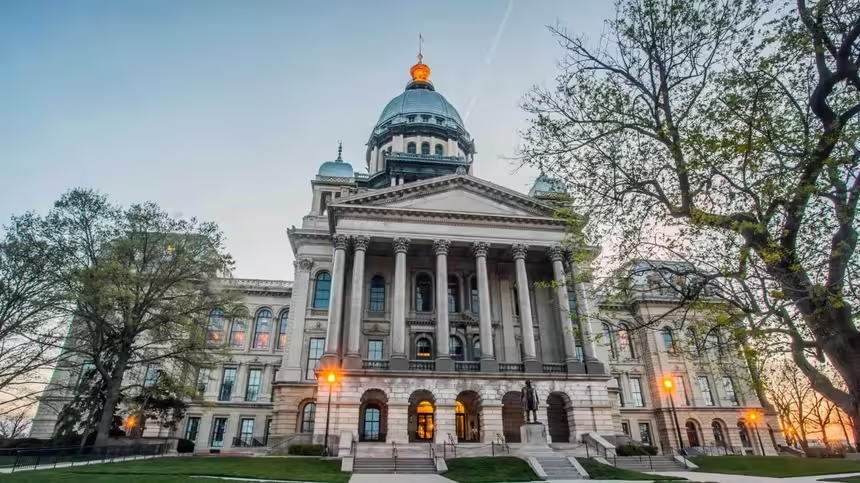
- Yeah, I was gonna say, for those who aren't familiar, Andrew and I, we're sitting in the basement of the Capitol right now as we're nearing the tail end of the veto session, which, like we were talking about before the show, it hasn't been very exciting.
Nothing's really happened.
And I think part of that, you know, so I think after the election results came out where it was projected that President-elect Trump would win and become the President-elect, you know, you had all the big Illinois elected officials, politicians like Governor Pritzker and House Speaker Chris Welch talking about, you know, we have to fight back against a Trump administration.
And there was that iconic line that Pritzker said where he was like, for Trump, he was like, "You wanna come for my people, you have to come through me first."
And so, you know, I guess to his credit, it hasn't been all just talk, right?
You know, he's teamed up with the Colorado Governor Jared Polis to create this coalition, they call themselves a non-partisan coalition of governors called the Governors Safeguarding Democracy.
And essentially it's just like a platform to discuss ways to preserve the state level democratic institutions.
But, you know, I think right now, because the Trump administration hasn't actually started yet, it's sort of hard for them to say what specifically they would want to do to sort of Trump-proof Illinois.
And so last week, there was a press availability with Pritzker and he was asked this question, like, what's on the top of your mind?
Like, what's on the agenda?
And he kind of like vaguely said, you know, "We're looking at how to protect undocumented immigrants.
We're looking at how to preserve environmental regulations.
We're looking at how to preserve access to reproductive care."
And, you know, I think those are all good, you know, like probably what we would expect for them to say.
It's just, you know, we're looking at now, we're reaching the end of the veto session and it seems like more likely that if lawmakers were to introduce any legislation to protect and preserve those things, then it probably would be during the lame-duck session, which is early January, or the spring session, which will start later that month.
- Okay, well, we'll be watching, and, of course, there's the added issue that Governor Pritzker and legislators have to deal with a projected deficit of more than $3 billion.
So, perhaps that will mute some of the discussion about, as you put it, Trump-proofing Illinois.
Illinois will need all the federal funding for sure that it can get.
Andrew, Dan Petrella of the "Chicago Tribune" recently wrote an interesting story, the headline, "Illinois' weak lobbying laws help sustain culture of corruption."
What did he find?
- Absolutely.
And, you know, before I get into this, just again, full credit to Dan.
It's a great piece and I would encourage everyone to go read the story on the "Tribune's" website.
The story and what Dan found was essentially, you know, a run-through of the history stretching back a hundred years at least of lobbyists, you know, these people who are paid to chat with lawmakers, share information, influence legislation one way or the other, a history of lobbyists sometimes crossing the line into less than scrupulous behaviors, bribery, you know, influence pedaling, that kind of corruption within the halls of government.
And there are countless examples.
Currently, as I'm sure folks who follow politics know, the former Speaker of the House Michael Madigan is on trial for a, you know, range of charges and he has a co-defendant who was for a long time a lobbyist in Springfield.
And he is by far not the only lobbyist who has ever, you know, gone before a judge for stepping over that line.
Dan also found that there are lots of proposals to kind of clean up the, clean up the ways that lobbyists might be too close or might be stepping over the line, like I've said, you know, and that includes potential solutions like requiring lobbyists to disclose their salaries, as many states and, you know, the federal government does, or lengthening the time between when a lawmaker can leave office before becoming a lobbyist because, as sometimes happens in Springfield, a lawmaker might retire and, you know, maybe a week later, as in the case of former Representative Tim Butler, who, you know, represented up here by Springfield, a week later, suddenly they're asking their old colleagues to support a bill for their new employer.
You know, they'll turn into a lobbyist that quickly.
And there have been attempts over the years and even recently, particularly, you know, after major scandals, everyone wants to make sure that Springfield looks like it's cleaning itself up, but these attempts have often fallen short or get watered down as the weeks go on and debates go on.
So, definitely an interesting look into how lobbying works at the Capitol.
- Very important reporting, and I agree.
So, make sure to read it.
Mawa, another interesting story by the "Chicago Tribune."
It found after Donald Trump's win, Illinois providers reported a spike in demand for abortion pills, birth control, and sterilizations.
Tell us about that.
- Yeah, so the Planned Parenthood of Illinois, they've reported an increase in the number of calls they were getting, right?
And the "Tribune" talked to this clinic called Carafem in Skokie where they basically were trying to have additional staff to meet this influx of people.
So, they were saying that, you know, people are really concerned.
They're concerned that under Trump administration, you know, access to birth control, access to mifepristone, which is an abortifacient, so a medication that people can take to induce an abortion, a medical abortion, you know, they're worried that access to these things will be curtailed.
And so one thing they're trying to do is kind of stockpile.
And this is something that I've been seeing just like even on my social media platforms and on my feeds and stuff, people are really concerned.
And it's interesting just to see how clinics now are responding to that, right?
I think we saw a similar trend when Roe first fell in 2022 where clinics like Planned Parenthood were staffing, right?
They were like wall to wall just having more people in the clinics because they knew that there would be an influx of people.
So, I'd be really curious to see, you know, when Trump does actually take office, like, how that will affect people coming into the clinics and the sort of services they're wanting to get.
- Very interesting.
Yes, indeed.
We have about five minutes left.
Andrew, we have another story related to reproductive rights and this continuing important issue in Illinois and all around the country.
The City of Carbondale is facing a legal battle over protest restrictions outside clinics that perform abortions.
This legal battle could have wide-ranging impact once decided.
Tell us about this.
- Yeah, so as I'm sure folks know, Carbondale has become quite a center of, you know, reproductive health services and abortion services, you know, since the Dobbs decision turned abortion laws over to the states.
And, you know, this can be a very heated subject.
People often protest outside abortion clinics.
And for those folks who are going to these clinics, you know, for whatever services they might need, that can often require walking through these protests and those can get pretty heated.
So, Carbondale decided to put a so-called buffer zone around medical facilities.
You know, folks cannot get within eight feet of someone going to use these facilities.
But the protest groups that protest outside of abortion clinics and reproductive health clinics, they say that this is an infringement on their First Amendment rights, that the First Amendment guarantees that they can go about their protest in a manner that they see fit.
And that challenge has now been taken to court and as the courts will look at this, it will be telling to see how far does the First Amendment go and how far does the First Amendment go in relation to medical care and healthcare privacy.
You know, these big, big ideas that are now being put to the test in a new way.
- As I understand it, Andrew, this case, while very important and expected to have some impact as it goes through the process, is not expected to go to the US Supreme Court at this time.
Is that right?
- Yes, yes.
That's my understanding as well.
It'll be interesting to see if it does because if this case does go to a court that has a wider jurisdiction, it will be wide-reaching.
Although, it's unclear whether or not it'll go all the way up that flag pole.
- Yeah, very interesting.
And I'm surprised, we actually have about two minutes left, Mawa, something that's developing and we're taping this on Wednesday, so there could even be another development on this, Mayor Brandon Johnson in Chicago suffered a defeat recently when he asked for a $300 million property tax increase.
He's brokered a new deal, but as I understand, it still includes a large property tax increase.
Tell us about this in our last minute.
- Yeah, I mean that 50 to zero vote was definitely shocking, but also kind of, I mean, it was symbolic, right?
I think as my colleagues at the "Sun-Times" reported, these budget negotiations to try to get that property tax hike to be lessened or just cut entirely were already happening a few days before the vote actually took place.
And so now the new proposal is $150 tax hike, which is still- - $150 million.
- Million dollars, yes.
Right.
$150 million tax hike, which is still, you know, a lot of people are saying too high.
But it's interesting because I was reading the "Sun-Times" this morning and my colleagues report that Johnson is sort of feeling like he's, I guess, kind of losing control of the budgeting process.
So, he kind of lambasted his critics by calling them, you know, throwing temper tantrums and saying that Chicago doesn't have time for that and that we need to get this budget process going and not drag it into December.
- Yeah, we will be watching and certainly maybe surprising to some that this was proposed considering up until this time, across the state, all of the talk has been about just the opposite, ways to cut property taxes as opposed to increasing them.
So, certainly a politically explosive issue, which may explain that 50 to zero vote when the $300 million property tax increase was proposed.
Mawa, Andrew, good luck in Springfield.
Thank you for being here.
- Thanks for having us.
- Thank you.
- That's "Capitol View."
For everyone at WSIU, I'm Fred Martino.
Have a great week.
(bright music)

- News and Public Affairs

Top journalists deliver compelling original analysis of the hour's headlines.

- News and Public Affairs

FRONTLINE is investigative journalism that questions, explains and changes our world.












Support for PBS provided by:
CapitolView is a local public television program presented by WSIU
CapitolView is a production of WSIU Public Broadcasting.