
Capitol View - November 23, 2023
11/23/2023 | 27m 14sVideo has Closed Captions
Capitol View - November 23, 2023
Illinois Governor JB Pritzker announces $160 million dollars will be provided to house and care for migrants from the Illinois Department of Human Services budget. We’ll have that story and much with Kent Redfield, Emeritus Political Science professor at the University of Illinois Springfield and Jeremy Gorner of the Chicago Tribune.
Problems playing video? | Closed Captioning Feedback
Problems playing video? | Closed Captioning Feedback
CapitolView is a local public television program presented by WSIU
CapitolView is a production of WSIU Public Broadcasting.
Capitol View - November 23, 2023
11/23/2023 | 27m 14sVideo has Closed Captions
Illinois Governor JB Pritzker announces $160 million dollars will be provided to house and care for migrants from the Illinois Department of Human Services budget. We’ll have that story and much with Kent Redfield, Emeritus Political Science professor at the University of Illinois Springfield and Jeremy Gorner of the Chicago Tribune.
Problems playing video? | Closed Captioning Feedback
How to Watch CapitolView
CapitolView is available to stream on pbs.org and the free PBS App, available on iPhone, Apple TV, Android TV, Android smartphones, Amazon Fire TV, Amazon Fire Tablet, Roku, Samsung Smart TV, and Vizio.
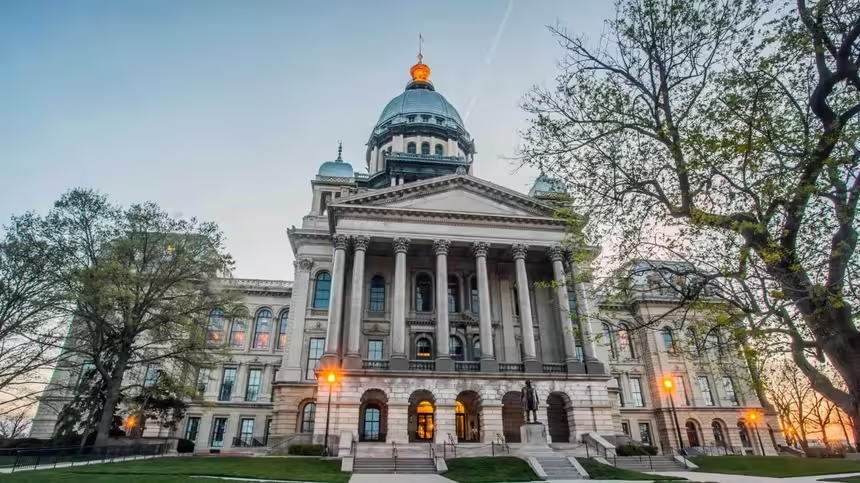
CapitolView
CapitolView is a weekly discussion of politics and government inside the Capitol, and around the state, with the Statehouse press corps. CapitolView is a production of WSIU Public Broadcasting.Providing Support for PBS.org
Learn Moreabout PBS online sponsorship(soft music) (camera lens beeping) (exciting music) - Happy Thanksgiving, and thanks for joining us on "Capitol View".
I'm Fred Martino.
We are thankful this week for the full half hour to discuss some of the most important issues in Illinois, and we have two of the best to keep us informed.
Jeremy Gorner with the Chicago Tribune, and Kent Redfield, emeritus political science professor at the University of Illinois Springfield.
Jeremy, you reported on our top story.
Governor J.B. Pritzker has announced $160 million from the Illinois Department of Human Services' budget to help and house the continuing influx of migrants.
Capitol Facts reports another 18 buses arrived last week.
This comes after a veto session in which there was no additional funding provided.
What is going on, and what do you think are the political ramifications for Democrats?
- Well, I think going into election season next year, it probably couldn't come at a better time for Democrats.
Obviously not for Governor Pritzker, but for others, on the state level.
But that being said, there was no supplemental budget during veto sessions, so it kind of begged the question is where did this money come from all of a sudden?
And we kind of had gotten hints, like just us reporters behind the scenes, like nobody was saying anything, it was hard to confirm that there was something going on behind the scenes that there might be more money available, especially because the city of Chicago had been struggling so much to actually put policies in place for their approach to dealing with the migrant efforts.
But 160 million, I mean yeah, like you said, we had heard that there could be something coming down the pipe, but at the same time, with no supplemental budget, 160 million did seem kinda surprising to us, and then of course it begs the question that there could be hundreds of millions of dollars and a budget shortfall next year, so how are they gonna manage that?
But this money's supposed to help the city of Chicago with the base camps for the migrants, as you know a lot of the migrants have been sleeping in police stations, and other spaces in Chicago.
It's gonna go- - Even O'Hare Airport, right?
- O'Hare Airport.
- Yeah.
- So I mean I think that obviously it's money that's welcome, but I think that it also, it signals a couple of things.
It signals that the state feels that the city isn't moving fast enough, and that the federal government isn't moving fast enough.
The governor has really been trying to get the Biden administration to help them out with federal money for this, and they just haven't seen that yet.
- Yeah.
And it's a big question, where is all of this going?
To your point, there may be some in Chicago who welcome, to use your word, this money, because it's needed, it's an urgent situation.
On the other hand, some others who wonder what about money for X, Y, and Z?
I mean, why is, yeah.
- Yeah, no so like when you were asking me about political ramifications, I mean yeah, there's certainly some elections next year for state, you know, legislative seats.
If there's gonna be new money during spring session, I mean, that could play a factor.
But in terms of what's going on right now, yes, there have been some lawmakers, there have been some in the Chicago City Council who've expressed resistance to more public money being allocated to the migrant effort because of problems in their own communities with an existing homelessness problem, poverty that's been plaguing their neighborhoods for generations, and of course the question comes, it's like, well you know, the government said that there was no money to fund these issues over the years, but all of a sudden, there's all of this money to help migrants, and that's bothered a lot of people, but I know that when we did the story last week of $160 million, the reason I bring up elections coming up, I was talking to at least, to one or two lawmakers, who seemed a little skeptical about this influx of money going from the state going into the migrant efforts, and all of a sudden, it appears that there could be folks who were initially critical changing their tune, saying instead of we need to focus on the problems in our neighborhoods and in our districts.
Now they're saying we praise Governor Pritzker, and we just want, we think that if he's gonna go all in to help, obviously the existing homeless population is a problem, but we need to help everybody, whether you're a non-citizen, or whether you're a citizen.
So the attitudes appear to be shifting a little bit in that direction.
- Yeah.
Well, and as we've always said, as we continue to cover this story, you do not hear arguments that this is not a crisis.
Everyone agrees it's a crisis.
The question and the controversy is who pays for it, and a lot of folks argue the federal government should be the one involved in a lot of different ways, including paying for this relief.
So we will continue to watch this, and appreciate, Jeremy, your reporting on it.
Kent, meantime, there is concern that Chicago's 60 day shelter limit is not enough time for migrants to apply for and receive work permits.
CBS in Chicago reported on this.
Tell us more.
- Well, this involves trying to manage sorting people out, figuring out who they are, how they're connected, trying to find, we want to put them not out on the street, but we want to move them through a process, and Governor was pretty specific, you know, we wanna do intakes, sorting sorts of things, we wanna give money to the city so we don't have people freezing to death as we're moving them through the system, then we wanna have money on the other end to get them out, rental assistance, to speed up work permits, all of those things, and so when you talk about putting limits on the time that the migrants can stay in a shelter setting, and this is like moving from the airport into something that isn't an individual kind of accommodation, or moving to a family, but it's a holding action.
Then having those limits on there, there's not much discussion of enforcement.
I mean, it's worrying to people, are we just gonna push people out the door?
It's probably better understood as we're trying to incentivize people moving, excuse me, moving through the system, and the hope is that if we're more efficient and effective in terms of coordinating what's going on, that we're not gonna be able to sort people, absorb them as they come to the city, we'll be able to keep track of everybody, moving them through, and then there'll be this good outcome on the other end.
Now whether that's gonna bear fruit or not, obviously what was going on was not working.
The Governor's in a position politically where he's gonna own this whether he's trying to take control of it and manage it or not, and so you've got that decision, and we don't want people freezing.
We don't want a huge mass meeting the army of press that's gonna come here for the Democratic National Convention next fall, or next late summer, and so that's, but everybody is, because of the uncertainty, because of how badly it's been handled to this point, that everybody's nervous about are we really trying to fix things, or are we just kind of, you know, flurries of activity, and so this is a start, but there's a lot on the line in terms of trying to get this done, plus, as Jeremy said, the budget situation, we moved money, we've got surpluses that came from COVID, and the Governor has the ability to move money within agencies, but ultimately that has to be replaced and forecasting what the economy's doing tomorrow, let alone what it's gonna be doing in July, or a year from July when we're wrapping up the next budget.
So there's an awful lot of uncertainty in this.
- Yeah.
And depending on timing, we may get a chance at the end of the show to talk more about the money situation.
Jeremy, I wanna move onto another topic now.
You also reported on a veto session story that looks like it will resonate for a long time.
Families and private schools blasted the decision by Democrats in the Illinois Assembly to let a tax credit scholarship program expire, meantime, public school advocates say that it was the right decision.
Tell us what you found, and again, what this could mean politically for Democrats.
- Well, I mean certainly, obviously we're talking about the Invest in Kids tax credit program, which is gonna sunset at the end of the year.
Lawmakers said the options are a veto session to extend that tax credit.
There was a proposal on the table to extend it for five years.
Some Republicans wanted it to be permanent, but the compromise was five years.
You know, despite a little bit of infighting among Republicans, they were pretty united in they had enough votes to pass legislation to extend the program, but Democrats were divided.
I mean, you had many Democrats, especially those who were staunch backers of teachers unions in the state felt that any kind of public incentives should be going to public schools, to public education, and but you also had some other Democrats, who represent districts that have a lot of underperforming public schools, who believe that their constituents, who perhaps come from low income families, deserve those opportunities, too, to attend the schools of their choice, to attend private schools.
You know, obviously, this was painted as a big PR campaign in the capitol, there were protests, like hundreds of people, children, adults alike, trying to get the lawmakers' attention during the final days of session, during veto session.
Obviously it fell on deaf ears, but this division, but basically, what it really turned into was kind of this proxy war of advocates for this program, it turned into this proxy war against teachers union, and it gave Republicans a chance to keep pushing for a school choice agenda.
These are obviously things that Democrats for years have been criticizing Republicans about, so it really turned into a huge ideological battle more so than a policy battle, which was one reason that this program just couldn't get the votes in the legislature, and especially since a lot of Democrats, like I said, you know, this was an attack on teachers unions, and Democrats really depend on a lot of support from teachers unions, so this was, again, only kind of fueled more animosity that a lot of Democrats had for keeping this program, but as far as going forward, I think it remains to be seen, whether in the springtime, could they come up with another proposal, especially before the school year ends, I mean, I've heard that that's very possible.
But as far as now, it's yeah, I mean, you've got a lot of progressive Democrats who, of course, were pretty dead set on keeping public incentives to public education, for state incentives, that is.
- Yeah.
- And some moderates, especially those who have a lot of Catholic schools in their districts, a lot of private schools, felt like yeah, we wish that this program could've lasted.
So what this does as far as a division among some Democrats, I mean, I think that kind of remains to be seen, but yeah.
I mean, I think that that's kind of where we're at right now, in terms of how the politics go, because Republicans obviously had broad support for this, especially since Bruce Rauner in 2017 signed this into law, so they've been pretty united.
It's really the Democrats that have been divided on this.
- Yeah.
Another one where I think we may be hearing about it again.
We'll keep watching on it for sure.
Kent, speaking of schools, a new story this week by Capitol News Illinois, officials at the State Board of Education said that they are getting more requests for increased funding for next year than the state could possibly afford.
This comes after other news that the state will face budget pressure from the influx of migrants and other issues.
Bring us up to date on the education funding challenge.
- Well, this is a fall ritual.
We start at the agency level, the State Board of Education, and we are trying to put together a funding proposal to present to the legislature.
You know, it's their ask.
This is what we want.
We know that there is an obligation under the funding formula reform to provide new money to be allocated to schools that are, according to the funding formula, underfunded, and so we've got, that is out there, people say well, we gotta meet our obligation.
Last year, there was a push to put even more money in there to catch up those failing schools more quickly, and so that is one of the pressures is are we going to just go with what the formula requires, or are we gonna put additional money into it?
Then you've got programmatic kinds of increases in terms of different constituencies would like to see the state investing in different kinds of educational initiatives.
And all of that, all of this adds up to more money than, everybody wants to say we at least put our order in.
We made the request, and then ultimately, the legislature is going to have to deal with what's always an almost insatiable demand for education dollars, starting from the districts, because if we got more state money, maybe we don't need to take as much property tax money, so I mean, that's the way that this bubbles up, and the budget situation, we're still living on COVID money.
We've got a $3 billion rainy day fund, or whatever it's expected to be.
That could disappear in a hurry if we don't backfill in terms of, we're either gonna have to drop initiatives that we're funding, we've been funding with COVID money for education, or we're gonna have to find the revenue to do that, and everybody says gambling money, all of these other things.
The demand's always bigger than the resources, so this is the first step in the annual working the way through the school funding.
- Yes.
Much more to come.
Well Jeremy, another issue now.
We move to, it's from one hot button to another hot button.
We now move to the environment.
Last week, we spoke with an activist involved in the fight against the so-called heartland greenway multi-state carbon dioxide pipeline that was canceled.
And now, another multi-state CO2 pipeline is facing setbacks.
Wolf Carbon Solutions proposed a pipeline that would have run from Iowa to Macon County, but it has pulled its application from state regulators.
What's the story?
- Well, you know there was testimony that came out of the Illinois Commerce Commission, that had recommended against this pipeline being built.
There were multiple concerns, including safety, and uncertainty about who would supply the carbon dioxide, and where the carbon dioxide would be stored.
I just wanna kind of also tee it off, just for context, I mean, scientists say that capturing and storing carbon dioxide is necessary, if our country is to achieve net zero greenhouse gas emissions by mid-century, and this could, you know, to stave off the worst effects of climate change.
That's why the Biden administration has really tried to push for these generous tax incentives under the inflation reduction act, and the Midwest is so attractive for this, obviously, because during the production of ethanol, corn-based ethanol, obviously that's what the Midwest is rich in, but yeah, I mean, but nonetheless, I mean there's still a lot of safety concerns among landowners have a lot of concerns.
In Mississippi, there was CO2 that got into the air, and a lot of people got sick during one incident a couple years ago.
I mean, that's like a frequently cited worst case scenario, if you will.
- Yeah, the landowner, Jeremy, the landowner we talked to last week who was part of the fight against that other pipeline that's now been canceled, eminent domain was an issue.
She was told well you know, if you don't give us access to your land, we're gonna take it, and so this is, again, really interesting.
I think a lot of people learned from that interview that that could even be possible.
They may not have known that eminent domain would be possible with something like this.
- Right, yeah.
And so aside from the environmental concerns, I mean, like the Mississippi example is an outlier when you think about safety.
But yeah, I mean, there was also, there's also issues about agreements, about land agreements.
And whether this is, whether they could get these agreements on time to make something like this happen.
I know that testimony had kind of said that ADM in Decatur, where this pipeline was supposed to end, they had not entered into a final agreement to supply for the project during, and there's just a lot of red tape that this project has had to go through, with not just safety, but land agreements, and just those with the folks who are actively involved in this.
- Okay.
Another one we're gonna continue to watch.
The story there, not over for sure.
Kent.
I wanna move onto this one, directly affecting people.
Advocates are hailing a regulatory earthquake as Illinois slashes a requested gas rate increase from several different companies.
Earthquake was a word used by an advocate in a story published by Capitol News Illinois, not my language.
What happens, and what does it mean?
- Well, this is a long standing story about the state regulating public utilities, and these are monopolies that usually, within geographic areas, there are probably four gas companies that handle most of the natural gas that comes in to heat your house, that sort of thing, in the winter.
And so historically, these commissions go by different names, at the state level.
They have been perceived, and the reality has been that they've been pretty company friendly.
And in the 70s, you started to get a movement towards can we kind of level this out a little bit and take the consumer into account, and- - And we should say, Kent, I think you'd agree with this, that that's not unusual.
Like, around the country, that the perception is very often that the regulation of these increases is rather loose in terms of how they agree often, very close to the amount that is requested.
Is this an earthquake, though?
Would you call it that, or is that a little strong?
- You know, this is, yeah.
I mean, this is round one.
- Okay.
- We've rejected, we've cut back the increases, we've made some other adjustments.
The companies say we're gonna push back.
We've got a new, we've got some new people on the board, and a governor that has been here for four years, gonna be here for at least three more, and a big Democratic control.
We've also introduced climate issues in addition to rate payer issues into regulating, in this case, natural gas companies.
And so, ultimately these are entities that have stock payers.
We don't want to drive these companies out of business, and so how this will play out longterm, but obviously, the advocates were cheering.
- Sure.
- And the companies had looks of concern after round one.
- Sure, okay.
So it's very interesting, we'll keep a watch on that.
Just about 90 seconds, Jeremy.
I wish we had more time.
We started the show with the news that Governor J.B. Pritzker announced $160 million from the Illinois Department of Human Services' budget will help and house that continuing influx of migrants.
That news came amid a projection of a fiscal year 2025 challenge, less revenue, just as spending pressures increase.
The prediction is a preliminary anticipated deficit of more than $700 million.
What is this gonna mean for the January session?
- I really think it depends on who you talk to.
I spoke with one lawmaker last week, albeit a Pritzker ally, who kind of downplayed the shorts fall as a problem because of the strong multi hundred million dollar surplus that the state has, but this is serious.
And especially with looming costs.
One thing to think about too is last year the story of the spring session was the immigrant healthcare program, and how costs of that kind of snuck up on everybody, and that's also something that's not going away.
That's just another thing that obviously lawmakers are going to have to take into account before coming up with the next budget.
So yeah, I mean, this is definitely something that is only, as far as what the migrant issue.
- Yeah.
- I mean, this is definitely something that isn't going away, it's something that's costing tens of millions of dollars a month for the city of Chicago alone.
I mean, so with the state, I mean, $160 million at that pace?
Do the math.
Is that gonna be nearly enough?
- Yeah.
- Maybe, it'll maybe hold you over for a month, but you know, for the next few months?
It's gonna be something that's not going away.
- We'll see.
I'm out of time.
I wanna thank both of you.
Jeremy Gorner with the Chicago Tribune.
Kent Redfield, emeritus political science professor University of Illinois Springfield.
Gentlemen, happy Thanksgiving.
- Happy Thanksgiving.
- Thank you.
- And thank you to everyone watching.
For all of us at WSIU, I'm Fred Martino wishing you and yours a very restful holiday weekend.
(bright music)

- News and Public Affairs

Top journalists deliver compelling original analysis of the hour's headlines.

- News and Public Affairs

FRONTLINE is investigative journalism that questions, explains and changes our world.












Support for PBS provided by:
CapitolView is a local public television program presented by WSIU
CapitolView is a production of WSIU Public Broadcasting.