
Capitol View - November 7, 2024
11/7/2024 | 26m 46sVideo has Closed Captions
Capitol View - November 7, 2024
Analysis of the week’s top stories with John Jackson of the Paul Simon Public Policy Institute at Southern Illinois University Carbondale and Peter Hancock from Capitol News Illinois.
Problems playing video? | Closed Captioning Feedback
Problems playing video? | Closed Captioning Feedback
CapitolView is a local public television program presented by WSIU
CapitolView is a production of WSIU Public Broadcasting.
Capitol View - November 7, 2024
11/7/2024 | 26m 46sVideo has Closed Captions
Analysis of the week’s top stories with John Jackson of the Paul Simon Public Policy Institute at Southern Illinois University Carbondale and Peter Hancock from Capitol News Illinois.
Problems playing video? | Closed Captioning Feedback
How to Watch CapitolView
CapitolView is available to stream on pbs.org and the free PBS App, available on iPhone, Apple TV, Android TV, Android smartphones, Amazon Fire TV, Amazon Fire Tablet, Roku, Samsung Smart TV, and Vizio.
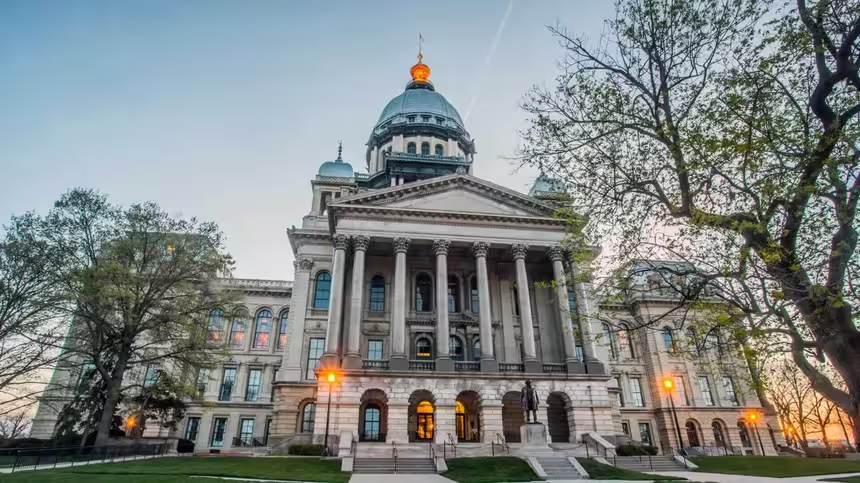
CapitolView
CapitolView is a weekly discussion of politics and government inside the Capitol, and around the state, with the Statehouse press corps. CapitolView is a production of WSIU Public Broadcasting.Providing Support for PBS.org
Learn Moreabout PBS online sponsorship(bright music) (dramatic music) - Former President Donald Trump is elected the 47th President of the United States, only the second president to do so in non-consecutive terms.
Overcoming his denial of the 2020 results, felony convictions, and the January 6th attack on the US Capitol, Trump is victorious, raising major questions about the path forward for America and the Democratic Party.
Thanks for joining us on "CapitolView."
I'm Fred Martino.
In addition to the federal races, we are going to look at results in the Illinois General Assembly.
For news and analysis, we welcome John Jackson of the Paul Simon Public Policy Institute at Southern Illinois University Carbondale and Peter Hancock from Capitol News Illinois.
John, you, as you know, have to go back to the late 1800s to see a former president elected to a non-consecutive term, Grover Cleveland.
Now, the history made in 2024 with former president, soon to once again be President Donald Trump.
Let's look for some answers.
An exit poll reported by NBC asked voters about inflation.
Three in four said it was a hardship.
Before the election, just before, a Gallup survey found about three in four voters said the United States was on the wrong track, some experts saying that there was simply no way for Vice President Harris, seen as an incumbent in a sense, to overcome concerns about inflation and the economy.
Your thoughts on this?
- Well, I think that's right.
I think inflation, the way the economy was understood by the American people, which was at considerable variance from the realities on the ground, the economy's actually in great shape already and has been the envy of the world, as "The Economist" magazine had it two weeks ago, but too many people didn't believe that, and felt put upon by inflation, and that plus immigration, don't forget, and the fear of the unknown people coming our direction because of immigration.
So those were key, and appeals to preserving democracy, and that things that Harris talked about didn't resonate enough.
- You know, John, I understand this contention about the fact that our economy is the envy of the world, that we're doing better than countries all over the world, and I do understand the secondary contention that inflation has been tamed, that overall inflation, when we're looking at the consumer price index, you know, it is way down almost to that magical 2% that the Fed uses as a metric.
But what do you say to folks who also look at the most significant expense for most folks, okay, their home, if you hadn't, if you weren't already in a house, and you had to buy a house, or you're a renter, home prices in the last five years have gone up by about 50%.
That is astronomical.
To put it into context, you know, this $300,000 house is $450,000, maybe out of reach for many folks.
Was this not enough in terms of Vice President Harris?
She did talk about trying to make housing more affordable, and a $25,000 incentive she proposed for folks buying a house, but was this just not enough?
- Well, it turned out not to be.
She did directly address that with both of those policy changes that she advocated.
But it obviously didn't calculate and compute for people, and it's also clear that wages are up significantly, and wages have actually outpaced inflation rate recently, but that message also didn't get through.
And what's unusual here is once we get out of an inflationary upward spiral, people accept that new base, and just move on.
It looks like people haven't accepted the new base, and didn't move on, and so, they took it out on Harris and the Democrats last night.
- Well, John, on another matter that certainly got a lot of attention in terms of this election, voters agreed with Vice President Harris and the Democrats on reproductive rights.
Abortion rights measures were approved by voters in most states where they were on the ballot.
I heard one analyst as we're taping this, though, contend that some people who voted for those measures in certain states may have thought that it was then safe to vote for Trump for President, and in other words, maybe their contention was, "I'm protected by state law on reproductive rights."
Your thoughts on that?
- Well, abortion was a good issue for the Democrats, and women won big time last night in most of those referenda, although I think they lost in three of the referenda that were on the ballots.
I think it was seven passed and three didn't pass.
But at any rate, they won on that issue.
But they certainly lost on women power, and women votes in general.
There won't be a woman president anytime soon, and there certainly won't be a Democrat run as a woman president candidate anytime soon I would predict.
And women just basically voted for the woman candidate with a significant gender gap, but it didn't carry over, and it wasn't enough.
I can't discern all of that hypothesis that your expert quoted, because you just don't have enough poll data that addresses it that way.
- Mm-hmm, well, we're gonna move on to a couple of other questions.
Before we do, as you look at last night, this week's election, what do Democrats do now?
- Well, they've got the hope for holding the House.
If they don't hold the House, there will be absolutely no constraints left institutionally on Donald Trump at all, because he owns the executive branch, he owns the Supreme Court.
They've given him an enormous gift with that decision on presidential immunity and presidential power.
Without the House, there will be no guardrails left, and if the Republicans controlled the House, there will be no constraints left on Donald Trump, except his own internal character, and for many people, that's not very reassuring.
- Yeah, so let's talk about, John, the US House races and the presidential race in Illinois.
Some were shocked to see the race for president much closer in Illinois and Virginia and even New York to an extent, with Harris wins much more narrow in those states than Biden wins in 2020.
In your view, what is going on?
- Well, we are a blue state, and we acted like a blue state last night.
Harris won Illinois fairly comfortably, although not as much as Joe Biden did.
Joe Biden won with 7 million more votes than Donald Trump did, and so, that's the key right there.
Harris lost by whatever it's gonna turn out to be, 2 million, something like that.
So that's at the grassroots, but in Illinois, we acted very much like a blue state, for example, on the House races.
We started out at 14 Democrats and three Republicans and we ended with 14 Democrats and three Republicans.
The only race that was even close was that 17th Congressional District, which was Sorenson versus McGraw.
Sorenson was a freshman.
If you're gonna knock off an incumbent, that's the time you've got to do it before the sophomore service, and Sorenson won, and the "Cook Report" said that it was gonna be a likely Democrat, and sure enough, it was.
So we're at status quo of 14 to three, but the House is critical nationally.
- Yeah, yeah, so not as much upheaval in Illinois as in some other states.
John, the Democrats, as you've already noted, lose the US Senate, including longtime incumbent Senator Sherrod Brown in Ohio.
I'd heard this week, he, in addition to putting up a very solid fight, he raised more money than he'd ever raised, $84 million was the report that I heard on NPR, but he still lost.
What reflections do you have on what we know about the national results, including the US Senate as a whole?
- Well, he and Tester in Montana were critical.
You can't get more of a red state than Montana, and now, Ohio has become a deep red state, and they just had too many headwinds.
They needed for Harris to do better, although not win, but she didn't do better in Montana, or Ohio, and it was just the situation they were in, and there went the Senate.
- Mm, what a night, what a night, what an election night, one that was surprising for so many people on so many levels.
Peter, I wanna move now to races in the Illinois General Assembly, the races that stood out to you, and the overall picture.
- Well, I thought the overall picture was quite a contrast with the national story.
I think the message you're hearing on the national level is that voters wanted change, especially when it comes to the economy, and immigration.
In the General Assembly, in the statewide races, they wanted no change.
Voters in Illinois essentially reelected the same General Assembly that they have.
There were, and we're just looking at unofficial preliminary results as we speak right now, but based on the numbers we have, there will be no party, no seat is going to change party hands.
I think you can draw a couple of (mumbles), one of two conclusions from that.
Either A, voters are very satisfied with the legislature they have, or B, the legislature did a magnificent job of gerrymandering the districts to lock in the partisan advantage that they have right now.
But it, you know, as we sit here on Wednesday morning, it looks like the Democrats are going to keep their supermajorities in both the House and the Senate.
There were a few races that are still very close, worth noting both of them Republican districts.
In the 47th District, which is part of Wheaton, Republican Amy Grant was barely leading her Democratic challenger, Jackie Williamson, by less than a percentage point, and close by in the Barrington Hills area, Republican Martin McLaughlin was leading Maria Peterson by about one percentage point.
If the Republicans are ever going to come back in Illinois, they need those suburban areas in the collar counties around Chicago.
So those are two very important races.
There were also two races that I thought were significant in the Metro East area outside of St. Louis.
One of those was, I think it's the 112th District, where Democrat Katie Stuart survived a challenge from Republican Jay Keeven.
That was a district that was kind of at the center of a debate back in the spring, when Democrats pushed through a bill at the very end of the session to prohibit the slating of candidates in districts where nobody ran in the primary.
At the time they passed that bill, Mr. Keeven was circulating petitions trying to get on the ballot as a Republican in that district, even though there were no Republicans in the primary that had been held back in March.
They passed that bill, but it was eventually overturned by the Supreme Court.
It was clearly an effort to try and protect Katie Stuart as well as a few others, but it was overturned.
But Katie Stuart survived that challenge nonetheless.
The other interesting one was in the 114th District neighboring where former Representative LaToya Greenwood, who was ousted two years ago, she kind of got redistricted in a negative way, she lost her seat two years ago to Kevin Schmidt, she came back this year, tried to regain her seat, came up short, so Schmidt is going to keep that seat.
So those were the key legislative races that I was looking at throughout the night.
No changes on the Senate side, and, you know, no real changes on the House side, either, so things are gonna- - Yeah.
- Stay the same.
- Well, while voters didn't demand a lot of change in terms of who they wanted to elect, or reelect in Illinois in terms of the legislative races, they do want change in terms of some statewide advisory questions.
These are just advisory.
They don't have any effect on their own, but they could lead to legislation.
Let's go through those advisory questions, and how voters responded.
- Okay, I think the one that was getting the most attention was the so-called millionaire's tax.
It would require a constitutional amendment to allow the state to levy like an additional surcharge, or an additional tax of 3% on income over a million dollars a year, with that money being earmarked in one way, or another for property tax relief.
That one did pass, appears to be passing by about a 60 to 40% margin.
Republicans, I think, tried to really liken that to the failed attempt to levy a graduated income tax a few years ago, which had failed at the polls, even though I think there was, it had passed in a non-binding advisory opinion earlier.
So again, it's non-binding, but it does kind of send a message to the General Assembly that there is a sizable percentage of the voters who would like to do something to provide property tax relief, which really, you know, property taxes really are, I think, among the most despised taxes that state governments can levy.
Another one that was on the ballot was to allow for civil penalties against elected officials who engage in election interference.
That passed by a pretty wide margin.
I think it was passing about 89 to 11%.
And then there was one that was kind of billed as the reproductive rights amendment in Illinois.
This would've been an insurance mandate to require health insurance companies to cover reproductive health treatments, including in vitro fertilization, and that one was passing by about a 72 to 28% margin.
So those were three really interesting topics.
The income tax proposal, I think, is one you're gonna have to look at real carefully.
It was drafted in a very broad, sort of general way, and it had the backing, I think, of former governor Pat Quinn- - Yes.
- Was pushing for it.
But I think, you know, when you put an actual constitutional amendment on the ballot and people see more specifics of it, the outcome might be a little bit different.
I think we just have to wait and see.
- We will be watching.
Well, finally, Peter, some Illinois counties voted on secession from the state.
We should say some legal experts contend that's not possible, even if voters approve.
What did voters say this year?
- Yeah, it is important to note that states are admitted to the union by an act of Congress, which is, you know, territories would submit proposed constitutions to Congress, Congress would vote them up, or down.
And so, this is not how states get admitted to the union.
There have only been a couple of examples, and you have to go way back in history of when states split to form two separate states.
That's how we got the states of, I think, Maine and West Virginia.
Nevertheless, I think there were, these appeared to pass in a number of areas, and I think you can take away kind of a cultural message.
You know, Chicago is obviously, you know, the 800-pound gorilla in the room when it comes to Illinois state politics.
Cook County and Chicago wield a lot of weight, causing resentment in other more conservative areas of the state, especially, you know, down the state in Southern Illinois, the Metro East area, which is becoming more and more conservative, parts of Eastern Illinois, where, you know, I think there was a resolution in the General Assembly a few years back from the group known as the Eastern Bloc, the very conservative Republicans from Eastern Illinois, you know, wanting to, you know, saw off Cook County as a separate state- - Yeah.
- So that Republicans would stand a chance in trying to govern the rest of the state.
I think there is a real cultural divide between Northeastern Illinois and Downstate Illinois, and this is kind of a reflection of that.
It might be, you know, it's certainly something for people to listen to and pay attention to when you're trying, talking about trying to create unity within the state.
But again, you know, in terms of, you know, practical impact, it's really, you know, just an academic exercise.
Illinois is not going to split into two states.
- Yeah, very interesting nonetheless, especially with the context of the national election this year.
John, we wrap up with this.
It's been overshadowed by the election, but the Illinois Governor's Office of Management and Budget published its mandated five-year budget projection, and there is very bad news for the state to the tune of a projected 3.16 billion, billion dollar deficit in the coming fiscal year, which begins July 1st.
You have the entire report.
What do you make of it?
- Well, I think a little context and a little history of budgeting in Illinois is in order here to put this in the right context and talk about its prospects as well.
In the 21st century, Illinois government ran in the red almost every year in spite of having a constitutional mandate to balance the budget.
We did not have a balanced budget in all the time leading up to Pritzker coming in.
They did all kinds of ways to get around it, and at the end of the Rauner administration for two years, we didn't even have a budget at all.
And so, when Pritzker came in, he and the General Assembly teamed up, and they decided we were going to balance the budget, and people don't understand we have had seven straight balanced budgets in Illinois, and it took a lot of strain, it took a lot of work, but that's what we've done, and the payoff for that is we've been upgraded by the New York bond houses on our credit rating I think it's seven times now.
We were just one above junk bonds.
Now, we can borrow money, and we can borrow money much more cheaply, because of those upgrades.
And number two, we paid off debt by paying off some of the borrowed bonds, and got the interest advantage paying off that debt.
Number three, we contributed the required contributions to the pension funds, and actually contributed more to the pension funds than we had to, and finally, we replenished the rainy day fund, which was totally depleted.
So my take-home message here is Governor Pritzker and General Assembly have done this seven times, and ultimately, they'll have to do it an eighth time.
There'll be some unpleasant parts of it, because, as you pointed out, there's a $3 billion gap, but this is the governor's own people that came up with this projection, and they projected slowdowns that are going to impact negatively on the revenue side.
So add that to the fact that they've, number one, always been very true and very right in their projections, and number two, CGFA, which is the legislative arm that does the same thing, has also been with the Governor's Office on making these projections.
So these are serious people doing serious things.
So we're faced with number one, cutting some of the services, or number two, raising some tax and revenue sources.
That's where that millionaire's tax comes back into play as one possibility.
But number two, on that possibility, I'm sure the Pritzker administration and the governor look back and say, "Oh, boy, we really should've passed "that graduated income tax bill," but it didn't pass, and so, somebody is gonna have to make some hard choices now to get that $3 billion under control.
- Yes, we'll be talking about what those choices are, I'm sure, in the weeks and months ahead, but the warning is out there.
Gentlemen, what a week, what a year, what a decade.
We are out of time.
John and Peter, thank you for joining us, and for putting all of this into perspective for us.
- Thank you for having us.
- Thank you.
- Good to have you both with us.
Stay with WSIU and wsiu.org for the latest post-election news.
I'm Fred Martino, thank you for being with us this week.
Hope you have a good week ahead.
(dramatic music) (dramatic music continues) (dramatic music continues)

- News and Public Affairs

Top journalists deliver compelling original analysis of the hour's headlines.

- News and Public Affairs

FRONTLINE is investigative journalism that questions, explains and changes our world.












Support for PBS provided by:
CapitolView is a local public television program presented by WSIU
CapitolView is a production of WSIU Public Broadcasting.