
Capitol View - October 10, 2024
10/10/2024 | 26m 46sVideo has Closed Captions
Capitol View - October 10, 2024
Fred Martino talks with Alex Degman from WBEZ and Andrew Adams of Capitol News Illinois.
Problems playing video? | Closed Captioning Feedback
Problems playing video? | Closed Captioning Feedback
CapitolView is a local public television program presented by WSIU
CapitolView is a production of WSIU Public Broadcasting.
Capitol View - October 10, 2024
10/10/2024 | 26m 46sVideo has Closed Captions
Fred Martino talks with Alex Degman from WBEZ and Andrew Adams of Capitol News Illinois.
Problems playing video? | Closed Captioning Feedback
How to Watch CapitolView
CapitolView is available to stream on pbs.org and the free PBS App, available on iPhone, Apple TV, Android TV, Android smartphones, Amazon Fire TV, Amazon Fire Tablet, Roku, Samsung Smart TV, and Vizio.
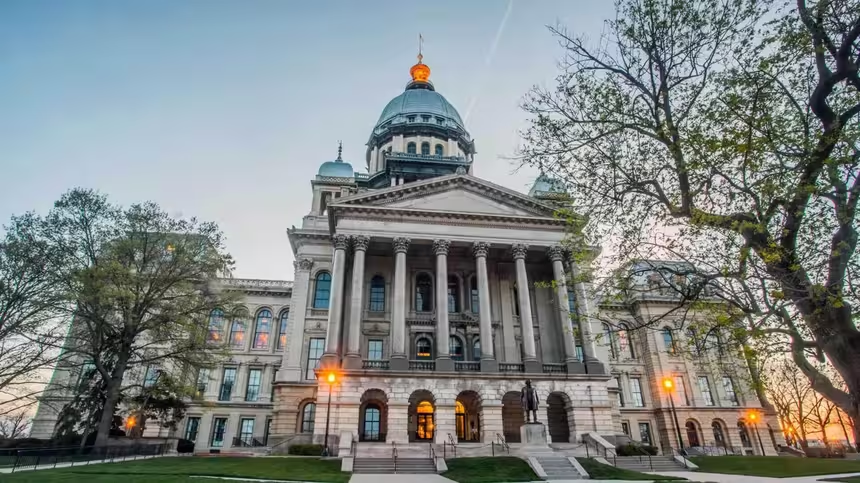
CapitolView
CapitolView is a weekly discussion of politics and government inside the Capitol, and around the state, with the Statehouse press corps. CapitolView is a production of WSIU Public Broadcasting.Providing Support for PBS.org
Learn Moreabout PBS online sponsorship(bright music) (dramatic music) - Thanks for joining us on "CapitolView."
I'm Fred Martino.
Tonight, an update on a story we've been following.
The entire Chicago school board resigns, and Mayor Brandon Johnson introduces a new board, stoking controversy.
Plus, concern over a technology being used in Illinois that is supposed to fight climate change.
That and more this week with Alex Degman from WBEZ and Andrew Adams of Capitol News Illinois.
Alex, upfront, the story everyone is talking about in Chicago, and in some other parts of the state, too, because Chicago schools do require a lot of funding from the state.
Chicago Mayor Brandon Johnson has unveiled a new Chicago Board of Education after what's being called a stunning shakeup.
Tell us more about this.
- Right, so let's start at the beginning with why this happened in the first place.
So Mayor Johnson wants to take out a roughly $300 million loan to help pay for teacher raises and pension payments for some other employees.
Now, Chicago Public Schools CEO Pedro Martinez doesn't wanna do that, and neither did the school board, which was handpicked by Mayor Johnson.
Now, what they did do was they passed a nearly $10 billion budget late last week, and it didn't include the pension payment, so there's a budget hole in not only this year's spending plan, but we're also looking at a roughly $1 billion shortfall in 2025.
Then the board resigned, as you mentioned.
So Johnson, just within the last few days, has appointed six new people, not the full seven that resigned, but six people.
They're still getting vetted by the mayor's office right now.
You've got a community activist, you've got people who are in politics already, retired teachers, political organizers, and people like that.
Now, Mayor Johnson I don't think has ever said this specifically, but it's pretty well understood that he wants Martinez to go because Martinez doesn't wanna take out that high interest loan.
But now that the entire board quit and he's appointing six new people, they're still being vetted as of this taping, as I mentioned, there's still talk that this was a power move, so that Johnson can get what he wants before voters actually select half the board this upcoming election.
So the question now is, you know, what do they do?
So state electeds from Chicago, the city, are either wary of giving Chicago Public Schools any more money because they don't like Johnson's leadership and they think that he's doing more harm than good, but others tell me that they're gonna try to do what's best for the city, despite how they feel about what the mayor's doing.
And I'm not really sure how this is gonna play out yet, but my guess is that we're gonna see state lawmakers let Johnson stew just a little bit on this before the election, to be honest, I mean, 'cause that's what they're focused on right now.
The veto session is not until after the election, and right now, there still does not really seem to be a whole lot of appetite to do any supplemental appropriations, or to address this during the veto session.
- Yeah, it'll be fascinating to see, and certainly a lot of controversy about this, in addition to a lot of journalism you can read about what's happening.
Folks can also find a scathing editorial that was issued by the "Chicago Tribune."
So there's one thing for sure, right, Alex?
We haven't heard the last of this.
- Oh, we'll be hearing about this for quite some time, Fred.
That's true.
- Absolutely.
Andrew, another thing we've been hearing about for quite some time in Illinois, and some other places, too, this technology, very fascinating, called carbon injection, the idea that you can put carbon into the ground, so that it doesn't pollute the air.
It's a technology designed to fight climate change, but there have been challenges in Illinois.
You reported ADM stopped carbon injection recently, as its Decatur facility remains under federal scrutiny.
Great reporting on this.
Tell us about it, Andrew.
- So the facility in Decatur run by ADM is the first of its kind and largest of its kind for these carbon injection, carbon sequestration projects, and, you know, ADM and advocates for this kind of technology will say that it's really important to decarbonize to reduce the pollution emissions for really hard to otherwise handle industries, like soy processing, which is what ADM does.
But earlier this year, ADM found that in their deep underground storage, in that underground geology where this carbon dioxide is stored, some of the liquid CO2 had moved from one of its containment zones out into other parts of the geology.
Now, we shouldn't be imagining some underground tank here, but this is essentially a leak, and that is according to the US EPA, the Environmental Protection Agency, a violation of their permit, of the Safe Drinking Water Act, and of some other EPA regulations to let this kind of leak happen.
Now, ADM says, and the EPA says that they're working together to address this, and both have said that, you know, at the time, there's no risk to drinking water, or anything, still under control, but they're working to contain this.
And then just a week, or two ago, late September, ADM found that briny saltwater, which is used in part of the process at a different injection well, or monitoring well, was also not where they thought it was, because they were looking at the whole system a little bit closer, and they found more issues.
Again, they're working with the EPA to address it, but in the meantime, they have paused all injection, which has given critics of this technology even more ammunition to say, "This is not ready, this is not safe."
- Something I know you've been reporting on for some time, and we'll be watching this as well.
Possible bumps on the way to fighting climate change.
Okay, Alex, we move on to hopefully some positive news now.
There has been some positive news coming out this week.
Illinois Governor J.B. Pritzker is leading a trade mission in Japan that is going to wrap up on Thursday as this airs with some of the state's top business leaders.
Tell us more about this.
- Yeah, this is the governor's attempt to try to bring more business to the state that align with some of his climate and policy goals.
We're talking about areas like clean energy, manufacturing, quantum computing, life sciences, and as you mentioned, it's a six-day trip he's taken with dozens of people from his administration, including House Speaker Chris Welch, Senate President Don Harmon, and some of the business leaders you talked about, the CEOs of Related Midwest, and ComEd CEO Gil Quiniones is over in Tokyo right now.
Now, the governor has, he's done this a little bit.
He's gone to Switzerland, Canada, he's gone to Great Britain over the last couple of years to not only tout the state's climate goals, but also that he thinks Illinois is a pretty good state to do business.
Now, the first day that he was there, he announced a deal with the medical diagnostic company Sysmex America.
Now, they are a subsidiary of the Japanese company Sysmex Corporation, but the American subsidiary is based in Lincolnshire, which is in southern Lake County.
Now, the Pritzker administration says that this will reportedly bring 100 new jobs to the area that they oversee, 'cause it's not just Lincolnshire.
They have facilities throughout the Chicago area.
It's gonna bring 100 new jobs while retaining the 550 they already have, and they're gonna be spending, Sysmex is, more than $20 million on the expansion.
Now, the governor has also so far given keynote addresses to Japanese business leaders, he's met with folks in the food processing industry there.
That's a place where Illinois is gonna try to make some inroads as well, and he also wants to talk a lot about quantum computing.
He led a roundtable at the University of Tokyo a little bit earlier this week to talk about what the state is doing right now.
You might remember just earlier this year all of the announcements that were made about quantum computing investments and the brand-new quantum computing campus in the Chicago area.
That is gonna be a really big get for the state, and he wants to make sure that that is front and center when he goes to these events, 'cause, Fred, I think you and I were talking about this a few weeks ago, like we think of quantum computing now I think what people thought of the internet back in the late '80s, like, "What is this?"
And nobody thought to get in the forefront of it, but now, J.B. Pritzker is saying, "Yeah, we need to kind of reign this in."
So that is among the things that he's trying to get done in Japan.
- Very important stuff, and hopefully will bring some additional jobs and tax revenue, much needed tax revenue, to Illinois.
Andrew, you covered another economic story featuring the governor as he touted economic development at a data center groundbreaking.
Tell us more about that.
- Yeah, the development of data centers, particularly in Northern Illinois, has really exploded in the past few years, and in no small part due to the governor's policy goals.
His administration, his Department of Commerce and Economic Opportunity, the kind of economic development folks within state government have really been pushing to attract data centers, and these are, you know, monumental, large facilities, think warehouse size and larger, that store, that house, you know, computer servers, computer equipment that is either used by one company, like Facebook has a data center under development, Microsoft has several in Northern Illinois, or rented out to various companies, and they can bring a lot of attention.
They're really big developments, and as kind of the digital economy continues to grow, that digital space has to have some kind of physical location to maintain its base infrastructure, and Governor Pritzker wants Northern Illinois to be one of the hubs for this kind of development.
Now, it's worth noting that data centers, because they're full of computer servers that could be accessed at any time, are always on.
So after a couple years of ramping up, they use a lot of electricity, which has been part of the fight over increasing electricity prices in Northern Illinois.
- Yeah, you know, and of course, as you know, there are some critics who say that this type of economic development project doesn't attract as many jobs as some others do, but then there are proponents who say, related to the whole question of electricity, that many of these tech companies want to create data centers where they're completely powered by renewable energy, so it gives the opportunity to build more infrastructure for renewable energy.
- Yeah, and on that subject, I will note that these data center projects, they bring a couple hundred construction jobs, mostly union type jobs, while they're being built out, and then the state government says that each of them brings about 20, maybe 30 permanent jobs.
So that's the kind of scale we're talking about.
But these would otherwise, these are, you know, multimillion, hundreds of millions of sometimes of development.
So that kind of mismatch can be part of what I think people are concerned about.
But the nuclear energy and renewable energy in Illinois is very attractive to companies, just like you said.
- Very interesting.
We will watch it carefully.
Well, we move now from the economy to criminal justice.
Alex, Illinois State Police investigating another Sangamon County officer-involved death.
What is the latest on this?
- Yeah, this has been a particularly bad summer, and early fall for that matter, for Springfield area police agencies.
Now, the latest case that we're talking about here is a pursuit that started in Springfield on September 21st.
Police, Sangamon County Sheriff's deputies responded to a burglar alarm at a motorcycle dealership, Hall's Harley-Davidson in Springfield, around midnight.
They didn't find anybody there.
They were responding to a burglar alarm, but a witness on the scene told them that they saw a white pickup in the area.
So a couple hours later, deputies are patrolling, and they spot a white pickup with a motorcycle in the open bed of the truck.
So obviously, they start initiating a pursuit, and the person did not slow down.
The pursuit continued, and the press release from the Sangamon County Sheriff's Office says that the suspects were throwing things out the window, like tools, and tire irons, and things like that.
So while that was happening, the deputies chased them south on 55 into Madison County, which is just north of St. Louis, and that's where they lost the truck.
They lost the truck, they were following the taillights for a little while, and as they were doing that, they came upon somebody lying at the edge of the road.
So they stopped the pursuit, and they tried to render aid, and the man was airlifted to St. Louis University Hospital, where he died four days later, and that's where we found out about this, the news media did, because the Sangamon County Sheriff's Department didn't tell anybody about this for almost a week after the event, and we found out that the man who died was 43-year-old Kirtis Shane Davenport of Kansas, and he had just been released from federal prison I think it was in May, this past May, after serving a number of years for a gun charge.
And the driver of the vehicle, I should mention, he wasn't the only one in the truck.
The driver is still at large, they don't know where he is, and the two deputies that were involved in this chase, they're on administrative leave while the State Police, as you mentioned, pick up the investigation on the pursuits.
Sangamon County's still investigating the burglary.
Now, the reason that this is getting so much attention, it's a wild story, but the reason that this is getting so much attention is because this is the second death in three months that Sangamon County deputies have been, you know, associated with, involved in, involving Sangamon County deputies.
Sonya Massey, you might remember, was shot and killed in her home by a former deputy in July, and that was in her home in unincorporated Springfield.
So Capitol News Illinois, who did this story that we're referencing, has also done some digging, like a lot of digging, actually, into what else that sheriff's department had, or who else they've hired, what practices that they're using to hire these folks, and, you know, just some of the stuff behind some of the hiring decisions that they've made.
So I would really recommend going to check that out.
- Yeah, and last week we did really get into a little more detail on one of the investigations, which revealed that another deputy had been hired after having a DUI arrest.
So this is certainly something that we will continue to watch, and, you know, Alex, we also have heard more and more about not just hiring, but questions about how are police officers, law enforcement trained to deal with various issues, including mental health, and is that training adequate?
- Well, and that's been a question for many years now.
Do we need to go into how these police officers are trained?
Do we need to do more cultural competency and things like that?
And that is part of what the newly formed Massey Commission in Sangamon County hopes to achieve.
The commission members were just seated.
A couple of Sonya Massey's family members are actually sitting on the commission, which is good news, because they're going to dig into things like that.
What do police need to do, if anything, to interact more with the community in ways that are, you know, better suited to the community they serve?
Do they need to be trained better, things like that?
So a lot of community members have expressed their opinions on this, and they're hoping that there is some change that comes from this, because we've seen these panels before, and they're concerned that this is just going to be, you know, so to speak, another report that sits on a shelf and gathers dust.
- We will be watching, and we should mention, because this is a developing story, this latest one, we are taping this on Wednesday, just in case there are additional developments before airtime.
Andrew, we conclude with another story related to criminal justice.
Capitol News Illinois published an investigation by a partner this week.
It is about the controversy involving a private prison operator in the state.
What did they find?
- Yeah, this is a story from, you know, our friends at "Bolts," a magazine that covers voting issues and criminal justice, and they took a look at Wexford Health Services.
Now, that's the private company that contracts for healthcare services, medical treatments, that kind of thing in state prisons, and they just renewed their contract for a new term, and that contract's worth about $4 billion.
So it's a big renewal, a big, big get for the company, and it's continuing its relationship with the state, which began, I think, back in the '90s.
And what this story found was that Wexford has faced kind of a long history of criticisms, complaints, investigations about the quality of its care.
Now, this can include things like neglecting medical treatments for certain prisoners, just kind of shoddy, or low quality service, and even, now, important to say, Wexford was not involved in this, but a Wexford lobbyist was caught up in a bribery scandal as well.
So it's had this history of kind of problematic behavior, and despite that, and despite having a different choice, the Department of Corrections went ahead and renewed the contract to keep Wexford employed by the state.
Now, there's kind of a larger story here as well, and that is that it's not just Wexford, right?
Wexford has issues, and that's well-documented, but, you know, prison reform advocates, prisoners, activists will tell you that, you know, all prison healthcare companies face similar criticism at some point.
All prison healthcare companies will have their share of bad days.
It's more a question of the privatization of this kind of service.
These services could be offered by the state, have been offered by the state in the past, and, you know, academic research has found that these private healthcare companies in prison settings, they have lower outcomes, people have worse health than when states, or, you know, other government entities are in control of those healthcare services.
- So are there folks then calling for the public operation of the health services?
Because, I mean, in addition to the health outcomes, you know, we've seen in other states very, very large lawsuits, which states have had to settle because of inadequate healthcare in prison.
- Yeah, there are definitely folks calling for kind of an end to this privatization practice for prison healthcare, and, you know, recently, this story that we published led with the story of a death in custody, because someone was trying to get healthcare during a medical episode, and they didn't get it, or they didn't get it in time.
And that kind of situation, now, no, not necessarily that one in specific, but that kind of situation can certainly lead to lawsuits.
It can certainly lead to big problems, both kind of perceived political issues of having this situation on the state's hands and also big financial issues.
You know, if enough people start suing because they feel they've been wronged by the state because of its decisions with prison healthcare, that can add up.
- Very important to cover this.
Very important stories this week.
Alex and Andrew, we are out of time.
Thank you both for being with us.
- Thank you.
- Absolutely, my pleasure.
- Finally this week, the Illinois Guardianship Association hosts its 2024 Fall Conference on October 24th in Springfield.
Free registration for the conference is available through the 18th online at illinoisguardianship.org.
I talked with Derrick Cummins of the Illinois Office of State Guardian about the conference and the work of the Guardianship Association.
- It does a lot of work with legislation and education of families and guardians of all sorts, be it public, or private, or the state guardians, or even just families.
It does a lot of education for attorneys and stuff.
It does a lot of things.
I'm a very small part of that, just co-chairing the education part of it.
But we do have two conferences every year.
Attendance is growing at those conferences since COVID, and we do a Spring Conference in Chicago, and the Fall Conference, which is what we're talking about today, is in Springfield, so that the folks from upper state and the lower part of the state can make it to a conference.
This conference is October 24th.
It's at the Illinois Education Association building there in Springfield.
It's from 8 to 4.
It's a great venue to have it, free parking, lots of restaurants- - So Derrick- - Close by, and a great conference room there.
We're very lucky to have those.
- So, Derrick, give us an idea.
Guardianship is in the news a lot, a very big issue, not just in Illinois, all around the country.
Give us an idea who should attend this conference.
- So it's really open to anyone that has an interest in this.
As I mentioned, a lot of guardians come, a lot of the state guardians come that work for the Office of State Guardianship, a lot of public guardians that work for counties, and family guardians, private guardians, just anyone that's interested in the well-being of the disabled, the developmentally disabled, the mentally ill, (clears throat) excuse me, the aged, disabled, anybody that wants to be looking out for those folks, and then attorneys come, so that they learn the latest legislation.
Social workers, private providers that are servicing our folks, they attend so they can learn, and we try to pick topics that are of interest to all those folks and that are relevant.
We don't just wanna take up time and do CEUs.
We wanna give something that they can take back to their day-to-day jobs.
- That was Derrick Cummins of the Illinois Office of State Guardian.
Once again, the Illinois Guardianship Association hosts its 2024 Fall Conference on October 24th in Springfield.
Free registration for the conference available through the 18th online at illinoisguardianship.org.
That's "CapitolView" for this week.
For everyone at WSIU, I'm Fred Martino.
Have a great week.
(dramatic music) (dramatic music continues) (dramatic music continues) (dramatic music continues) (dramatic music continues)

- News and Public Affairs

Top journalists deliver compelling original analysis of the hour's headlines.

- News and Public Affairs

FRONTLINE is investigative journalism that questions, explains and changes our world.












Support for PBS provided by:
CapitolView is a local public television program presented by WSIU
CapitolView is a production of WSIU Public Broadcasting.