
Capitol View - October 12, 2023
10/12/2023 | 26m 46sVideo has Closed Captions
Capitol View - October 12, 2023
In this episode of CapitolView: Fred Martino talks with Rep. Patrick Windhorst, the Republican from Illinois House District 117. They discuss a variety of issues, including economic development and the need for bipartisan solutions. Our analysts bring us up to date on a number of important stories facing the General Assembly, including a request for federal help to care for immigrants in Chicago
Problems playing video? | Closed Captioning Feedback
Problems playing video? | Closed Captioning Feedback
CapitolView is a local public television program presented by WSIU
CapitolView is a production of WSIU Public Broadcasting.
Capitol View - October 12, 2023
10/12/2023 | 26m 46sVideo has Closed Captions
In this episode of CapitolView: Fred Martino talks with Rep. Patrick Windhorst, the Republican from Illinois House District 117. They discuss a variety of issues, including economic development and the need for bipartisan solutions. Our analysts bring us up to date on a number of important stories facing the General Assembly, including a request for federal help to care for immigrants in Chicago
Problems playing video? | Closed Captioning Feedback
How to Watch CapitolView
CapitolView is available to stream on pbs.org and the free PBS App, available on iPhone, Apple TV, Android TV, Android smartphones, Amazon Fire TV, Amazon Fire Tablet, Roku, Samsung Smart TV, and Vizio.
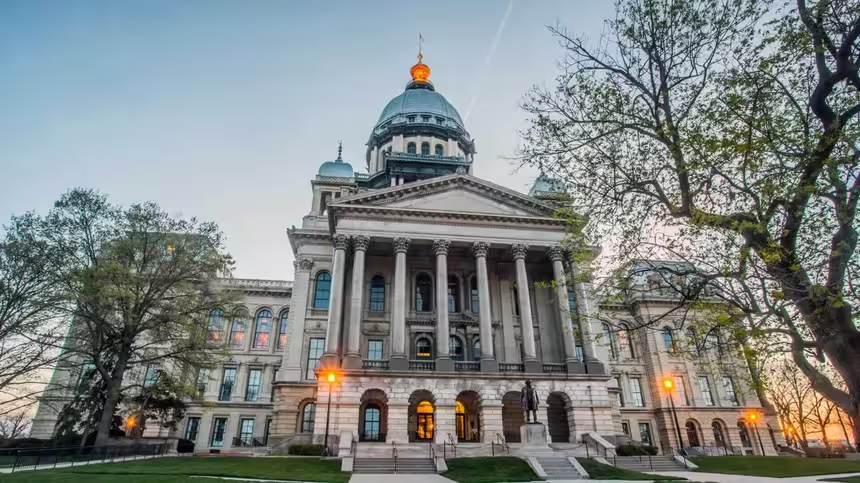
CapitolView
CapitolView is a weekly discussion of politics and government inside the Capitol, and around the state, with the Statehouse press corps. CapitolView is a production of WSIU Public Broadcasting.Providing Support for PBS.org
Learn Moreabout PBS online sponsorship(upbeat music) (music continues) (intense music) (music continues) - Thanks for joining us on "Capitol View".
I'm Fred Martino.
Up front this week, we continue our conversation with representative Patrick Windhorst, state representative in Illinois House District 117.
We begin with his thoughts on economic development.
- So when I talk to business owners in Illinois or those that may be interested in coming to Illinois, our tax system and regulatory system is one of the first things that comes up as a discussion point.
And we are surrounded by states in southern Illinois, we have Kentucky, Tennessee, Missouri, Indiana, we have states in close proximity to where we are that have a better business climate and lower taxes.
And that causes difficulty, a roadblock potentially for us in southern Illinois when we look to recruit businesses to our area.
Now, we have a lot of good people in southern Illinois, a lot of good organizations that are working to highlight some of the strengths.
In fact, all the strengths that we have here, our transportation system, natural resources, the river, rail, air, the things that we have in southernmost Illinois that are attractive to business.
But the state needs to do its part, and we need to make sure that as a state government, we are not putting additional burdens that are unnecessary on business, that we're keeping a tax rate that is competitive with low surrounding states so business will come here.
You know, as it relates specifically to economic development, we had a recent effort by the governor to bring in a company, an electric vehicle manufacturer and battery makers to the state with use of some of the funds the General Assembly has given him.
Some of my side have expressed concern about the connections that the Chinese company has with the communist government there, and whether those funds are gonna be directed, potentially benefiting the Chinese government, the communist government.
So that is something we need to be careful about, we have been paying attention to on the Republican side, and we'll continue to pay attention to.
But overall, as far as a state, making sure we're competitive with surrounding states, that we're providing a good business environment, and that we're highlighting our strengths will go a long way to improving our economic and business development.
- Anything else you want to add on that, on things that you'd like to see?
Any specific things to attract or retain jobs?
- Well, again, the complaints I hear, and I know these business owners, that they're looking to invest, they're looking to start businesses.
But they're also looking, I can start one in Metropolis, Illinois or Harrisburg, Illinois or Paducah, Kentucky, Evansville, Indiana, even down into Nashville, Tennessee.
And they compare what the costs are going to be for running that business that are just brought on by state regulation.
And other states have shown an advantage.
So we have to highlight them the strengths that we have as it comes to our state and particularly our region.
And again, those are our infrastructure and our natural resources.
- Okay, well, recently Marion celebrated the STAR bonds to help redevelop a former mall in the city as well as surrounding property.
Give me your thoughts on the STAR bond program, and should that be expanded in your view?
- I'm interested to see how it works for Marion.
The information that I've received and reviewed for this program looks like it really has a good opportunity for growth and to achieve its purpose of proving the economic climate there in Marion.
Marion's been a strong economic driver for southern Illinois, and I think this project will help continue that.
One of the most important things, and one of the primary things behind STAR bonds is to attract people to come from outside the region to spend money.
And it looks like that if the project is fulfilled, which I have no reason to doubt that it will be, that that will be accomplished.
So what we have to do as a region then of southernmost Illinois is make sure that when those people come to the region to take advantage of what's being offered in Marion, that they are also taking advantage of other things throughout southernmost Illinois, the Shawnee National Forest and our great small towns in our region.
And so it'll be us as a region working together to make the most of those tourists and visitors coming in to make sure that we highlight all of our region.
So I am interested to see how it's going to play out there.
It started about 2010, I believe, or '11, when the first STAR bonds legislation came forward and was approved.
And of course we hadn't really seen anything developed till this point.
So I think a lot of us who weren't in the legislature back in 2010 are interested to see how this plays out going forward.
- Yeah, I mean, I imagine a lot of folks would be watching this because Marion is not alone by any means in having very large properties, malls in particular, where there's been this massive exodus.
I have seen this in many cities, not only in Illinois, but in other states where I've lived previously where the mall is either closed or it's a shell.
There's, you know, really maybe a vacancy rate much larger than the occupied rate in the mall.
And some would argue that there is a need for some kind of a program to try to invent a new model there.
- And there, as it relates to the Marion project specifically, there is reason for optimism.
The mayor and the developer have laid out a very thorough plan and what they've put forward I have no doubt will attract people to the region.
Sports tourism in particular is very big right now.
And the addition of youth sporting facilities as well as those for adults I think will go a long way toward attracting large groups of people to come to southern Illinois.
So it is exciting.
- Very interesting.
In our final time together here, I wanted to give a chance for you to talk about something that I find interesting, and that I'm curious to hear your reflections on.
And that is the experience that you had being a Republican floor leader.
- So just for those who are viewing, the floor leader's job is essentially, in the minority party, is essentially to make sure that the bills are vetted as they come through to the House floor.
So the first task is to read every bill that comes through committee and comes to the House floor to make sure that I have a grasp on what the bill does.
I also speak with the leading Republican in those committees to make sure that, you know, there's not anything I'm missing about a bill.
And then from that point, I am charged with organizing the debate on the bill.
So that can be, on a large bill that gets a lot of media attention, that could be making sure we have the right representatives speaking on the bill who have strong points to make, to make sure that the bill is vetted in that way.
On smaller bills that maybe are more technical in nature or don't make large changes to the law, it almost always falls on me or the leading Republican on that committee to lead the questioning and debate, to make sure our members are fully aware of what the bill does, so they can be fully informed on how they wanna vote.
So that vetting process plays a role to vet for the public, so the public fully understands what the bill does, but it also is designed to make sure our members who are voting understand fully what the bill does so they can make an informed vote.
My predecessor in this position's Mark Batinick from Plainfield, Illinois.
He served for four terms of the last two as floor leader.
And he has provided a lot of good guidance and information and ways to be an effective and strong floor leader.
And I've tried to follow that and emulate that as best I can.
It's important that, in this role, to make sure that the bills are getting the hearing they need so that the public is informed and our members individually are aware fully of what they're voting on before they vote.
- Sounds like a lot of work.
- It is, it's a challenging position, there's no doubt.
And, you know, with that vetting, not only the reading, but the questioning of the sponsor of the bill, that is its own unique set of skills to make sure that when you're getting the information that is important, and making the best points as it relates to the strengths or weaknesses of a given bill.
So it does involve a lot of preparation.
In fact, most of the job is preparation.
But it does also present a chance for you to express, or myself, I should say, to express an opinion that not every member is gonna have that opportunity.
- Okay.
Another question for you.
How do you think legislators can foster bipartisanship in Illinois?
- Well, it's difficult.
You know, particularly, we are 40 Republican members of 118 total.
So the majority party can pretty well do what it pleases as far as passing legislation.
They only need 60 votes to pass legislation, they have 78.
So that means that we see a lot of bills go through that do not have Republican support and often don't have Republican input, meaning we are not solicited for our advice, our criticism.
It just comes up for a vote and we have to make the vote.
We will see issues, I hope, that are not on the far left of the spectrum as we've seen in recent years.
We're hopeful we'll see issues where we can have bipartisan support.
BIPA, the Biometric Information Privacy Act, which I mentioned, we're hopeful that that results in a bill that has bipartisan support.
We should have bipartisan support on ethics reform.
I believe most members in the General Assembly should want to see those changes, some of those I highlighted, be passed into law.
It's almost universal in the General Assembly that we acknowledge that our property tax system in Illinois is an issue.
It is causing us to lose population.
It's an anchor on businesses in a lot of ways.
And it's just a large problem from northern Illinois to southern Illinois, almost universally acknowledged.
So that is a hope that we can reach a bipartisan consensus on property tax reform in such a way that we can improve that system to give some relief to our taxpayers, while also funding the schools in a way that they should be funded.
You know, some of that was with evidence-based funding was designed to relieve the property tax burden that we have, and we haven't seen that fully come to fruition yet.
Those are a few areas that, you know, I think we can potentially see bipartisanship.
And one thing that would drive bipartisanship is if the numbers were closer in the partisan breakdown in the House and the Senate, because just by its very nature, then you would be more likely to need somebody on the other side.
And, you know, I think the closer the numbers, the better that is for not only Republicans in the General Assembly, it's better for a lot of my colleagues on the other side of the aisle as well.
And I think it's better for the public because there'll be a better product, better laws produced when the numbers are closer and not so spread out as they are now.
- My guest was Patrick Windhorst, representative in Illinois House District 117.
And you can watch the entire conversation on WSIU's YouTube channel.
Subscribe to WSIU on YouTube so you never miss an update.
We would love to hear from you.
Email your comments anytime.
The address is contact@wsiu.org.
Analysis now, and I am pleased to welcome John Jackson of the Paul Simon Public Policy Institute at Southern Illinois University Carbondale and Jeremy Gorner of the "Chicago Tribune".
Jeremy, we start in Chicago, and the continuing influx of migrants.
Earlier this week, Governor JB Pritzker appeared on the CBS program "Face The Nation" to talk about the crisis.
New York mayor Eric Adams also appeared.
Adams says that New York is on track to spend $5 billion on migrant care this year, $12 billion over three years.
Yes, that's billions with a B.
The Tribune reports Illinois has appropriated roughly $328 million toward asylum seekers since the first busload of migrants was sent by Texas Governor Greg Abbott.
More than 17,000 migrants have arrived in Chicago since August of last year.
Of course, Illinois is also spending hundreds of millions of dollars on healthcare for some immigrants, separate from the other migrant relief.
Jeremy, truly becoming an overwhelming situation, I think.
I would assume this is why the governor sent the very pointed letter and is now appearing for media interviews to talk about this.
Where is this all going in your view?
- Well, I think the next question for us, you know, for the State House is, you know, we have veto session coming up.
Is there going to be a supplemental appropriations bill to handle the costs for the influx of migrants?
And you know, based on the governor's answer yesterday, it sounds very uncertain.
You know, I asked him that point blank.
I know that aside from yesterday, maybe a week ago or so or two, he didn't really sound optimistic about that.
He didn't say yes or no, just like yesterday he really didn't.
But, you know, one would think that, the governor's office works very closely with the legislature on plans like that if they were going to have a supplemental budget that could handle more costs for the influx of migrants.
So it's really gonna be a question of how much more state money are we gonna see.
I mean, you know, at least in the near future, I know that Chicago Mayor Brandon Johnson and his aides are really trying to lobby for more money outta the state.
Of course as we know, you referenced the letter, you know, to President Biden about, they're also lobbying the feds of course.
But as far as like state funds go with veto session coming up, it's kind of unclear what's gonna happen there.
It could be a matter of, you know, what if they look at the existing budget?
Is there any money that they could shift around to address this influx?
- Well, addressing that, Jeremy, there are emails going around, things posted on websites already about statements that money is being shifted from rent relief programs.
And that is correct information out there, then, you're-- - That's, well I know that that was something that Pritzker had talked about at the very least wanting to do.
I haven't seen what you're referencing, but I know that that is something that governor has talked about.
Because you know, for example, you know, the city of Chicago, they're talking about erecting tents as the weather gets colder.
What the governor wanted to see is actual, like housing apartments being used for migrants and perhaps a rental assistance program being utilized for that, you know, with state funds.
But one of the things that they were really banking on, you know, in the near future with veto coming up was this supplemental appropriations bill.
And I say they meaning advocates.
And it's really kind of unclear whether we're going to see that.
- With people, you know, very concerned with inflation right now and their own expenses, to see state money continuing to grow for this issue, I would assume that there are some who would view this as a very politically sensitive issue that we're dealing with here.
- Right, I mean, you know, because what you're also seeing now is, look, at least in the city of Chicago, you know, obviously this migrant issue has taken center stage.
You know, as you said, the governor said that his administration has helped out with more than $300 million towards that effort.
But Chicago also has a homelessness problem.
They have a problem.
They already had an existing problem with poverty in, you know, for generations on parts of the south and west sides, you have residents on the south and west sides who are now, you know, hearing news about money going to the migrants.
They're just like, you know, what about us?
I mean, clearly the government hasn't been taking care of us.
They haven't been taking care of the homeless problem like they should.
I mean, there was a flood disaster on the west side this past summer.
So, you know, the examples are innumerable where you have a growing number of residents who are saying, hey, we already have problems in impoverished parts of the city.
You know, what about us?
You know, so that's I think what folks like Brandon Johnson and Governor Pritzker are running into in terms of pushback.
- Certainly something I think we'll be talking about for many, many months to come, a continuing issue.
And I appreciate your reporting on this very much, Jeremy.
John, I wanna move to another issue now.
The power of labor continues to be in the news.
And in Illinois workers are seeing gains.
In Chicago, an agreement was reached to eliminate the sub minimum wage for tipped workers over five years.
Inflation, as I said, continues to be a major problem.
Some would argue it's the main reason President Biden's approval numbers are so low.
John, what is the danger here in trying to balance pay hikes for workers while keeping inflation in check?
- Well, this is one way to help the lowest paid workers on the scale.
They're at the bottom of the scale.
Under current law restaurants and bars can pay only $9.48 per hour to waiters.
Illinois current minimum is $15.80.
So this is a $6.32 difference.
And the waiters are supposed to make this up in tips.
But if they don't do it, the restaurants are supposed to make the difference good and make them come up to $15.80.
It's going to be phased out over five years.
Some restaurants say they can't afford this and they'll reduce staff, they'll raise the prices or both, or they may even go out of business.
In terms of inflation, this is kind of in a small micro way the dilemma of the Fed in terms of their objective is to keep as many people as possible employed at high rates as possible on the one hand, but also keep interest rates down and keep the economy growing.
And this is only 100,000 workers in Chicago, so I doubt it has any macro impact on inflation in general, but nevertheless, it epitomizes that dilemma on, does giving them more money cause them to spend more money and somehow contribute to inflation?
- And a dilemma not only for Illinois, but but really across the country.
Jeremy, you reported recently on a major change coming in the Pritzker administration, the head of the embattled State Child Welfare Agency stepping down at the end of the year.
Tell us more.
- Yeah, so Mark Smith, he really had been head of DCFS for four and a half years.
I mean, he lasted longer than more than a dozen other directors before him in like a previous 16 year period.
I mean, being director of DCFS has been a revolving door.
It's an embattled agency.
You know, there's been just numerous cases over the years that we in the media have reported about cases of abuse and neglect that have fallen by the, you know, where DCFS dropped the ball in many cases.
And yeah, so Republicans obviously seized the opportunity during last year's election to go after Governor Pritzker for, you know, basically the agency just being in shambles and blaming, you know, Mark Smith.
And of course Pritzker fought back that criticism by saying that, you know, the heads of these agencies, it's been a revolving door.
You know, why would I do that, basically when we need time to basically try to improve things?
But there's been scathing reports that have come out as of late, including one, two weeks ago from the Auditor General basically just, you know, reporting delays in DCFS, you know, significant delays in reporting abuse and neglect to local prosecutors, state agencies, school officials.
And you know, a week later you see that Mark Smith decides to step down.
So it's been talked about by Pritzker officials as probably the toughest job in state government.
And what they're gonna be looking for is somebody who has experience at a big bureaucracy, somebody who's worked in the public or private sectors and child welfare.
And it's gonna be a challenge to actually, I've been told it's gonna be a challenge to find a successor because of all the negative publicity that agency has gotten.
- We'll watch it.
Alright, about a minute 15 left there, John.
Another labor story, though a story as well about the rising cost of healthcare for all of us.
Illinois, just one of a handful of states that does not participate in a nursing compact that would allow nurses with licenses from other states to get an Illinois license.
A bill to enter the compact has been stalled.
Despite that, several Democrats have proposed a union backed law that would require new minimum nurse staffing requirements.
Tell us about this.
- Well, since the COVID pandemic, we've all become more aware of the shortage in healthcare workers.
This could help some at the margin, but other states are going to try to keep their own nurses.
So it's probably a minor contribution.
The unions' want to mandate by law of the staff to patient ratio in hospitals, nursing homes and other facilities is understandable, but the hospitals and nursing home associations are opposed.
They say there's not enough nurses to go around now.
And this is an especially acute problem in rural areas, downstate, and in minority community facilities in urban areas.
I think a better long-term solution's what SIU Carbondale, Edwardsville, John A. Logan are doing.
And that is we're trying to recruit and train more nurses, more healthcare workers, trying to get them into the stream.
And I think that would, at least in the long term, be the real solution.
And other universities are doing that as well.
There's one study that we will be 14,400 short by 2025.
So we've got find some solutions.
- Very sobering.
Thank you for that information, John.
And also thank you Jeremy for being with us today.
- Thank you.
- Thank you for joining us at home as well.
For everyone at WSIU, I'm Fred Martino.
Have a great week.
(intense music) (music continues) (music continues) (music continues)

- News and Public Affairs

Top journalists deliver compelling original analysis of the hour's headlines.

- News and Public Affairs

FRONTLINE is investigative journalism that questions, explains and changes our world.












Support for PBS provided by:
CapitolView is a local public television program presented by WSIU
CapitolView is a production of WSIU Public Broadcasting.