
Capitol View - October 17, 2024
10/17/2024 | 26m 46sVideo has Closed Captions
Analysis of the week’s top stories with Mawa Iqbal of WBEZ and Amanda Vinicky from WTTW.
Analysis of the week’s top stories with Mawa Iqbal of WBEZ and Amanda Vinicky from WTTW.
Problems playing video? | Closed Captioning Feedback
Problems playing video? | Closed Captioning Feedback
CapitolView is a local public television program presented by WSIU
CapitolView is a production of WSIU Public Broadcasting.
Capitol View - October 17, 2024
10/17/2024 | 26m 46sVideo has Closed Captions
Analysis of the week’s top stories with Mawa Iqbal of WBEZ and Amanda Vinicky from WTTW.
Problems playing video? | Closed Captioning Feedback
How to Watch CapitolView
CapitolView is available to stream on pbs.org and the free PBS App, available on iPhone, Apple TV, Android TV, Android smartphones, Amazon Fire TV, Amazon Fire Tablet, Roku, Samsung Smart TV, and Vizio.
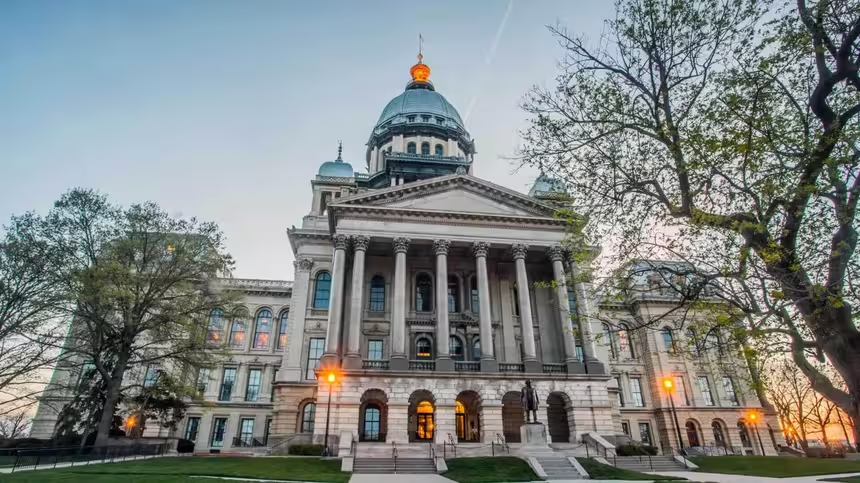
CapitolView
CapitolView is a weekly discussion of politics and government inside the Capitol, and around the state, with the Statehouse press corps. CapitolView is a production of WSIU Public Broadcasting.Providing Support for PBS.org
Learn Moreabout PBS online sponsorship(bright music) (dramatic music) - Thanks for joining us on "Capitol View."
I'm Fred Martino.
Tonight in the wake of Sonya Massey's death, Springfield will test a new way to handle mental health calls.
Plus, turnover at the Chicago School Board sparks talk about state intervention.
That and much more with our guests, Mawa Iqbal of WBEZ and Amanda Vinicky of WTTW.
Mawa, upfront this week, Illinois officials are battling misinformation to protect the integrity of this year's election.
Tell us what they're doing.
- Yeah, so they're doing a lot.
The Chicago Board of Elections is having three information sessions where they're showing this video that basically breaks down, like, "Here are our security protocols, and in addition to security protocols, just like having security officers, we're also gonna show you how our ballots are being tabulated.
So here's all the cybersecurity protocols we have to protect against hackers, to make sure that everyone is filling out a proper ballot."
And so it's all done in a way, I think, to just kind of put everyone at ease.
The Illinois Attorney General's Office is also putting out a PSA to let people know how to spot AI-generated images on online, on social media, wherever people can see it.
And the State Board of Elections also putting out a PSA to just kind of encourage voters that if you're looking for election information, the best way to look would be at your local election authority's website.
There's also gonna be, the League of Women Voters is having a mis-/disinformation task force session, like a public listening session that they've been doing throughout the state.
And there's actually one in Springfield tonight, which I'm gonna plan on going to.
So it should be pretty interesting.
But I would say in addition to trying to combat misinformation, a lot of election officials are also thinking about just physical security.
An Illinois law now allows poll watchers and poll workers to remove their last name off their ID just for their own protection.
And some election officials are also gonna equip themselves with Narcan in case they get any suspicious packages that might be laced with fentanyl.
So it's gonna be a lot.
They're definitely beefing up security.
And in the article, election officials talk about how part of it is because this election is pretty divisive and then there's already have been threats of violence against presidential candidate Donald Trump and also just there's gonna be a lot of people coming out.
They're expecting a pretty high voter turnout.
So they wanna make sure that everything, security is locked in.
- Okay, a lot's happening, and we should say that we're taping this on Wednesday in regard to the event that you're going to learn more as Illinois gets ready for a lot more in-person voting.
Of course, already, previously we've mentioned on this program, folks have been mailing in their ballots or dropping them off in person at ballot dropboxes in Illinois.
Because we have one of the most extensive operations in terms of allowing people to vote by mail or through the dropbox, something I've personally done already and appreciate that service being available very, very much.
We move to an update on last week's top story now.
Amanda, the Chicago School Board turnover.
You have been reporting on this and a headline in your story for WTTW says that it's even sparked talk of state intervention.
Bring us up to date.
- Well, so this is an evolving situation and really a huge deal in Chicago, for obvious reasons, and that these are people who make key decisions about schools in the state's largest city.
And parents, families, business leaders are concerned about the direction that Chicago Public Schools is potentially going and what is perceived by critics to be turmoil.
That's something that Mayor Brendan Johnson says, "No, this is all being done with intent in fulfilling a vision that voters wanted.
That's why I am in this office."
So we're waiting to see still for an additional member to be appointed to the school board after you had the entire, largely handpicked by Johnson himself, board abruptly resign rather than take out a high-interest loan or fire the school's CEO, who also disagrees with Johnson that taking out a high-interest loan is the path forward.
That's something that could put the school into insolvency and further hurt its credit rating.
But Johnson defends that as a move necessary in order to beef up education, to bring more teachers, librarians, assistants, extracurriculars into schools and invest in neighborhood programs, particularly in schools that are attended by mostly Black and brown children in largely disinvested neighborhoods- - And your note about finances.
- So that's really the backdrop there, mm hm.
- Yeah, and your note about finances puts the spotlight on the fact that this is a story as well for the entire state of Illinois because Illinois provides a lot of state money to Chicago for its schools, more than any other school district, of course, in the state.
- Well, and CPS is asking for more money and they are making the argument.
It had been just for really CPS and I think with recognition and a nod that CPS is not a per a list that the state has calculated, not the school that is hurting, not the district in Illinois that is hurting essentially the most.
And so asking for truly billions of dollars to be directed more toward education, that's something that I think is not going to happen.
But you have sort of two paths here.
You have an expectation and an ask for additional money toward education.
So no matter what, I think that's something that we're going to see Governor J.B. Pritzker have to propose in his budget.
The question is, is it going to be enough to satisfy critics?
I don't know that he needs to "satisfy" the mayor or the Chicago Teachers Union, but more money does have to be put into education.
It's a conversation that's going to be happening and puts pressure on the state as there are already a lot of asks.
And then there's also this notion, because of the turmoil that I referenced in terms of the board turnover, whether there's going to be additional information.
One has to remember that it was the state that really created this path toward an elected school board.
That's something that Chicago voters will be selecting 10 members of a new, larger school board in just a month's time.
Hence, this is really such a big deal because of the short timeline before the election.
And so is the state going to go back and say, "Hey, wait, the mayor, you were going to have the ability to appoint the other half of the board plus the president, but now we're going to put restrictions on you."
Johnson talked about a state takeover.
That's something that lawmakers have pushed back on, saying, "We're really not talking about that by any means."
But by the way, that's something that the state really has done.
There's a path for that in Illinois law that sets up an opportunity for the state to get involved when you have a district that is in real fiscal distress.
We've seen it in North Chicago, we've seen something like that in East St. Louis.
So it's not something that is being talked about now by any means, but I think that there are certainly opportunities for Illinois government to get involved if Chicago lawmakers feel true pressure.
And that's something that they might get agreement with from legislators from downstate because there's also, I think, a lot of skepticism downstate about Chicago and the direction that it's going and its school district.
- Okay, well, I know you'll be watching.
Mawa, another follow up now.
You have been reporting on our next story.
In the wake of Sonya Massey's death, Springfield will test a new way to handle mental health calls.
Tell us more about this.
- Yeah, so state lawmakers a few years ago passed this law called CESSA, which pretty much stands for the Community Emergency Services and Supports Act.
And it would essentially require 911 dispatch centers, emergency operators to create a model where if you get a call and someone is in the midst of a mental health crisis, instead of dispatching law enforcement officers, you dispatch a team of trained clinicians.
And so the law hasn't been rolled out yet.
Since 2021, there have been regional advisory committees that have been meeting and these are committees that are made up of dispatch experts, mental health experts, law enforcement, and they're all just kind of talking about how this law will work.
And so what's interesting is that Sangamon County, which is where Sonya was living and was killed, would be one of the first places to roll out implementation as like a pilot center.
And so when I talked to sources for the story, they said that that will most likely happen by the end of this year, early next year.
So it'll be a long process, of course, since this was passed like three years ago and then it's being rolled out now into next year as it's taken a while.
But for the story, it is something that it seems like it's very complex, a very nuanced issue.
I was talking to the 911 dispatch director for Sangamon County and he said that as of now what they do is when they have someone who's calling in to report a mental health crisis or someone who's reporting suicidal ideations, they'll immediately send an officer there first and then the officer on the scene will assess, "Okay, is this something that's for us?
Is there like a potential crime taking place, a danger aspect, or should we call in a behavioral health team?"
And when I talked to experts about it, like in the context of Sonya Massey's death, as we all know, she had called 911 to report a potential prowler that was around her house.
And so it's one of those things where, earlier in the day, we have records that show that she was going through a mental health crisis.
Her mom, Donna Massey, had called 911 to report that her daughter was experiencing paranoid schizophrenia.
And then later that day, Sonya goes to a local Springfield hospital to get mental health treatment.
But none of that information was relayed to 911 dispatchers.
And so experts, when I talked to them and I was like, "Would this system of, this new law, have prevented her death?"
And they seem to not really have a clear answer as to if it would have.
They seem to think maybe it wouldn't have just because the call was to report a potential crime taking place, which would then warrant a law enforcement response.
But it was one of those things where they said this new law, CESSA, is like a first step in addressing this very complicated problem.
- Great information and a great example there of perhaps process improvements that can come about through your reporting.
Folks can read more at wbez.org.
We now move on, Amanda, to a related story.
"Capital News Illinois" is suing Sangamon County for records involving another issue, a sheriff's office pursuit.
Tell us about that.
- Well, yeah, so I think there's a lot of attention on police in general, but in specific, the Sangamon County Sheriff's Department following Massey's killing.
And so this is I believe the second potential sheriff deputy related, or at least investigation, into an officer involved death in the past few months.
And so the "Capital News Illinois" is seeking public records to learn more about why an individual who apparently had been chased by sheriff deputies from Sangamon County was later found dead roadside.
It's really unclear what happened in this situation.
Apparently, the driver of a truck that had been trying to escape a pursuit from sheriffs is still missing.
The sheriffs made that pursuit and the belief that this may have been a truck that was part of a theft at an auto dealer.
We really don't know a lot of that, which is exactly what a Freedom of Information Act Request is for, seeking to find those details so the situation can be more accurately reported on.
The Sheriff's Office denied it, because again, this is, as I noted, an investigation right now into what happened with the deceased individual, what happened with this apparent police pursuit, or sheriff's pursuit, I guess I should say.
So we don't have a lot of answers, but "Capital News Illinois" not buying that an ongoing investigation is a reason to deny making those records public, because it's the Illinois State Police that are doing the investigation, not the Sangamon County Sheriff's Department.
So I guess perhaps a little bit of solace there that you do have a separation external body instead of an internal one looking into this incident.
And there we have it.
- All right, we will continue to follow this and bring you updates on this program.
Mawa, we move to economic news now, and it's another follow up, a lot of follow ups this week, your colleagues at the "Chicago Sun Times" report judges recommend an Aqua Illinois rate hike be reduced by a whopping 43%.
Tell us why.
- Yeah, so Aqua Illinois is a water utility that serves 273,000 customers in 14 counties across the state.
So they have a pretty large consumer base.
And state regulators are basically recommending that the state agency that oversees utilities approve from a total of 19 million to $11 million, which the Citizens Utility Board, which is this utility watchdog group that advocates against massive rate hikes, they say it's a great first step.
Even though it's a 43% reduction, they say it's not enough.
I have a quote from the Executive Director, Sarah Moskowitz.
She says, "It's a step in the right direction for long-suffering Aqua customers, but we believe the evidence submitted by consumer advocates calls for an even greater reduction for customers who have for years faced high bills and poor water quality."
- Okay, we will be watching.
Very interesting stuff.
Amanda, speaking of money, Cook County has proposed a 6.8% increase over its 2024 budget.
You reported on the plan for WTTW.
The $9.9 billion budget includes money to fund violence intervention.
Tell us more about this.
- Well, so what I think was really interesting about Cook County is we spend a lot of time, we just did, of course, talking about Chicago and its school system, state money for education.
Counties get a lot less attention, even Cook County, which, of course, is huge and encompasses Chicago.
And I think part of that is because there's this layer of government that folks are kind of like, "Wait, what do they do?"
But also in the instance of Cook County, because things are relatively okay.
The Cook County president described it as a good news budget, good news, and that there are not any major cuts, there are no major layoffs.
And also there aren't any taxes, increased fees, or new taxes, that is, there are taxes.
It's just not new ones or higher ones.
And so I think that's really, for me, the takeaway and sort of the lack of attention that government bodies get when things are going relatively functionally, when things are going relatively well.
The Cook County board president, this is just a proposal, it is not soup yet, but certainly the ingredients are there and it likely will be a soup resembling what she's tossed into the pot, given that this is a body that just has one Republican on it.
And Cook County Board President Toni Preckwinkle has another very powerful title, and that is head of the Cook County Democratic Party.
So she generally gets a lot of what she wants.
I think the other interesting kind of take from this budget is that we'll be examining what's happening to COVID dollars that have been built into budgets.
Again, with Chicago public schools and a lot of schools statewide, depending on these past couple of years on infusion of COVID era cash from the federal government that will be going away, cities, counties, all levels of government, and state government included.
That is something that Cook County says that it's taking very seriously, both in terms of spending down as required by the federal government.
The grants that have to be spent or the money goes away.
So by the end of this year, you not only have to have decided where that money's gonna go, but really have what are essentially contracts in place that will make it happen.
And then also planning forward for what's going to go with all of the programs, with all of the areas that have been built into budgets these past couple years.
How are governments going to make do without it?
Cook County says it has a plan.
I suspect many other governments do not.
- And Amanda, what's the violence intervention piece that is in the headline?
- Well, so this is again, going to be sort of a new program, something that Cook County is looking to try to spend some of that cash to do.
And we don't know a lot really about the violence intervention part.
- You don't know a lot about it yet, okay.
Something, again, something to to follow up on.
We may have another follow up on that, because certainly violence in the news all of the time, particularly on this program, as it relates to criminal justice.
Mawa, two of your colleagues at WBEZ, in fact, reported on our next story.
The headline, quite alarming, says, "Handguns turned into machine guns keep fueling killings in Chicago."
Tell us more.
- Yeah, I mean it's a real problem.
Basically, people can purchase these devices called switches that essentially turn regular handguns like Glocks into rapid fire machine guns, which are definitely outlawed for civilian use.
Actually, a really interesting tidbit.
Historically, machine guns were basically outlawed in this country back in the 1920s because of what was kind of going on in Chicago where you had these gangsters using Thompson submachine guns or Tommy guns in gangland warfare across the city.
And so basically in the article, the reporters talk to the head of the United States ATF, which stands for Alcohol, Tobacco, Firearm and Explosives Bureau in Chicago.
And they said that this really became a problem, people putting switches on handguns, starting in 2019.
So it's a pretty recent thing.
And it's been steadily growing in popularity partly because it's used in a lot of gang activity, but also it's kind of being glamorized in a lot of music too.
There's rappers from Chicago who talk about using switches and using it to kill people.
The University of Chicago Crime Lab says switches, along with high-capacity magazines, magazines are basically the device that holds bullets, have dramatically increased the lethality of shootings.
And that's because they let the shooters fire more bullets at a more rapid pace and hit their targets more often.
According to Cook County State Attorney's Office, 69 people were charged in machine gun related cases in 2021, and most of those cases involve a gun equipped with the switch, and this has steadily been on the rise.
So it's something that definitely the Chicago law enforcement is paying closer attention to and trying to crack down on.
It's also a national issue too.
The federal authorities are also trying to sort of limit and curtail the proliferation of these switches.
And what's interesting, too, is that the state of Chicago is actually suing the gun maker Glock saying that the company's endangering people in Chicago because their handguns are so easily convertible.
It's basically the way their handguns are manufactured, it makes it easy to attach switches to them.
And my colleagues reported that when they reached out to Glock, they doing anything illegal.
- Yeah, very interesting.
- We'll see how that pans out.
- We'll watch it, very important story.
And Amanda, for our final story, we also are talking about guns.
You reported for WTTW on this, advocates pushing for tighter rules around reporting stolen guns in Illinois.
Tell us about that.
- Yeah, so that's something that is already law, although I'm still waiting on the Illinois State Police for any figures as to how often there are actually reports to law enforcement when a gun is either lost or stolen.
The effort here would be to make the window shorter so that you would have to report it within 48 hours or face consequences for that.
There's a coupled effort to mandate more requirements for storage.
Basically, the effort would be to require that a gun be locked up if you have a child in the house.
Right now, again, that's something that's already Illinois law except for that's done by the time a youth reaches the age of 14.
And advocates say that's not old enough.
We know that guns are the leading cause of death for youth.
And so they want that to be raised to 18.
And also include those people, if you live with somebody who isn't able to have a gun, maybe they committed a felony or are under some sort of domestic order of protection and so they can't have a gun, or not protection, but they are the ones that are allegedly doing the wrong, that you would also have to lock up a gun.
This is something that gun rights groups, both of these efforts, they push back on.
They say that gun owners are responsible and don't need the state to be interfering.
And they say that if a gun, say, is stolen, that they're the victim, they shouldn't be made into someone who is potentially liable for this from the state for doing something wrong by not reporting it.
So we will see, both of these are efforts that advocates are hoping to push in the upcoming veto session that is about a month away or so, although critics are certainly skeptical that much is going to get done in veto session, let alone either of these measures, particularly given that they've been floating around Springfield in some capacity for quite some time.
- Such important journalism, Amanda.
And as is often the case when we report on stories, sometimes what is not the headline surprises people.
They didn't realize.
I'm sure there are a lot of people who listen to what you just said and are very surprised to find out, well, the law on the book that's supposed to protect children and families only goes up to age 14, not the age of adulthood, as you pointed out, 18.
- Yeah, it's one of those where a reporter in Illinois government, there are so many laws, so it's hard to be able to really drill down and know all of 'em.
I think that there have been, this is just various efforts.
I guess I will also add that these are some of the same organizations that had been working to pass Karina's Law and that's another one that they say is not gone from their sights.
But I think you do have perhaps more, you have additional conversations going on, realizing that to some people, these are really simple and obvious measures, and to others, it is just a "Heck no, don't go there."
And it's coming, there's a lot of court action, of course, involving the Second Amendment.
- And that's a story within itself.
Many, many, many stories we've heard of.
Mawa and Amanda, thank you for your wonderful work and for sharing some of that with us today.
We appreciate it.
- Thank you.
- Thank you.
- Thank you as well for joining us at home.
That is "Capital View" for this week.
For everyone at WSIU, I'm Fred Martino, have a great week.
(dramatic music) (dramatic music continues) (dramatic music continues)

- News and Public Affairs

Top journalists deliver compelling original analysis of the hour's headlines.

- News and Public Affairs

FRONTLINE is investigative journalism that questions, explains and changes our world.












Support for PBS provided by:
CapitolView is a local public television program presented by WSIU
CapitolView is a production of WSIU Public Broadcasting.