
Capitol View - October 19, 2023
10/19/2023 | 27m 9sVideo has Closed Captions
Capitol View - October 19, 2023
Anchor Fred Martino puts the major political news into context with Jason Piscia, Director of the Public Affairs Reporting Program at the University of Illinois Springfield and Kent Redfield, Emeritus Political Science Professor, University of Illinois Springfield.
Problems playing video? | Closed Captioning Feedback
Problems playing video? | Closed Captioning Feedback
CapitolView is a local public television program presented by WSIU
CapitolView is a production of WSIU Public Broadcasting.
Capitol View - October 19, 2023
10/19/2023 | 27m 9sVideo has Closed Captions
Anchor Fred Martino puts the major political news into context with Jason Piscia, Director of the Public Affairs Reporting Program at the University of Illinois Springfield and Kent Redfield, Emeritus Political Science Professor, University of Illinois Springfield.
Problems playing video? | Closed Captioning Feedback
How to Watch CapitolView
CapitolView is available to stream on pbs.org and the free PBS App, available on iPhone, Apple TV, Android TV, Android smartphones, Amazon Fire TV, Amazon Fire Tablet, Roku, Samsung Smart TV, and Vizio.
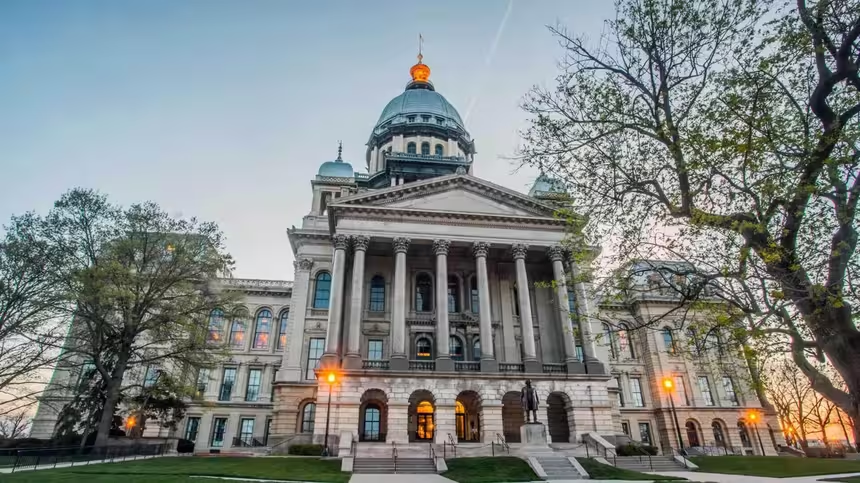
CapitolView
CapitolView is a weekly discussion of politics and government inside the Capitol, and around the state, with the Statehouse press corps. CapitolView is a production of WSIU Public Broadcasting.Providing Support for PBS.org
Learn Moreabout PBS online sponsorship(bright music) - Thanks for joining us on "Capitol View", I'm Fred Martino.
It's been an extremely busy few weeks in Illinois politics.
There was stunning news about the influx of migrants in Chicago, and legislators are expected to use the veto session this month to update gun safety laws again.
We have those stories and much more this week with our analysts, Jason Piscia is Director of the Public Affairs Reporting Program at the University of Illinois Springfield, and Kent Redfield is an Emeritus Professor, Political Science Professor from that institution.
Gentlemen, thank you so much for being with us.
- [Both] Good to be here.
- Jason, I wanna start with the veto session.
Columnist Rich Miller reports Governor J.
B. Pritzker and House Speaker Chris Welch are both indicating Chicago should not expect a veto session appropriations bill to help the city handle the increasing influx of asylum seekers.
Columnist Rich Miller wrote, quote, "Allocating or reallocating money to help asylum seekers only validates complaints by Black and Latino political leaders, including legislators, that their own constituents are being short-changed by state government in favor of the new arrivals," end quote.
Your thoughts?
- Sure, thanks.
You know, the veto session, first of all, just for some basic knowledge is, you know, that two week session here in the fall where, you know, with the word "veto session" in it sort of indicates that, you know, lawmakers are coming back to consider any vetoes that the Governor did over the summer.
But, you know, traditionally that isn't, that's usually the very least of the lawmakers' worries when they come back.
They're usually coming back to try to deal with some emerging issue that's hot in the news, that needs something, that needs some attention from the legislature.
As a result, the migrant issue around Illinois, especially in Chicago, is especially relevant right now, there's a lot of people talking about, what should the state be doing to help this situation with the busloads and busloads of migrants coming in from Texas and other states into Chicago?
Mayor Brandon Johnson in Chicago has indicated, you know, his city needs some help, that's where most of the migrants are coming into.
And if we look at the calendar, winter is coming, the cold weather is coming, and Chicago is not a friendly place in the winter when it comes to the weather.
So there are some worries about how the city is going to be able to handle this, you know, what's becoming a humanitarian crisis, in some ways.
And there was some efforts by him to convince state lawmakers and state officials to throw some extra money his way to help his city deal with this issue.
As you mentioned, the Governor and the Speaker have both indicated that we're not gonna be talking about migrant funding during the veto session.
A lot of people are saying, you know, the state has already invested millions, you know, 330 million up to half a billion dollars so far to help deal with the migrant crisis throughout the state.
As a result, we're not expected to see anything more to come out during the veto session.
And as Rich's column did mention, you know, this is a touchy political issue.
You know, one reason that always gets thrown around is, you know, we're close to an election season and specifically, we're right in the middle of a petition passing time where candidates are going door to door, seeking signatures to get their names on the ballot.
There is some worry that if lawmakers take a controversial vote dealing with migrant funding or anything related to this, that, you know, some angry opponent will come out of the woodwork and run against them.
- Let's follow up on that, Jason, I mean, give us a sense of how this might shape the political landscape, not only in Chicago, but really statewide with reporting from The Chicago Tribune that indicated, as you mentioned, Illinois has spent nearly $330 million on relief due to this influx of migrants.
- Yeah, you know the state has a lot of financial challenges on its hands, and I'm not sure the average Illinois citizen is able to differentiate about, you know, the seriousness of what's happening on the home front with the seriousness of what's happening with the migrants coming into Illinois.
So I think there's a certain, you know, as Rich's column mentioned, the African-American and Latino caucuses and voters feel that, you know, a lot of these funds should be going to to help their communities in Illinois.
- And it should be mentioned, there is no question and I have seen no coverage of folks saying that something shouldn't be done.
Everyone seems to agree something needs to be done, we must provide help.
But the separate question is, who pays for it?
And that's a different question because, as you know, and the Governor has asked this directly to President Biden, the Federal Government, the statement is, needs to step up here.
- Sure, I mean, yeah, with the way the migrants, the moving of these people, like cargo from one state to another, it's making a huge burden on states like Illinois.
And, you know, as you mentioned, Governor Pritzker did write a letter to President Biden about, you know, the Federal Government needs to step up on this and help states with this issue, it shouldn't be falling completely to the states.
And I think that's part of also the political reason why, you know, we're not gonna be dealing with this issue on the state level during the veto session.
- Yeah, all right, well, following up on this, Kent, very, very important to mention, and this is a story that was missed by many news organizations, The Chicago Sun Times reporting, you might call stunning.
It turns out the Federal Government has been helping to pay for the relocation of migrants to Chicago.
The Sun Times reports Catholic Charities has been using FEMA money to fly them here from Texas.
The Sun Times writes that, "The plane tickets are paid for using funds from the Federal Emergency Management Agency.
The nonprofit, Catholic Charities, has been awarded $48 million through FEMA's Emergency Food and Shelter Program since December, that compared to only about 7 million awarded to Chicago, according to FEMA."
Thoughts on this, Kent, it would seem that when you think this issue couldn't get any more explosive, it actually does.
- Yeah, this is almost, where to start?
I mean, you know, they were talking about a federal grant program.
The allocations go to the states that have, you know, are on the border that are dealing with, you know, people that are, and we have to clarify, you know, a lot of these are people who are making asylum claims and the federal law says, you know, you can make an asylum claim and you can remain in the US while that claim is being processed.
So, you know, we've haven't clarified or done anything really with the federal law.
You know, we dealt with executive orders rather than legislative action because of the, you know, this paralyzes congress.
It's a better issue, you know, then solving of the problem is not nearly as good a thing to run on these days, it's just having that issue out there.
So, you know, it's not entirely clear that this is a proper use of the funds that have been allocated, but it's almost a question of, you know, no one really being in charge, you know.
And so, when we start with the federal level, you get this situation, which is putting more pressure on Chicago.
- And according to the reporting in The Sun Times, there was no coordination with Chicago.
It was just flights are coming in, which you might argue makes it, you know, I carefully use a word like "stunning", but in this case, some would say stunning because this was emergency food and shelter, according to the reporting.
Well, how do you pay to ship to have someone get on a plane, not knowing if they're going to have shelter?
You know, if there's no coordination, how do you know?
- No, and this is just a similar situation exists with buses that show up at all hours unannounced, you know, so there's no coordination.
You know, this whole thing should be, there should be a national policy that we agree on, you know, that states can operate with in a context.
But by the time you investigate how a grant is being spent or try to say, "Well, we really ought to clarify this in Congress," you know, good luck these days with no speaker of the house and total gridlock.
And so, it just becomes, you know, a metaphor for the whole of how badly we are mishandling immigration.
- Kent, I have to ask you this, 'cause you spent your career as a political science professor, and as I was thinking about doing this show today and then on Sunday watching "60 Minutes" on CBS and seeing another story about how Florida was involved in paying for flights of people to Martha's Vineyard, who were not even in Florida, who were in another state, who they were paying to find people who were willing to go and get on, and they're being accused of deception, deceiving those people.
It occurred to me that, and I don't know, I want your reaction, from someone who taught and studied political science, we keep saying this since the Trump era, we are in such uncharted territory, there are things happening here that are so off the charts and there really isn't the context sometimes to say that, to say, this is just completely bonkers, is a good word for it.
- Well, yeah, we have chaos, in terms of how we're dealing with immigration and that makes it very difficult for people who really want to solve problems and to move forward, get some type of rational strategy and balance in what we're doing.
But the chaos also creates opportunities for people to do political posturing, position taking, you know, kinds of activities that have an impact in terms of, you know, politics and political campaigns, but have no real impact on dealing with the problem.
And so, and if you don't have, you know, either administratively or in terms of the Federal Government exercising legislation in coordination with the executive branch, you know, then states are left to fend for themselves, and we've got a real problem in terms of Illinois, the Governor does, because, you know, I don't think the Mayor and the Chicago City Council's handling of the issue is very encouraging.
The Governor doesn't want to, you know, take responsibility, wear the jacket for all of this.
On the other hand, you really don't want either chaos or the national media spending a lot of time writing stories about tent cities in Chicago when the Democrats are trying to hold a national convention.
And so, unfortunately, some of this gets down to, you know, not only what's good policy, but what's good political optics.
And so, you know, the legislature's not gonna act between now and when they get back in January, really now until March when they get through the primary, that leaves it up to the Governor.
- Yep.
- And you know, he is going to have to exercise leadership within his limited ability to do things.
You know, these are staggering sums to John Q.
Citizen, you know, we're dealing with the $50 billion state budget.
Now, there's all kinds of money in there, and so, in context, these are not huge sums, but when we're operating on the margins of not being able to meet obligations, schools, mental health, care of children, then it's one more thing that, you know, no one needs either politically or in terms of, you know, trying to provide services for the citizens of Illinois, you know that immigration is such a mess.
- It is, and, of course, as you referenced, in 2024, the Democratic National Convention in Chicago, so a lot of people are talking about that and questioning and wondering about what the stories will be outside that convention and this is one of them that there is concern about.
I need to move on, Jason, we move to another issue for the veto session, it's another attempt at strengthening gun safety laws, tell us about this.
- Yeah, you know, we mentioned earlier that it seems like the state legislature might not wanna take up any overly political, overly hot issues during the veto session to give themselves some political cover, but this is one that might get some traction.
So there was a bill that the House considered in the spring that would require law enforcement to take away guns from people who have orders of protection taken out against them, if you are, you know, a domestic violence victim, you can seek an order of protection from the person who is accused of abusing you.
One of the remedies within that order of protection is you can ask law enforcement to take away the firearms that belong to that alleged abuser.
The way the bill works or the way the law works now, the removal of those firearms is somewhat inconsistent, and we saw that happen tragically over the summer, we mentioned that this bill passed the House in May.
Within a few weeks later, there was a tragic case in Chicago where a woman took out an order of protection against an alleged abuser.
He came back and shot the woman and two of her kids, and the woman and one of the teen children died, tragically.
So this bill has some extra motivation behind it, as we go into the veto session.
The lawmaker, who is putting the bill forward, wants to make it more clear that law enforcement does need to get in there within two days and physically confiscate those guns.
As I mentioned, the process of doing that now has been sort of inconsistent.
There's been cases where the guns have been relinquished but they've been relinquished to someone who lives in the same home as the alleged abuser, so the effectiveness of that is very limited.
And there's been other cases where there's been miscommunication between law enforcement agencies.
This bill seeks to make it very clear, law enforcement needs to get in there and get those firearms out of the home and away from the person.
There are some questions about how this will all work in real life.
You know, the Illinois State Police theoretically will sort of oversee all this, but they'll need to work with local law enforcement to actually get into those homes.
And then, what happens to the guns themselves?
Who stores them?
Who's responsible for them?
What's the process for getting them back if there is such a process?
So still a lot of questions to be answered.
- Laws only matter when you have enforcement of the laws.
So, you know, that's great context, but it'll be very interesting to see.
It seems like this is on track for passage, we'll update and watch it.
I do need to move on, Kent, some economic news now that is good news for Illinois, I am glad we have some good news to talk about here.
Federal money will help the state develop hydrogen technology.
Columnist Rich Miller wrote about this, tell us more.
- Well, this is part of the larger infrastructure bill passed by Congress, and there's money in there for a number of initiatives involving trying to develop green energy, reduced carbon.
And so, this idea of extracting hydrogen as an energy source and, you know, occasionally, you'll see things on the news about, you know, vehicles that are being, you know, cars, trucks that are being run on hydrogen.
And so, we've got, seven centers, you know, areas where they're set up, Illinois is in one of those areas, seems to have, you know, maybe more of the lead in that, where you've got, you know, potentially a billion dollars worth of spending that's going to take place.
- Yeah, and I should say, Kent, for folks who are not familiar with this, this isn't just a hypothetical.
In other words, just like we have electric cars now that are getting more and more popular, while it's a very tiny percentage of the market and mostly in California, which has, you know, nation-leading environmental laws, Toyota, as an example, has been a leader in developing hydrogen technology and there are cars driving on the road as we speak in California that are powered by hydrogen.
So, you know, it is another possible tool in the toolbox.
I think the big question is though, we're struggling now to figure out speeding up building the electric infrastructure.
How do we, at the same time, think about building up another infrastructure for hydrogen pumps?
But nevertheless, it's one more tool in the toolbox and it's not only for cars, so that context is important too.
So, we'll just see where this goes.
Final thought before we move on?
- Always these things, always with an asterisk because you know, you gotta make it work, you're talking about dealing with state and local governments.
- Oh yeah.
- You don't know how stable things are at the Federal Government, and then the technology has to compete and sometimes what looks great on paper doesn't end up to be the, you know, the alternative that you thought.
So this is investment, it's good to have, but nothing is guaranteed, particularly as we move towards alternative energy.
- You didn't intend it for it to be a segue but you gave me, Kent, a wonderful segue, not guaranteed there.
(chuckles) For our final few minutes, Jason, meantime, there is another clean energy project with a big setback, we've been talking about this for years.
It's that carbon dioxide pipeline in Illinois and elsewhere in the Midwest.
A big setback here, tell us about that, give us an update.
- Yeah, the company that is planning that pipeline that was set to sort of span, yeah, 1,300 miles across five different states to transport carbon dioxide from, you know, different states, and actually the termination of it would be right here in central Illinois where I sit today.
But that company withdrew that permit application just amid, you know, they've been getting raked over the coals from environmentalists and landowners and farmers about the safety of this project and how effective it is in doing what it intends to do.
So we don't know where this project stands at this point.
This company's also pulled its permits back in Iowa, which is actually the state where it sort of winds its way through the most out of all the five states involved.
But, so, you know, when this did happen not too long ago, or at the beginning of 2023, the same company withdrew its permits, permit applications here in Illinois, but then refiled them just a few weeks later.
So I'm guessing this isn't a full abandonment of the project, but it is a setback and kind of is, at this point at least, a temporary win for the opponents to this project who are concerned that, you know, there's this underground storage pipes and facilities are coming right underneath their homes and their farms.
- Yeah, all right.
Very quickly, Kent, we're running out of time, but I wanna move to education, Capitol News Illinois looked at a report on the state's educators, and it appears a labor shortage continues.
- Yeah, absolutely, I mean, you have overall numbers, you know, how many vacancies do you have?
You know, are you gonna be able to cover the classrooms?
And the overall numbers are not bad, you know, in comparison to pre pandemic kinds of indices.
When you get down into the details then, you know, are you covering spots with a lot of substitute teachers?
How much continuity do you have in the classroom?
Do you have teachers with temporary qualifications?
And then, you know, there's a lot of polling that would indicate a lot of dissatisfaction with the current, you know, people that are teaching that are looking, you know, for an early exit.
And so, you don't know how stable your base is.
There's a lot of uncertainty there, in terms of, you know, our ability to staff classrooms.
And so, it's just one more problem in, you know, a very complex situation that we have in Illinois fiscally and politically, at this point.
- Yeah, and it's another one, as there are so many, a national issue as well, shortages of educators, not just teachers, by the way, across the country in a variety of states.
I wanna thank my guests, Jason Piscia, Director of the Public Affairs Reporting Program at the University of Illinois Springfield, and Kent Redfield, he's an Emeritus Political Science Professor from that institution.
Gentlemen, thank you both for joining us today.
- Thank you.
- Good to be here.
- Spirited show today, thank you for joining us at home.
For everyone at WSIU, I'm Fred Martino, I will be back next month.
Jack Titchener will be filling in for me on "Capitol View" for the next two weeks, with the news this past couple of weeks, I'm glad I have a fill in.
(laughs) He'll also host a special Friday edition of "Illinois Lawmakers" on November 10th.
Hope you have a great week.
(bright music)

- News and Public Affairs

Top journalists deliver compelling original analysis of the hour's headlines.

- News and Public Affairs

FRONTLINE is investigative journalism that questions, explains and changes our world.












Support for PBS provided by:
CapitolView is a local public television program presented by WSIU
CapitolView is a production of WSIU Public Broadcasting.