
Capitol View - October 26, 2023
10/26/2023 | 26m 46sVideo has Closed Captions
Capitol View - October 26, 2023
From renewing tax credits for children attending private and parochial schools to allowing small nuclear power plants for industrial uses, Illinois Lawmakers are considering a wide range of issues as they return to the Statehouse for their annual fall veto session. Illinois Lawmakers host Jak Tichenor talks with Capitol News Illinois reporters Hannah Meisel and Peter Hancock about the issues.
Problems playing video? | Closed Captioning Feedback
Problems playing video? | Closed Captioning Feedback
CapitolView is a local public television program presented by WSIU
CapitolView is a production of WSIU Public Broadcasting.
Capitol View - October 26, 2023
10/26/2023 | 26m 46sVideo has Closed Captions
From renewing tax credits for children attending private and parochial schools to allowing small nuclear power plants for industrial uses, Illinois Lawmakers are considering a wide range of issues as they return to the Statehouse for their annual fall veto session. Illinois Lawmakers host Jak Tichenor talks with Capitol News Illinois reporters Hannah Meisel and Peter Hancock about the issues.
Problems playing video? | Closed Captioning Feedback
How to Watch CapitolView
CapitolView is available to stream on pbs.org and the free PBS App, available on iPhone, Apple TV, Android TV, Android smartphones, Amazon Fire TV, Amazon Fire Tablet, Roku, Samsung Smart TV, and Vizio.
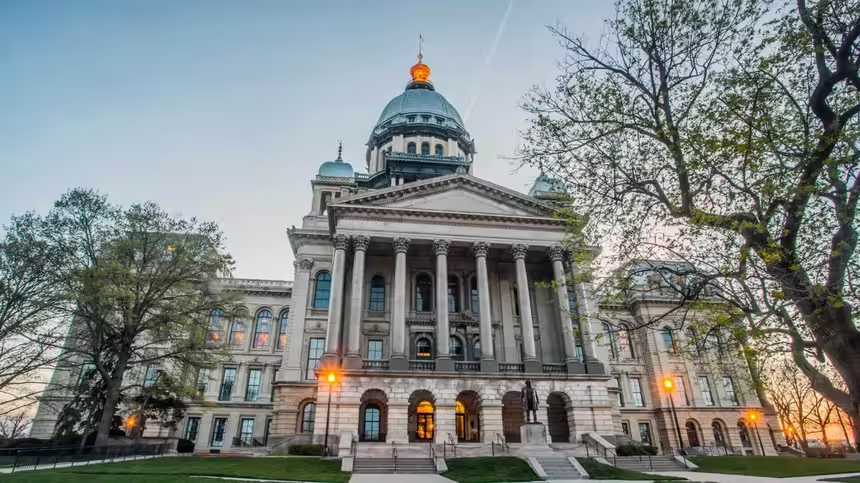
CapitolView
CapitolView is a weekly discussion of politics and government inside the Capitol, and around the state, with the Statehouse press corps. CapitolView is a production of WSIU Public Broadcasting.Providing Support for PBS.org
Learn Moreabout PBS online sponsorship(upbeat music) (image beeping) (image whooshing) (dramatic music) - Welcome to "CapitolView."
I'm Jack Tichenor sitting in for Fred Martino this week.
Our guests are Hannah Meisel and Peter Hancock from Capitol News Illinois.
The fall veto session is underway Springfield, and unlike a lot of previous years in Governor Pritzker's administration, there actually are some vetoes to consider, along with a number of other issues over the next three weeks.
"CapitolView," Capitol News Illinois has done a great job in providing us with a primer of what we might expect in coming days.
Before we dig into the actual vetoes, I wanna touch on what an issue that has had an awful lot of attention over the spring and summer months, and we've been hearing a lot about whether lawmakers are going to renew the Invest in Kids tax credit program which will sunset at the end of this year.
Peter, you've worked a lot on this issue.
What does the program actually do?
- Okay, this is a program that provides a tax credit for people who contribute to scholarship funds for private and parochial schools.
It was part of a bipartisan compromise back in 2017 when Republican Bruce Rauner was governor.
The state was in the middle of a budget impasse, and lawmakers wanted to get past the impasse and they wanted a new formula for funding K through 12 public education, but they needed enough votes to get over a governor's veto.
And so this was kind of a bone that was thrown to Republicans and to school choice advocates that said, you know, it's not direct state money going to private and parochial schools, but the state will forego some tax revenue in exchange for other people giving money to private and parochial schools.
And so that was part of the bargain.
That program, however, sunsets at the end of this year.
Now we have Democratic super majorities in both chambers.
We have a Republican governor, or a Democratic governor, I'm sorry, who has no intention of vetoing additional money for public schools.
And so Republicans don't quite have the same leverage that they had back in 2017.
And so there's a lot of bargaining going on about whether or not this is going to be renewed, and if so, in what format.
I'm gonna be interested to see how the votes break down because I don't think this is strictly partisan.
I think there are certain groups of maybe upper income liberals, what are sometimes called limousine liberals, and Birkenstock Republicans who like to send their kids to elite prep schools and wouldn't mind having a scholarship program.
So we'll see how it comes out.
There are going to be negotiations all through the veto session.
There are gonna be a lot of different iterations of bills to renew this program, and it'll be interesting to see where it lands, you know, in the first or second week of November.
- It was interesting covering the spring session this year on Illinois lawmakers.
It was an issue that was batted around quite a bit in the abbreviated spring session that wrapped up a little earlier than it usually does.
And in the end, Republicans withheld basically all of their votes on the final budget bills because they said they really hoped that that would've been in the final mix.
Would that be right, Hannah?
- I mean, I don't buy that Republicans would have put their votes on a budget anyway.
But yeah, I mean this was definitely something that was disappointing to Republicans to not see because, you know, it is a very, in the grand scheme of, you know, if you view it strictly through a state budget lens, it's $75 million, which is a very small piece of the budget pie.
Those $75 million, you know, is what the state would have otherwise gotten in tax revenue.
But instead it, you know, as Peter described, it goes toward tax credits if you contribute to these scholarship funds.
Now there are, you know, a few proposals on the table that would shrink the total pie from, you know, 75 million annually to around 50 million, and then also shrink the tax credits for people who contribute large amounts of money, but then also make the tax credits bigger for, you know, middle income people who would contribute a little bit less.
Because, you know, of course you never want a program to turn into really rich people kind of taking advantage of what some might call a tax loophole.
And so, you know, we have a couple proposals on the table, but it's still early days.
Usually in the two veto session, the first week is people, you know, still getting back to Springfield, seeing each other after a while, maybe having a few, you know, meetings, but really the substantive work usually gets done in the second week and the week between a lot of phone calls and jacking because they know that, you know, you have a real deadline coming up at the end of that second week.
You know, there's an added pressure on Democrats, on Governor J.B. Pritzker, because Pritzker has been kind of all over the map, you know, in terms of does he wanna keep this scholarship?
When he was first running for governor back in 2018, he wanted to, you know, eliminate the scholarship program, but then in the last few years he has signaled that he's more open to its renewal.
And then of course, on Friday of last week, the governor said that, you know, he'll sign whatever is put on his desk when it comes to the scholarship program.
Actually, that was Thursday, and then on Friday morning that prompted a kind of scathing statement from the state big teachers unions accusing Pritzker, their kind of progressive liberal hero, of siding with "right-wing governors," is their phrasing.
So it is definitely a gauntlet lay down because, you know, as Peter described, it's kind of a ideological split because, you know, some people think of this as a backdoor way for public money going into private schools.
- So stay tuned on that because this will probably go through several iterations between now and the first part of November, as Peter was saying.
Lawmakers still considering a bill that will clarify existing laws that mandate that guns be taken away from alleged abusers after judges grant a certain type of domestic violence order of protection against them.
Where do things stand on that now?
- You know, I think there's still behind the scenes kind of negotiations, as you said in your intro to that just now, which I think a lot of people don't seem to understand that this is exhausting law.
That if I go in front of a judge and I petition for a domestic violence order of protection with what's known as the firearm remedy, which asks the judge to, you know, make sure that my alleged abuser, they have guns in the house and the guns are taken away, current law is very unclear on the process by which that would happen.
And so this law would clarify that law enforcement would have to go collect, seize the guns within 48 hours of a judge signing off on that certain type of domestic violence order of protection.
And, you know, it would clarify a few other things that are unclear when, you know, the order of protection law interacts with, you know, how the FOID card works.
The Illinois State Police of course have oversight of FOID.
They're supposed to be automatically suspended, you know, anyone who is hit with any type of order of protection.
But you know, what happens after that?
Even though technically you're not supposed to have ownership of guns if your FOID is suspended, it seems like in practice that's not actually happening because the state police can't be everywhere and local law enforcement don't really have a clear directive to do much about it.
And so for this to be workable, there would have to be, you know, a process by which the ISP, you know, empowers local law enforcement to do that.
And also, you know, even more practical things that I frankly would've not thought of that local law enforcement are a bit worried about, like where do I physically store the firearms that are seized?
If I am a, you know, small police department in a rural area maybe my evidence locker is already overflowing.
And then, of course, I have to have the, you know, I have to be responsible for these firearms, and that's a, you know, kind of a liability.
- Very complicated issue, and we hope to know more about that in the next couple of weeks.
Interesting development this week at the Capitol.
A proposal is moving forward to allow legislative staff to unionize, do collective bargaining for the first time.
Peter, it passed out of committee yesterday on an eight to four party line vote with Republicans voting present on it.
Speaker Welch is in favor of the bill.
Where do things stand?
- Well, right now it's mainly the Democratic staff in the House Speaker's office that is demanding this.
And, you know, you're not hearing so much from the House Republican staff or from either of the caucus staffs over on the Senate side.
It kind of grew out of the effort last year to pass a constitutional amendment that guarantees a fundamental right for workers to organize and engage in collective bargaining.
However, buried inside the details of Illinois state labor law within the group of public employees, cities, counties, municipalities, state, school districts, there are certain groups that are carved out that do not have a right to organize and have union elections supervised by the Illinois Labor Relations Board, and among those groups are legislative staff.
So when Democratic leaders in the legislature pushed through this constitutional amendment and said everybody has a right to organize, legislative staff stood up and said, "Okay, hey, how about me?"
These people do work incredibly hard.
You know, anybody who's ever covered a legislative session or gone through one knows, you know, the incredible overtime hours that are involved in it.
They are paid what could arguably be called modest salaries.
They're not entitled to the same benefits such as overtime pay, paid family leave, those kinds of things.
It's really interesting how legislatures often exempt themselves from laws that they impose on other people.
And so you're seeing the Democratic staff in the legislature stand up and say, "Hey, how about us?"
So the optics of it, you know, for the Democrats who pushed through this constitutional amendment, the optics are not good.
So they are getting, you know, behind this, you know, this effort.
I think you just saw earlier this week the Republicans just kinda sitting on their hands because I think they're saying, "This isn't our issue.
"You know, it's a revolt within your own caucus, "so you guys go deal with it."
And so that's kind of where we stand.
It will definitely come up for a vote in the House.
I think the Senate is sitting back and saying, "Let me see whether or not it gets out of the House, "and then we'll take a look at it."
- Yeah, I was curious about that where President Harmon stood on that issue.
I wanna move into the vetoes, starting with this attempt to try to end a nearly 40-year moratorium on the construction of new nuclear power plants in the state of Illinois.
Senate Bill 76 passed earlier in the spring that would lift that nearly 40-year moratorium.
The bill is basically centered, it's legislative intent is centered on these small modular reactors that could be dropped in at large industrial production sites and places like that.
I don't think the intention was originally to try to build, you know, big plants like Clinton or the ones in the quad cities or suburban Chicago, but it's all kind of mixed up in that now.
Where do things stand?
- This is a very interesting bill.
You know, I think there are definitely a lot of people who would like to override the governor's veto.
But of course, you know, to override the governor's veto, it takes, you know, the three-fifths majorities, which of course Democrats have.
But what's interesting about this bill was it was a mix of Democrats and Republicans who pushed it through the legislature.
You know, you make a good point about these being small nuclear reactors.
You know, places like Europe are kind of far ahead of the U.S. in nuclear development writ large.
I think nuclear development in the U.S. kind of halted, you know, or at least slowed to a trickle in the last 40 years.
And of course, we had this moratorium in Illinois.
We currently have six large scale nuclear reactors, but five of them are in the northern ComEd territory.
And so folks in central and southern Illinois who are largely Ameren customers, they're not really getting the benefits of this relatively, you know, cheaper source of energy, certainly cleaner than burning coal.
You know, I think universally acknowledged when two years ago there was this big fight over this energy transition legislation that nuclear power would have to be the bridge to the future where, you know, people dream of having all wind and solar.
But you know, we just don't live in that world right now.
And so having, you know, not just the bridge of our existing six reactors in Illinois, but having the availability and option to have these smaller reactors that would be kind of contained to large scale industrial facilities, which of course are, you know, the hugest energy users in Illinois, that's what people want.
But, you know, the governor had not been super clear about his intentions this spring.
You know, he was a bit vague on what he wanted to do ultimately, and then he did ultimately side with environmental organizations that wanted him to veto it.
But definitely a really, really interesting bill because it kind of hearkens back to the way Springfield used to work where, you know, there was a bill, you know, there was an issue that had, you know, kind of statewide support, so it's very- - The old agreed bill process where everybody kind of gets a crack at the thing, right?
- [Hannah] Mm-hmm.
So we'll see what happens.
- Well, the Republican senator who originally sponsored that, Sue Rezin, says she thinks she's got enough votes to override it, but as a backup she's got a separate bill that would seem to address a number of the concerns that the governor put on the table.
- That's right, that is what our colleague Andrew Adams reported last week.
It seemed that she had taken out, you know, her original language back in the spring.
You know, things were negotiated, and so what Sue Rezin did was she brought back her original language and filed it in a standalone bill.
And so I guess we'll see whether either the veto override, you know, gets put on the floor, or Rezin's next bill or, you know, nothing at all.
- While we're on the subject of the utility area, Governor Pritzker issued an amendatory veto to a bill that would grant existing electric utilities in downstate the right of first refusal to build transmission lines until the end of 2024.
What did that original bill do in terms of the major downstate utility Ameren and some other municipal utilities?
And why did the governor have cause in his view to make some tweaks to that?
Peter, you wanna take that one?
- Well, yeah, this is really kind of an interesting issue.
I think the general theory behind the bill was that if we need additional transmission lines to get power from this plant over here down to this community to hook up to the grid, whatever utility company has the franchise for that territory ought to have the right of first refusal because they're running power lines and transmission lines anyway.
And I think the governor's concern was that the laying of transmission lines is an industry unto itself, and, you know, giving one entity an upper hand in a competitive market will eventually drive up prices for consumers, and so that it ought to be more competitive.
It is really a very complex and kind of arcane area of the energy economy.
But there's, you know, a lot of money, a lot of lobbying going on behind the scenes on this, so people have a great deal of interest.
This is one of those things that as we shift to a new kind of power grid, relying more on renewable energy, the people who are able to transmit the energy from the wind farms, from the solar farms, from wherever back onto the grid where it gets distributed to everybody else, these are gonna be major players in that transition to a new kind of energy economy.
And so you're just seeing, you know, the power forces shaking out, trying to see who's going to have the advantage in this.
- Right, and it's a major bill for labor unions like the International Brotherhood of Electrical Workers, traditionally a strong Democratic ally.
- Yeah, but there are a lot of jobs involved in there, and so they want to be guaranteed access to these high paying jobs with the companies that they're used to dealing with.
- I wanna switch to a story that you covered this week, Peter.
Governor Pritzker made news this week by proposing to consolidate all of the state's early childhood services into a single new state agency.
It would take over certain functions of the state Board of Education.
There's something in there from the Department of Children and Family Services and the Department of Human Services.
Early childhood education, of course, has been an issue that the governor has shown a lot of passion for over the years.
What's he trying to do with this?
- I think he's really trying to streamline all of these divergent services.
The Illinois State Board of Education administers block grants to build and expand preschools around the state.
The Department of Human Services operates programs where they do home visiting and early intervention for infants and toddlers.
The Department of Children and Family Services is in charge of licensing daycare providers.
And that has been very controversial- - Oh, yeah.
- In another area because they're still working on regulations from that.
And there are many lawmakers who say that really shouldn't be part of DCF's portfolio.
And so the governor came out and proposed this week to put all of this under a new as-yet-to-be-named state agency.
He has named a transition coordinator who's going to work out of the State Board of Education, but basically it's going to be a new agency.
Basically, he was saying, you know, for parents and for healthcare, or for childcare providers it's a halftime job just trying to navigate through all of these different agencies.
You know, where does the funding come from?
Who's in charge of the rules?
How do you get your kid into one of these programs?
And so he just kinda wants to put it under what is bureaucratically called a one-stop shop, and hopefully that'll make it all run smoother.
- You can do certain things through executive orders, but I imagine this would have to have legislative approval.
- Right, he signed an executive order to get the ball rolling and to start the transition process, but it's going to be a multi-year process, and eventually the legislature is gonna have to weigh in, especially through the budget when appropriations are made and then through the regulatory process about, you know, who makes the administrative rules and what sort of authority they have.
It's gonna take a number of years and the legislature will have to weigh in on it.
- And there is a big fiscal impact in this because earlier in the year, of course, lawmakers passed the governor's proposal for investing another $250 million in a variety of these services for kids.
Hannah, I'm just curious in gauging the reaction from what you've heard around the Capitol, any thoughts on how this might be viewed when it actually finally drops in the legislature?
- You know, I think a lot of people would get behind the goal of creating a separate state agency to kind of streamline things.
It's always difficult when you're dealing with agencies that are kind of somewhat siloed even though they're working on kind of the same thing, and it's very frustrating.
Actually, it reminds me earlier, you know, maybe a month ago Governor Pritzker had asked the Biden administration to kinda do the same thing, make one streamlined office to deal with the migrant situation because, you know, as a state, as the city of Chicago dealing with all these different agencies that are siloed are a difficult thing.
So, you know, again, the goal I think a lot of people would get behind, but, of course, when you're creating a new state agency, you are, you know, creating a permanent, you know, funding, you know entity that you are funding, and you always have to be careful about how you structure that or else, you know, you could end up in situations where you're stuck in a structure that isn't working and, you know, is in fact you know, maybe hindering goals or is flat out wasteful.
And so, you know, the last time that we created a new state agency was, I don't know, maybe eight years ago when in the Rauner administration we created the Department of Innovation and Technology.
And so creating a new state agency is not an easy thing, not an everyday thing.
But again, I think a lot of people would get behind these goals.
- Peter Hancock, Hannah Meisel, thank you so much for your good work at Capitol News Illinois and keeping the folks in the state informed of all the happenings in the state capitol.
We certainly appreciate it.
We will be back next week with another edition of "CapitolView."
Thanks for joining us.
(dramatic music) (dramatic music continues) (dramatic music continues)

- News and Public Affairs

Top journalists deliver compelling original analysis of the hour's headlines.

- News and Public Affairs

FRONTLINE is investigative journalism that questions, explains and changes our world.












Support for PBS provided by:
CapitolView is a local public television program presented by WSIU
CapitolView is a production of WSIU Public Broadcasting.