
Capitol View - October 28, 2022
10/28/2022 | 26m 46sVideo has Closed Captions
Capitol View - October 28, 2022
In this edition of CapitolView, Host Jennifer Fuller talks with Dan Petrella of the Chicago Tribune and Mike Miletich of Gray Television. With less than two weeks before Election Day, polls are showing Democrats with leads in most statewide races – but Republicans continue their push. A look at the issues before voters, and more.
Problems playing video? | Closed Captioning Feedback
Problems playing video? | Closed Captioning Feedback
CapitolView is a local public television program presented by WSIU
CapitolView is a production of WSIU Public Broadcasting.
Capitol View - October 28, 2022
10/28/2022 | 26m 46sVideo has Closed Captions
In this edition of CapitolView, Host Jennifer Fuller talks with Dan Petrella of the Chicago Tribune and Mike Miletich of Gray Television. With less than two weeks before Election Day, polls are showing Democrats with leads in most statewide races – but Republicans continue their push. A look at the issues before voters, and more.
Problems playing video? | Closed Captioning Feedback
How to Watch CapitolView
CapitolView is available to stream on pbs.org and the free PBS App, available on iPhone, Apple TV, Android TV, Android smartphones, Amazon Fire TV, Amazon Fire Tablet, Roku, Samsung Smart TV, and Vizio.
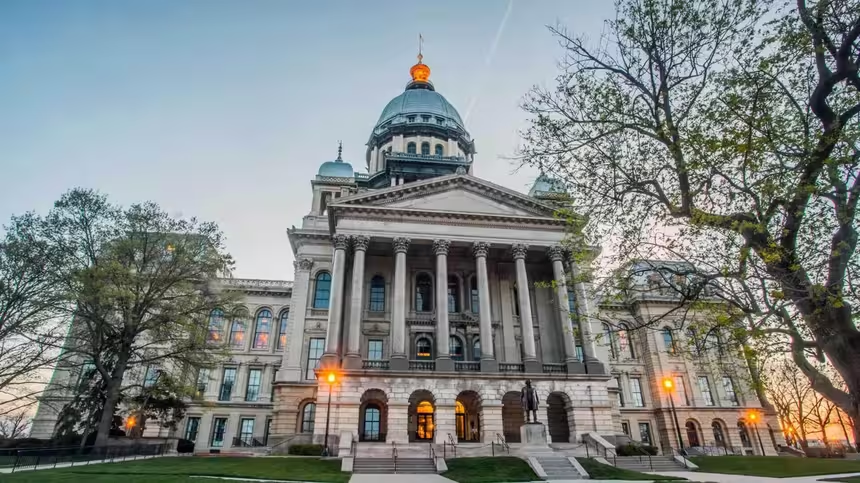
CapitolView
CapitolView is a weekly discussion of politics and government inside the Capitol, and around the state, with the Statehouse press corps. CapitolView is a production of WSIU Public Broadcasting.Providing Support for PBS.org
Learn Moreabout PBS online sponsorship(upbeat music) - Welcome to Capital View, your weekly look at the happenings inside and outside the Illinois State Capital, I'm Jennifer Fuller.
Our guests this week are Dan Petrella from the Chicago Tribune and Mike Miletich of Gray Television.
Gentlemen, thanks for joining us.
- Good to be here.
- Thanks, thank you for having us.
- We'll start with something that as we record this hasn't happened yet, but by the time people see it, it will have happened and that's the US Senate debate.
The major party candidates for US Senate in Illinois, incumbent Democrat, Tammy Duckworth and Republican Challenger Kathy Salvi, are set to square off in their one televised debate of this campaign season and as we talk about this, new polling shows that Senator Duckworth has a double digit lead in terms of support leading into the November election.
Dan, how important is a debate like this?
Is there any chance that Kathy Salvi can really make any big strides?
- You know, it's a good question.
I think that, like you said, you know, polls aren't perfect, and we've seen crazy things happen with polls in the last few elections for sure.
But, you know, she may went over some undecided voters out there, people still making up their minds or just tuning into the fact that there's an election in less than two weeks now, trying to get to know who these candidates are.
But when I think, I think when you come to this race, you can kind of follow the money and look at the fact that control of the United States Senate is on the line.
And this is not a race where republicans nationally are focusing their resources.
We have, you know, republican conservative mega donors who are very active here in Illinois, spending their resources in federal races in other places that seem more winnable for them.
That would be, you know, my take on that.
I think that it would be really hard for her to defeat a popular incumbent especially like Tammy Duckworth.
- Mike, what are Republicans looking at when they're looking at federal races?
Is Illinois still a solidly blue state very reliable for them, or are they going to have to start getting involved, do you think?
- I think the main focus right now is looking more towards the races that are downstate in terms of Mary Miller also looking at the tight race between Nikki Budzinski and Regan Deering.
That is one of the huge races the Republicans are excited about and I think that I've seen more about those two races than I have seen anything about Kathy Salvi, it, signs are a big thing and you don't see many signs in Springfield, maybe even Southern Illinois.
I'm not sure what it's like near you, Jen, but there's really not a lot of talk about this race.
And you're right with the polling, I mean, it's 49.1 to 39.3 that that is, you know, big differential there.
And it's a lot different than what we're talking about for a governor's race, per se, where there is room to grow, as Dan mentioned, a very likable senator.
I don't think that Kathy Salvi has a lot of room to grow there.
- You mentioned the polling and that comes this week from Emerson College.
It shows Democrats across the board in those statewide races have a good amount of support, but not in all cases outside the margin of error.
So there is still a possibility that some of these races are a toss up, they're further down the ballot.
We're looking at things like the Secretary of State's race, for example, which is an open seat as Jesse White is retiring.
Mike, are you surprised at all by these polling numbers this week?
Are you weighing them at all as we're roughly 10 days away from election day?
- I did think that it was notable that you saw a little bit of change for the governor's race right after the final debate, but it's nothing that should shock people because there is that general growth that you see for people that get excited to vote when it comes to midterm elections.
Obviously whoever the incumbent is in Washington can make a big difference come voters at home.
But the one thing that I was surprised about actually was in terms of the attorney general polling, Tom DeVore polling at 39%.
You know, a lot of people like Attorney General Kwame Raoul, and it's very interesting to see someone that was relatively unknown that back when the Attorney General was first elected, you know, four years ago with Kwame Raoul.
You never knew who Tom DeVore was until these COVID 19 lawsuits that he partnered up with Senator Darren Bailey.
This man would not be running for statewide office unless he had success from these COVID 19 lawsuits across the state.
And there were so many that were countless cases that kept coming through the court system.
- Dan, what about you?
When it comes to the polling particularly, you know, take a look at the attorney general's race, for example are you surprised at the margins at all?
Do you think that this is how things are going to shake out?
You mentioned earlier that polls can surprise us, they can be not what we expected them to be once those votes are cast.
- Yeah, I mean, I think when you look at the margins of error compared with the previous polling that Emerson College and, and WGN did, you know, there, these aren't too, the movement isn't too huge when you factor in the margins of error.
I think it's part of what we're seeing in national trend.
Maybe some of the polls are moving back to favor Republicans a little more.
But I think when you look at the governor's race, for example, when you break it down regionally, at least according to this one poll, the governor's still ahead by about 12 points in the Chicago suburbs, which there's, you know, there's a very little path to victory for Senator Bailey if the governor's ahead by double digits in the Chicago suburbs.
I mean, he's gonna get wiped out in the city of Chicago, and he's gonna win downstate probably, you know, he's ahead by about 12 points there.
But most of the voters in the state of Illinois reside in the suburbs of Chicago, or at least a, let me do my math here, in Chicago and in the suburbs.
And if you don't win, you know, a substantial margin in the suburbs and you're gonna lose the city bite a ton, there's really, the path to victory is very narrow.
- [Mike] And you have to win Pritzkerville, right?
You have to win there.
- So let me ask you this, Dan, when it comes to that polling, we still see a good number of people saying they're undecided or they'd like to vote for another candidate.
There are other candidates on the ballot, third party candidates who would hope to break into that double digit territory, perhaps become an established party.
But how likely is it that those undecided voters will actually cast a ballot for someone other than JB Pritzker or Darren Bailey?
- You know, that's a good question.
I think one of the things that jumped out at me is, this is about a third of the undecided voters said they were leaning toward voting for someone else.
There's a libertarian candidate on the ballot, but that's really the only other option that could leave the governor's race blank.
You know, I think it's, the undecideds are always an interesting crowd.
You wonder how much they're in tune with politics before you know, this narrow window before an election and a little bit unpredictable because of that.
- Is it possible, Mike, that people have not heard about either of these two candidates, that they've been able to avoid the barrage of whether they're campaign mailings, online ads, on air ads, those sorts of things?
- I think it would be very challenging for someone to not know who Governor JB Pritzker is, or Senator Darren Bailey on that fact.
I mean, both have been across the state and alone, there's stories all over the place.
And as you mentioned there's mailers, there's constant ads.
I know that there are people in Illinois that say, I don't wanna be involved in politics, I'm not interested, but you have to think that they know who these two men are.
Now, mind you, maybe they like Dave Richard Irvin, you know, they had more interest in him during the primary and they said, okay, I'm done, I'm out.
But I don't think they're learning enough about the libertarian candidates for other offices as compared to, you know, trying to do their own research.
So it's curious, I mean, are they just gonna say, okay, I'd rather just sit this one out and weigh another four years, I'm not sure.
- Another question that voters may not have a lot of information on, at least that's what we're hearing from people, is this proposed constitutional amendment for the state of Illinois, this amendment would make it a right for workers to unionize in the state of Illinois.
There are proponents and opponents, as you might expect on any issue like this, but a lot of people are saying there's just not enough information out there.
Too many people are gonna go into the ballot box, whether it's in early voting, mail in voting ahead of the election date or on November 8th itself and say, well, goodness, what is this?
I don't know anything about it.
Mike, is there a a path to success for this amendment, or are we gonna see something similar to what we saw with the graduated tax proposal just a couple of years ago?
- Well, less than two weeks left.
I think that both sides for and against the workers' right amendment are going to be working as hard as they can to get their messaging out there.
Clearly, it's not at that 60% threshold just yet support wise.
And what does that mean?
Is there going to be more press conferences across the state, not just in Chicago for people to know, this is why we're supporting a right to unionize and a right to collectively bargain.
Are you going to see many of the Republican candidates across the state do press conferences saying why they oppose this?
And, you know, we did see a little bit of press coverage from the Chamber of Commerce, Illinois Manufacturers Association explaining why they're against it.
They feel it could make the job and business market in Illinois less inviting for businesses that could come to the state over the next five to six years.
They, I'd spoke with the Chamber of Commerce, Todd Mischke not too long ago, and he said there are people that have businesses that are here in Illinois saying, you know, if this thing passes, I'm just gonna move to Florida or Ohio and other states so that I can have a better opportunity for my business.
In terms of the unions, I feel that they're really just trying to push home the fact that this is what we've always wanted.
Many argue that, hey, unions already have the ability to do this.
They're just trying to get it so that lawmakers can never take it away from them.
It's you know, it's gonna be interesting down to the wire.
I'd hope to see another update in pulling on that within the final week to really say the least.
- Sure.
Sure, Dan, Mike brought up a, maybe we'll call it a technicality, but constitutional questions are tricky when you get to how those ballots are cast, how those ballots are counted.
In order for this to be ratified, 60% of the voters who vote on this question have to say yes, or you have to have a majority of the total number of people who cast a ballot in Illinois.
Is that something that people are confused by, do you think?
Is it something that's so complicated people may skip the question?
- Yeah, I think it's very confusing, just the math there of how you get it across the finish line.
And that's one thing that I wasn't clear on from the polling is was, you know, how many people are just gonna see this and not know what it is and leave it blank.
Under voting on referendums is a big issue.
And I think we saw, I can't remember the exact numbers off the top of my head, but there were, there was some significant under voting when it came to the graduated income tax amendment a couple of years ago that you mentioned.
So really I think it's more likely that if it were to pass it would be because it got that 60% on the question threshold.
And it looks like supporters have some work to do to get it there.
And I think there's been a lot of nightmare scenarios being thrown out there about this meeting.
Higher property taxes for folks.
One that I saw this week that seemed frankly kind of absurd is that it would give unions the power to negotiate that they wouldn't have to go through background checks to work for DCFS anymore.
Just, you know, there's all, we get into this silly season in politics where all sorts of outlandish claims are flying.
And I think it's a hard sell I think for some people who aren't part of the labor movement.
And you know, a this is entirely anecdotal, but I was talking to one Democratic candidate who mentioned that they had heard from some rank and file union members while they were campaigning who were gonna vote against the amendment.
So it's, it'll be interesting to see there.
I don't know if there'll be any polling afterward to show, you know, how it performed among subsets of people like union members.
But that would be very interesting to see.
- You mentioned that things get a little bit squirrely, a little bit perhaps confusing and those 10 days or so we have left before the election.
More early voting sites are now open across the state in addition to the ones at the local county clerk's office or other election authority.
People try to read tea leaves when it comes to what early voting numbers look like.
You know, have the county clerks and election authorities received more democratic ballots back, or have they received a larger percentage in previous years?
And so that might mean something, Mike, we are seeing more people casting ballots early again this year.
We are seeing an increase in mail-in ballots.
But do those numbers really mean anything to you?
- You know, I do think that the vote by mail push has been very interesting since we've gone throughout the COVID 19 pandemic.
Obviously a lot of people utilized it during 2020 and we get to a point here where this year, I don't know about you guys, but I received five different applications for vote by mail ballots in my mailbox.
And I thought this would be interesting to see.
So information from the State Board of Elections right now, over 817,000 people have requested mail-in ballots, roughly 37.6% have returned them.
People may take their time to see what they wanna do in terms of their ballot, but there's also that question of will people say, okay, I decided that I do actually want to show up and vote on that day, that's still a possibility.
They don't have to rely on their vote by mail ballot.
But I'm curious to see the amount of people that are going out and voting early on the Republican side and making sure that they get their vote out there for the candidate that they like.
I have heard many times Senator Darren Bailey telling people to vote early, which is interesting because a lot of times you mostly hear that from Democrats and he's saying, vote early, bring your friends, tell your family to go and it's a change messaging that I haven't seen before.
So it has been a bit of a new era in terms of voting in Illinois, I think.
- Dan, what's say you, do you see similar things?
- I was just gonna say prior to the 2020 election when former President Donald Trump made all sorts of wild accusations about, the false accusations about mail-in ballots, it was actually, I think in many instances, more popular among Republican voters, they tend to have, you know, an older voter base.
People who maybe it's a little harder for them to get out to the polls on election day.
So it's interesting to see them maybe embracing that again a little more now that there's not that loud voice at the top of the party telling people not to vote by mail 'cause they're gonna do whatever, the accusations were with your ballot.
I still, yeah, I still think it does maybe, you know, the vote by mail ballots will probably tend to trend a little more democratic on the whole, and I think it's, you know, I think it's just evidence that it's here to stay as the pandemic hopefully, eventually fades into memory, that I think people will want to continue having in session.
I know personally as a Cook County voter can be helpful for some people with just all the judges we have to go through to evaluate, having time to sit at your computer and figure out who all these people are is a positive thing for some folks.
Or if you don't understand what the amendment is, you can look it up while you vote.
- Yeah, something else outside of perhaps the campaign realm, this week, the annual state report card for Illinois schools was released from the Illinois State Board of Education.
You can get more information on your local district by going to Illinoisreportcard.com, but still some statewide statistics are included in that as well, in addition to really detailed breakdowns of each individual school district and the schools within those districts.
And Dan, is there any big surprise here?
A lot of people have been very curious about what things would look like as these students worked their way through the COVID pandemic.
- I think, you know, overall reading and math scores probably are not where people would want them to be.
The silver lining that education officials have been putting out there is that progress is much improved.
So the scores might not be to the level that they would like them to be, but compared with the previous year's scores, there's been, you know, or previous scores, there's been big improvement.
Graduation rates are up across the state, which is another positive that officials are touting.
I'm curious to see, I'm actually, as soon as we're done here, going over to hear what the governor has to say about the report cards.
So I'll be curious to see what his take on it is.
- Mike, you cover a vast area that includes a lot of rural and urban schools, what are people expecting to see and what are they preparing for in terms of those challenges?
- I do think that a lot of the people, specifically in central and southern Illinois are happy that students are back in the classroom.
They felt that there was a big learning loss during COVID 19, especially in some areas where they may not have had access to the proper tools to have virtual learning or students just didn't wanna participate because they were at home doing other things.
There was a big push to say, hey, my students aren't learning enough of the math, reading, writing skills they need.
And that has played big into Senator Bailey's campaign noting that, you know, we need to make sure the parents are leading this in helping their students in whatever way they can.
He's trying to promote more of the school choice options.
And I feel that the messaging changes a bit and it has confused some voters by telling people that, oh, Illinois schools are feeding students at a young age about, you know, critical race theory and sexual education, but that has nothing to do with how kids are learning about their core math, reading skills and that confuses a lot of the voters downstate.
- Another issue that comes up as a part of this, lawmakers take a look at the school report cards when they're looking at things like evidence-based funding, which is in place and that's how some of the education dollars are doled out across the state.
Do these numbers in your mind, make a big difference, Mike?
Or is this what lawmakers would've expected?
Is there any pause that could be put on things to let schools catch up from the COVID break?
- I, if anything, I think that they could invest more, which they've continuously done.
I think the goal overall is to make sure that by the time that we get to, let's say 2025, we've seen significant improvement for schools.
And it's looking at the schools that received, you know, a smaller amount of funding years ago before we had the evidence based funding model and looking, are those schools in southern Illinois on the same scale as schools in Naperville or Creek Bonne, you know, are they moving up the scale and looking better?
Which are those graduation rates improving?
Yes, you know, and it's going to be a longer span of time before we see true growth, but I think in, further investment can only help the schools and lawmakers on both sides of the aisle believe in that.
- Dan, what about the achievement gap that we see so many times between underrepresented populations and majority populations?
Do you think that the COVID experience, as we've seen so many times, has impacted some of those underrepresented populations more dramatically?
- Yes, you know, I haven't dug into the numbers that are just out this morning, but I think it's safe to say that, you know, black students, Latino students were hit hardest by the pandemic, particularly, you know, not having, in many cases access to the same technology to help with at home learning.
And I think that that is an area that a lot of school districts are gonna be focusing on, trying to close that gap even as they were, you know, before the pandemic, there is a big pool of federal money that came in the school districts to help them with some of this.
So it'll be interesting to see how districts look at the scores this year and sort of figure out how to marshal those federal dollars to address some of the issues and how long it takes kids to catch up.
- Mike mentioned that students are back in the classroom this year and people are very glad to see those students back in front of a teacher and meeting and talking and interacting with people on a one-to-one level.
But still, we're looking as we head into the traditional cold and flu season at the potential for a COVID spike as medical experts have been warning for quite some time now, that this is a virus that could potentially come back year after year, be a part of the cold and flu season.
One of the things that we're hearing about this week is another outbreak at one of the Illinois veterans homes.
This time again at LaSalle Veterans Home, another COVID outbreak there, but leaders there say, look, all of the residents have been vaccinated.
The cases for the most part are mild.
Were moving them into isolation.
Mike, this became a bit of a political football earlier this year when there were issues with the LaSalle Veterans home and COVID and dozens of veterans died.
Is this time around different, does this become a political issue again?
- I think if there is an attempt specifically from Senator Bailey to attack the governor on this, it would be hard to know that it's the same exact problem as before because we do have these new tools.
We have vaccines and we also have Paxlovid.
We have options for treatment for people to make sure that they're okay.
These are mild cases, which is being reported right now, of course, and it's a big difference compared to people that were in very serious condition during the worst of the pandemic when we saw, as you said, dozens of veterans lose their lives.
And I think right now there's also better care being taken by employees to follow protocols in the facility, which is a big difference compared to what we saw in the previous outbreak when there was many rules broken and employees not really caring about what they were doing.
- Dan, we've talked a lot about how COVID has been a part of this election cycle.
It's still at the same time voters are saying, listen, I'm more worried about the economy.
I'd really like to know when we're going to see some of these prices go down or, or things like that.
Would a COVID spike, do you think, make a big impact with just 10 days before ballots are cast?
- [Dan] You know, I think unless we really see hospitalizations start to explode like they did back in December or January of last year, hospitals get overrun and really stretched.
I think it's hard for that to come back to the forefront of people's minds unless, you know, they have a relative who is very sick right now with it.
You know, I think it's hard for Senator Bailey to attack Governor Pritzker on the COVID outbreaks at the LaSalle Veterans Home because he was a poster child for fighting against the efforts that the governor was taking to try to fight COVID.
He won't say whether he's vaccinated, he clearly opposed masking, so it's kind of a hard way for him to find an angle to criticize the governor on that.
And the governor has a good response of, you were among the people telling people not to follow the mitigations, which led to these outbreaks.
- These are issues that we continue to talk about and we'll continue to watch here on Capital View and throughout the news in the next couple of weeks and beyond the election.
Mike Miletich, Dan Petrella, thank you so much for joining us.
- Thank you.
- Thank you.
- And you can find more of Capital View by going to our website, WSIU.org and find us on our YouTube channel.
Until then, thanks for joining us on Capital View.
I'm Jennifer Fuller, we'll see you again next time.
(upbeat music)

- News and Public Affairs

Top journalists deliver compelling original analysis of the hour's headlines.

- News and Public Affairs

FRONTLINE is investigative journalism that questions, explains and changes our world.












Support for PBS provided by:
CapitolView is a local public television program presented by WSIU
CapitolView is a production of WSIU Public Broadcasting.