
Capitol View - October 3, 2024
10/3/2024 | 26m 46sVideo has Closed Captions
Capitol View - October 3, 2024
This week: Voting begins in Illinois. we’ll look at some interesting ballot questions and other issues. Plus, an Illinois Supreme Court ruling reinstates a rule that allows the state to revoke a Firearm Owners Identification card for people charged with a felony.
Problems playing video? | Closed Captioning Feedback
Problems playing video? | Closed Captioning Feedback
CapitolView is a local public television program presented by WSIU
CapitolView is a production of WSIU Public Broadcasting.
Capitol View - October 3, 2024
10/3/2024 | 26m 46sVideo has Closed Captions
This week: Voting begins in Illinois. we’ll look at some interesting ballot questions and other issues. Plus, an Illinois Supreme Court ruling reinstates a rule that allows the state to revoke a Firearm Owners Identification card for people charged with a felony.
Problems playing video? | Closed Captioning Feedback
How to Watch CapitolView
CapitolView is available to stream on pbs.org and the free PBS App, available on iPhone, Apple TV, Android TV, Android smartphones, Amazon Fire TV, Amazon Fire Tablet, Roku, Samsung Smart TV, and Vizio.
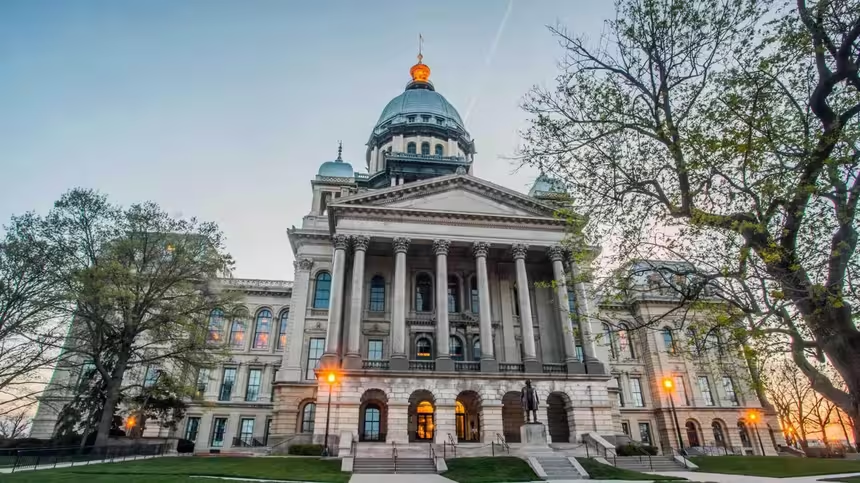
CapitolView
CapitolView is a weekly discussion of politics and government inside the Capitol, and around the state, with the Statehouse press corps. CapitolView is a production of WSIU Public Broadcasting.Providing Support for PBS.org
Learn Moreabout PBS online sponsorship(lighthearted music) (majestic music) - Thanks for joining us on "CapitolView."
I'm Fred Martino.
Voting begins in Illinois.
We'll look at some interesting ballot questions and other issues.
Plus, an Illinois Supreme Court ruling reinstates a rule that allows the state to revoke a firearm owner's identification card for people charged with a felony.
That and more this week with Kent Redfield, emeritus political science professor at the University of Illinois Springfield, and Peter Hancock from Capitol News Illinois.
Kent, we begin with election 2024, early voting starting in much of Illinois this week.
Ballots are being received in the mail as well.
The "Chicago Tribune," as you know, previewed the election.
Tell us more, including information about the ballot questions that we're going to be answering as voters.
- Yes, the election has started even though it's 30 days away.
Illinois one of the most friendly states in the nation as far as registering to vote, and then your opportunities to vote, you know, what method you choose.
And so right now you can go in certain counties, it kinda phases in.
You can go and vote in person at a designated place rather than wait to vote in person at your precinct on, you know, election day.
You can wait until election day certainly and show up at the polls, and then mail it- - And Kent, we should say at this moment, since you just said that, you mentioned Illinois being a friendly state in terms of voter participation.
If someone is watching and they are not registered to vote and they actually wait and wait and wait, we do have same-day registration.
So on election day, you can go to the polls and you can register and vote on the same day.
Not every state is like that.
And I mentioned vote by mail, you can sign up for that option, not probably now, but for the next election, and then never have to worry about this.
You'll get your ballot if you choose.
You can get your ballot in the mail all of the time, which is a wonderful convenience for many people.
- Absolutely, and, you know, if you do late registration, we don't call it same-day registration, we say it's the grace period in Illinois- - Okay.
- I don't know why, but you do have to have two forms of ID.
You know, you have to go through, you know, the formal registration and sign all of the documents.
But yes, on election day, you can still, it's still not too late to register to vote.
Now, in addition to all of the contests, starting with the presidential election, we also have three advisory referendums that the legislature puts on the ballot.
And so these are questions that you're essentially, you know, polling the electorate, as you will, as you will.
They, you know, some of this is just kind of feel-good position-taking kind of activity.
Some of it is really kind of testing the temperature.
And then there's all this situation where the Constitution limits the number of questions you can put before the public.
So if you've got something coming and you're in the Democratic majority, you see something coming you might not like to be on the ballot through an initiative, you can put three other position questions on the ballot and freeze every everything out.
So voters are going to ask if they think we should have civil penalties for people who interfere with elections, which, again, maybe to a certain extent kind of re-passing the statutes, but that's one of the question.
The second one looks at whether or not we should have essentially a surcharge on people who make more than a million dollars to generate some extra money.
This would require constitutional amendment.
And, you know, it has not been that long since we turned down a constitutional amendment for allowing a graduated income tax by getting rid of the flat tax.
This is probably, you know, from a public finance standpoint, this is not the best way to get, you know, around the flat tax, but it would require a constitutional amendment.
Pat Quinn, who's been a, you know, a fixture in Illinois politics, seems like forever, is pushing that one.
- And Kent, it may be popular because it's aimed at using the money to reduce property taxes, which is a issue in Illinois that is always on people's minds and being talked about, but doesn't seem like there's much progress on it.
- Yeah, absolutely.
The last one has to do with essentially asking whether we should place all of the various laws that we have supporting reproductive freedom, you know, in the Constitution.
We have not done that yet.
And, you know, there's also just a turnout factor.
If these are essentially friendly amendments from a Democratic standpoint, then you can tell your voters that, you know, go to the polls, this is your opportunity to make your voice heard.
So, it doesn't do anything whether they pass or fail, but, you know, this is a feature that is not unusual when voters go to the polls in Illinois.
- Love it.
Love it.
And it'll be very interesting to see the results there and if it does give political will for folks to propose, you know, some sort of legislation that responds to the will of the voters.
Peter, you covered some Illinois Supreme Court rulings.
These include diverse issues, everything from a hospital room privacy to gun safety rules.
Tell us more about your story.
(Peter speaking faintly) - The act that requires you to carry a FOID card.
What had happened was a father and son in the Metro East area around St. Louis were out over 4th of July weekend shooting off their rifles in their yard, kind of celebrating the day.
There was, I don't know if there was alcohol being consumed or whatever, but it seemed to be pretty festive, and some people complained, and they were cited for a felony charge of illegal discharge of their firearms.
Well, under the FOID Act, it requires that you lose your FOID card or have it at least suspended if you are under indictment or under charge for a felony.
And that stems from a federal law that says people under indictment for certain felonies are not allowed to own or possess firearms.
And so these two people were charged, they lost their FOID cards.
The charges were eventually reduced down to misdemeanors.
They applied and got their FOID cards back, but then they sued, saying that that part of the law was unconstitutional.
They had been charged but not yet convicted of a felony.
And so during that approximately one-year period while they were waiting for this case to be processed, they were deprived of their constitutional right to keep and bear arms and use them for self-defense.
This goes all the way to the Illinois Supreme Court, which decided this on rather a technicality.
And if you think about it, what they were really implicating was the federal law that says you're not allowed to own or to possess firearms if you're under indictment for a crime that could result in a penalty of one year or more in prison.
What the Supreme Court said was they didn't have standing to sue because they had already had their FOID cards reinstated.
Therefore, at the time they sued, they were not being injured by the law.
And so the Supreme Court kinda threw it out and they left this question open, essentially, about whether or not this law is constitutional.
So the law goes back into effect.
A lower court judge had in fact issued an injunction to block enforcement of the law, but that was later lifted while it was being appealed to the Supreme Court, and the Supreme Court has lifted it permanently now, unless or until somebody who actually has standing is allowed to sue.
Another case, and this just, you know, it kinda helps you understand (chuckles) the broad range of topics that Supreme Court justices have to deal with, sometimes just in the course of a single day or a single week, had to do with a man, had to do, the question was, what sort of expectation of privacy do you have when you are in the emergency room of a hospital?
This had to do with a shooting incident that occurred in the small town of Murphysboro down in southern Illinois and your part of the state.
One man was brought in by ambulance with a gunshot wound to the head.
He was dead on arrival.
Another man was brought in, dropped off by a friend.
He had a gunshot wound to the leg.
In a small town like Murphysboro, you can pretty much assume that these two cases are related, two people with gunshot wounds showing up at a small town hospital at the same time.
Police arrived and they went into the trauma unit.
There was, and apparently took possession of bloody clothes that this one, the guy who'd been shot in the leg, took possession of his bloody clothes.
He was eventually charged with first-degree murder for killing the other guy.
And the question was whether or not the police had a right to be in the trauma room and to take possession of his bloody clothes.
There was question, seemed to be unresolved, at least in the briefs filed with the Supreme Court, about whether or not he had given consent to let them look at his clothes.
Anyway, the upshot of it was that the Illinois Supreme Court, in line with a lot of other, both state and federal courts, have said that when you are in the emergency room of a hospital or you're, you know, admitted to a hospital, you basically have the same expectation of privacy that you would have if you were in a hotel room that you had rented, which is to say that police need to have a warrant before they come in and start searching, and so they succeeded in getting that evidence excluded.
That was the Supreme Court's order.
So, anyway, long way of saying you do have some right of privacy if you are in a hospital, even a publicly owned hospital, apparently regardless of how you were brought in, but you do have that right of privacy, and it does impose further restrictions on law enforcement in terms of what they're able to do when someone's brought into a hospital.
I mean, we've all seen these, you know, these police procedural shows, you know, where there's a shootout on the street and people are taken to the hospital and the cops go into the hospital to try and question the victims and the suspects.
This was kinda like that, only the courts are now saying that police have limited authority when they go into a situation like that.
- Very interesting, very interesting case and very consequential as well.
Kent, an investigation co-authored by the "Chicago Tribune" looked at surveillance cameras in Chicago.
I understand that it found those cameras were not very effective.
Tell us more.
- Yeah, this is a really interesting investigation.
It's, and the "Tribune" partnered with the issue's Answer Project, which is sponsored by the BGA.
And, you know, as someone who, you know, a Downstater then, you know, I really had no awareness of kind of how the Chicago Police Department was using surveillance, what they call, you know, police observation devices, what we would normally think of as, you know, cameras on light poles, that sort of thing.
Apparently, you know, this started back when there was a huge concern over terrorism under, you know, Richard M. Daley 20+ years ago.
There's about 4400 devices that are out there, you know, affixed cameras deployed in various parts of the city.
The police department also has access to surveillance cameras that are part of the Chicago Transit Authority, the Chicago Public Schools, and private businesses.
You know, we're talking 35,000 cameras.
And so, you know, there's a, and that apparently is one of the problems.
There's just way too much data out there.
Cameras are probably most effective when people are monitoring them live, although you can go back and obviously download recordings from cameras.
But what they found was it was very, very difficult to get information about how they were being deployed, how effective they were, and what little they were able to find shows, you know, a pretty startling lack of accountability because it was hard to tell, you know, exactly when they were valuable, when they were not valuable, you know, and there's, in terms of deployment, it seemed to be, you know, not really data or need driven, that we had places where there were lots of cameras in areas with low crime, no cameras in other areas with crime.
There were surveillance issues.
There's apparently one community that, through their alderman, has resisted any kind of these devices in their neighborhood because they're concerned about surveillance.
And so, you know, it's very, very uneven.
That was what was, you know, particularly troubling is, you know, you've spent 280, at least, million dollars in the last 20 years, probably twice as much money on this as the very controversial, you know, ShotSpotter technology that the city council has been arguing about.
And there's just no basis, or there's not, there's no, there does not seem to be any kind of systematic examination of best practices, and- - Oh!
That's very concerning- - That's really troubling.
- Especially with that amount of money.
So very important investigation, and we'll see, maybe it will lead to some changes in terms of where cameras are placed and then how long that data is stored, and is it used, is it effective, in the future.
So very interesting reporting on that and glad to see it for sure.
Another very important story this week, Peter, an investigation published by "Capitol News Illinois" looked into the screening of those who apply to work as deputies for the Sangamon County Sheriff's Department.
Tell us more about that.
- Okay, this was a project that was done by one of our investigative reporters, Beth Hundsdorfer, and who typically does an excellent job of getting at every detail of this.
Sangamon County, which is essentially Springfield and its surrounding area, has been under the microscope for the hiring practices of its sheriff's department.
But it's not just Sangamon County, I mean, Sangamon is kind of the entire state in microcosm at this point, but they've been under the microscope because a number of months ago, a sheriff's deputy named Sean Grayson allegedly shot and killed a young, unarmed African American woman named Sonya Massey, who had called police.
Ms. Massey apparently had some mental health issues, but she had called authorities because she thought there was a prowler outside her house.
The sheriff's deputies arrived and one thing leads to another.
She's shot dead in her own home.
And it turns out that this officer, who has since been discharged and charged with first-degree murder, had been employed at a number of other law enforcement agencies in the surrounding area and had some, allegedly had some misconduct allegations in his file.
So the question was whether or not this was a one-off or was there a systematic problem within the hiring practices in Sangamon County.
The sheriff under pressure because of that incident, Jack Campbell, has since resigned and has been replaced.
This had... Beth's investigation found that as recently as earlier this year, there was another case where an officer was hired despite the fact that just a few weeks before his hiring, had been involved in a single-vehicle DUI accident, was apparently very intoxicated at the time of the accident, but was hired nonetheless.
And one of the things we found was that you can be...
There are very few qualifications for being a sheriff's deputy written into law.
You have to be 21 years of age, you have to pass a written test, and you have to have not been convicted of certain felonies or disqualifying misdemeanors.
Other than that, under the law, you're allowed to be hired as a sheriff's deputy.
Of course you have to go, you know, there are training requirements, and I imagine each individual county sheriff has, you know, their own standards, but this has been an issue legislatively, you know, going back to the killing of George Floyd in 2020 and the, you know, the social upheaval that occurred out of that.
The Legislative Black Caucus, largely in response to that, came in with this broad-based social justice reform package that was considered during a special session in 2021.
And among the many things that they looked at were the qualifications for law enforcement.
What can be used to have them discharged?
Can they be discharged for misconduct?
Whether or not misconduct allegations can be made public.
And the upshot of it is that it appears that law enforcement, the law enforcement community, is largely still protected by this old system.
You know, law enforcement looking after law enforcement.
And there is maybe still room for additional reforms, at least in terms of minimum qualifications and disqualifying criteria, things that should make people ineligible or force their removal from a law enforcement agency.
- Very important work and something that I would encourage everyone to read at "Capitol News Illinois."
Kent, we wrap up with another interesting investigation, this one by the "Chicago Tribune."
It looked at Chicago Mayor Brandon Johnson's fight for control of city schools.
What did you find?
- The mayor of Chicago, under change made back in the '90s when Jim Edgar was governor, appoints the Chicago Board of Education, which appoints the superintendent of schools.
And, you know, up to that time, Chicago School District was just like any other school district in Illinois.
And so there's some controversy or disagreement about why the legislature gave control of the Chicago schools to the Chicago mayor.
Some, there was a claim this would make for better accountability.
Off the record, there were some Republicans who said, "We're just gonna give this mess to the mayor.
It'll be his fault and it'll be one more thing, you know, to bother a Democrat."
But however it came about, that's the reality.
And so right now, this Mayor Johnson is pressuring members of the Chicago Board of Education to terminate the superintendent of schools.
This is a fight over how we're going to deal with the budget deficit, which is part of the Chicago schools, which is part of a larger fight about how we're going to fund whatever contract we get between Chicago Teachers Union and the Chicago Board of Education, within the backdrop of a huge budget fight next spring when the state is going to be looking at some serious deficits.
And the mayor, Mayor Johnson, has been, you know, mounting an effort to lobby Springfield for more money.
And so, you know, it is a dispute within a dispute within a dispute.
And it's frankly, you know, I mean, the public finance part of this is that the mayor and some people within the board would like to borrow money short term, you know, issue bonds, borrow money, to pay for some pension issues and to pay for salary increases.
The superintendents of schools is resisting that because it's gonna cost you a lot of money.
You really shouldn't be borrowing money for operating expenses.
And then on top of all of that, if it couldn't be more complicated, we're now transitioning into an elected school board.
Half of that board will be elected in the fall, but the mayor will still appoint the other half of the board.
And so, you know, there's a certain sense in you look at this and you just say, you know, "Hand me the popcorn, this is gonna be interesting to watch."
(Fred laughs) On the other hand, you know, this is, you know, the largest school system in the state has horrendous problems, you know, with enrollment and so, you know, it is really critical.
And plus, you know, anything you do for the Chicago Public Schools, all of the Downstate schools would like the same consideration.
And we're gonna have a really, really tight budget because of next year at the state level because all of the funding's gone away.
- Yeah.
- From COVID.
- A Chicago story that really previews a very difficult situation for the entire state with this enormous amount of money that is needed by the city of Chicago, not just for schools but for so much more, transit, et cetera.
Kent and Peter, thank you so much.
We're out of time, but very interesting stories this week.
Thank you at home for joining us as well.
And for everyone at WSIU, I'm Fred Martino, have a great week.
(majestic music)

- News and Public Affairs

Top journalists deliver compelling original analysis of the hour's headlines.

- News and Public Affairs

FRONTLINE is investigative journalism that questions, explains and changes our world.












Support for PBS provided by:
CapitolView is a local public television program presented by WSIU
CapitolView is a production of WSIU Public Broadcasting.