
Capitol View - October 31, 2024
10/31/2024 | 26m 46sVideo has Closed Captions
Capitol View - October 31, 2024
Analysis of the week’s top stories with Jeremy Gorner of the Chicago Tribune and Charlie Wheeler, emeritus director of the public affairs reporting program at the University of Illinois Springfield
Problems playing video? | Closed Captioning Feedback
Problems playing video? | Closed Captioning Feedback
CapitolView is a local public television program presented by WSIU
CapitolView is a production of WSIU Public Broadcasting.
Capitol View - October 31, 2024
10/31/2024 | 26m 46sVideo has Closed Captions
Analysis of the week’s top stories with Jeremy Gorner of the Chicago Tribune and Charlie Wheeler, emeritus director of the public affairs reporting program at the University of Illinois Springfield
Problems playing video? | Closed Captioning Feedback
How to Watch CapitolView
CapitolView is available to stream on pbs.org and the free PBS App, available on iPhone, Apple TV, Android TV, Android smartphones, Amazon Fire TV, Amazon Fire Tablet, Roku, Samsung Smart TV, and Vizio.
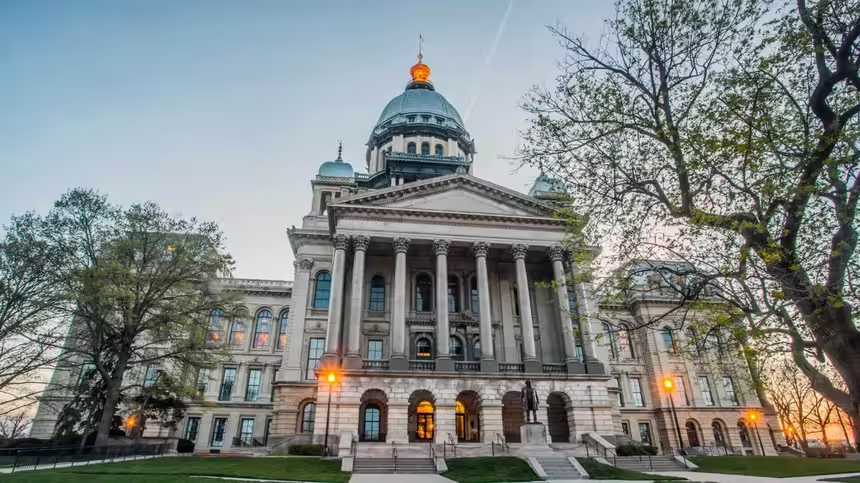
CapitolView
CapitolView is a weekly discussion of politics and government inside the Capitol, and around the state, with the Statehouse press corps. CapitolView is a production of WSIU Public Broadcasting.Providing Support for PBS.org
Learn Moreabout PBS online sponsorship(bright music) (exciting music) - Thanks for joining us on "Capitol View".
I'm Fred Martino.
It's our final show before next Tuesday's election, and coming up, we're gonna look at some races in the state legislature, but first, everyone is talking about the presidential race, and the youth vote will be critical.
That's why we spent some time at Southern Illinois University Carbondale to talk with students about their choice in the presidential election.
We spoke with several SIU students, and one student from the University of Illinois.
And we heard a diverse set of opinions.
It did not take long to find a supporter of former president, Donald Trump.
And we talk with an undecided voter, as well.
But more young people we spoke with are supporting Vice President Harris.
- So this year, I'll be voting for Harris.
This is my first presidential election, and I'm really excited.
- [Interviewer] Okay, and why are you voting for Vice President Harris?
- So I'm voting for Vice President Harris because from what I've seen, and the research that I've done, she seems to have a more sustainable plan for my generation, and seems to be more focused on actually bringing in change to the government and to the policies and procedures that are done, rather than focusing more on running the country like a business, and focusing on profits, and what we can do better, how to make more money instead of focusing on the actual good of the American people.
- My choice is going to be Donald Trump.
- [Interviewer] Okay, and why is that?
- I think that Donald Trump brings more to the table.
His last current in office, he did much better than Harris was even doing.
- So there's clearly only one choice, 'cause I'm not a fascist.
I prefer Harris over Trump for sure.
I'm not super happy with her, it's just 'cause of a few of her different viewpoints via transgender rights, there's also the Gaza situation as well, there's some issues with that.
But besides that, I would rather go with that and improve from that than just go with Trump, because there's nothing really there.
There's no good policy along those lines, and frankly, there's not actually integrity there either, so that's kind of where I'm at right now.
- I'm gonna vote for Kamala Harris.
It's not necessarily a hatred towards Trump by any means, and naturally, I think policy's an important thing to look at rather than just the nostalgia we see online, and the yelling back and forth from either side.
But you know, I think there is a clear change.
I was first old enough to vote for Obama's second term, which I did, and I think when he left office, there was a certain new level of unity.
We were over the many phobias, not just in a more unified, although there's still plenty of work to go, or accomplish, but there's a big accomplishment over closer unification and race, over a lot of the phobias with homosexual, gender fluidity, whatever it may be.
I'm not advocating one way or another, but it seemed more unified as a country overall, and then I think although Trump implemented some economic policies that clearly benefited the country, that unification seemed to have broke, and something, I think a lot of the work that the Obama administration had put in place, I don't know, I think it's a matter of do we want to unify it as a country, or is it just getting the best bang for your buck and maximizing the dollar?
I don't necessarily think that's always the right way to go.
We'll always figure it out as a country, as we always have, but that's my strong opinion.
I think the unification needs to be strengthened, and we need to come back a little bit more together as a country in that fashion, if that makes sense.
- Well, I personally feel like Kamala Harris has some great facts, and she is pointing out a lot, and in the past, I had disagreed with a lot of things that Trump had said, but within time, and history, I had shaped my thoughts in agreeing with a lot of things Trump has done for America.
But that doesn't mean that Kamala Harris doesn't intend to make America great again.
- [Interviewer] So you're thinking you're gonna vote for Vice President Harris?
- I think I am going to.
There are a lot of things that she says, and with me being a part of the LGBTQ, I feel like she would make it a lot better for America, and a lot safer for me.
- I'm gonna vote for Kamala, because we need a woman.
Like, this world has been ran by men for years and years and years, like can we get a woman up in here?
Let's just, I feel like she'll make the world a better place.
- I am voting for Kamala Harris, and why am I voting for Kamala Harris, because like she said, we need to go forward, and we do not need to regress America.
- So I'll be honest.
I'm undecided.
I do still plan on voting, but there's a lot of conflicting information out there.
Me personally, I don't identify with an individual party, so that is very hard to navigate in finding a third party, so I'm just looking to do a little bit more research before I vote to find the best candidate.
But as of right now, I don't know.
- Make sure to vote.
In Illinois, you can even register in person on election day, and starting Tuesday night at five, join WSIU TV for nonstop election coverage from PBS News.
There are also closely watched races in the Illinois General Assembly.
More on that and other stories in the state this week, with Jeremy Gorner of the Chicago Tribune, and Charlie Wheeler, Emeritus Director of the Public Affairs Reporting Program at the University of Illinois Springfield.
Jeremy, you reported recently that the state GOP leader is trying to sell hope in the uphill battle to cut into the Democratic stranglehold in Illinois.
Tell us more.
- Yeah, Fred.
So House GOP leader Tony McCombie, I think, has accepted the fact that they're just significantly, well, out-funded compared to the Democrats in the legislature, their campaign arm.
And she's kinda looking ahead to the 2030 census, when they'll have another redistricting opportunity.
Republicans have often accused Democrats, who are in the legislative super majority, of gerrymandering the legislative districts following the 2020 census, which they believe has significantly contributed to the vast super majorities that the Democrats have in the legislature.
So she has her sights on trying to maybe try to regain seats a little bit at a time, couple here, you know, couple here in one election, couple there in future elections.
That's kind of what she's trying to do.
The problem is they are just outmatched in terms of funding.
I mean, for example, the state Democratic party and the Illinois House Democrats campaign arm, they reported maybe $5.5 million that they had left in their campaign coffers through September.
This was after spending about $7.7 million last quarter.
You look at the state Republican party and the House Republicans campaign group, they only had a little over $1 million on hand, and this was after spending maybe $3.35 million last quarter.
And I'm not even counting, in terms of the financial disadvantage that Republicans have, I'm not even counting what House Speaker Chris Welch and Senate President Don Harmon have for their campaign funds.
It's just, it's big mismatch there, obviously.
That being said, Democrats obviously control the state.
This is a decidedly blue state.
And I spoke with one political observer who also said that one thing Republicans are gonna also have to compete with and to the extent that there are swing districts, in Tuesday's election, in some of these legislative districts, it's gonna be interesting to see what kind of impact Donald Trump's presence will have down ballot.
Somebody I talked to suggested that there could be a little bit of a guilt by association possibility that Republicans running for these legislative seats will have to compete with Trump at the top of the ballot, because Trump is not popular in Illinois.
He's lost the last two presidential elections, 2016 and 2020 each by 17 points.
And it doesn't look like that needle is improving one way or the other for Trump as he's running for another term here.
So basically to the initial question about what Republicans are trying to do, they're trying to gain seats little bit little if they can, and see if the odds will be in their favor come 2030, when there's another redistricting opportunity.
- Yeah.
We'll have to be watching for sure.
And now briefly, Charlie, you have more from a Chicago Sun Times article, it says that there are some Illinois house races to watch where suburban challengers could affect the Springfield power balance.
Tell us more.
- Yeah, I would criticize, maybe that's too strong a word, but I would take issue with the notion that this could affect the power balance.
No way.
The Democrats are gonna come out with a super majority.
And back in the day, people blamed Mike Madigan 'cause he gerrymandered the map.
Well the most recent map, Madigan did not gerrymander it.
It was gerrymandered by the Dems, and before that map, in the house, the Dems had a 73 to 45 advantage.
Under the new map, there's now 78 to 40.
And odds are that the Republicans are gonna actually lose seats.
One of the seats that was discussed in the Sun Times article, and one that I think is probably the most likely to swing, one of the two I think most likely, is in the 52nd district where Marty McLaughlin from Barrington Hills is being challenged by Maria Pearson from North Barrington.
And in that district, the Democrats dominated, well, dominated is too strong.
But every statewide Democrat won the district two years ago.
And McLaughlin won by less than five points against an opponent who didn't have very much support from the Democratic Party.
And so the odds are very strong, I think, that Peterson, who's a very hard worker, is gonna win this time around.
One of the districts that I think is gonna be in play that was not included in the Sun Times article is the 47th House District where representative Amy Grant of Waukegan, or I'm sorry, Wheaton, is being challenged by Jackie Williamson, who is also of Wheaton.
And in this district, the fact that Grant has been supported by the pro-life groups, and Williamson is a very ardent reproductive rights backer, I think that'll have a significant impact on that race.
One of the things to remember is that the demographics of the suburbs have changed dramatically in the years that I have been watching.
Part of it is the fact that some once lily white solidly Republican districts in the south suburbs are now majority minority, solidly Democratic.
On the west side, the black community has moved westward, and so areas that once were solid, Cicero township, for example, solid Republican, now it's solid Democrat.
And you also have the Latinos moving into the suburbs so that cities like Aurora and Elgin have very significant Hispanic populations, which tend to vote Democratic.
- It's a fascinating thing, isn't it?
- Let me add one more thing- - It is a national issue.
You know, I grew up in the Philadelphia area, and we heard this week how former president Donald Trump was visiting Allentown for a rally, and Allentown is a majority Latino city now, so- - Yeah, and one of the things that, let me add another thing about the suburban vote.
The fact that the Dobbs decision came down and suddenly reproductive rights are a major issue among suburban women, I think that has really contributed to the Democrat surge in the suburbs, and as Jeremy noted, the fact that Donald Trump is, for want of a better term, he is considered quite despicable by a lot of suburban women, that's not gonna help down ballot Republicans in these races.
- Yeah, and we'll talk more about the effect of reproductive rights in the races coming up.
Jeremy, another election story now.
Capitol News Illinois ran a report from a partner that noted non-citizen healthcare programs, like the one in Illinois, are drawing presidential campaign attention.
Tell us more.
- So a couple years ago during the pandemic, at least just talking about Illinois, the state launched a program that provided publicly subsidized healthcare for older immigrants who were in the country without authorization, and there's been certain, there was an expansion of that program, there's been at least one expansion of that program since this went into effect in 2020, or when it passed in 2020.
And the issue, and it became starting as a campaign issue, or really for Governor Pritzker, not so much a campaign issue but a policy issue after he was elected, where there were projections that this would cost, put like a $1 billion budget hole for the state.
Ended up costing the state last year, I believe it was half a billion dollars, which for this current budget, it's costed around the same thing.
This does not include the money that the state has been providing for migrants.
This is totally separate.
But what we've seen is that you have states like California, Minnesota, and others, who have implemented similar programs for older immigrants, who are in the country without authorization, and because of this trend, what we're seeing, as you mentioned, Fred, it has become a national campaign issue.
It's something that Trump has capitalized, and representation have capitalized on, because it's obviously a program that is too costly, and Trump, to begin with, has taken a very aggressive stance on immigration, and he's using, and Republicans, among other things on Kamala Harris, have used this issue as just another point about why they feel that her immigration policies are weak.
I know that in the state of Illinois, this program, though, for older immigrants, was capped.
I believe there were, Governor Pritzker closed enrollment earlier this year because it was becoming too costly, and because he could foresee that in the coming months, it was gonna be too costly, which the fear was that thousands of people who would normally be recipients on this program would not be able to take advantage of it.
I believe it was about 6,000, I think is what the number was.
So the point is is that this is a program in Illinois that has cost, in the last couple of years, each year, it's cost in the neighborhood of half a billion dollars.
- Yeah.
- And we've seen- - Some would argue- - Yeah.
- Under-reported, even if it does not have an effect on our election.
Worth talking about this week, because this is being used politically elsewhere, where it may have an issue.
So it may have an effect, rather.
So speaking of healthcare, Jeremy, and I do wanna return to reproductive rights and that issue with Charlie.
Capitol News Illinois had another interesting report from a partner this week.
This story is about an Indiana woman who sought healthcare in Illinois due to abortion restrictions in her state.
Tell us about that, Charlie.
- All right.
Well, this is the case of a 33-year-old woman and her husband who are the parents of two young boys, and they decided to continue their family.
And she was pregnant, and everything was going fine.
They went in for an ultrasound, and they found out that the spine of the fetus was, I guess deformed is the right word.
There was a hole in the spine, and a lemon-shaped head, as it was described in the story, that was the indicator of a more severe form of what the term they used was a neuro tube defect.
- And bottom line, Charlie, was she- - Now let me- - Could not get healthcare in Illinois, or in Indiana, so she had to come to Illinois to get healthcare, right?
- Right.
Indiana has a near total abortion ban with limited exceptions for life of the mother, rape, and incest, and fatal fetal anomalies.
Well the doctor said, "Well, what your fetus has is this abnormality," but there was so much red tape to get permission to do it in Indiana that she came to Illinois, she came to Champagne and had it done.
And she, in the story, she talked about her frustration, saying, and this is her quote, there were, quote, "A lot of white men in my uterus right now making decisions."
And so she went to Illinois to a clinic in Champagne, had the procedure, and she says she's not sorry about it.
It was the right thing to do.
And she's- - Charlie, I want, go ahead.
- And she's hoping that by telling her story, she'll make it more aware, people more aware, of what the horrible implications of this are for women who are in a position that she and her husband found themselves in.
- And Charlie, just to wrap up, 'cause I wanna get to one more story with Jeremy, you think these stories that we're hearing all over the country, where there may be votes not only for the presidential race, where reproductive rights is on the ballot, but actual state laws around the country on reproductive rights.
Do you think this will be a fundamental factor in the Tuesday election?
- Oh, I think so.
As I indicated earlier, certainly in our House races.
- Yeah.
- And in other suburban areas, and one of the things that I'm looking forward to see is when the votes are finally all tallied, to see if the states in which there are abortion rights measures on the ballot, if those measures receive more favorable votes than any of the candidates for any other office.
- Okay.
Very interesting.
We have about four minutes left, Jeremy, for a story I wanted to get to, was part of your reporting for the Chicago Tribune, and a follow-up for us here at Capitol View.
You recently wrote about a Kankakee County board share who stepped down from his position after taking a job with a firm building an electric vehicle battery plant.
Tell us more.
- Right, so last year, the Pritzker administration celebrated moving the Chinese owned electric battery vehicle manufacturer, Gotion, to the city of Manteno, which is in Kankakee County.
As part of the package given to Gotion, Governor Pritzker said that they would be getting about a half billion dollars in tax incentives, and there could be more potentially from the federal government.
And as a result, though, there was some backlash from residents and a community group, and Republicans in the area, saying that among other things, they were concerned about, they were raising fears about Communist infiltration when it was discovered that the parent company of Gotion basically in their bylaws said that, had made some reference to falling under the Chinese Communist Party.
So there's a lot of fears that were being stoked by far right Republicans about Communist infiltration coming to Manteno.
And so some Republicans have made this a national issue, because there's a similar plant that is gonna be built, slated to be built, in Michigan.
Now at the same time, the Kankakee County board approved itself of being one of the 10 taxing bodies for the Gotion site in Manteno, which is a former K-Mart factory, and basically as part of this deal, property taxes on this new Gotion site would be kept at $2 million a year for 30 years.
So fast forward about a year later, Andrew Wheeler, who is the chairman of the Kankakee County board and participated in approving Kankakee County as a taxing body, takes a job with Gotion.
So the issue was is that he didn't want to step down as board chair while still working at Gotion, but he wasn't attending to Kankakee County for business, so he basically resigned last week.
But separate from that, I had asked another county official about the optics, really, of him taking a job at Gotion when his board participated in giving them, and bringing them to Manteno, and I was told it was not a quid pro quo, despite of what the appearance may look like, but nonetheless what you have here is a former board chairman that participated in bringing Gotion to Manteno now takes a job with the company.
So that's basically where- - Well, and it may raise awareness, Jeremy, that there was no waiting period for someone to take a job after voting on an incentive for that future employer.
We know that in states around the country, state legislators often do have waiting periods, so fascinating important reporting, and thank you for bringing it to us.
Something to be aware of, and an enormous project there as you pointed out, about a half a billion dollars in state incentives over many years for that EV battery plant.
Jeremy, Charlie, thank you both for being with us.
- You're welcome.
It was a pleasure to be here.
- Pleasure to be here, Fred.
Thanks.
- Good luck on election day.
That is it for us.
Make sure to vote if you haven't done so already.
For everyone at WSIU, I'm Fred Martino.
Have a great week.
(exciting music) (exciting music continues) (exciting music continues)

- News and Public Affairs

Top journalists deliver compelling original analysis of the hour's headlines.

- News and Public Affairs

FRONTLINE is investigative journalism that questions, explains and changes our world.












Support for PBS provided by:
CapitolView is a local public television program presented by WSIU
CapitolView is a production of WSIU Public Broadcasting.