
Capitol View - October 7, 2022
10/7/2022 | 26m 46sVideo has Closed Captions
Issues leading into the November Election.
With early voting underway, candidates up and down the Illinois ballot are working to make sure voters actually cast a ballot. Panelists Charlie Wheeler and Alex Degman talk with Jennifer Fuller about how the campaigns are evolving, with just weeks to go before Election Day.
Problems playing video? | Closed Captioning Feedback
Problems playing video? | Closed Captioning Feedback
CapitolView is a local public television program presented by WSIU
CapitolView is a production of WSIU Public Broadcasting.
Capitol View - October 7, 2022
10/7/2022 | 26m 46sVideo has Closed Captions
With early voting underway, candidates up and down the Illinois ballot are working to make sure voters actually cast a ballot. Panelists Charlie Wheeler and Alex Degman talk with Jennifer Fuller about how the campaigns are evolving, with just weeks to go before Election Day.
Problems playing video? | Closed Captioning Feedback
How to Watch CapitolView
CapitolView is available to stream on pbs.org and the free PBS App, available on iPhone, Apple TV, Android TV, Android smartphones, Amazon Fire TV, Amazon Fire Tablet, Roku, Samsung Smart TV, and Vizio.
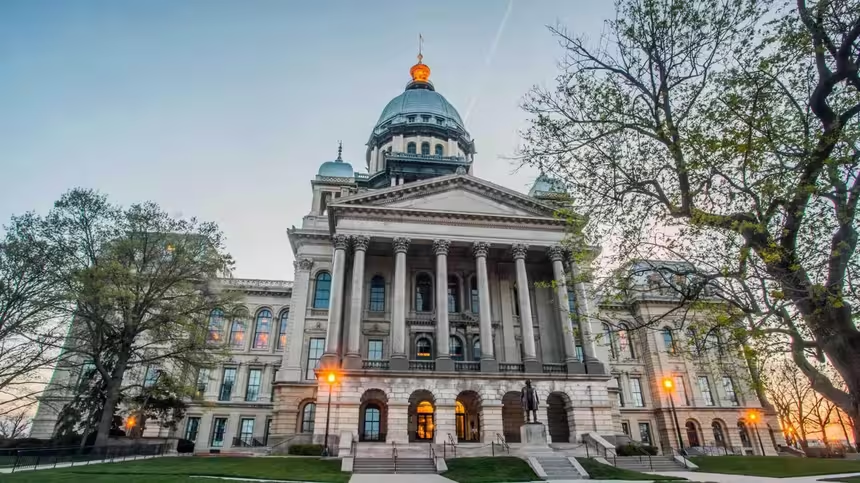
CapitolView
CapitolView is a weekly discussion of politics and government inside the Capitol, and around the state, with the Statehouse press corps. CapitolView is a production of WSIU Public Broadcasting.Providing Support for PBS.org
Learn Moreabout PBS online sponsorship(upbeat music) - Welcome to "Capital View", our weekly look at the happenings inside and outside the Illinois State Capital.
I'm Jennifer Fuller.
Our guests this week are Alex Degman of Illinois Public Radio and Charlie Wheeler, the Emeritus Director of the University of Illinois, Springfield Public Affairs Reporting Program.
Gentlemen, thanks for joining us.
- It's always a pleasure to be with you guys.
- And we should mention to folks that are watching as we air this, so we're actually taping before the gubernatorial debate between JB Pritzker and Darren Bailey.
We'll have a complete rehash of what was said, not said, and all the other parts coming up next week on "Capital View".
So let's get to some things that have been going on this week.
We are now just a few weeks from the November 8th election.
Years ago, we would be talking about candidates winning over or working to win over those undecided voters or making sure that people who ordinarily wouldn't vote in a midterm election would actually get to the polls this year.
Charlie, how has that changed over the years?
Do you think that there's a large group of undecided voters at this point?
- I would guess probably not and part of it is with the advent particularly of the internet and the ubiquitousness of Facebook and Twitter, information is getting out a lot more quickly than it would back in the day when I was an active reporter in the Dark Era before the internet was invented by Al Gore.
And so people know who these folks are, they form their opinions, there's been a ton of money spent by Governor Pritzker in burnishing his credentials, his record, and in defining Darren Bailey as the guy who is really very conservative.
And as a matter of fact, the most recent polling has Pritzker winning.
There's an outfit called 538, run by a guy named Nate Silver and it's an a analytics analysis place and it handles polls.
It started out doing baseball stats, which is where I first came across it, but they aggregate polls and they have a, I don't know how it works, but last week they ran like 40,000 simulations of the gubernatorial vote in Illinois, and they found that the chances of Darren Bailey being elected were less than one in a 100, which is pretty low.
And so I would guess that it's more likely that the White Sox are gonna hire me to succeed Tony La Russa than it is that Illinois voters are going to choose Darren Bailey to replace Governor Pritzker.
By the same token, Tammy Burke, Tammy Duckworth, the US Senator also has more than 99 to 1% chance of beating her Republican candidate who's opposing her for the election.
- Alex, if the top races the race for Governor, the race for US Senate are, for all intents and purposes, decided if the polling is to be believed.
What races are you watching?
There is of course, the open seat in the Secretary of State's race and a few others that I know people have kind of a close watch on, what are you watching?
- Well, Charlie mentioned the US Senate race between Tammy Duckworth and Kathy Salvi and I think that that is a, it's as he said, it's a pretty foregone conclusion that Tammy Duckworth is gonna win this race.
But I think it's really interesting to watch for if no other reason, then it's just interesting to see that this is kind of how elections have been going.
These are the kind of races that we've been seeing kind of up and down the ticket.
We're seeing it to, I would say a little bit of a lesser extent with JB Pritzker and Darren Bailey, but it's the same kind of thing.
You have an incumbent and then you have a challenger who by all intents and purposes 10 years ago, probably would not be in the position that they are now.
So even though it's a pretty I would say it's maybe foregone conclusion isn't the right word to use, but we probably know how the US Senate race is gonna shake out and it's interesting to watch.
And then there's also a couple of congressional races in Illinois.
We're seeing some tight races in the northwest part of the state in the quad cities and believe it or not, there are national ramifications for that election.
The balance of power in Congress is not decided so that'll be really interesting to watch.
- Certainly, Charlie, what might.
- And I would add to that too besides the race up there in the 17th district to replace the retiring Cheri Bustos there's one here in Central Illinois, a kind of a strange snake-like district that goes from Champagne all the way down to the St. Louis western suburbs, where there is no incumbent.
It's the 13th district under the old map, it was represented by Rodney Davis and of course, he lost a primary bill to Mary Miller in a newly created I believe it's the 12th district, but in the current 13th, it's Nicky Budinski, who is a former Democratic staffer running against Reagan Deering.
And the most recent polls had Budzinski up by three points, but there was still roughly 25% of the electorate at this time and this was done the last week of September that were undecided, so that's when to keep an eye on too.
- Charlie, certainly parties don't want any sort of surprise come November, but do you think there's any room here in any of the races for a surprise, a candidate to come in at the last moment and really surge?
- I would say, oh, sure.
There will certainly be some surprises.
I can't think of any election and I've been watching this stuff for more than 50 years where there was not at least one surprise.
And a lot of it will depend on how effective the candidates are at getting their voters to the polls.
Now, one of the differences these days of course, is that you have early voting.
As a matter of fact, I've got my ballot sitting in my family room for me to fill out and mail back.
There's already been according to like the state board of elections if I recall, like something like 1% of the mail and ballots that were requested and received have already been returned.
So there's gonna be a lot of people who will vote beforehand, but I think the ground game, the ability for the organizations is to identify their voters, make sure they get to the polls, that's gonna determine some of the races for the legislature and maybe some county offices, things like that where there may be some chance of a surprise, someone who is in a district you think should go democrat will lose to a Republican and vice versa.
I remember back in my days there were racists in a district that was drawn to definitely favor one candidate over the other.
And the favored candidate was someone who was not really into the retail campaigning, didn't go out, didn't knock on doors, didn't meet voters, didn't press the flesh and wound up losing.
I remember one time I had the guy who was running house elections for Mike Madigan tell me about a candidate in a district heavily Democrat, he says, well, he's gonna lose.
I said, "how's he gonna lose?"
He said, "he's lazy, he doesn't get out there and the Republican has really worked his tail off."
Sure enough, that was the outcome of it.
So yeah, there will be surprises, but you know I can't say which ones they'll be.
- Sure, you know, it all comes down to turn out, another thing that it all comes down to is money.
And as we continue to see the reports coming in leading up to the November 8th election, it's becoming abundantly clear that the Republican candidate for governor Darren Bailey will not be able to match JB Pritzker's money, that's been said all along.
Alex, is there any room do you think in Illinois for a grassroots out funded campaign to be successful anymore?
- Boy, it's getting really difficult.
And it doesn't seem like it's been this way for all that long, we've only been seeing the really, really well funded candidates come in over the past decade or so.
But now that they're here, now that well, Bruce Rounder obviously in 2014, and then JB Pritzker and Bruce Rounder went head to head in 2018, especially in this cycle I just don't think that there's a lot of room for these, you know, $25, $50, $100 donations like there used to be.
I hate to sound cynical, but it just doesn't seem likely given the fact that we have basically a billionaire candidate who's self-funding his campaign.
There's no way that average people can compete with that.
- Charlie.
- I would say that's not only the governor being able to give money to himself, if I'm not mistaken in the month of September, Darren and Bailey raised less than a million dollars.
Governor Pritzker gave himself 20 million in the month of September and he also bowled out something like $10 million to other Democratic candidates up and down the ticket.
I believe he gave money to every Democratic County organization, to every other candidate running for statewide office.
And when you have the amount of money that Governor Pritzker does, giving somebody a million dollars would be like me, donating $10 to Goodwill.
- So if the polls are to be believed and you know, a lot of these races are in many cases already decided.
We're seeing a lot of the campaigning turning from, deciding which candidate to vote for to the candidates talking about the ultra negatives of their opponent and the reasons that you could never vote for that person.
Alex, I'll start with you.
How does this affect their effectiveness as lawmakers and policymakers going forward in terms of being able to reach across the aisle or have those positives in the minds of the voters?
- Well, negative campaigning is nothing new.
We've seen negative campaigning as long as politics have been around and historically anyway, we have seen pretty nasty campaigns yet, they generally have been able to come together especially after maybe a bruising primary and get things done and put that aside because generally politicians know that that's part of politics in order to win, in order to win the election you have to do what you need to do.
And in a lot of cases especially lately, we've seen that the most effective way to do that is to go negative, but that's part of politics.
And as far as being able to come together, reach across the aisle after that, I would certainly hope so.
I think that's gonna happen this time around because if it doesn't it would be a first if we literally well, and then I say that yet, I say that yet I remember the era that we had in 2014, 2015, 20 6, all of the non, all of the no budget years.
So it is possible that we won't work together.
It is possible that politicians don't work together, but I would say it's rare.
Charlie, would you say it's fair to say that that's rare?
- Yeah, I would say one big difference is as things stand now, the Democrats are gonna control all those statewide elected offices.
I would guess the one who's the open Secretary of State is the one that's maybe most in play where Democrat Alexi Giannoullias is running against Republican Dan Brady.
But even if Brady wins, the Secretary of State really doesn't have much influence on the day to day operations of law making.
And if you look at the general assembly, we're gonna have a Democratic governor whereas back in rounder years, we obviously had a Republican governor who would not work with the Democrat legislature or you could reverse it and say, well, the Democrat legislature wouldn't do what Governor Rauner wanted her to do, but the Democrats are gonna control the General Assembly.
As a matter of fact, they can even lose some seats and still have a super majority.
And so what that means is that the Republicans are basically irrelevant and to the extent that the Republicans have anything to do with legislation, they can either decide to be opponents, which they were on a lot of the initiatives that Democrats have, or they could decide to work with them on certain issues and try and be cooperative.
But as far as them being able to have an influence in changing the overall direction no, it's not possible.
I mean, the Democrats have 41 members of the Senate, they could lose five of those be down 36 and they still have a three six majority that allow them to do anything.
In the house, they have 73, they can lose two and still have their three fifths.
So you can be really nasty, but in the lead up to the general election all the vitro and all the dirty campaigning and the garbage and the attacks, it's all directed at the person across the aisle and after the dust settles and we move into January, were in new General Assembly, the people who you were attacking aren't gonna be there because you will have won and they're not gonna, they will not have won.
So I think it's bad in that it gives people a bad taste for government and for politics and for getting involved and in determining public policy.
But in terms of the practical operation of the General Assembly, I don't think it's gonna have much effect.
- Sure.
Speaking of policy, let's move into that because one of the issues that continues to garner headlines and one of the things that it appears lawmakers will be talking about in their veto session after the election in November and early December, is the Safety Act and criminal justice reform.
And Charlie, we've seen legislation file that would amend the Safety Act and add some changes, this is not unexpected, but we are starting to see Governor Pritzker and other Democratic leaders saying, Yes, we're going to consider some changes.
What, if anything do you see happening in the veto session versus waiting until the lame duck session in January or even into the next General Assembly?
- Well, to be honest, I don't know what all changes.
I know that the Republicans, Darren Bailey for example, the gubernatorial candidates says, well, we should scrap the whole thing and start from scratch, that's not gonna happen.
There is concern voiced by Republicans and I think by something like a hundred of the 102 county states attorneys that come January 1st, we'll have to let everybody go that we have in jail, that's not accurate, that's an exaggeration.
I think there'll be some adjustments made clarifying exactly what are the grounds on which someone can be held?
There's some vagueness, there's a Supreme Court initiative going on now trying to develop implementation rules and I believe there are half a dozen or so counties that are experimenting under pilot programs that the General Assembly funded with doing away with cash bail.
One of the arguments that raise, that's been raised that I think is maybe more revealing than its proponents would admit is the state's attorneys are saying, it would be impossible for us to be able to go through these hearings and determine that Charlie Wheeler is really a danger, that he's gonna flee or that he's gonna harm someone else?
It's a lot easier for us to just throw Charlie Wheeler in jail and say, okay, here's your bond, it's a hundred thousand dollars.
If you got 10,000 cash you can walk if not, you're gonna sit here for maybe a year or more.
And what that suggests to me is that the state's attorneys are admitting that they really aren't doing a good job in that.
In theory, the Constitution says you're innocent until proven guilty, but the argument of some of these state's attorneys seems to be, well, you wouldn't have been arrested unless you were guilty in the first place.
The Springfield police wouldn't have arrested Wheeler unless he was guilty so why should he go free and what the Safety Act says, if it can be established either that wheeler is a danger or that he's gonna skip town, then he should be allowed to go free.
The impact being as I think was Governor Pritzker said, the pretrial fairness portion of the Safety Act, has a quote from him, creates a system where detention is based on risk resident poverty.
That's why domestic violence groups and other victims' rights groups support it.
Public safety is best addressed by focusing on risk community not on who can't afford to pay their way out of jail.
So that's kind as I say, there will be tweaks, we'll adjustments made, but in terms of some wholesale revamp or repeal, that's not gonna happen.
And it'll probably happen in the veto session, which starts the first week before Thanksgiving.
And to the extent it doesn't get done in the veto session, it'll be done right after the first of the year.
And the reason I say that is because if some of the changes are contentious and some of the Democratic caucuses don't wanna support them and they don't get the three fifths then after the first of the year they can support changes that would become effective immediately with a simple majority.
So that gives in the Senate, it gives them an 11 vote surplus if you will and in the house they have 13 extra votes.
So something will change, I'm not sure what it will be.
It won't be as dramatic as the opponents want.
You know, the governor also pointed out that there's money in the budget to help local governments pay for the implementation.
I think he said there was something like 26 million additional dollars in there for these pretrial services.
So the fact that the local government started saying, Oh, this is gonna bankrupt us, we're gonna have to raise property taxes, I think that's kind of bogus.
- Alex, I wanted to ask you as you're covering the legislature as it's in and as it's not, does it seem that there's a consensus at this point about some of the modifications that need to be made?
Does it look like this will move easily or is this going to be highly contentious for the foreseeable future?
- Well, it looks like there at least are some concrete ideas on paper.
There have been some bill sub flying around it.
As far as I know Governor Pritzker, when asked about it, I'm talking specifically about State Senator Scott Bennett's proposal that would as Charlie was talking about, clarify some things and make sure that there are certain things that are better understood than they are now.
But I think that as far as consensus is concerned, I think we'll have to see because I myself, through the people that I've talked to haven't heard whether there's any kind of favorability for it yet, it's just under review.
But it seems like at least what I've been hearing for the past few weeks is that the bottom line is that Democrats seem willing to tweak this, they seem willing to compromise and not repeal it entirely obviously, but they're willing to do some work to it because it seems clear to me at least that they understand that there are some legitimate questions.
It's not just, it's not all Republicans trying to scare people as they say.
There were some legitimate concerns with this and I think that they realize that and there there's at least consensus among that.
- Charlie, just a few.
- And I would say that the fact there will be tweaks made is not surprising, I don't have an accurate count, but every legislative session there are I don't know, seven, 8,000 bills, maybe more than that introduced.
The vast, vast majority of them don't create new laws.
The vast majority of them are changes in existing law, tweaks to modify what's now in the statute books to reflect what the current necessity is.
We passed this a couple years ago, it's really not worth it, so we gotta adjust this, that's what most of the General Assembly does.
So I don't think the fact that it's gonna be changes made to the so-called Safety Act is anything to be surprised by.
- Charlie, just a few minutes that we have remaining in the program, the Commission on Government forecasting and accountability is out with its first quarter of the fiscal year analysis as the first quarter would've ended September 30th.
And it was a bit of a good news, bad news situation.
They're saying look, revenues are up, this is good, but as we look at inflation and some of the other pressures on the economy, there is definitely room for the bottom to fall out and some of the tax revenues that are expected for the state over the rest of the fiscal year.
What's your rate of this analysis?
Do you think that lawmakers are gonna need to make changes to the budget or tweak things as they go?
- I would think they're not going to have to make any changes.
I think the temptation will be to spend the additional revenue that appears to be there and what the commission reported is that through the first quarter from July, 1st, through the end of September, base receipts and I'm gonna be rereading this so I don't mess up the numbers.
Base receipts are up 260 million despite the fact that base federal sources are 515 million behind last year's pace.
Once you add 764,000,001 one time APA Federal Aid reimbursements, the overall gain in state general funds revenues through September was more than a billion dollars.
And the inclusion of this billion dollars or this additional APA money, the 764 million was not originally anticipated for FY 23, therefore it was not accounted for when they adopted the FY 23 budget.
So in that sense, it's like found money, income tax, personal income tax receipts are up 347 million.
Net corporate are up 201 million net.
Sales tax are 130 million above last year at this time.
But as I say, you have this chunk of money that you weren't anticipating and so what do you do with it?
What I would hope the legislature does not do with it is decide to go ahead and doll it all out, start new programs, but rather perhaps use some of it for the unemployment trust fund, put some of it additional money into the pensions.
And as a cautionary note the "Kaiser Report" says, it's believed the current high rates of inflation, unstable market conditions, geopolitical uncertainties, the assumed absence of additional federal stimulus dollars will create an environment or a slow down in Illinois revenues is inevitable.
It's not yet happened for FY 23, but three quarters of the fiscal year still remain with plenty of time for things to turn around.
- Certainly.
Charlie, I'm gonna have to, I'm gonna have to wrap you up there, but yeah, as as we said, certainly something we'll want to keep an eye on and we will do that here on "Capital View".
Charlie Wheeler, Alex Degman, thank you so much for your time this week.
- Thank you.
- My pleasure.
- And thank you for joining us on "Capital View".
You can find our episodes online at WSIu.org and at our YouTube channel.
I'm Jennifer Fuller, we'll catch you next time.
(upbeat music)

- News and Public Affairs

Top journalists deliver compelling original analysis of the hour's headlines.

- News and Public Affairs

FRONTLINE is investigative journalism that questions, explains and changes our world.












Support for PBS provided by:
CapitolView is a local public television program presented by WSIU
CapitolView is a production of WSIU Public Broadcasting.