
Capitol View - September 12, 2024
9/12/2024 | 26m 46sVideo has Closed Captions
Capitol View - September 12, 2024
Analysis of the week’s top stories with Kent Redfield, emeritus political science professor at the University of Illinois Springfield and Jeremy Gorner of the Chicago Tribune.
Problems playing video? | Closed Captioning Feedback
Problems playing video? | Closed Captioning Feedback
CapitolView is a local public television program presented by WSIU
CapitolView is a production of WSIU Public Broadcasting.
Capitol View - September 12, 2024
9/12/2024 | 26m 46sVideo has Closed Captions
Analysis of the week’s top stories with Kent Redfield, emeritus political science professor at the University of Illinois Springfield and Jeremy Gorner of the Chicago Tribune.
Problems playing video? | Closed Captioning Feedback
How to Watch CapitolView
CapitolView is available to stream on pbs.org and the free PBS App, available on iPhone, Apple TV, Android TV, Android smartphones, Amazon Fire TV, Amazon Fire Tablet, Roku, Samsung Smart TV, and Vizio.
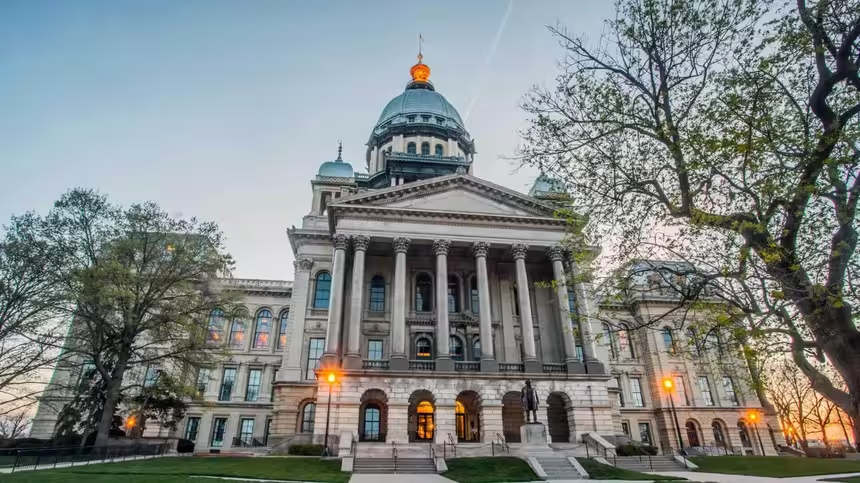
CapitolView
CapitolView is a weekly discussion of politics and government inside the Capitol, and around the state, with the Statehouse press corps. CapitolView is a production of WSIU Public Broadcasting.Providing Support for PBS.org
Learn Moreabout PBS online sponsorship(bright music) (dramatic music) - Thanks for joining us on "CapitolView."
I'm Fred Martino.
This week, reaction as Vice President Kamala Harris and former President Donald Trump debate ahead of the November election, plus veteran political columnist Rich Miller covered two election-related questions, Illinois Governor J.B. Pritzker's possible future, and the governor's use of freedom as a way to position important issues.
We're gonna talk about Miller's columns, the debate, and much more with Jason Piscia.
He is director of the Public Affairs Reporting program at the University of Illinois Springfield, and emeritus director of that program, Charlie Wheeler, is with us as well.
Jason, first up, your reaction to this week's debate.
- Yeah, I had the pleasure of actually watching the debate alongside about 50-some other students here at UIS.
We had a little debate watch party on Tuesday night, so it was fun to eat some pizza and cupcakes and watch it all happen.
I think, you know, I think a lot of people came into this debate wanting to hear more from Kamala Harris on where she stands on issues, just because we haven't had the opportunity to do that, given the very condensed time that the campaign has come together for her, and I think there's also always lots of interest to see how much that former President Trump can sort of stay on task, and keep it together, and kind of talk about the issues, and maybe not delve so hard into personal attacks.
I think we saw a lot of that.
I think we heard, you know, some good issue stuff from Harris.
Obviously, she did a good job of baiting former President Trump to, you know, sort of trolling him on his convictions, and his bankruptcies, and how he lost the election, and was fired by 81 million people.
That sort of got his hackles up, and got him defending himself, and sort of played into her plan to get him off track.
At the group that I was at, you know, in, they sort of, the students reacted more, most loudly to, you know, when Trump made, you know, outrageous claims, such as migrants eating dogs in Springfield, Ohio, and other things that, you know, were obviously unbelievable, and you'd never think they would come up for a debate.
But I think this, you know, we always say that debates are for the undecided voters.
I guess it will remain to be seen how many undecided voters were swayed one way, or the other.
You know, we know one undecided voter, Taylor Swift, made a big announcement on Tuesday night on how she felt about the election.
So we'll see where it goes from there.
- And Kamala Harris has gotten generally very good reviews for her performance, not so much with former President Donald Trump, not very good reviews, and certainly, the Harris campaign must feel that she did well.
They have offered another debate to the Trump campaign, and as we tape this on Wednesday, they have not accepted that invitation.
Charlie, I'd like to get your thoughts on this debate.
I would say, as we seemed to say all of the time, many people say, "Like no other debate I've ever seen."
I mean, just truly something very, very odd for sure, a lot of people would say.
- Yeah, and I think the best impartial, not necessarily impartial, but the best way to judge who the winner was is to look at the reaction from the Harris camp.
They were just ecstatic that she did really well, and from the Trump camp, the reaction was, "Well, it was fixed, it was rigged.
"Those moderators, it was three against one."
And I would say that's total malarkey.
I thought, and if you just looked at the pictures, didn't listen to the words, you just looked at the images of the two candidates, Kamala Harris spoke to the people, and she looked like she was, to use a cliche, like she was really happy to be there, and she was enjoying herself.
Trump looked angry, and scowling, and just, she really got under his skin, and he went off, went off the message that his handlers wanted him to stress on, and he got off into that goofy stuff, like Jason said, about the Haitian immigrants eating people's dogs and cats in Ohio, which is just totally bonkers.
- And, you know, Jason mentioned that as well, and one thing we should say that illustrates the challenge of dealing with any kind of appearance by a political candidate who will make misstatements, it illustrates the difficulty of trying to do fact checking in real-time.
But on that issue, we have to say the moderator, David Muir, the anchor of "World News Tonight," he had prior to the debate contacted the city manager in Springfield, Ohio, who said that there was no evidence of that allegation.
And so, he did say that in the debate, that there was no evidence of immigrants eating pets.
And, you know, that is just one of a variety of times that the moderators did try to address those things, and this is one of the really important issues and challenges of doing a program, even if it's not a debate, where you're having to try to fact check in real-time.
- Well, and some of, that was a pretty easy one to do.
Some of the other stuff that he said that was equally inaccurate, but not as bizarre, for example, he said that we have the highest inflation rates ever, and I'm old enough that I can remember what it was like back in the, I guess it was during Jimmy Carter's presidency, when the inflation was in double digits, and it's, I think the highest it got under Biden was 9%, and down now to around 3%.
But I think for me, the best summation of it was the lede that my former sometimes colleague Lynn Sweet, who's now the Washington Bureau Chief, had in her story in the paper today, and she said it, I'll quote her here, "A scowling former President Donald Trump "came out of the riveting Tuesday debate "with Vice President Kamala Harris showing who he really is, "an election denier who believes he won the 2020 vote, "a candidate who lies, rants, rambles on incoherently, "can't answer a question straight, is defensive, "and incapable of containing his anger."
- Well, you know, and those are things that- - And let me add- - Were not a surprise, right, Charlie?
- Right.
And if you were to just look at the images of the two of them without having the sound on, just the reactions, Trump was angry, and he was scowling, and it occurred to me, Kamala Harris is kind of looking at him, and she had, it struck me she had the posture, or the look on her face of, say, like a preschool, kindergarten teacher would have if some three-year-old was throwing a tantrum in the corner.
It was like, "Oh gosh, are you really doing that?"
- And certainly, Charlie, we have heard a lot after this debate, and we're gonna hear a lot more, about the stylistic differences between Vice President Kamala Harris and former President Donald Trump.
But it should be mentioned, I earlier talked about the fact checking by the moderators.
It should be mentioned, and it is not being mentioned generally in these terms in media coverage that I have seen that Vice President Kamala Harris also did fact checking during this debate, and she did it extensively on a variety of issues.
Perhaps most notably, she mentioned when Donald Trump repeatedly talked about immigration, that the Biden administration worked, and made many concessions to come up with a bipartisan immigration deal that was supported by what are often called the most conservative of Republicans, and former President Trump thwarted that deal, and this was mentioned in the debate by Vice President Harris.
That's important not only for the fact on that matter, but also important because it relates to the contention that former President Trump made at the end of the debate that Vice President Harris hadn't done anything on issues.
Well, that was a specific thing that was not only done, an agreement was reached, and it appeared as if it was ready for passage, and was thwarted due to former President Trump.
Very quickly, Charlie, your thought on that issue?
- Well, I thought that was an example of where she turned the argument.
Like I think going in, one of the arguments that the Trump camp wanted to make was that we have these millions and millions and millions of criminals from all over the country, and Joe Biden is standing there with open arms saying, "Come in, come in, we want you.
"Come eat our cats and dogs."
And she flipped it, and said, "Look, we had a deal, "and you're the one who put the kibosh on it."
Well, she also corrected him when he said, and the moderator did, too, when he talked about how there's after-birth abortion after nine months, and technically, once a baby is born, it can't be aborted anymore, and as a matter of fact, in every state of the Union, it's a criminal offense, sometimes punishable by death, called infanticide if you were to kill a child immediate when it's born.
So that was an outrageous lie, and she called him, Harris called Trump out on that.
- And we would not have time for this show if we went through every single example, but I did feel it would be remiss not to mention the immigration example, because former President Trump mentioned immigration repeatedly during the 90 minutes, and even when it wasn't part of the question, and he seems to continue to be obsessed with that, that issue, but not connected to reality.
The other thing, the other assertion that he made was, you know, that crime had gone up when statistics show that immigrants overall commit crimes at a lower rate than people who are born in the United States.
So this is so important, and I hope that the obsession over style doesn't miss the substance that is so important in our dialogue, and so important as people have to decide who they're going to vote for, with voting beginning actually in just days in Pennsylvania.
It will start the early voting, one of the most important states as a swing state in this election.
Jason, I wanna move on now.
If Vice President Kamala Harris does win the election, there is a lot of speculation already about her cabinets, and columnist Rich Miller wonders if Illinois Governor J.B. Pritzker would be interested, or if he might run as governor for a third term in Illinois.
What do you think?
- Yeah, I think a lot of people are discussing this, especially during the Democratic National Convention.
He was asked at one point what his plans are, and I think as a smart husband, he mentioned right away that he needed to talk to his wife about it, and sort of get her feedback before he made a decision.
But yeah, there's a question on what he would do next.
Rich's column correctly pointed out, and it's hard to believe if you think about it, but if after Pritzker serves his two terms, he'll have been the longest serving Democratic governor in Illinois history at just eight years.
You know, previous governors got close.
Blagojevich got close, but he got impeached and thrown out of office around year six, and others never made it to year eight, either.
You know, I've been thinking about this as well.
You sort of think with Governor Pritzker's large financial base and sort of his profile of being a governor that has led on progressive issues to turn Illinois into sort of this oasis of progressivism surrounded by these other states that go in the other direction, you wonder if like a cabinet position might be the right fit for him.
I think it might not be the right fit for him if you think of many cabinet positions.
You know, in many cases, those people sort of fade into obscurity, into the background of the administration, and really out, are not out in front on a lot of issues.
There are some exception.
You see Pete Buttigieg, the Transportation Secretary, will appear a lot on the cable shows, and Fox News especially to sort of be an attack dog on Republicans.
But I'm not sure that role fits Pritzker very well given his, you know, his financial means, and his great interest in wanting to lead on these social issues.
So, you know, I could see him wanting to run again for a third term, or take on some sort of a national profile that gets him out in front of people and then leading on these issues.
I'm not sure what that position looks like, or if it's even an elected position.
But, you know, at this point just, you know, thinking about, you know, how we see Pritzker lead on these issues, you know, being in the background of a Health and Human Services director, or somewhere in the background of a cabinet room doesn't seem like it fits to me at this moment.
- Okay, well, we'll have to wait and see.
It will be fascinating to see what happens.
Columnist Rich Miller, Charlie, had another interesting column focused partially on Governor Pritzker.
He noted that the governor uses the concept of freedom as a way to position issues.
Charlie, your thoughts on this, positioning freedom when you're talking about a variety of different things?
- Well, and it's nothing new.
You could go back to when he first was running.
Bruce Rauner was the governor, and Pritzker talked about how Rauner was anti-union, and Pritzker talked about the freedom for working men and women to affiliate in the workplace.
So that goes back, what, six years, eight years, whatever the math would be, and he also talked about it in terms of reproductive rights.
He talked about it in terms of the, the same sex marriage, how this was equality for everyone.
So he sees freedom and equality as being kind of synonymous, and it's, and from my perspective, a lot of the folks who are like the Freedom Caucus in the Congress, or the General Assembly, their freedom is freedom for me to do what I wanna do, and freedom for you to do what I think you ought to do also.
(Fred laughing) - So do you think this is effective?
Do you think, Charlie, do you think this is effective, using freedom in the way that Governor Pritzker uses it, and others, by the way, who use this concept?
- Well, all I can say is that Pritzker won pretty handily last time, and Democrats- - Yeah.
- Who follow this tack have overwhelming majorities in the General Assembly.
Now- - Yeah.
- Pretend to know what somebody in Indiana would think about freedom, or somebody in Missouri, but I know in Illinois, it resonates with the folks.
- Yeah, and I mean, of course, different people put this different ways.
Minnesota Governor Tim Walz, who is, of course, the vice presidential nominee in the Harris, along with Kamala Harris for president, he says, "Mind your business."
I mean, it's a little longer than that, but I won't use the other word, "Mind your business," and that's, you know, gets to your point of what folks want to do in their personal lives.
The way he frames it is it is your business, not the government's business, and some would say that Vice President Harris did a good job of that last night, or I should say this week, talking about the issue of reproductive rights as well, that it's not the government's role.
Jason, we would love to have freedom from talking about money issues, but that is not gonna be happening anytime soon.
Illinois faces a lot of budget pressure.
Tell us about the latest update on revenue.
- Yeah, the CGFA, the legislature's financial projection arm came out with their monthly report talking about where we stand on state finances about two months into this new fiscal year.
You know, not much, but the, you know, state revenues are looking good.
They're ahead of last year's pace by about $430-some million, about 6% ahead of the pace.
It did note, the report, that there's one area of caution, that sales taxes were somewhat, quote, "somewhat disappointing," down 3% from the previous year.
You know, sales taxes are a big part of the state's general fund, making up about 21, 22% of all the money the state takes in for the general fund.
You know, they note that, you know, probably with the way the weekends fell between the two Augusts, there was one less day for money to come in this past August than there was the previous year.
But still, the CGFA's revenue manager mentioned in a quote, "One less receipting day likely contributed "to this month's year-over-year decline, "but this source's lack of growth in recent months "is becoming concerning, "and something that will be monitored closely "in the months ahead."
You know, there's been talk of a fiscal cliff of some sort that, you know, the good times have been rolling after this COVID comeback is dissipating, and we're sort of settling back into maybe real life a little bit from a financial standpoint.
So we'll have to see what that means in terms of where the money's coming from and how much is available to do future budgets.
- Okay, very interesting, and certainly something we'll continue to follow, and especially that sales tax number.
Very concerning to some.
Charlie, we have about four minutes left for our final story.
This is a story we've been following for some time.
Capitol News Illinois has done a number of reports on this.
A Sangamon County coroner's affidavit shows up to 800 human remains could have been misidentified.
What is the latest on this story?
- Well, the latest, to give a little more background on this, this is an issue involving a Carlinville funeral home, and it dates back, well, what was uncovered in the investigation dates back, I believe, to 1917, or sorry, 2017, and it first came up almost two years ago, when a county coroner was contacted by a family whose loved one had been sent to this funeral home for cremation, and they'd not heard anything from the funeral home.
So they talked to the coroner, and the coroner goes to the funeral home, and they find the body is still there in an unrefrigerated room, and the coroner gets ahold of the state agency that licenses funeral homes, the Department of Financial, what is it, Professional and Financial Regulation, whatever it is.
But anyway, the people who license the funeral homes, and they basically say, "Well, we'll do an investigation."
Three months later, the coroner calls back, "Well, we're still working on the investigation.
"We can't say anything until we're finished."
And then this happened with a Sangamon County family.
And so, the Sangamon County coroner went in, paid a visit to the funeral home, and found bodies there, and one heartbreaking story he told was there was a body there, and he called the family, and the family said, "Oh, yeah, we have grandpa's ashes, "and they're sitting there on the mantel."
He said, "Well, no, that's not your grandpa.
"That's somebody else."
And apparently, as you mentioned, as many as 800 families could've gotten the wrong ashes, and it's something that happens, because in cremation, the body is destroyed to the extent that there's no DNA available.
And so, to do it the right way, the crematorium is supposed to put a titanium token, if you will, with the body that contains the name and all the information, and apparently, this funeral home in Carlinville did not do its own cremation, but farmed them out, and never bothered getting those titanium tags back to associate with the remains.
So the bottom line is that the Macoupin County State's Attorney is still exploring what kind of charges might be brought against the funeral home and its proprietor, and the legislature this past spring passed a bill that Governor Pritzker signed, I think it was last month, that mandates funeral directors keep a chain of custody with unique identifiers that stay with the remains to ensure the proper identification of remains through cremation, or burial, and he also requires, the law requires the Department of Financial and Professional Regulation to report within 10 days to do an inspection of the funeral home after they get a complaint.
And so, that's the latest, and we'll see whether or not there are charges filed against the proprietor of the funeral home.
He's given up his license.
He's not gonna do it anymore, and they're waiting to see what kind of punishment he should get for the, just the sad tragedy.
These folks, there was one lady who talked about how she had her mother's ashes, and she had it made into a necklace, and she wears the necklace, and she prays, and talks to her mother every day.
And the coroner had to say, "Uh, I'm sorry, "but that's not really your mom."
- Oh my goodness- - You know?
- It is tragic, and such important reporting.
We'll continue to follow it, and appreciate your summary of a lot of investigation there.
Charlie and Jason, thank you both for being with us this week.
- Good to be here.
- Thank you for being with us at home as well.
For everyone at WSIU, I'm Fred Martino.
Have a great week.
(dramatic music) (dramatic music continues) (dramatic music continues)

- News and Public Affairs

Top journalists deliver compelling original analysis of the hour's headlines.

- News and Public Affairs

FRONTLINE is investigative journalism that questions, explains and changes our world.












Support for PBS provided by:
CapitolView is a local public television program presented by WSIU
CapitolView is a production of WSIU Public Broadcasting.