
Capitol View - September 14, 2023
9/14/2023 | 26m 46sVideo has Closed Captions
Capitol View - September 14, 2023
In this episode of CapitolView: Fred Martino speaks Dr. Paul Jacobs, the Republican Representative in Illinois House District 118. They discuss accomplishments during the legislative session, as well as priorities for the year ahead. Plus: Analysis of the incentives being provided to lure new businesses to Illinois, including a major battery manufacturing plant.
Problems playing video? | Closed Captioning Feedback
Problems playing video? | Closed Captioning Feedback
CapitolView is a local public television program presented by WSIU
CapitolView is a production of WSIU Public Broadcasting.
Capitol View - September 14, 2023
9/14/2023 | 26m 46sVideo has Closed Captions
In this episode of CapitolView: Fred Martino speaks Dr. Paul Jacobs, the Republican Representative in Illinois House District 118. They discuss accomplishments during the legislative session, as well as priorities for the year ahead. Plus: Analysis of the incentives being provided to lure new businesses to Illinois, including a major battery manufacturing plant.
Problems playing video? | Closed Captioning Feedback
How to Watch CapitolView
CapitolView is available to stream on pbs.org and the free PBS App, available on iPhone, Apple TV, Android TV, Android smartphones, Amazon Fire TV, Amazon Fire Tablet, Roku, Samsung Smart TV, and Vizio.
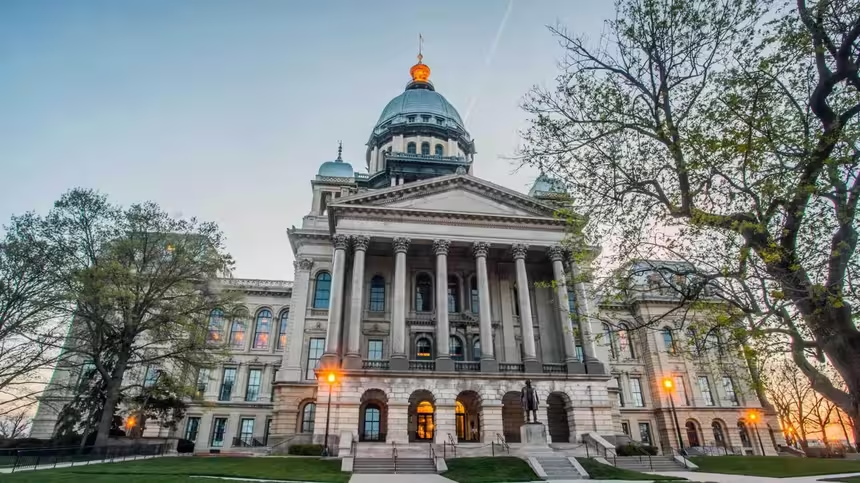
CapitolView
CapitolView is a weekly discussion of politics and government inside the Capitol, and around the state, with the Statehouse press corps. CapitolView is a production of WSIU Public Broadcasting.Providing Support for PBS.org
Learn Moreabout PBS online sponsorship(light upbeat music) (camera shutter beeping) (dramatic music) - Thanks for joining us on "Capitol View."
I'm Fred Martino.
Upfront this week, a look back at the legislative session and a look ahead to new priorities.
My guest is Dr. Paul Jacobs, a Republican from the Illinois House District 115.
Dr. Jacobs, thank you so much for being with us.
- Well, we appreciate it, I'm glad to be here, thank you.
- It's great to have you here.
I wanna start today with the legislative session.
Your thoughts on the biggest accomplishments this year.
- Well, unfortunately, some of the biggest accomplishments weren't what the conservatives would necessarily want to see, but I think I would rather focus on some of the bigger accomplishments that we did through the District down here more than anywhere else.
The areas that were extremely important were economic development to me and so we worked very hard with the, well, the Black Caucus, Hispanic Caucus.
I have a very good working relationship with them and if you wanna pass things, with two to one voting against you, you need to have friends on both sides.
We have to be bipartisan.
There's no way you're gonna get things done.
But we were able to pass it a bill that I was very happy to get passed.
It was dealing with the Fort Defiance, the Toll House.
Many people don't even know to Toll House down there but the Toll House used to collect tolls as you went across the bridge to Kentucky.
The bridge was built in the '30s and it was a toll bridge.
Well, it was paid for by 1948, but the state has still been taking care of that building up north of Fort Defiance.
It's on the Fort Defiance property.
They've been taking care of that for all these many years and they've had a number of things in there but it hasn't ever gone anywhere.
What we did though is we were able to get the state to sell that or get it ready to be sold to a company out of Wickliffe over in Kentucky that's going to bring a processing fish processing plant in, and it'll add hopefully between five and 20 jobs there, which we need in Carroll.
So it's something that we're really, really pretty proud we got that done.
We worked on a number of other things.
The Democrat Sheriff in Jackson County had a request that we work on police cars.
You know, if you're in Cook County, they have parking lots full of police cars.
If they've wrecked one one night, they're okay.
But if we wreck one in Jackson County or Williamson, or one of our counties, Alexander, we can't replace those things.
Just like snap your fingers and there they are.
Anything over $30,000 has to be put out to bid.
Well, it could be months before they could replace it which means there's not gonna be a police officer out in that squad car the next day.
So that was one of the things that we did get passed and it was also bipartisan.
I was able to get all the Republicans, all the Democrats to vote with that, same thing with the Toll House.
So there are things that were getting good, that are good for our district.
You know, from the taxpayer's sense, I think it was fairly disappointing in that I would prefer to see taxes go down, but I'm there.
If we're sending the taxes to Springfield, it's my job to bring them back down.
So you know, I think that there were things that were good and some things that were bad.
94% of the bills that are passed are bipartisan and people never get that through the press.
They never hear that 94% of them are bipartisan and unanimous.
So, I mean, it's a huge endeavor but you're going to always have that little group of bills, that 6%, that last 6%, that's why we have a conservative and a liberal party.
We're never going to agree on the abortion issues, on Second Amendment issues, balanced budget issues.
Those are the things that are the tough ones that we have to hammer out behind those closed doors, so to speak.
But many times those bills get passed, and they aren't necessarily what we would like to see passed.
- Dr. Jacobs, before we move on, since you mentioned taxes and the need to lower taxes, if you could be more specific about that, what would you like to see tackled first in terms of reducing taxes in Illinois?
- Well, the first thing we need to do is get our house in order.
If you look back to, just shortly short time ago, 2018, the budget was $37 billion.
Okay, since then, it is now $50 billion.
We've added $2 billion in basically new projects every year for six years.
Don't do that.
Quit doing that.
That's a place where we can cut taxes.
In 2018, the actual income that came in was 36, let me look.
I think it's 36 billion.
So we were still about a billion short on what the budget was.
So we weren't balanced.
And each year it was a little bit short, a little bit short, a little bit short.
But the other taxes that we need to realize are being collected, your road taxes, highway taxes, special state, funds taxes, bond taxes, all those taxes add up to back in 2018 they added up to about 90 million, I'm sorry.
So the real tax that we have sent to Springfield back in 2018 was simply 90.
It was 99 billion.
Okay, 99 billion.
Now, this year we're sending in almost 200 billion.
So we've raised the taxes over 100 billion, and we're still short in the budget.
You were able to use a lot of the COVID money to balance it out, but there are places to cut.
And the first place to start really just quit adding additional expenses.
If we could just keep from adding $2 billion of new spending every year, we would be much further ahead.
You gotta pull that about.
- If you were able to accomplish that and you were able to cut expenses so that you were able to lower some taxes, what would be your priority?
What tax first would you want to lower?
- If you could lower taxes, I would not be objecting to a complete 5% cut on every agency, 10% cut on every agency.
It wouldn't be fair to just say, well, we're gonna take it from here or here or here.
I think that everybody's just gonna have to tighten the belt a little bit.
And when the revenues, if the revenues don't come up to what we think hopefully are going to come up to, we're not gonna have any choice.
You can't continue to tax and regulate your businesses to the point where they move out of the state.
- And if those cuts, and Dr. Jacobs, if those cuts were made, what tax would you want to see cut first?
Would it be property taxes?
Would it be in the income tax, sales tax?
What is it, which tax needs to be cut first in your view?
- Again, all of the above.
Okay, I think if you were able to just go across the board and cut some of the taxes all across the board, it would be a fairer way to do it.
Property taxes are out of control.
We all know that, but we do have to have our services.
So you have to balance all those things.
But if you quit adding additional new programs, that would be a great place to start.
- Okay.
Very interesting discussion and an important one, and one that I'm sure we'll continue to have with many different legislators on this program.
So, moving on, we talked about briefly there about the legislative session and some of the things that you were proud of.
What are the most important issues that you're still working on for the upcoming year?
- You know, one of our biggest problems right now is the passage of the seizure, the energy bill.
It had some good things in it, but it had some very bad things in it.
Joppa over in Patrick Windhorst district was closed down, the companies closed down, so there's no electricity coming there.
Baldwin will be closing in 2025 which is over in David Friess' district.
And in my district, the Grand Tower natural gas plant was closed down, and that created this vacuum of property taxes in Grand Tower, they paid $1.3 million to the school district there.
And we were able to, last year and this year get that put back in for Joppa and for Grand Tower.
And that was through our friends on the other side.
They were able to get that for us because they realized there was nothing in the energy bill that took care of the reduction in the property taxes.
And we can't have the public absorb that 1.3 million every year without doing something about it.
So we've got to still look at those things in the next sessions, some of the things that are coming up, the veto session, one of the major things that we'll be doing, I think it may be one of the only things that we do is the nuclear power plant bill that the governor vetoed.
And he vetoed it for a few reasons that he felt were very important, that were very important.
The bill isn't Chernobyl or Three Mile Island.
The bill is bringing out the ability to bring these portable, we'll say portable nuclear power plants.
They're based completely on what we've used for decades in our submarines.
And we have knocked on wood, no problems with those nuclear power plants.
If you go up to, if you go up to Mount Vernon, which used to be in my district but it isn't now, but Continental Tire, Continental Tire could run completely on two of those units.
So we want to continue with the energy discussions and not be just run off the floor.
We need to get the nuclear power plants working.
We don't want to take away the ones from Chicago, right now we don't have any replacements for that.
Those are some of the important things that we just need to do.
The cost of energy is way too high.
I've got one of the gentleman that used to work for me at my winery before I sold my winery which I sold three years ago.
But at any rate, he bought this little store in Alto Pass, and that little grocery store was paying about eight or 900 a month in electric.
And then when CJ came through, the electricity is going down, Ameren's going up, he's over $2,000 a month.
So somebody's gotta absorb this stuff.
You know, the grocery store, we have 13 little grocery stores throughout the district, throughout Patrick Windhorst and over here in my district.
Those little grocery stores can't afford to pay two or three or 4,000 a month in electricity.
You got to address all those issues.
Whether or not we'll be able to, I don't know.
But those are some extremely important things that I think that we're fine, let's do the solar, let's do the wind, let's do hydro, let's do all those.
But I think they jumped the gun with the seizure and made everything just too soon.
We're not ready for it.
Maybe we can make some bills that change it up a little bit.
That's what I'm hoping for.
Veto session I think is gonna be fairly straightforward on energy.
I'm sure that they're gonna bring some things that the conservatives just really hate, but they had two to one.
So I mean, they have the votes and that's okay.
We just have to deal with it.
- My guest was Dr. Paul Jacobs, representative in Illinois 118th District.
We'll have more of that interview next week on "Capitol View."
And you can watch the entire conversation on WSIU's YouTube channel, subscribe to WSIU on YouTube so you never miss an update.
We'd love to hear from you.
Email your comments anytime.
The address is contact@wsiu.org.
Analysis now and I am pleased to welcome Hannah Meisel of Capitol News Illinois and John O'Connor of the Associated Press.
Hannah, some big news in the last week about a major battery manufacturing plant coming to Illinois.
Give us a sense of the project and the major incentives required to seal the deal.
- Right, so in Manteno, which is by Kankakee, there's set to be this, I guess it's $2 billion project of this huge electric vehicle battery plant set to open.
You know, the company Gotion, which is, we can get into its ties to China later, it's set to create 2,600 jobs begin production in 2024.
So that's kind of a tight turnaround to actually get that plant built and up and running.
And this is a massive, massive kind of business subsidy Illinois is giving under a relatively new program that's designed to bring companies that are related to electric vehicle manufacturing in Illinois.
Over 30 years, Illinois is set to give away more than $330 million in tax credits, state and local governments combined would be more than $536 million in incentives and tax breaks.
This is a pretty major announcement feather in the cap of Illinois Governor J.
B. Pritzker certainly who has set out to bring these manufacturers that have to do with electric vehicles to Illinois with the goal to make Illinois kind of the Midwest hub or even the hub in the entire United States for this sort of manufacturing.
Of course, we already have Rivian which has been up and running for, gosh, at least, I don't know, four or five years now.
And you see those Rivian cars out in the wild and it is pretty cool.
I've toured them.
So this is a pretty big announcement, but nothing's ever guaranteed.
I mean, our neighbor to the north in Wisconsin a few years ago, maybe more so now, gave away many, many, many millions of dollars in tax credits, kinda rolled out the red carpet, I think even used state funds to build infrastructure roads to this plant built by this company called Foxconn, with the promise of I think they were supposed to be building these small electric components.
And Foxconn has barely done anything.
And so it's a huge example of you can promise everything, you can promise the world but if you don't have strong oversight or really if you don't have teeth in trying to make sure that these companies do what they say, it can be a massive failure and you kind of egg all over your face.
- Yeah, we'll see what happens.
You know, Hannah, you noted tax credits, if I recall the "Capitol News Illinois" story also said that there's also subsidies involved as well for this, correct?
Yeah, so this is interesting.
I mean, and you also noted a connection with this company to China.
Do you expect that that will become a political issue down the line, or really it might be more dependent upon what's happening in the news in regard to China?
- I think both.
I mean, I think it already has.
We saw last week after the governor announced this, Republicans already coming out and saying, oh my God, this company Gotion has ties to the Communist Party.
You know, there are definitely concerns there.
I'm not gonna say that this is not, this is something to be totally ignored, China's rising action, trying to establish a global dominance, that is worrying for the US and we should not ignore that.
However, I think a lot of the initial statements that we saw were definitely overstatements of what this company does.
But yes, like you said, definitely dependent on what happens in the news as this plant continues to be built and eventually roll things off of the line.
- We'll watch it.
Well, John, incentives of course are common in Illinois and in other states.
Here is another interesting example.
A new audit shows St. Clair County taxpayers are spending a lot of money on the MidAmerica St. Louis Airport.
The airport only has one carrier, Allegiant, so news that Boeing is planning to build US Navy drones there may be welcome news for some, the state is spending money too to build a rail connection to Lambert Airport.
What's this all about and where do you see this going?
- Well, as Hannah pointed out, if you don't have oversight of these things, you can end up with egg on your face.
And fortunately, in many cases, traditionally the EDGE credit in Illinois, other incentive programs to draw businesses here have check marks, have goals, and if an incoming company doesn't meet those goals, they are liable for repayment or some remuneration of the efforts of the subsidies or tax credits that they got.
In this case, in MidAmerica, it's just a subsidy.
And what the audit found was that the taxpayers had to double the subsidy in the past year from 5 million in 2021 to 10 million in 2022.
And I'm not sure that there are deliverables, if you will, associated with that money.
It's been over the 30, what, 27 years since the airport was built and opened.
It's been kind of a carrot and a stick thing.
We're hoping that the donkey will come, if we hold the carrot out there and the carrot is, as you said, even the state is getting in the building, extending the light rail from Lambert all the way to, well, if you only have one carrier, I think the hope is that it will draw more carriers.
But you just don't see that kind of participation in regional airports like that.
- Hence why I mentioned the Boeing project.
So hopefully for Illinois and for those local taxpayers that that will be successful because projects in this state, and of course across the nation are dependent upon economic development if those subsidies and tax credits are to continue.
Well, Hannah, one pitch to businesses to stay in Illinois or to move here involves relatively low utility rates.
And there's pushback to keep those rates low despite a state law, the Climate and Equitable Jobs Act that allows utilities to recoup investments to reduce carbon emissions.
"Capitol News Illinois" reported on a lawsuit against ComEd's fees connected to that law.
Tell us about it.
- Right.
So way back in 1997 when Illinois did electric deregulation and what eventually happened was electricity rates kind of plummeted and it became the selling point for businesses in a state where businesses typically complain about Illinois's regulatory environment taxes, et cetera.
This was the bright light.
And so in 2021, when it seemed clear that CEJA or something like it would actually pass, businesses warned that increasing electric rates would follow.
What's interesting about this lawsuit is that manufacturers who have sued over kind of tech, this part of the law that basically allows utilities to charge a fee, this carbon free resource adjustment which basically is the subsidies to these nuclear plants.
Now, nuclear plants across the board, unless you were really kind of on the fringe in negotiations in Springfield, these nuclear plants, everyone agreed were necessary to keep online to kind of bridge the gap between the traditional mix of energy we have now and the future that environmentalists want, which is a lot more reliance on solar and wind.
But basically under the program, if actual market rate for electricity is lower, utilities can credit consumers for the difference which they did last year.
However, if the market rate is higher than fixed price, utilities can add that charge to customer bills to make up the difference.
- So, we will be watching this so it affects not just businesses, but consumers as well.
Alright, John, in our final minutes, last week we talked about Governor J.
B. Pritzker's news conference in which he announced an effort to get work permits for immigrants arriving in Illinois and elsewhere.
Several more busloads of immigrants came into Chicago last week and there are housing and healthcare costs growing as well.
What are people saying about this, notably with Chicago in the national spotlight for next year's Democratic National Convention?
- What's interesting is Chicago, well, the reason that Chicago was one of these cities to which these immigrants are being bused is because it's a sanctuary city.
And when this effort began a year ago already, Chicago said we're a sanctuary city.
We welcome these people.
It's a lot of people, but we get it.
What's interesting in the comments last week, Mayor Johnson said, we can't continue this unless there is solid immigration reform.
And to me that says Governor Abbott has proved his point, this is why Governor Abbott in Texas started busing these people out of Texas saying I'm busing these people out to Democratic cities until President Biden reforms, has some solid immigration reform.
And this is what we heard from Mayor Johnson.
So it sounded like Governor Abbott, like I said, has proved his point.
The city is busting at the seams and trying to build new or open new centers to house these immigrants.
But you can't, if you're seeking asylum, you can't seek a work permit for 180 days under federal law.
And that's the best case scenario.
So that's why right now they're idle during the day and they're sitting on the streets and they're getting into trouble, as idle people will do.
And this is a sore spot for the city.
- So something to watch for sure.
And we've seen a lot of national press about the Mayor of New York City as well, with a lot of strong statements that this is not sustainable and it must be addressed.
Certainly something we're gonna probably be hearing a lot about in Illinois and nationally as we move quickly toward the 2024 election.
Thank you so much to my guests Hannah Meisel of "Capitol News Illinois" and John O'Connor of the Associated Press and thank you for being with us on "Capitol View" as well.
For all of us here at WSIU, I'm Fred Martino.
Have a great week.
(dramatic music)

- News and Public Affairs

Top journalists deliver compelling original analysis of the hour's headlines.

- News and Public Affairs

FRONTLINE is investigative journalism that questions, explains and changes our world.












Support for PBS provided by:
CapitolView is a local public television program presented by WSIU
CapitolView is a production of WSIU Public Broadcasting.