
Capitol View | September 17, 2026
9/16/2026 | 26m 46sVideo has Closed Captions
Brian Sapp hosts this week’s top stories with analysis from Kent Redfield and Dan Petrella
Brian Sapp hosts this week’s top stories with analysis from Kent Redfield of the University of Illinois, Springfield and Dan Petrella from Chicago Tribune.
Problems playing video? | Closed Captioning Feedback
Problems playing video? | Closed Captioning Feedback
CapitolView is a local public television program presented by WSIU
CapitolView is a production of WSIU Public Broadcasting.
Capitol View | September 17, 2026
9/16/2026 | 26m 46sVideo has Closed Captions
Brian Sapp hosts this week’s top stories with analysis from Kent Redfield of the University of Illinois, Springfield and Dan Petrella from Chicago Tribune.
Problems playing video? | Closed Captioning Feedback
Where to Watch CapitolView
CapitolView is available to stream on pbs.org and the PBS app.
CapitolView
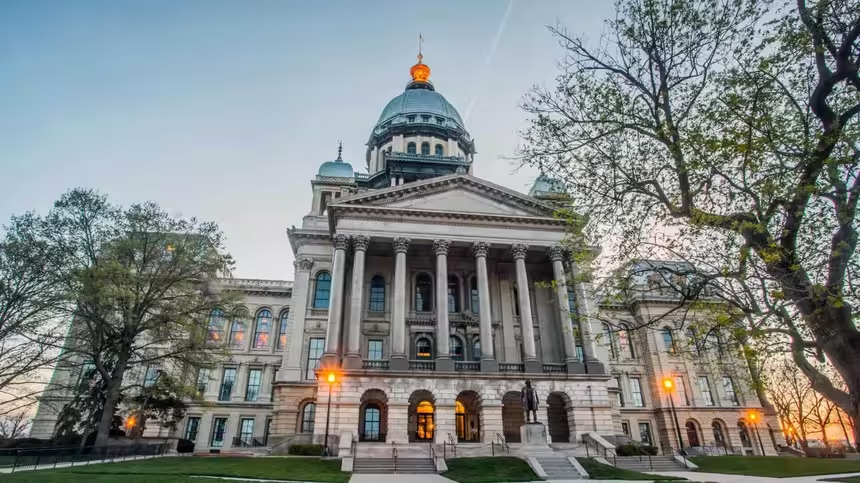
CapitolView is a weekly discussion of politics and government inside the Capitol, and around the state, with the Statehouse press corps. CapitolView is a production of WSIU Public Broadcasting.Providing Support for PBS.org
Learn Moreabout PBS online sponsorship[MUSIC] [MUSIC] >> Welcome to the Capitol View on WSIU.
I'm Brian Sapp.
The Legislative Ethics Commission has named David Risley to replace outgoing legislative Inspector General Michael Mukasey, who is resigning.
Mccluskey's resignation came last week amid some growing criticism over his handling of recent investigations in the Illinois legislature.
Also, a recent repor co-authored by one of our guests today looked into the spending of Covid relief money by the state of Illinois, Coo County and the city of Chicago.
We'll find out what he foun out and is an endorsement from the president helpful in thi year's gubernatorial election.
We'll talk about President Trump's recent endorsement of Darren Bailey.
Joining us this week to talk about these topics is Kent Redfield.
Redfield.
Sorry.
He's the political scientist, professor emeritus at the University of Illinois, Springfield, and Dan Petrella.
He is a reporter with the Chicago Tribune.
Kent.
And Dan, welcome to the program.
>> Great to be here.
>> Glad to be back.
>> Good to see you guys.
Let's get started.
It seems to be the story tha hasn't really resolved and um, the legislative ethics concerns.
Last week Mr.
Mccuskey resigned.
Dan, can you kind of tell us how we got here and a little bit about Mr.
Risley?
All right, Kent, I apologize.
>> Oh, okay.
Uh, so how we got here?
This really goes back to, uh, the George Ryan scandals and, uh, a big push for, uh, ethics in state government and, uh, and a dramatic expansion of the inspector general model of having someone at an agenc or a constitutional officer's, uh, you know, uh, office to, uh, be, provide oversight, someone that, uh, you know, whistleblowers can talk to.
Uh, and so this model was applied very extensively throughout state government.
Um, it is a bureaucratic model that works best when you've got, uh, a hierarchical organization and, uh, and basic kind of, uh, huma resource functions and things.
Uh, it has been a problem applying this to the Illinois General Assembly because, uh, you've got, uh, essentially, uh, 118 people, uh, of equal, uh, status who are elected officials in the House and 59 in the Senate.
And, uh, so when it was designed, uh, back in this era where we were applying this model, uh, what we came up with, what the legislatur came up with was a model where, uh, there was an awful lot of, uh, secrecy non-transparency a lot of constraint on wha the inspector general could do.
Uh, and part of this is, has to do with, uh, you know, legislators get to be legislators by winning elections.
And, uh, so, uh, an HR complaint, uh, involving an assistant manager in some division.
Uh, doesn't have quite the ramifications, at least in the way the legislature looks at it as having, you know, some unfounded, uh, complaint, getting a lot of publicity, uh, that will live on forever in, in the next campaign and on social media.
So, uh, it's not, there's been a lot of criticism over time, uh, that it just hasn't worked very well.
And, uh, the inspector generals that have had the position, uh, before, uh, the current one that just resigned have complained that, you know, they really don't have any ability to investigate.
They're very constrained.
And, and it's almost the criticism has been it's more like kind of a judicial model where you're, you're coming in and, and trying a case sort of thing.
Uh, and there is, of course, there's a joint House Senate committee that oversees this and, uh, and is the one that issues, uh, you know, blesse investigations, issues, reports.
So it's not particularly transparent, very reactive.
Now, we had a big blow up involving a representative of a since resigned.
Lots of criticism of how that case was handled.
Things like it has a one year statute of limitation.
It's not clear when you wor for a legislator, you're an at will employee, and there's no kind of human resource, uh, structure like you would if you were, uh, working in a department in the Secretar of state's office or something.
And so, uh, given that pushback then, uh, and criticisms of the way the inspector general, The former Inspector general handled this.
And in fact, the the speaker of the House, you know, it's a very complicated that, you know, we don't necessarily need to get into the details, but, you know, so now we've got another push to get, uh, let's rethink this office.
Let's get it, you know, so it's more responsive to the people who are, you know, the victims in this.
And, uh, and, and it's, you know, certainly the legislature's interest, you know, not to look bad.
And so, uh, we now have another push.
Uh, you know, how can we rethink the model?
Uh, but up being again, u against these constraints that, uh, uh, legislators are very very nervous about, uh, handling about, uh, allegations, uh, you know, becoming public.
And, uh, so I that's, you know, I'd say that's where we are at this point.
We've got a person that doesn't fit the traditional mold who has just been appointed, who has more of an investigative prosecutorial, prosecutorial kind of, of, of background and stuff.
Uh, but this is to b determined in terms of whether or not, uh, this becomes, ho can we fix this versus how can we make this go away?
And, uh, that's, uh, you know, that that seems to be a pretty, pretty common, uh, you know, inflection point when we're dealing with these kinds of issues.
>> Yeah.
And I'll say last tim they tried to fix this office, they passed a, a legislativ and government ethics overhaul back in 2021, and it caused the previous legislative inspector general to resign, calling the office a paper tiger because they had actuall somewhat weakened the abilities of the office to to ferret ou wrongdoing rather than expanding powers, as all the folks who ha held the office previously had had called for.
And what's interesting about about Risley is that he was actually considered last time around when they ended up appointing former Judge Mccuskey.
He was the favorite candidate o the Democrats on the Legislative Ethics Commission at the time.
Um, but Republicans on the committee objected because he wasn't one of the two finalists that a search committee had recommended to them.
So, um, there was some back and forth over that.
They ended up going with Mccuskey.
Um, but yeah, it's an office that has long struggling history.
Um, I can't give a very good rundown of it if you want to know more about it.
My colleague Gregory Pratt and I did a story a couple years ago for our Culture o Corruption series that looked at legislative inspector general inspectors general, and sort of how, you know, weaknesses built into the system intentionally to, uh, particularly fo legislators who write the rules, um, to sort of evade the leve of scrutiny that maybe employees in the executive branch, uh, go under under their inspectors, general.
>> Okay.
Well, we'll have to see how Mr.
Risley does.
He takes on, takes the reins at the end of the month.
And there's still plenty of, uh, sounds like system to figure out.
And we'll see what the legislature does.
I'm sure we'll have to wait until after the election.
Like most things, I want to move on.
Um, the stay with the legislature.
But the governor signed a bill this summer.
The medical aid or no, I'm sorry.
Wrong story.
I'm going to skip that.
The pandemic recovery money.
Um, Dan, you and yo co-authored an article looking at how the state of Illinois, Cook County and the city of Chicago spent the money.
You said you've been working on this for a while.
Can you tell us what what you found out?
>> Yeah, this was a project.
My colleague Addie Quigg, who i sort of our our public finance guru here at the Tribune, sh covers the city and Cook County.
Um, she and I go an opportunity back in 2024 to be part of the initial cohort of a local data journalism initiative with the Universit of Chicago's Mansueto Institute for Urban Innovation.
And the problem we came to them with was we have these thousands and thousands o pages of project and expenditure reports that the city, count and state filed with the federal government for what was called the American Rescue Plan Act, which, uh.
If you want to think back to the pandemic, was in spring of 2021, when President Biden had first taken office.
Um, Congress passed this $1.9 trillion relief package from that $350 billion went out to local governments and state governments across the country.
Um, and, uh, from that pool, $11 billion came to, uh, to the state of Illinois, Cook County and Chicago.
Other municipalities across the state also got money.
Um, but the project was bi enough just looking at the state and, and the two other largest governments within the state, um, state got about 8 billion.
The rest was divided up between Chicago and Cook County.
And we really wanted to know on the ground level where all this money was going.
How is it being used?
Um, who were the non-profit organizations and businesses and things that were, were getting some of this money?
Um, and what we learned was it was very, very hard to track, uh, where all those dollars and cents were going.
Um, you know, the system was really set up in a way where, um, you know, there was a lot of reporting going on, but the, when you dug beneath the surface, um, not a lot of detail about wha the programs that were getting the money were actually doing or what their goals were for, uh, violence prevention o affordable housing construction or all these different things.
This money could be used for.
Um, and what we found was very little, little scrutiny, um, from the federal government dow to the city of Chicago level of how the money was being spent.
Um, you know, there were various, uh, audits and inspector general reports that sort of touched on little bits and pieces of it.
Um, one of the the things that we featured in our story was an audit that came out last year from the state Auditor General about the back to business grant program that the Department of Commerce and Economic Opportunity ran.
It was about a $410 million program outside of the Unemployment Insurance Trust and what was called revenue replacement, which i basically budget hole plugging.
It was the state's largest expenditure of this money.
And the Auditor General identified lots of problems with with the way the program was run, they hired outside grant administrators to make decisions.
Uh, there were folks getting money who maybe shouldn't have and folks being denied who maybe shouldn't have.
And, um, you know, it was, um, everyone was working quickly and there was not a lot of um, you know, scrutiny and not a lot of attempt to really dig beneath the surface in places where it has been identified that perhaps money went, uh, went to people who should have been disqualified for various reasons, um, and very little effort from the state at this point to really try to to claw any of that money back.
So, um, it was, it was a complicated process and really, um, you know, one of the conclusions we came to is that, um, nobody seems to be terribly concerned with, you know, making sure that all these various programs that got money actually, uh, achieved the results that they were going for.
Um, and, uh, you know, one of the experts we spoke with said, you know, really we'll never know how successful, you know, broadly, um, these programs were.
And obviously there's been complaints that that pumping that much money into the economy, uh, contributed to some of the inflation that we've seen over the last, you know, half decade or so.
So, um, we're hoping to have some more stories on the subject down the line.
Uh, and, uh, yeah, it's, I encourage people to go read it at at chicagotribune.com.
>> Yeah.
And if they go, did I remember right that like, can people go in and look at these numbers themselves?
Is there an opportunity for that?
>> Yeah.
>> Um, the folks we worke with at the Mansueto Institute University, Chicago put togethe a tool that that's linked to on our website where you can really drill down into the data.
Um, and then we also have some maps and graphics there where you can look specifically on the back to business program to see if your favorite restaurant in your town got any, uh, got any public money through these programs?
And, um, yeah, it was, it was an interesting project.
And, uh, it just shows you, uh, you know, despite all we hear about transparency in government that, uh, sometimes the transparency is not very deep, I guess I'll put it that way.
>> And that's what it sounds like.
Just a lot of a lot of moving parts at that time, a lot of big numbers being pushed out.
And, uh, hopefully, hopefully people can look at this and maybe, you know, make some decisions for themselves and encourage the legislatur to be ready for the next time.
I want to keep on moving.
Um, move on to our next topic.
And Dan, I was going to stick with you.
Um, the medical aid and dying law went into effect this past week.
As I said earlier, Governor Pritzker signed that and, um, there was a couple of lawsuits brought by some religious groups, people who had and I think also disability group.
Um, the law still went into place, but there were a couple of decisions.
Can you kind of fill us in where we are?
>> That's right.
Yeah.
There were there are two court decisions out of the federal, uh, federal court here in Chicago.
And there were sort of conflicting decisions.
There was one lawsuit brought by disability advocates where, um, judge, uh, decided not to, uh, to block the law from going forward.
But then, um, the, uh cardinal of the Roman Catholic Archdiocese of Chicago also filed a lawsuit on behalf of Catholic health care providers and hospitals objecting to, uh, objecting to the law, which requires hospitals and physicians to provide, um, medical assisted, uh, end of life care.
Um, you know, sometimes people call this, uh, you know, medically assisted suicide is one term for it.
Um, But, uh, the state law went into effect, put the safeguards in place where you have to request multiple times and things like that before you are given access to, um, to these drugs.
But the, the Catholic Diocese o Chicago, um, has objected that it would violate people's First Amendment rights, um, their, you know, freedom of religion to object to participating in this obviously, um, goes against teachings of the Catholic church.
And so, uh, the, the federa court, um, put it on hold just specifically for, uh, for those providers here within the Archdiocese of Chicago.
Um, so it's really, you know, a live issue.
We'll see how it plays out.
Um, it is, um, obviously a contentious issue.
It's been one, you know, for a long as I can remember, this has been an issue of public debate.
I guess it kind of went quiet for a while, but really has become a subject of, of much debate again.
And, uh, interestingly, it wa one that came up after Governor Pritzker went and met Pope Leo, um, which was, you know, from all reports, a good meeting.
But this was one issue where, you know, they did discuss and the Pope reportedly brought up, uh, his disagreement with this law before, uh, before the governor signed it.
>> Okay.
Well, I guess we'll let the let it play through and see if there's what changes are made and what the courts finally decide.
Uh, moving on to politics, we've got a little under ten minutes left.
We've got a couple politics stories.
Of course, we're heading into the campaign season.
Um, Kent, President Trump is having I mean, there's been some mumblings here in the state, of course, you know, national topics.
But, uh, he's starting to make his way into our local politics here.
He, uh, voiced his endorsemen of Darren Bailey, who's running against governor JB Pritzker.
And he also is planning on coming to Chicago soon.
So what Okay.
What are we looking at her when it comes to the president in Illinois and our politics?
>> Well, and you know, that' Trump endorsing Darren Bailey, the Republican candidate.
That can be the good news o the bad news, depending on your, you know, your perspective.
Uh, and it contrasts from four years ago where, uh, Darren Bailey actively sought out, uh, and very, you know, very publicly sought, uh, President Trump's endorsement.
Uh, he's been pretty, uh, you know, not he's, he, he has not had that same kind of, uh, you know, hunger and thirst this time around.
And, and, uh, has made a point of saying, well, you know, he's, he's, he supports all of the things that Trump, you know, a lot of Trump's policies, but he's not really, not really MAGA.
So, uh, you know, this is reading the, uh, voting, uh, demographics of Illinois that, uh, the Republicans have lost, uh, tremendous ground in the suburbs of, uh, northeastern suburbs, which used to be their stronghold.
And, uh, that's resulted in, uh, really kind of a historic, uh, Democratic dominance of statewide office in, in Illinois.
And so, uh, as much as, uh, perhaps, uh, you know, uh, Darren Bailey doesn't want t talk about this, uh, it just, it turns out that the President' Cup, which is a golf tournament that pits the United State versus the world, except Europe, uh, is in and Medinah Country Club in, uh, DuPage County.
And so there's going to be a lot of publicity.
He's the president i the honorary chairman, chairman of the Presidents Cup.
That makes certain sense.
And so he is.
He's made a point of saying he's going to go there.
He's going to present the trophy.
Going to cheer on the Americans.
And this will be a lot of opportunity for other people in Illinois media, uh, to, uh you know, have a chance to ask questions, uh, in addition to the national media.
And so, uh, and the presiden is not reluctant about talking about, uh, people he likes, uh, and people he doesn't like.
And so we can assume that, uh, both, uh, his assessment of Bailey and his assessment of Governor Pritzker will come up, uh, in some of the conversations.
So, uh, this is, uh, you know, it it is an interesting contrast from two years ago, four years ago.
And again, it it the fact that the that the Republican vice lieutenant governor nominee is from DuPage is from the northeast suburbs.
Uh, you know, tells you that they've been reading the returns and they know, you know, where they have to make up, uh, make up ground.
So, uh, you know, one more, uh, one more inflection point as we roll on to, uh, you know, to, to election day in November, 50 days, somebody said, which is, uh.
>> Yeah.
And I haven't seen a lot of the commercials yet.
Dan um, what do you, what d you make of this as we kind of get closer with the president making his voice heard?
>> Well, uh, I.
>> Have to think, uh, the the Pritzker campaign was pretty happy with that news yesterday.
They seem to certainly be, uh, you know, having a field day with it.
They've been trying to make this point all along that despite his efforts to run away from from Donald Trump, or at least keep him at arm' length, that that Darren Bailey is very much aligned with the president, who is deeply unpopular here in Illinois.
Um, and an interesting side not to the story is that I believe I saw some, uh, colleagues reporting that the reporter who asked the question of Trump was a former TV personality from central Illinois name Bennie Harmony, who now is with the real America's Voice Network and was at Darren Bailey's gubernatorial campaign launch last fall.
Um, and raised some eyebrows with some of her comments, such as saying, uh, questionin whether Governor Pritzker even knew what a Bible was.
Um, so, uh, just an interesting side note there.
And I think, uh, as Ken said, I think it's maybe even fewer than 50 days till the election now, but it's going to be, uh, certainly an interesting, um, you know, stretch here to see how things play out and whether there's really, you know, a difference in this final push of the campaign from what we saw four year ago from these two candidates?
>> Definitely.
I'm sure it'll give us plenty to talk about over these next few months here on Capitol View as well.
Kent, we have about 3.5 minutes left.
One more topic you brought up as we were planning this week, a little bit of inside baseball, as you said.
But I think it's still interesting to talk about in this state that is very heavily Democratic leaning.
And they have a strong machine.
But you were telling me a little bit, and there's been some writing about this difference of opinion, I guess, between the the House Democrats and the Illinois Democratic Party.
>> Right.
The we've had the Democrats have had a coordinated campaign where they pool money and put out literature, you know, promoting Democrats in general.
And this ran pretty smoothly when Speaker Madigan was also the chair of the Democratic Party and had pretty good relations with John Cullerton and then Don Harmon, the last two Senate presidents.
And now we've got a situation where there's a disagreement about where money is going is being spent.
And the coordinated campaign, the state party apparently wants a little broader playin field than the House Democrats are comfortable with.
And that eventually led to them saying, well, we're not going to participate in the coordinated campaign.
Uh, the state party pushe back and said, well, you know, you if you play with us, then you get a big discount on your, uh, running your ads.
But, uh, you know, we can't give you the discount unless you're dealing, you know, in this coordinated fundraising spending kind of thing.
And then we now have $2 millio that the speaker has given had given to the Democratic Party that has now been returned.
And they're looking at money, previous money, and trying to decide whether that's all been spent and whether there's some refunds coming.
And, you know, you would thin that the Democrats with the big majority and all the money they have, would try to, you know, play nice amongst themselves.
But this just seems to be, you know, they're bound and determined to give the Republicans a little more ammunition on, you know, why you, uh, might not want the Democrats running your state.
>> Okay.
We have just a little bit under a minute.
Dan 30s, is this going to have much of an impact on what we see in the fall?
>> You know, it may keep.
>> The Democrats from picking up an extra seat.
Uh, somewhere around the state.
But I think what's interesting about it is the backdrop that it's happening against is questions about Speaker Chris Walsh's leadership.
Going back to what we were talking about at the top of the program with the sexual harassment investigation, or lack thereof, of former state Representative Harry Benton, who resigned earlier this year.
So there's some internal, uh, disunity among the House Democrats as well.
So it's going to be interestin to see how that plays out during the fall campaign as well.
>> Okay.
Like I said, there's plenty of plenty of things happening.
Illinois is pretty solidly Democrat, so we'll see how they are playing their cards.
Uh, gentlemen, thank you for joining us.
It was good talking to you.
That's it for this week's edition.
Thank you.
Yeah, that's that's it for thi week's edition of Capital View.
On behalf of Kent Redfield and Dan Petrella, I'm Brian Sapp.
Thank you for joining us.
[MUSIC]
 New Episode
- News and Public Affairs

Top journalists deliver compelling original analysis of the hour's headlines.

- News and Public Affairs

FRONTLINE is investigative journalism that questions, explains and changes our world.

 New Episode
 New Episode
 New Episode
 New Episode
 New Episode
 New Episode
 New Episode
 New Episode
Support for PBS provided by:
CapitolView is a local public television program presented by WSIU
CapitolView is a production of WSIU Public Broadcasting.