
Capitol View - September 21, 2023
9/21/2023 | 27m 51sVideo has Closed Captions
Capitol View - September 21, 2023
In this episode of CapitolView: Fred Martino speaks Dr. Paul Jacobs, the Republican Representative in Illinois House District 118. They discuss his ideas for ethics reform and economic development. Plus: Analysis on the end of cash bail and efforts by Democrats and Republicans to attract new supporters in Illinois.
Problems playing video? | Closed Captioning Feedback
Problems playing video? | Closed Captioning Feedback
CapitolView is a local public television program presented by WSIU
CapitolView is a production of WSIU Public Broadcasting.
Capitol View - September 21, 2023
9/21/2023 | 27m 51sVideo has Closed Captions
In this episode of CapitolView: Fred Martino speaks Dr. Paul Jacobs, the Republican Representative in Illinois House District 118. They discuss his ideas for ethics reform and economic development. Plus: Analysis on the end of cash bail and efforts by Democrats and Republicans to attract new supporters in Illinois.
Problems playing video? | Closed Captioning Feedback
How to Watch CapitolView
CapitolView is available to stream on pbs.org and the free PBS App, available on iPhone, Apple TV, Android TV, Android smartphones, Amazon Fire TV, Amazon Fire Tablet, Roku, Samsung Smart TV, and Vizio.
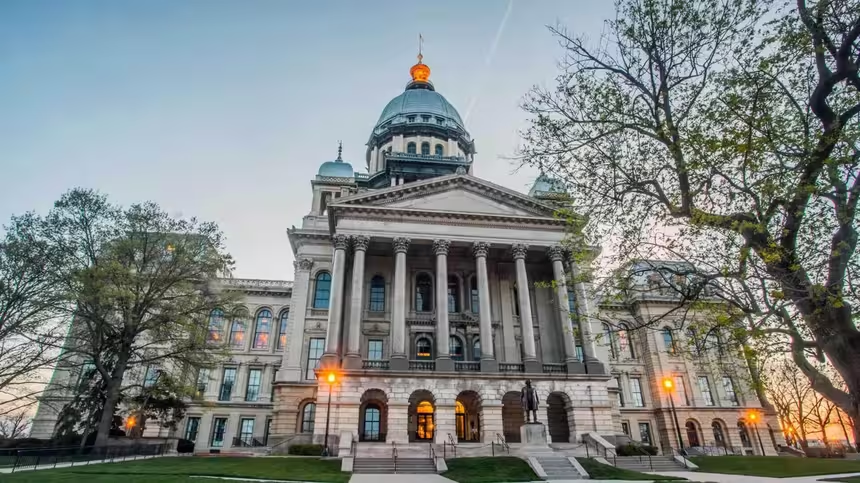
CapitolView
CapitolView is a weekly discussion of politics and government inside the Capitol, and around the state, with the Statehouse press corps. CapitolView is a production of WSIU Public Broadcasting.Providing Support for PBS.org
Learn Moreabout PBS online sponsorship(upbeat instrumental music) (light meter bleeping) (upbeat instrumental music continues) (upbeat orchestral music) (upbeat orchestral music continues) (upbeat orchestral music fades) - Thanks for joining us on "CapitolView" I'm Fred Martino.
Upfront this week we continue our conversation with Illinois House representative Dr. Paul Jacobs.
This week we hear his thoughts on ethics reform and his frustration at a lack of progress.
- I tell you, it's falling on deaf ears constantly, but we have had over, I think in the 101st, which I was not in the State House in the 101st, but I was in on the 102nd, and now in the 103rd legislative assemblies.
In the 101st, 102nd, and 103rd, the Republican Party put in over 130 bills that were never even taken out of committee on ethics reform.
And they're simple ethics reforms.
Right now, a legislator can be a lobbyist for local governments.
Well, I think that's terrible.
I don't think that that should be there.
So that's one ethics reform.
The Inspector General, at this point, has no subpoena power.
They have to come to the State House and ask us if they can subpoena somebody or have a court case on somebody that has been unethical that's a legislator.
We need to give the Inspector General that permission to do that without having to come to us.
The last Inspector General quit because of that, and she was very good.
And she was finding things that were unethical, but she couldn't subpoena, she couldn't do anything with it, and the Party did not, the majority party didn't want anything to do with it.
So, I mean, those are a couple of things that need to be done.
I'm certain that there are a whole lot more, but those are two of the biggest ones.
And you know, another one I think that's extremely important is many of the legislators will quit even before their term is up and become lobbyists.
Well, I think that we have gotten a bill in that's changing it somewhat to six months or a year, which is helpful, but I think it should be three years to discourage that whole process.
The lobbyists don't get credit.
Many times, the lobbyists really do help the state because they know both sides of what they're lobbying for.
And by law, they're going to tell you, they're gonna tell the legislators on both sides, this is what's good, this is what's bad with that.
So the lobbyists are important.
I don't think that it's a great idea to have just instant lobbying from someone who's has been in the power in the State House.
I think that it should be three years.
- Understood.
Very interesting discussion and again, one I'm sure we'll have again in the future as hopefully, at some point, this comes up for discussion again.
I know that you were on the Higher Education Appropriations Committee.
Tell me your thoughts on the major increase in spending for higher education.
- Well, it goes back to spending in general.
I do feel that we're sending money into Springfield and it is my job to bring whatever money we can back down to my district.
SIU, of course, is in the district and I think that it's extremely important that we fund as much as we possibly can.
The problem I'm having with spending in general, you know, since it is a spending issue right now, our hospitals requested 20% increase in Medicaid payments.
Medicaid has not been adjusted in, I think 28 years.
The hospitals have dealt with 28 years of inflation, inflation, et cetera, higher costs, higher health costs, but have only, we were able to get them a 5% increase instead of the 20%.
So spending, we have to spend our money more accurately.
I think that the spending on the university is important.
They left out though some of the community colleges in the original stuff, so I, you know, I wasn't totally satisfied with the way they did it.
But, you know, it's up to us to bring that back down here.
SIU is a great research, you know, we've got med school, we've got law school, we've got MBAs, we've got so much there and we definitely want them to continue.
So I think the spending was okay.
I'd like to see it come from some other areas though, too.
- Okay, and as a matter of disclosure, WSIU is licensed by Southern Illinois University.
One final question for you on higher education, what do you think is needed, if anything, to help state universities and colleges increase enrollment?
- Well, you know, I'll say this, I think that hiring Chancellor Lane, I'm not trying to blow smoke, but he's been a real kind of a fresh, breath of fresh air in that he listens.
I met with him when he first got here.
Maybe he was here a month or two in that.
I met with him and I know many other business leaders, legislators, a lot of people have met with him.
And I think that he came away with one of my particular complaints for the last 50 years has been not recruiting locally.
You know, just think if you bring a quarterback in, even in the college sports, you bring a local quarterback in, you're gonna have tremendous amount of people coming from Du Quoin or Pinckneyville or Marion or wherever, they're gonna come to see these kids.
The talent that we have here is leaving.
51% of our kids that are college bound leave the state, 51%.
He has gone out personally to the high schools throughout all of the area, all the way up into the East St. Louis, everywhere.
And he personally goes in and talks to the kids.
And I think that's why we had a first time in 10 years an increase in the enrollment at SIU because I think he's been involved with it.
And I think that's extremely important.
I think President Mahony has been involved with it.
They've come up with good programs.
The Step Up Program, I don't know if you're familiar with the Step Up, but the Step Up involves the community colleges.
You go two years at the community college at that cost, and then you can then transfer it to SIU.
I can't remember how many community colleges they have in contract with that.
But then they can go into SIU, still pay the, if I'm not, this is what I understand, they can still pay the third year of the community college costs and then the fourth year is regular cost.
But they can do it for 25,000.
They'll get their whole university degree from a university that is a research university.
It is a good university.
And that's competitive, then, with our partners, our friends down at Murray State and CIMO.
When you had to pay 80,000, 70,000, 90,000, it wasn't competitive, so they've come up with some pretty darn good ways of increasing.
And I think that that's what they need to keep doing, you know, just increasing the local talent, keep those 51% that are leaving right here.
And I think we can, I think we do it.
- All right, thank you for that.
Well, one area where we need more graduates is healthcare.
But you have been working on another solution, as well.
Illinois is one of only a handful of states that does not participate in a nursing compact to allow nurses to get an Illinois license if they have a nursing license from another state.
Give us an update on legislation you've been behind this that would allow Illinois to join the nursing compact.
- Nursing compact as it was introduced by Representative Gabel.
I was a co-sponsor on that bill.
It was something that would in fact do just what you're saying, it would allow nurses from other states to be able to have that reciprocity to come in and get licensed here.
They had to be licensed, you know, it's not just, well come on in here, we'll give you a nursing license.
You'd had to be licensed.
Medicine was behind it, everybody was behind it when it was first introduced.
- And most states are included, as I said, that Illinois is one of just a handful of states not included in this.
- What happened when we got the bill in committee, 'cause I'm on healthcare licensing also, the healthcare licensing, everybody was onboard, including the Nurses Association.
Well, all of a sudden the Nurses Association wasn't onboard, and then we had to rethink a lot about, okay, what are we doing?
Then we had the Nurses Association dropped out, Chicago Black Nursing Association dropped out, and they were against the bill.
So the bill right now is kind of a little bit in limbo.
That may come up, it may come up.
It was not voted on.
It didn't come out of committee, it was pulled, basically, and so it's sitting there.
The problem that we're running into is just like I was talking about, the hospitals having their difficulty in not having raising the Medicare.
They also are having to pay the traveling nurses extremely high amounts of money.
And it's not the traveling nurses that are getting all that money.
They're corporations that are coming up and getting contracts with the nurses so that they will then go and discuss, these corporations will go and discuss the pay that's gonna be received from the hospital.
- I'm glad you mentioned that context because it's very important to understand that there are cost ramifications in reducing the pool of nurses because you still need care.
You hire traveling nurses, as you had mentioned, and that is extremely, extremely expensive.
I want to, because we only have a couple minutes left, move on.
I understand you've been working on other licensing reforms, as well.
Tell me about that.
- Well, we have one in Veterans that we could talk about in a bit.
But the biggest thing, I think, that what we're doing is we're realizing that there's a major problem with the licensing.
And it's, I don't care if it's hairdressers, barbers, it's everybody, surveyors, and not just healthcare.
The healthcare is being hit by it quite heavily because you, I've had people call, constituents call, saying, look, I've moved here to Illinois, a nurse anesthetist.
And one particular guy, I know.
She's just at wits end 'cause she has not received a license in six months and she's gonna have to leave and go back.
And that was one of the people that we could've hired and kept here.
So, you know, what we've done is we've talked with the licensing agency and we have discussed why, what's the holdup.
And what the holdup is, they are putting in a new computer system.
Well that's great, but let's get the computer system in.
Why can't you then just issue temporary licenses until you get that completed?
I mean, they're doing that, not to bring up one of the 6%, but the doctors that are coming in to man the abortion clinics are getting a two-year extension.
They're getting a two-year permit to work until they get their licensing done in six months, eight months, or whatever.
Well, why aren't the other physicians and nurses that are wanting to come in have the same thing?
So that's what we're trying to do.
Look, just put on a temporary thing for everybody.
Don't just pick and choose who you want.
But, you know, right now, there's a, there's a hospital critical problem going on up in Springfield where SIU does use the hospitals up there.
Well one of the hospitals right now is firing 300 to 400 people in Springfield, one hospital.
So, I mean, there is a critical problem with the traveling nurses that we have to look in more with the compact nurses, which we have to look in more.
But I think that that goes back even in veto session, some of that stuff may end up being addressed.
It's important, extremely important.
Healthcare is probably the most important thing we can have.
- We're quickly running out of time.
You mentioned Veterans.
I know you served on the Veterans Affairs Committee.
We have a couple minutes to talk about that and what you've accomplished there and what you hope to accomplish in the last minute and a half or so.
- Basically, we wanted to make sure that Veterans were able to get licensed if you're hospital.
If you're transferred into Scott, for instance, and you are licensed in another state, you had to go through a whole nother licensing process and we passed a bill that would speed that up.
That was one of the things we were working with with it.
- Licensing for?
- Nurses, physicians.
Because if you go from state to state to state, you fall under a different licensing.
But if it's military- - So that would be healthcare for Veterans then?
- [Dr. Jacobs] Yes, yes.
- To help healthcare for Veterans, got it.
- Well, not so much healthcare as actually just licensing.
If you bring a nurse in from Norfolk to Scott, all right, they would have a long time to get licensed.
- Oh, I see, a military nurse.
- Military nurse, yes, I'm sorry.
- Got it.
- I wasn't clear.
But the, you know, there was housing that was involved just quickly, some housing issues, there were homeless Veterans.
They need to be given some privilege or some idea if there's some federal money that's available, et cetera.
Because there's a tremendous number of homeless Veterans.
That's probably partly why we have 26 Veterans a day that commit suicide.
I mean, there's a ton of things that we feel that Veterans, as a Veteran, I need to do.
- All very important issues, and I'm sure, Dr. Jacobs, things that you will be working on in the year ahead, as well.
And we appreciate you taking some time with us today to share your thoughts and some of these accomplishments.
Thank you for being here.
My guest was Dr. Paul Jacobs, Representative in Illinois House District 118.
You can watch the entire conversation on WSIU's YouTube channel.
Subscribe to WSIU on YouTube so you never miss an update.
We would love to hear from you.
Email your comments anytime.
The address is contact@wsiu.org.
Analysis now, and I'm pleased to welcome Brenden Moore Statehouse Bureau Chief for Lee Enterprises and John Jackson from the Paul Simon Institute at Southern Illinois University, Carbondale.
Brenden, beginning this week, state courts in Illinois cannot jail individuals who are accused of crimes simply because they cannot afford to post bail.
Let's talk about what that means.
- Yeah, so for, this is a long time coming.
The Safety Act passed in the middle of the night in the beginning of 2020.
There were a few trailer bills and there was kind of a couple years lead up time to ramp this up.
The pre-trial fairness provisions that eliminate cash bail, Illinois being the first state to entirely do so, was supposed to go into effect in January, but there was a court case that delayed it and that was resolved.
And this week is the first week we get to see this in action.
And so, basically it means what, you know, the most simple definition is that you cannot be jailed simply because you can't afford to bond out.
Now the provision is, or the standard is are you a danger to the community or to others?
Are you a flight risk?
And there are now certain, I guess, I guess standards that prosecutors have to prove in order to detain somebody.
And so we're seeing that play out across the courts, across the state this week.
There's probably gonna be some growing pains as the folks adjust to this new system, but they've certainly had time to adjust over the past couple of years.
And so basically, and Illinois is the first in the nation to do this entirely.
So, you know, undoubtedly there'll be problems that arise, especially maybe in some smaller counties where it's gonna be difficult to handle the workload because it's gonna be a higher standard to detain somebody.
But, again, it's been a couple years coming and now we can finally get to see it in action.
- Yeah, one of those issues where we need to look at the larger context rather than, you know, individual cases because as you point out, imply there, I think, undoubtedly we'll hear about individual cases over time, but we'll be watching it for sure.
It's an interesting issue and making a lot of national news this week, including on NPR.
Just hearing that on some of the news magazines.
Well, John, we recently learned, here's another interesting issue, that the Illinois House Speaker's staff could test the limits of the state's Workers' Rights Amendment.
This was covered in a story by Capitol News Illinois.
Tell us more.
- Well, Fred, I think this story needs to be set into a bit of a larger historic context briefly, and I wanna talk about that, that is historically unions have been declining in numbers and in strength and in political clout for decades.
Many would date that back to Ronald Reagan, I think 1981, firing the air traffic controllers, for example.
And they went downhill steadily after that.
And there have been bad signs for the union, right to work laws passing in a number of states where they would be unheard of before, like Michigan, for example, and the Janus case, which was a terrible blow to the unions on the financial front, that is, with respect to paying union dues.
Recently though there have been a sign, lots of signs of a renaissance of the union movement.
The strength has been growing.
The sites of the UAW out on strike and all the story this week about them.
And that strike may spread to other over the weekend.
That, and of course, the Writer's Guild been going on for a long time, maybe going to set earlier organizing at Amazon and Starbucks.
Most notably in Illinois was the passage in the midterm elections of the Workers' Rights Amendment to the Constitution.
- Yeah, and so what's the test of that amendment in this issue with the House Speaker's staff?
- Yeah, exactly.
I think that's the question right now.
And that is Workers' Right Amendment passed with more strength than I expected and obviously that's the question that this entails.
These staff members want to join but the general assembly has always exempted itself through a law that already has been on the books for years.
And that's the whole question of Illinois Public Labor Relations Act.
And so the question now is the act that already on the book going to supersede the amendment, which has just been passed, or will the amendment prevail and will these people on the staff of the Speaker get to organize and get to join probably AFSCME.
- Well this will indeed be interesting to see where all this goes and especially with the 2024 Democratic National Convention in Chicago.
I'm sure there is a desire to come up with some solution on this and quickly.
- Yes.
- Okay.
Well, Brenden, speaking of politics, Democrats are trying to improve their chances in next year's election downstate while the GOP is looking for improvements in the Chicago suburbs.
Bring us up to date.
- Yes, I feel like this comes up a lot, every cycle, especially the past few cycles as we've seen this realignment happen across the country with Democrats really draining support in rural areas and Republicans draining support in the suburbs.
Illinois is no exception.
I think that the question is more existential for Republicans in Illinois because, quite frankly, they have no path back to power if they can't figure it out in the suburbs.
Whereas Democrats, I'm sure they would love to do better in some of these downstate areas, especially Southern Illinois where they used to do well, some of these districts that were represented by David Phelps, Glenn Bechard, Jerry Costello.
But, quite frankly, they don't really need those districts to do well in the state because they have, as those representatives have left and similar representatives have left, they've been replaced with even more members in the Chicago suburbs.
So that's a trade that that's been pretty good for Democrats.
Whereas Republicans, you know, they really need to figure out how do you win in the suburbs, you know?
And I guess for both parties, the question is gonna be do you wanna be a pure party or do you want to be a big tent party because, and while you know, Republicans will probably have a hard time anytime Donald Trump's at the top of the ballot, they're not gonna do well down the ballot unless they can moderate their positions on abortion and on gun rights, you know, gun control in the suburbs where those, you know, you have some more socially moderate, socially liberal electorates.
And the same thing for Democrats.
I mean, like, Glenn Bechard was pro Second Amendment, anti-abortion.
A lot of folks used to run as Democrats in Southern Illinois were that.
Is that allowed in the party now?
So I think you're gonna see both parties are gonna try, I'm sure, again, the Democrats are gonna run some, try to win some extra seats downstate, they're gonna try to win the Metro East and LaToya Greenwood's district.
She lost a shock race a couple years ago.
Mike Marin's retiring, his Danville-based district was won by Pritzker and by President Biden in 2020.
So there are some opportunities for them.
And then the Republicans are defending a lot of seats in the suburbs that were won by President Biden and Governor Pritzker.
And again, the question's gonna be do they have the resources to fight, and can they, I guess, moderate their positions to win some more seats that they will need given that the majority of the state's population, a vast majority is in the Chicago suburbs and in Cook County.
- Very interesting and great reporting on that issue, as well.
Thank you very much for that.
John, in our final few minutes, a former trooper is trying to get his driving privileges back nearly 16 years after a fatal crash.
Tell us about this.
- Well, this is a tragic case.
This grows out of a high speed crash that caused the death of two sisters.
It was over in the St. Clair Mall area on I-64.
The speeds involved were up to 126 miles per hour.
Allegedly the trooper was not only driving that speed, but he was also allegedly, and I think it's been proven talking on the phone or at least listening to a conversation with his girlfriend and looking at the computer.
So they warn us not to be distracted.
That sounds pretty distracted.
And so as a result of that, this crash was tragic and these two lives lost.
I think as a result of the horrific nature of the accident, former Secretary of State Jesse White had always blocked this man getting his driver's license back.
But we've got a new Secretary of State Alexi Giannoulias now and so there's going to be a new hearing.
The question will be, has the evidence changed?
Will there be a new decision now?
The state's already paid this family $8.5 million and they had made payouts on this trooper seven previous crashes, $1.7 million.
So I think it's very problematic as to whether or not he'd get his driver's license back.
And surely and clearly the family are opposed.
And I would put it into a larger context.
I think this is part of the whole victim's rights movement, which has come into its own in this country and to some extent, I think the transparency of the police movement, things like body cameras, for example, what they're showing now and how much they've been used in subsequent court cases.
I think all of that kind of thing is the bigger trend that we're talking about in the context here.
- I do think the larger context, it makes this story something that we really need to think about and talk about.
Also, something that's debated from time to time all over the nation and there are different standards, when is a high speed chase actually something that should be done regardless of whether or not there's any kind of a distraction in the car.
That is a question because those high speed chases have led to deaths in other states.
Very serious matter.
Such an interesting conversation.
Wanna thank both of you.
Brendan Moore is State House Bureau Chief for Lee Enterprises and John Jackson is from the Paul Simon Institute at Southern Illinois University, Carbondale.
Thank you both for being here.
- Good to be with you.
- And thank you so much for being with us at home.
For everyone at WSIU, I'm Fred Martino.
Have a great week.
(upbeat orchestral music)

- News and Public Affairs

Top journalists deliver compelling original analysis of the hour's headlines.

- News and Public Affairs

FRONTLINE is investigative journalism that questions, explains and changes our world.












Support for PBS provided by:
CapitolView is a local public television program presented by WSIU
CapitolView is a production of WSIU Public Broadcasting.