
Capitol View - September 26, 2024
9/26/2024 | 26m 46sVideo has Closed Captions
Capitol View - September 26, 2024
Analysis of the week’s top stories with John Jackson, Paul Simon Public Policy Institute at Southern Illinois University, Carbondale and Brenden Moore, Lee Interprises.
Problems playing video? | Closed Captioning Feedback
Problems playing video? | Closed Captioning Feedback
CapitolView is a local public television program presented by WSIU
CapitolView is a production of WSIU Public Broadcasting.
Capitol View - September 26, 2024
9/26/2024 | 26m 46sVideo has Closed Captions
Analysis of the week’s top stories with John Jackson, Paul Simon Public Policy Institute at Southern Illinois University, Carbondale and Brenden Moore, Lee Interprises.
Problems playing video? | Closed Captioning Feedback
How to Watch CapitolView
CapitolView is available to stream on pbs.org and the free PBS App, available on iPhone, Apple TV, Android TV, Android smartphones, Amazon Fire TV, Amazon Fire Tablet, Roku, Samsung Smart TV, and Vizio.
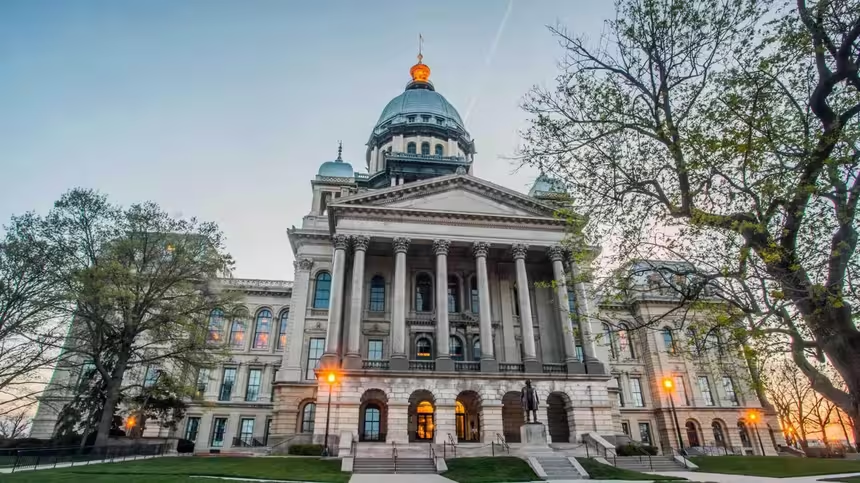
CapitolView
CapitolView is a weekly discussion of politics and government inside the Capitol, and around the state, with the Statehouse press corps. CapitolView is a production of WSIU Public Broadcasting.Providing Support for PBS.org
Learn Moreabout PBS online sponsorship(bright music) (uplifting music) - Welcome to "Capitol View" on WSIU.
I'm Jeff Williams in this week for Fred Martino as we take a look at what's going on around the state in Illinois politics.
And to help us guide that discussion this week, we are joined by John Jackson, visiting professor of the Paul Simon Public Policy Institute, and Brenden Moore, Illinois state government reporter for Lee Enterprises.
Gentlemen, welcome.
Thank you for joining us.
- Thanks for having us.
- Always a pleasure.
- Wanna start with a couple of federal court cases that broke late last week.
The first is a challenge to Illinois' assault weapons ban, the case that was heard last week in US District Court in East St. Louis.
In all likelihood, I believe it consolidated four other legal challenges to the assault weapons ban.
I think it's probably safe to say that this is the opening move in what will ultimately result in a Supreme Court review.
John, what is at the heart of this legal challenge to the state's assault weapons ban?
- This is just the latest in the Illinois case in challenging the rights of individuals under a couple of landmark Supreme Court cases.
The first was the Heller case, which was 2008, and the second landmark decision is called Bruen decision in which the court has ruled that individuals have a right to carry and keep guns, and Second Amendment applies to individuals rather than just to the states, as had been the law before that.
The question is, are there any limits?
And the question is being played out all over the country, not just in Illinois.
Ours, of course, is assault weapons ban, and that's what this one is about.
The critics of the court's decision have pointed out that all of the Bill of Rights at one time or another have restrictions on them.
They're not absolute.
Even Justice Scalia talking in the Bruen decision said that there can be some state and local government rulings that the right of the government prevails over the right of the individual.
And that's of course what's at stake here.
Is it going to be an absolute right?
For example, the critics of the decisions that the court has taken say that we've had a ban on machine guns since 1935, and it's been widely accepted and widely followed.
But the question here is, what is a machine gun?
Can a gun like an AK-47, AR-14, which can spew out 60 to 100 rounds a minute, is that practically a machine gun?
And the proponents of gun control say yes, obviously.
It's for military use.
It was made for military use, originally coming out of M-1s, M-2s, M-16s, which evolved this direction.
Most everybody agrees that the military's got to have these kinds of weapons for firepower and that law enforcement agencies have to have these kinds of weapons.
Where the gun control advocates want the line drawn, however, is that civilians should not have those kinds of weapons and the high capacity magazines that follow from it.
So that's the question here.
NRA wants all of these to go up to the Supreme Court because they think the majority of this court will be friendly to their position, and they've generally been right when they've made it to the Supreme Court, with some exceptions.
Illinois wants there to be some limits growing out of the tragic circumstance in suburban Chicago on July 4th, 2022 as the example that propelled this particular law.
So that's what's going on.
I might add that those who don't want any limits say that you're about to take guns away from peaceful citizens, law-abiding citizens.
The problem with that, of course, is the young man in Butler, Pennsylvania that almost killed former President Trump was a law abiding citizen by definition up until that point.
So that's what's going on.
- John, as you reference, it's a bench trial.
Judge Stephen McGlynn is expected to make a ruling in the coming months.
In the grand scheme, does it really matter which side of this case he ultimately decides on?
'Cause it does seem like that it is headed on a fast track to the Supreme Court.
- Well, one suspects that the NRA did what's called jurisdiction swapping.
He's in East St. Louis.
What little you can discern so far makes one think that he's likely to be sympathetic to the NRA position, but that's not known for sure until he rules.
- Okay, second case I wanna touch on is in the federal corruption probe of former Speaker of the Illinois House Michael Madigan.
There were several cases involved in this federal probe, one of the main ones involving former AT&T Illinois executive Paul La Schiazza.
His case ended in a mistrial last week when a federal jury couldn't really decide if he tried to bribe Speaker Madigan.
Madigan's own corruption trial is still scheduled to begin sometime next month.
Brenden, is this mistrial a setback in this federal probe or just kind of a bump in the road?
- I think that's still to be determined.
The judge has not scheduled a retrial yet.
He wants to hear more from both sides before that gets done.
The jury was deadlocked.
According to the "Tribune," it was an 11-to-one deadlock in favor of conviction.
So apparently they did convince the vast majority of jurors that this gentleman did attempt to bribe former Speaker Madigan.
The allegation kind of similar to the ComEd Four trials that Mr. La Schiazza, his company basically indirectly paid one of Speaker Madigan's allies, former State Rep Eddy Acevedo, over a nine-month period where he did little to no work as a lobbyist.
And in exchange, AT&T got favorable legislation, you know, passed out of the Illinois House, which obviously Speaker Madigan controlled with an iron fist.
So this is perhaps a setback but maybe just a temporary one.
You know, and obviously we saw in May of last year the ComEd Four were convicted of attempting to bribe Speaker Madigan.
And as you said, the former speaker goes on trial in a few weeks up in Chicago.
It'll be interesting to see, I guess, how the Supreme Court ruling from this summer maybe impacts that and maybe impacts this case, which kind of threw into question the government's use of the bribery statute to convict officials at the state level like Speaker Madigan.
So, we will see, but it does appear, though, that again, if 11 to one was the vote, that, you know, jurors seem to be more likely to convict than not.
But obviously in our system, you need an unanimous decision, and they weren't able to come to that in this case.
- Sure.
Let me ask... We're not unknown to convicting our elected leaders in the state of Illinois.
Brenden, have you noticed, has this had any impact, since it is a probe, and since it is former House Speaker Madigan?
Has it had any impact on the House during this legislative session in how they're conducting business at all that you can tell?
- Honestly, not a whole lot.
I mean, it's kind of surprising 'cause Speaker Madigan was speaker up until 2021.
But there's a lot of members that have not served with him.
There's been a lot of turnover in the House over the past few years, and so there's a lot of people that don't remember what it was like to serve under the speaker.
And, you know, the now speaker, House Speaker Chris Welch, has often said it's a new day in Springfield, that things are different, and they are different to an extent.
But you really don't see that influence all that much under the capitol dome.
You know, they did pass some ethics legislation after the former speaker left.
A lot of folks would say that it didn't really have a lot of teeth.
It could have been a lot stronger, but I think it's fair to say that there really isn't much of a cloud anymore on under the capitol dome besides maybe the reputational one.
It certainly doesn't affect the way that they do business all that much.
- Sure, sure.
Just a quick, quick, another quick question.
John, you've observed Speaker Madigan throughout his tenure in Illinois politics.
What do you think history is gonna write about Michael Madigan?
What would you write about Michael Madigan?
- Well, I think history will write two things.
One will be a negative, and one will be a positive.
The positive is he was a master at the political process.
He understood it.
He lived it and breathed it.
He was often referred to as the most powerful Democrat in the state or maybe even sometimes the most powerful person in the state, and it's because he knew how the legislative process worked.
And he got an enormous amount of things done, many of them good I think, and some of them would certainly be bad depending on who's doing the judgment there.
But of course, the old culture of the old ways of doing business in Illinois are what we're talking about here, and that remains to be seen in terms of the conviction and what might come and might not come out of his trial.
But he's going to be counted as perhaps the last of the old bosses and political way of doing business in Illinois.
- Changing gears a little bit, it is election season, and we're entering the final stretch leading up to the November 5th general election.
The vice presidential candidates will take the debate stage next week.
I believe that's a CBS debate, Republican Senator JD Vance of Ohio and the Democrat Minnesota Governor Tim Walz.
Gentlemen, what do each of you expect to see or hear?
What are you looking to hear or see out of next week's debate, which will probably be the last debate before the election?
- Well, Brenden, you can go first, and I'll go second on that, okay?
- Perfect.
Well, obviously, and, you know, John probably has watched a few more of these than I have, but vice presidential debates really don't tend to move the needle all that much unless there's a real terrible performance, which I guess there could be.
But really, the objective for both of the candidates will be to obviously defend their running mate and their record and try to draw a distinction.
I think you'll see a lot of focus on the economy, on the cost of living.
On the Democratic side, I think Governor Walz is gonna focus on the issue of abortion.
That's been a big issue Democrats have tried to play up ever since Roe overturned a few years ago.
Republican side, I think JD Vance will, Senator Vance will talk about crime and immigration.
You know, we've seen them play up some of these, I guess, false accusations and narratives coming out of Springfield, Ohio about Haitian immigrants and eating cats.
You know, perhaps, we see some of that.
You know, I would not be shocked if we see Governor Walz lean into his, "they're weird" narrative about Republicans, especially as we have that kind of discourse about some of those interesting topics about eating cats and things like that.
But at the end of the day, I don't expect it to move the needle all that much.
I think we saw, at least from the polling we've seen since the last presidential debate, that it maybe moved the, you know, polls maybe one point, maybe two points, if that, which could be decisive in a close race.
But again, I think, you know, they are fighting over, you know, thousands of undecided voters, not millions, you know, across a few crucial states.
So it's really gonna be micro-targeted at some of those few true swing voters that are left.
- Yes, I agree with that.
- John.
- It probably won't move the needle all that much, but I do want to emphasize this is a terribly important debate for a couple of reasons.
Number one, as we know, this is the understudy for the president, and it can change in a second, in a minute, as the Butler Pennsylvania case shows us dramatically.
So it's important there.
But indeed, secondly, and just as important, this is the first official decision that each candidate made, JD Vance on the part of Donald Trump, and of course, Governor Walz on the part of Vice President Harris.
So it's important to look at and examine how they behave.
And I think that will lead to some very interesting exchanges.
I think JD Vance is going to be having to defend what both he and Trump did with respect to the Springfield, Ohio situation because that fits their narrative, and they're mining it because it does fit their narrative, and Vance has advanced it almost as much as Trump has.
But on the other hand, there's been a lot of pushback, mostly from Republicans, from the governor on down to the mayor in Springfield.
So we'll see how he defends that.
I think Walz has got to fill in more about the vice president's economic position.
She spelled them out in great detail already, but the media haven't been paying that much attention.
And certainly there are lots of questions that the average voter still have about who he is, who she is, and how they might govern.
- Along with electing our next president and vice president, I believe all 435 House members are up for reelection this year.
And one of the congressional races in particular in Illinois has been targeted by the GOP, and Brenden, it's up in the central part of the state, the 17th district, between I believe first-term incumbent Eric Sorensen and his Republican challenger Joseph McGraw.
Brenden, tell us about this race.
Why is this one being targeted by the GOP?
- Well, it's quite frankly the only race that is up for grabs in Illinois this cycle.
I mean, most others, I think we have a pretty good idea what the outcome's gonna be.
This one is one truly competitive one.
So, as you mentioned, this is Central Illinois, Northwest Illinois-based district, kind of goes from Rockford to the Quad Cities to Peoria to Bloomington-Normal.
And you know, it's marginally Democratic.
It voted for Congressman Sorensen, a Democrat, by about four percentage points last time, and he's running for reelection.
But it's one of those blue-collar districts that Republicans think that they can play in, so they put up retired Judge Joe McGraw.
And, you know, so far, the campaign, Sorensen has focused a lot on what he's delivered for the district in terms of bringing money back, kind of using the powers of incumbency in that sense.
He's focused a lot on abortion, which is pretty big topic in that district as a border district with Iowa, where they have pretty much a total ban.
But McGraw has, on the other hand, focused a lot on crime, kind of trying to lean into his background as a judge and saying that "I'll be a law and order guy.
I will support law enforcement.
I'll support, you know, tougher stance at the border, on immigration."
So that's kind of where the playing field has been.
So far, I mean, McGraw just went up on the air with some television ads.
Sorensen's been up since beginning of September.
He has a lot more money than McGraw does, so he's kind of been able to get his message out a little bit more.
The national Republicans really have not been playing in this district just yet.
They were heavily involved in 2022 to try to elect Esther Joy King.
They spent, I believe, about $6 million.
You know, some top Republicans have have told me that basically they view kind of the House majority, very narrow House majority that they have, is gonna be won or lost in some of these House districts in New York and in California, on the coast basically.
So Illinois has kind of been lost in the shuffle so far, but, you know, we still have 40-some odd days until election day.
They could come in late and perhaps make it a little bit more competitive.
I think most would say that Sorensen is the favorite to win reelection, but again, it's gonna be probably be a single-digit race to the end.
- Sure.
John, we have incumbents in the 12th, 15th, and 13th Congressional Districts, I believe, what, two Republicans, a Democrat.
Do you expect any of those districts to flip in November?
- Not really.
Starting here where we live in Carbondale, deep Southern Illinois, Mike Bost is the incumbent.
He's well entrenched.
He's unbeatable, as he proved in the primary when he had take on the former Bailey, who was the Republican nominee for governor before he ran for this, and he beat Darren Bailey.
He'll be there as long as he wants to be.
He has Jackson County attorney Brian Roberts running against him.
But there is a bigger lesson here, and quickly it shows how much Southern Illinois, parts of Central Illinois, and much of the South have realigned.
When I came here, this was a stronghold for the Democratic Party.
We elected people like Paul Simon, Glenn Poshard, from the Metro East area, Alan Dixon, and Dick Durbin from the Metro East area.
And that was the power of the Democrats down here, and now it's all gone.
It's all red.
And the same story in terms of Mary Miller in the 15th.
She beat Rodney Davis to get into that position in the first place.
She's died-in-the-wool MAGA, an avid follower of Trump, and it shows what you get when you get a MAGA member of Congress.
I understand there's some complaints about her among local officials about how much she's interested in policy, but that's not gonna beat her.
And then finally, Nikki Budzinski, that shows what redistricting can do because the Democrats creatively created (laughs) a district that at least leans Democratic, and they've gotten Nikki Budzinski.
She's well recognized and well regarded, and Democrats think she's got a bright future.
- We've got about four minutes or so left, and I wanted to touch on the fall veto session.
I wanted to get into that by way of a story, Brenden, that I think you did last week.
There is a proposal to ban carbon sequestration within the Mahomet Water Aquifer.
And I think a bill to do that is going to go through the veto session, but kind of give us the backstory behind how that bill came about and the importance of this aquifer and what the carbon sequestration problem may create or do there.
- Yeah, so this is a really a follow-up from what happened in the spring session when state legislators passed state-level carbon-capture and sequestration regulations.
So this is technology that's heavily regulated at the federal level, but there were some gaps, and, you know, environmental advocates, in addition to some business groups, you know, wanted to fill those in and clarify some things.
So they did that.
They included a two-year moratorium on pipeline construction and, you know, clarified pore space ownership below the ground, things like that.
But left unaddressed was this issue of the Mahomet Aquifer.
So this is an aquifer that provides water for about 800,000 people in Central Illinois, about a 20-county area, roughly.
It is the sole source of water for these folks, so there really is not an alternative if something happens, unlike in some other areas.
So there was a real push to get protections in here that would prevent basically drilling within the aquifer area.
And this kind of, I mean, had been in the works for months, this legislation, which is sponsored by Senator Paul Faraci from Champagne and Representative Carol Ammons from Urbana.
But the same week they introduced it, it was reported by us and others that Archer Daniels Midland, which has the only classics well in operation in the country, basically allowing them to sequester carbon below their facility in Decatur, had basically violated their permit and the Safe Drinking Water Act by basically because there was a leak that allowed for carbon to basically be released above where they're permitted to inject carbon.
And this was 5,000 feet below the surface, so I mean, it was way below where any water was.
Water was not in danger in this case, but it just did underscore that this technology is not foolproof, that, you know, accidents can happen, that, you know, I guess this material can corrode, and so folks want extra safeguards.
And so I think you're gonna see a big push in the veto session perhaps next year if it doesn't get through in November to add these protections to the Mahomet Aquifer.
You know, business groups would say that you can't do that because that would severely limit where you could sequester carbon in Illinois.
Illinois is viewed as being kind of one of the prime places to do this.
But when you talk to folks that represent those areas, they'll say, "Even there's a 0.0001% chance something happens, we can't gamble with our drinking water."
And I think you're gonna see a bipartisan push on that from lawmakers from Central Illinois.
- All right.
John, about 30 seconds left.
Anything else you think will be popping up in the fall veto session?
- Not the veto session.
No, I don't think that's going to be much of a story.
I mean, it's mostly routine.
I do wanna say I think the story that we're missing is what's changing on the economy and how the media cover it because there is some movement.
It's the most important out there.
Everybody says that, and it has been moving somewhat in Harris's direction.
She points out that inflation is down.
Wall Street is up.
Your 401k is in better shape.
And of course, she advocates for her economic plan, and Donald Trump's out there advocating for his economic plan.
- All right.
John, thank you.
We'll let you have the final word for this week's "Capitol View."
John Jackson, Brenden Moore, thank you both so much for joining us.
For Fred Martino, I'm Jeff Williams.
Thank you for tuning in to "Capitol View."
(uplifting music)

- News and Public Affairs

Top journalists deliver compelling original analysis of the hour's headlines.

- News and Public Affairs

FRONTLINE is investigative journalism that questions, explains and changes our world.












Support for PBS provided by:
CapitolView is a local public television program presented by WSIU
CapitolView is a production of WSIU Public Broadcasting.