
Capitol View - September 28, 2023
9/28/2023 | 26m 50sVideo has Closed Captions
Capitol View - September 28, 2023
In this episode of CapitolView: Fred Martino talks with our analysts about a wide range of issues facing Illinois. We’re learning more about the ramifications of the state’s elimination of cash bail, a first in the nation effort. Plus: what does the state’s ban on assault weapons mean? And: we’ll hear about privacy protections being argued before the Illinois Supreme Court.
Problems playing video? | Closed Captioning Feedback
Problems playing video? | Closed Captioning Feedback
CapitolView is a local public television program presented by WSIU
CapitolView is a production of WSIU Public Broadcasting.
Capitol View - September 28, 2023
9/28/2023 | 26m 50sVideo has Closed Captions
In this episode of CapitolView: Fred Martino talks with our analysts about a wide range of issues facing Illinois. We’re learning more about the ramifications of the state’s elimination of cash bail, a first in the nation effort. Plus: what does the state’s ban on assault weapons mean? And: we’ll hear about privacy protections being argued before the Illinois Supreme Court.
Problems playing video? | Closed Captioning Feedback
How to Watch CapitolView
CapitolView is available to stream on pbs.org and the free PBS App, available on iPhone, Apple TV, Android TV, Android smartphones, Amazon Fire TV, Amazon Fire Tablet, Roku, Samsung Smart TV, and Vizio.
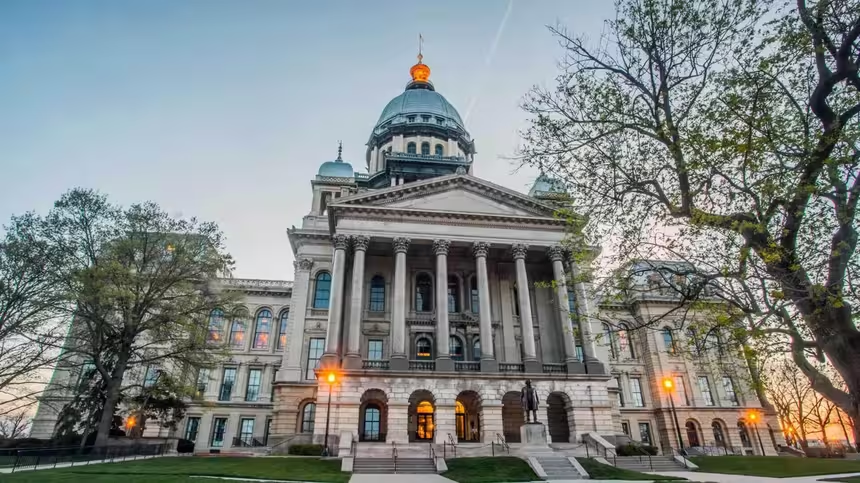
CapitolView
CapitolView is a weekly discussion of politics and government inside the Capitol, and around the state, with the Statehouse press corps. CapitolView is a production of WSIU Public Broadcasting.Providing Support for PBS.org
Learn Moreabout PBS online sponsorship(soft music) (dramatic music) - Thanks for joining us on "CapitolView."
I'm Fred Martino.
It's been an extremely busy time with a diverse set of issues facing Illinois.
We're learning more about the state's decision to eliminate cash bail, a first in the nation effort.
And the Biden administration has responded to calls from Illinois and other states to take action on some immigration issues.
That and much more from our panel, Dan Patrella, from the Chicago Tribune, and Charlie Wheeler, Emeritus Director of the Public Affairs Reporting Program at the University of Illinois, Springfield.
Dan, I want to begin with you with another issue, a very controversial one, new state police rules for assault weapons take effect October 1st, tell us about that.
And your thoughts on efforts by some to use this as a political weapon, saying that it's an attack on the Second Amendment.
- That's right.
So this goes back to the ban on a long list of high-powered firearms and high-capacity ammunition magazines that the legislature passed in January and governor J.B. Pritzker signed into law right when he was sworn in for his second term.
And beginning on Sunday, people who owned the weapons that are now banned at the time the law went into effect on January 10th, I believe it was, will have to fill out an affidavit to be filed with the Illinois State Police, essentially notifying the state police that they own those weapons, that they're grandfathered in and not subject to the ban.
The big question is whether this law is going to, you know, withstand scrutiny in the courts.
The Seventh Circuit, US Court of Appeals heard arguments over the summer on this issue and has yet to issue a ruling on whether the law will stand.
It's one that could very well make its way to the US Supreme Court, so it's really an ongoing issue.
But nevertheless, unless the Seventh Circuit comes down in the next couple days and throws out the law, this registration system is supposed to take effect starting on October 1st.
We have already seen some folks such as former Republican governor candidate, Darren Bailey say that, you know, they don't believe this is right, that they will, you know, essentially have a standoff on their front porch if somebody comes to take their firearms.
Of course, no one is coming to take anyone's firearms.
So, Second Amendment proponents have really made it a political issue and it'll be interesting to see what compliance with the new registration requirement is like and how the state police and other law enforcement go about enforcing that.
- You know, do you think that the political weight of this is diminished by the fact that we see so many polls where there is very broad acceptance of certain restrictions for gun safety like universal background checks, restrictions on assault weapons, and the like?
- You know, I think it's a very interesting question, because it is, you know, I think Democrats put forth the law out of the sincere belief and also because they know it is something that is strongly supported by a wide swath of the public.
The question is whether it is supported by a majority of the nine justices on the US Supreme Court, because that's ultimately what will be, you know, the arbiter of whether this survives.
You know, we saw them last summer, I believe, was the summer of 2022 strike down New York State's concealed carry restrictions, and saying that they were too onerous.
And that's really the question of whether the proponents of this ban here in Illinois can find a way to fit it into the framework that the US Supreme Court has set up for what is an allowable restriction on gun ownership.
- Okay, well, we'll be watching.
Charlie, another law enforcement issue.
Illinois is now the first state to eliminate cash bail and the political attacks have already started.
- Yeah, and that's true.
And for some little background, under the old system, people would be brought in, hauled before a judge, and in a couple minutes the prosecution would speak, public defender would speak, if there were a defender.
The judge would say, "Okay, Wheeler, you can go.
Your bail is $500,000."
And then I would have to put up 50,000.
And if I could put out the 50,000, I could walk free.
It didn't matter what I was charged with.
On the other hand, if I were someone who was, for want of a better term, someone who was in poverty and could not come up with the money no matter how slight the offense might be, I'd be sitting in jail for months, losing my livelihood for my family, sometimes even losing the custody of my children.
And so the state, oh, I think it was right at the end of the last legislative session, decided to do away with this and put in a new system where people in most instances can go free unless they pose a threat, a specific real and present threat to somebody else or if they're a flight risk.
And one of the very first cases in Cook County involved a woman who was arrested for, let me make sure I get what her offense was.
She was attending the Mexican Independence Day festivities, and around 2:30 AM that evening, or I guess the next morning, she allegedly pulled out a canister of pepper spray and sprayed it at four Chicago police officers.
And ultimately she was let go without being held.
And there was a lot of complaints about it and people were really going crazy.
"When is it okay to pepper spray police officers?"
The public defender for her noted that this was her first Chicago arrest.
She's a sole provider for her young child.
And prosecutors didn't seek to detain her.
And what I thought was interesting, and the judge said to her, the one thing you have to do is you have to be here for your next hearing or you're gonna go in the slammer.
What I thought was interesting, all this wailing and gnashing of teeth, Will Lee who is the bond court reporter, longtime bond court reporter for The Trib, pointed out under the old system, she would've walked anyway.
She would've had to put up a $500 bail and then she'd be out the door anyhow.
- Yeah, yeah.
And that's an important point.
I wanted you to get there in terms of that first case, because that's not the only issue that we've seen where if you look at this law you have to have all the information, you have to have the context.
And Dan, while some republicans try to use the elimination of cash bail as a safety issue, "Capitol News Illinois" had a very interesting angle, a story that notes murder suspects who would've been released on bail under the previous system are now actually staying in jail.
- That's right.
And, you know, I think one of the things that's been overshadowed in a lot of the political rhetoric surrounding this issue is the fact that the elimination of cash bail, this new system was widely supported by groups that advocate for victims of domestic violence, other groups like that because they, you know, it prevents situations where someone who might actually present a danger to the public or to, you know, specific people can get out of jail.
As Charlie alluded to earlier, just simply because they have access to the money or because they have a relative who can, you know, put up their house as collateral or what have you.
You know, or can, you know, can tap into a, you know, investment account or whatever to pay their bail.
You know, it's an issue that the Democrats, I think, didn't quite message maybe as much as they could have as they were in during the 2022 election cycle, defending on these attacks that they're soft on crime.
They were very much focused on the equity and and justice part of this argument.
You did hear them sometimes say Governor Pritzker and others that, you know, this will allow us to keep dangerous people in jail.
But that wasn't really the main focus of why they were proposing the law or the way that they were defending it.
- In a sentence, while cash bail was eliminated, it doesn't mean detention is eliminated.
- That's correct.
Yeah, that's correct.
It gives judges more, you know, ability to review the specifics of a specific case and determine whether this person poses a risk, or as Charlie says, poses a risk that they're not gonna show up for court when they're supposed to.
And it'll, you know, it'll be interesting to see.
I don't think these small anecdotal instances are really gonna tell us much.
I think it's gonna take time for the system to get fully implemented and to really be studied to see what the effect has been.
The research that has been done so far, from my understanding in places that have, no one's gone quite as far as Illinois has, but people have done bail reforms that are akin to this, there hasn't been, you know, huge spikes in crime seen in those places.
So it'll be interesting to see what happens here over the next several months and years.
- And one hitch in.
- If I could follow from that.
It was interesting, 'cause here in Sangamon County, and Sangamon County is not a rabidly left wing county, it's basically pretty conservative.
But our sheriff, Jack Campbell said after the first few days of this, he said he didn't know whether this was gonna cause more crime or not.
He said, I think in three months we'll have a very good idea.
And then the chief judge of the judicial circuit that includes Sangamon County also said that we just don't know what the effect will be long-term.
Talk to me in three or six months.
So as Dan said, the anecdotal evidence doesn't really tell us that much about how this is gonna play out.
- Yeah.
Context and data, that's what we need.
However, we also need clarity, as I said, that just because cash bail is eliminated, it doesn't mean that everyone goes free.
There's still an ability to do detention in certain cases.
And as I mentioned that story by "Capitol News Illinois," found that in fact murder suspects who would've gone free if they had cash bail offered to them, now are sometimes staying in detention.
Charlie, one more story on the elimination of cash bail that is worth noting and that is part of the context.
Columnist Rich Miller wrote about a "Capitol News Illinois" story that uncovered an interesting fact.
According to Illinois law, only counties with 35,000 residents are required to set up an office of public defender.
So we don't have, you know, equality across the state in terms of the infrastructure to support our justice system.
Let's talk about that, Charlie.
- Okay, well, as you said, the law, and I think it's a law that hasn't been updated since 1949, says only counties with 35,000 or more residents are required to set up offices of public defender.
And out of the 103 counties in Illinois, 63 of them are less than that.
As a matter of fact, if I'm not mistaken, only maybe a couple dozen counties actually have more population than the typical ward in the city of Chicago.
And so in Cook County, the judge who's presiding over this, Mary, and I'm not sure if I'm pronouncing her name correctly, Mary Marubio, said it's not so different from how we release people now.
It's just that money will no longer be a condition of release.
On the other hand, and this was a story about Hannah Meisel of "Capitol News," she spoke to the, for want of a better term, the part-time public defender in Gallatin County, a man named Nathan Rowland.
He's the part-time public defender serving Gallatin and neighboring Hamilton.
The two counties between of them have a population of roughly 13,000 based on the 2020 Census.
He's also the President of the Illinois Council of Chief Defenders.
And he points out that for these smaller counties, it's very difficult to be able to have a full-time public defender.
And so you have to have part-time people or counties have to share a public defender.
And in his area down in southeastern Illinois, it's difficult for other reasons too.
For example, he pointed out that neither the counties that he serves, neither Gallatin nor Hamilton, actually have a jail.
So when they have to bring somebody before the court for a bond hearing or for whatever, they have to get sheriffs from neighboring counties to bring them from the neighboring county jail into Gallatin or into Hamilton.
He also pointed out that there's no real funding mechanism for public defenders whereas many other states actually have a state system to pay for public defenders, which by the way, I think would be a good idea in Illinois.
- [Fred] Okay.
Well this is interesting, like so many.
- Another thing that I found interesting in this discussion with Mr. Rowland, - [Fred] Mm-hmm.
- he pointed out that people talked about, well, electronic monitoring, we're gonna use electronic monitoring.
He pointed out many rural areas such as the ones he serves, electronic monitoring wouldn't really work, because there's lots of areas that don't have cell phone coverage, no reliable broadband, even landline.
So somebody could be on electronic monitoring and suddenly the systems go down and they say, "Okay, you're off."
But is it because you actually strayed or is it because the backup just crashed?
And I thought that was interesting.
As I say, the way around this, in my judgment, would be for the state to set up a process where we have a public defender, an office of public defender, that provides, they don't need it for Cook County, but that provides it for some of the small rural counties.
- Yeah.
So it may have revealed another issue that goes far beyond this change in the law, eliminating cash bail.
Dan, we're gonna move from crime to another hot button political issue, and that is immigration.
And the Biden administration has responded to calls by Illinois and other states to help immigrants get work permits.
Tell us about this.
- That's right.
Officials in Illinois and Chicago and other places as well, New York and elsewhere, have been calling for months for the Biden administration to ease the process by which asylum seekers are able to get permission to work while they're here in the country.
It had really been met with sort of radio silence from the White House for quite a while.
And then last week they announced that they would make some changes, largely targeted toward particularly people who have arrived from Venezuela, which is a decent percentage of the folks who have been coming to Chicago and elsewhere from the southern border, speeding up the process for them to get work authorization.
You know, it's hard to get an estimate out of the state and city of exactly how many people this would affect.
As of, I think it was late July, there were about 4,000 Venezuelan migrants in the shelter system in the city of Chicago, that didn't count people who had already left the shelters and gone elsewhere.
You know, this is something that folks are hoping that will sort of alleviate the strain on the infrastructure here in Chicago for sheltering and caring for the migrants.
Because part of the problem is that they're not legally allowed to work when they arrive, so they're dependent on, you know, either nonprofit organizations or the government to provide shelter, food, and take care of their medical needs, those sort of things.
You know, it's a question whether this will be, the process will be made easier for people arriving from other places in Central America as well in South America.
And so, you know, I think the system here in Chicago is still very strained.
There's been a lot of discussion recently about a proposal that Mayor Brandon Johnson has made to house folks in sort of tent encampments.
And there's some money from the state that's supposed to be getting awarded later this week to help municipalities and counties care for folks who are arriving.
So it's a very thorny issue.
And there's a lot of hope that this work authorization move by the White House will sort of alleviate some of that burden and allow people to sort of start establishing themselves here in Illinois.
- And what's so very interesting is an issue that's continuing to grow, as we've seen in recent weeks with the surge on the border and many places including El Paso still busing folks who, in that case, in the case of El Paso, folks who wish to be bused to another city, Chicago and New York among the cities where there's enormous stress in terms of housing and food and other issues.
So something we'll be watching.
Charlie, another very important issue I want to get to in our remaining minutes here.
While the Illinois Supreme Court considers the state's existing privacy regulations, lawmakers are talking about broader privacy issues.
This one affects all of us.
Tell us more.
- Well, this is a proposal put forward by senator, excuse me, Sue Rezin, who's a Republican from Morris, to put in place an "age-appropriate design code," and that's in quotes.
Basically, it would require companies that offer online services likely to be accessed by children to assess the impact of those services and explain privacy policies in language that children would understand.
And companies that violate this will be subject to fines up to $2,500 for negligent violations of privacy protection.
One of the things I found was interesting is that the legislation spells out all of this, you know, all the requirements.
And the law itself says that before any new online services, products or features are offered, a company has to complete a data protection impact assessment for any online service likely to be accessed by children, maintain documentation of this assessment as long as the online service is likely to be accessed.
And this is a brand new law.
And as you say, it builds on the privacy law where Illinois is one of the national leaders.
One of the things that's interesting about this particular legislation, which is an amendment to a bill that started out as a bill dealing with banking, it sets up a children's data protection working group made up of folks who have experience in children's data privacy, physical health, mental health, computer science, children's rights.
And it will be an eight person group, two people appointed by the governor, two by the president of the senate, two by the speaker of the house, and two appointed by the AG.
And they have a pretty busy agenda.
They're gonna take input from a broad range of stakeholders.
They're going to try and identify these services that are likely to be accessed by children, figure out what would be the best interest of children with respect to their privacy.
There's a whole laundry list of things they're supposed to do.
But what I found was most interesting is that this proposed law, the bill also would say on or before January 1st, 2024, the working group shall submit a report to the general assembly.
And I'm thinking to myself, well, let's see, the veto session starts in October, and so it's not likely that this bill will be enacted into law much before November.
So in essence, you're asking this group in six weeks to take on this monumental task.
- Yeah, we may see a delay there for sure, but a very important issue, and I didn't want to ignore it, because a lot of people concerned about privacy, not only when it comes to children, but for all of us.
Dan, I want to wrap up here in our final minutes with another important story.
We recently reported on major incentives being used to attract a battery manufacturing facility in Illinois.
The company is based in China and the political attacks have already started.
Tell us about this.
- That's right.
The Pritzker administration has really been trying to position Illinois as a hub for electric vehicle manufacturing and electric vehicle parts manufacturing.
They've had, you know, very few big successes so far, but one of the really recent major successes was the attraction of this Gotion battery plant to come into Manteno, down in Kankakee County.
It's a facility that's supposed to eventually employ about 2,600 people.
A $2 billion battery factory for electric vehicles.
And it's about half a billion dollars in state incentives that helped bring them here.
But the Illinois Republican Party and others have charged that this company is too closely associated with the Chinese Communist Party.
Even going so far as insinuating in campaign fundraising emails and things of that nature that the Chinese government might be using it to spy on military bases in the area.
The mayor of Manteno pointed out to Crain's Chicago Business I believe it was, that if there are military bases close by where this factory is supposed to go they've been operating in secret, because he's not aware of them.
There are some that are, you know, within the broader region, but definitely nothing like bordering where this battery plant is going in.
But, you know, it's hard for republicans to admit victory for Governor Pritzker on attracting a major business development to the state, because part of the narrative that they have tried to build now for, you know, five, six years about Pritzker and the Democrats is that they're destroying business in Illinois and their policies are causing companies to flee the state.
So, you know, when the governor does get something like this that's sort of a feather his cap, it doesn't really leave the Republicans a lot of of room to maneuver.
You know, I think, I believe it's even in a Republican legislative district where the battery plant is going.
I might be incorrect about that, so I should fact-check myself, but yeah.
- It's fascinating, isn't it?
And this is fascinating on a national level, because think about all the noise we heard about the fact that China, a Chinese company in our final minute here, controls one of the most popular social media platforms, TikTok.
And now, you know, that's not even in the news anymore.
Not to say that it's not a question and an issue and that it'll be revisited, but we don't know yet if this has teeth, do we?
- No, you know.
- What I found interesting about is, is Mark Denzler, who's the head of the Illinois Manufacturers Association, when this brouhaha about this Gotion company erupted, pointed out that they have another plant up in Michigan and it's been cleared by the feds that this is not.
- The federal government.
Okay.
Dan, final word on this, Dan.
We got about 20 seconds.
- Yeah, no, I was just gonna say, it's one of those things where, you know, each party is always trying to position itself as the one that's better for the economy and for workers.
And so, you know, instead of of taking the victory of, you know, potentially 2,600 jobs coming to a district represented by a member of their party, the Republicans have to try and find an angle to criticize and attack the governor.
- All right.
Well, that is our time for now.
Thanks to my guest, Dan Patrella from the Chicago Tribune.
Charlie Wheeler, Emeritus Director of the Public Affairs Reporting Program at the University of Illinois, Springfield.
Thanks for being with us at home as well.
For everyone at WSIU, I'm Fred Martino.
Have a great week.
(dramatic music)

- News and Public Affairs

Top journalists deliver compelling original analysis of the hour's headlines.

- News and Public Affairs

FRONTLINE is investigative journalism that questions, explains and changes our world.












Support for PBS provided by:
CapitolView is a local public television program presented by WSIU
CapitolView is a production of WSIU Public Broadcasting.