
Capitol View - September 5, 2024
9/5/2024 | 26m 46sVideo has Closed Captions
Capitol View - September 5, 2024
Analysis of the week’s top stories with Kent Redfield, emeritus political science professor at the University of Illinois Springfield and Jeremy Gorner of the Chicago Tribune.
Problems playing video? | Closed Captioning Feedback
Problems playing video? | Closed Captioning Feedback
CapitolView is a local public television program presented by WSIU
CapitolView is a production of WSIU Public Broadcasting.
Capitol View - September 5, 2024
9/5/2024 | 26m 46sVideo has Closed Captions
Analysis of the week’s top stories with Kent Redfield, emeritus political science professor at the University of Illinois Springfield and Jeremy Gorner of the Chicago Tribune.
Problems playing video? | Closed Captioning Feedback
How to Watch CapitolView
CapitolView is available to stream on pbs.org and the free PBS App, available on iPhone, Apple TV, Android TV, Android smartphones, Amazon Fire TV, Amazon Fire Tablet, Roku, Samsung Smart TV, and Vizio.
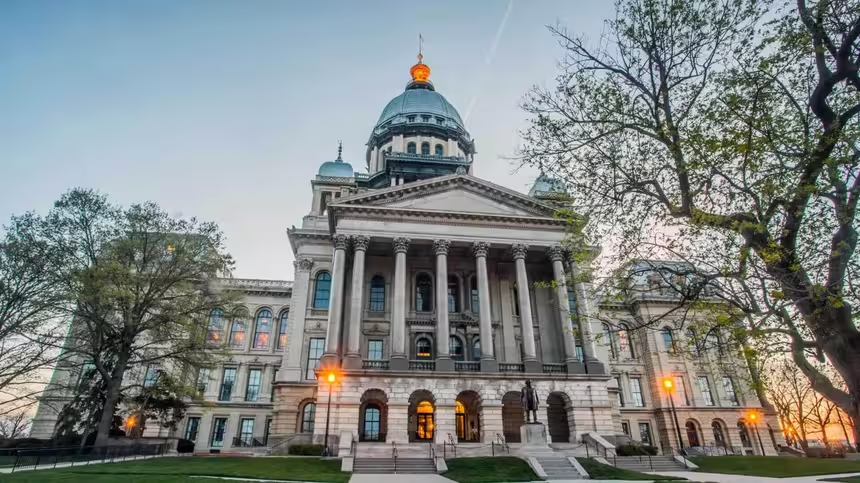
CapitolView
CapitolView is a weekly discussion of politics and government inside the Capitol, and around the state, with the Statehouse press corps. CapitolView is a production of WSIU Public Broadcasting.Providing Support for PBS.org
Learn Moreabout PBS online sponsorship(soft music) (dramatic music) - Thanks for joining us on "Capitol View."
I'm Fred Martino.
Calls for state action after four people are shot to death on a suburban commuter train.
Meantime, part of the state's concealed carry law is ruled unconstitutional.
And an investigation finds little oversight of campaign donations in Illinois.
Those stories and much more this week with Kent Redfield, he's emeritus political science professor at the University of Illinois Springfield, and Jeremy Gorner of the Chicago Tribune.
Gentlemen, thank you for being with us this week.
- Good to be here.
- Good to be here.
- Kent, I want to start with you.
We're gonna begin with a story that's putting Illinois in the headlines.
After a shocking tragedy, four people were shot to death this week, apparently a random shooting on a Blue Line train in Forest Park.
Forest Park Mayor Rory Hoskins called the murders a "outlier," but he asked for leaders in Springfield to consider investing in more public safety resources.
Kent, I'd like to get your thoughts on this and how might the state act with continuing gun violence in Chicago and elsewhere.
And as we tape this on Wednesday, just Tuesday night, another shooting, this one in Rogers Park.
A CTA employee was shot and seriously wounded.
So a continuing problem.
- Yes, and this is one of those stories that just brings together a whole number of things that we're struggling with.
Obviously, by definition this is a mass shooting.
We've killed more than four people other than the gunman.
And it isn't someone opening fire in a crowd or something like that, but rather appears to be kind of systematic, almost executions of people on a train.
So there's that aspect.
There's an aspect of homelessness.
The fact that this is on part of the mass transit system within Northeastern Illinois.
This is an area we're gonna have a huge showdown in the General Assembly next spring over, how are we gonna organize mass transit?
Who's gonna be in charge?
How are we gonna fund it?
And so the mayor's concern that, these are a couple of lines that are ending in his city, so these are drop off and pickup points in an area that has relatively limited police capacity.
And so, yes, we wanna make trains safer, we wanna deal with all aspects of mass shootings.
Later, we're gonna talk about concealed carry, its relation to how do you make trains safer.
Harden the target, more guards, arm the passengers.
What do you do with this person?
Apparently, at the moment, no motive.
But it raises the issues of access and how to restrict access.
How do we screen?
And so this just kind of opens up this plethora of ills that we have in terms of things that we need to be wrestling with.
- Yeah, I think you hit on the issue here, that this is such a complex issue because indeed we're talking about gun safety regulation as one aspect of this, but mental health, another issue in these cases and other cases and the need for infrastructure in terms of mental health.
There's training issues in terms of law enforcement, awareness of the public to be aware when you're on public transit or elsewhere if you see something suspicious.
So there's just so many different aspects to this.
But it also comes down to the proliferation of guns in our society.
And that when you do have someone who wants to do harm, the ease of which to do that when you have a firearm is different than if there wasn't the easy access that there often is in this country.
- Short term, we are where we are.
And so in terms of a legislative response, I think there will be a lot of sympathy for trying to provide, essentially harden the target.
From an economic sense, that's going to be attractive.
The whole point is to get ridership so that you reduce congestion so that you make people's lives easier, they can move about the area.
And if people are afraid to go on trains, then you're defeating the whole purpose, which is to maximize the ridership because of the public benefits.
- And there's another issue that you're raising.
So another possible issue from this.
It has truly been one of those tragedies that has made national news, unfortunately in the last week, to really raise a lot of fears and a lot of concerns.
I wanna move on now to Jeremy, because there was another story this week related to gun safety, ironically, related in a way to this.
It's a federal court decision.
A judge has ruled that a section of the state's concealed carry law is unconstitutional, directly related here.
Tell us about this court case, Jeremy, that you reported on.
- Yeah, Fred.
So basically this case arises from 2013.
Illinois in 2013 became the last state in the country to adopt a concealed carry law.
And that measure included a number of places where concealed carry license holders were not allowed to carry guns, such as government buildings, such as stadiums where sporting events take place, hospitals and public buses or trains.
Fast forward to 2022, four people, three of whom are from the Chicago area, filed a lawsuit basically arguing that the provision that prohibits CCL holders from carrying guns on public buses and trains violated their Second Amendment right to self-defense and right to bear arms.
And basically what these four plaintiffs had said in court papers is that they would ride the CTA and Metro lines more often if they were allowed to carry a concealed weapon aboard the public transportation systems.
But, of course, if it weren't for fear of getting arrested basically.
- And apparently the judge agreed and said this was unconstitutional, but the law remains in effect.
Is that right?
- Yeah, the law remains in effect.
So the law, technically, if you read the decision, it only mentions the four plaintiffs that this decision applies to.
But their lawyer is arguing that, "Yeah, it only mentions the CTA and Metro, "it only mentions my four clients.
"But what's called into question "is the broader applicability "of this decision down the road."
Who knows what this could mean in the future?
I mean, as far as the plaintiff's lawyer's concerned, this is a decision that could arguably apply to every CCL holder who wishes to take public transportation.
But obviously what this lawyer did was caution, when I spoke to him via email, cautioned that if you are a CCL holder, he wouldn't advise taking a concealed weapon onto a bus or train because he doesn't want those people to get arrested.
So we'll see what happens.
I mean, certainly, the attorney general's office has basically said, "It is important to note "that this only applies to the four plaintiffs, "but we will likely appeal the ruling."
So, yeah, it is still the law of the land, but I think what this decision has shown is that, this is the first evidence I've seen where this law has been called into question like this where there was a ruling in the gun rights community's favor.
So that's basically where it stands now.
- Very interesting.
And, again, another reminder of the complexity of this issue.
Because it involves so many different things, and then often goes to the courts to decide, so in terms of actual gun safety legislation.
Well, influencing the legislation, influencing the courts, many would argue, campaign contributions.
And, Kent, that brings us to our next story.
Gun safety, many other issues often in the spotlight when it comes to campaign donations.
And the Chicago Tribune had a very interesting investigation, finding that big money floods Illinois campaigns with few rules and little enforcement.
Tell us about this.
- Well, we are existing in an era defined by the U.S. Supreme Court, which has made it very difficult to limit the flow of money because basically they have ruled, through a series of decisions, that spending money on politics is protected speech.
And so they want states or the federal government to restrict when they try to place limits, when they want to restrict it, to just strictly quid pro quo kinds of situations, essentially a bribery or extortion.
They will allow some regulation in terms of the appearance of corruption.
So they're interested in corruption, the appearance of corruption.
And so Illinois does have contribution limits.
You as a citizen can only give 6, $7,000 to your favorite candidate.
But it turns out that there are a number of ways to move around those limits.
And two quick things here.
Illinois has a very permeable system, but it also has a very transparent system.
And so one of the reasons that Rick Pearson and Ray Long can write this story is that you have to organize and file committees and file reports with the state Board of Elections.
And if you're spending independently of a campaign, you still have to file reports with the state Board of Elections.
And so these documents are out there.
But our ability to keep private money from coming in is severely limited, both by independent expenditures, but also, what the story shows, is legislative leaders use a couple of loopholes.
Having to do with, either if you self-fund or if somebody spends a lot of money in your race in independent expenditures, we waive the limits.
And now we have legislative leaders routinely then funding their own race for the legislature.
That allows the limits to come off.
The sums are staggering.
The operating engineers in the last election cycle contributed $22 million to campaigns.
On the other hand, if you're a very rich individual who wants to run for office like Bruce Rauner or JB Pritzker, you can spend your own money, an unlimited amount.
The governor, two campaigns ago, started off by putting $125 million in his campaign fund.
In the Republican primary in 2022, Darren Bailey was funded by Dan Proft and Richard Austin was funded by Ken Griffin.
Close to $100 million coming in either directly or indirectly.
So we do have transparency, but there is absolutely no question that big, big money is flowing into the system.
And you have to ask, what impact does it have?
I think it's pretty clear it has a big impact.
- Yes.
Very good reporting.
Something everyone should read this week.
Jeremy, you covered another story making news.
This was last week.
The Illinois Supreme Court has sided with Republicans, upholding the unconstitutionality of a ban on candidates named by the party who did not run in a primary.
But lost in some reporting on this is an important point in your story.
This decision only affects the November election.
If no changes are made, in future elections, candidates would have to run in the primary, correct?
- Correct, yeah, so basically, like you said, Fred, this decision only applies to this upcoming election in November.
And basically what this means is that... Before what happened is that, before Democrats moved to change the law during the last spring session, local Democratic and Republican committees, they regularly fill vacancies for legislative spots on the general election ballot in races where there were no candidates from the respective party that had run in the primary.
And the candidate slated by the political party was still required to obtain the necessary candidacy petitions to run.
But if a party did not field a candidate in the primary, didn't mean they couldn't run the general election.
So this law was meant to put a stop to that.
And, of course, there were a lot of Republicans who cried foul when Governor Pritzker signed this into law, because they looked at it as, you're trying to basically change the rules in the middle of an election year.
But either way, like, so what you saw was this Sangamon County judge basically ruled it unconstitutional.
But once it was appealed and it went to the Illinois Supreme Court, there were two Supreme Court justices, Scott Neville and Joy Cunningham, they recused themselves from the decision.
And that was something that I couldn't confirm exactly why that was.
So that's basically two of the seven members.
So that leaves five remaining justices.
And they were divided on the Sangamon County judge's finding of the law being unconstitutional.
So according to the Illinois Constitution, you need four concurring justices to decide on cases.
So basically the state Supreme Court was forced to basically punt the issue back to the circuit court.
So that's why the ruling stands the way it is.
But the overarching message here is that it's only going to apply to the November election.
Unless there's a change in the law between now and 2026, which is gonna be the next election or anything like that, then the old law, the way it was, is gonna remain the same.
- Very interesting.
And we'll see how it all plays out.
Some would argue, of course, a good thing that we may have more information then about the general election candidates if they have to run in a primary and we get more familiar with them through that process.
Kent, a recent investigation found that state money to eliminate food deserts was not a quick fix, with many grocery stores receiving one-time funds unable to continue operating.
Well, a new report this week from the Chicago Sun-Times looked at a different program.
That investigation found Chicago's answer to food deserts has left a trail of debts, lawsuits, and even a utility bill that has not been paid.
Tell us more.
- Well, this is a situation where we do have food deserts, particularly in a number of urban areas where it is very difficult, particularly if you don't have access to an automobile, to get to a grocery store.
We encourage people to buy food, prepare it at home.
This is the most efficient, cost-effective, and healthy way for people to feed themselves.
And so we obviously would like to have more shopping opportunities for people, particularly in distressed areas.
The market does not work in these situations.
If you can't make money, if you don't believe that you can keep your employees or your customers safe, then businesses will withdraw from areas, and that contributes to further decline within those areas.
And so the city of Chicago wanted put money into a program to see if you could start up and sustain locations that would be essentially grocery stores.
You have to find a partner in terms of doing that.
And, again, if you are Walmart, you know where you can make money and how you maximize making money.
They're not good economic opportunities.
- And so they found a partner which made a lot of promises for a lot of different stores to open, but in the end, only one apparently did, and it never really took off.
There was only one location potentially.
It's very interesting because it's a notoriously low profit margin business, the grocery business.
So critics might say, "This could have been predicted, this happening."
- Yeah, I think it's very difficult for government to come in and try to say, "Well, the market doesn't work.
"We'll put some money in there and fix it."
And there's not a good history with that.
I mean, long term you wanna develop areas so that you can attract business.
Short term, you have to work.
Can you do things with transit?
Can you do things with food banks?
Are charitable organizations, what are the things that you can provide that are going to make lives better?
Just throwing money, doing something sometimes is not the best strategy if it's not economically sound.
- Okay, well, thank you, Kent.
We have about three minutes left, Jeremy, for our last story.
Stunning news about a lawsuit settlement from Capital Fax.
It reports the tollway paid a construction company $25 million after neglecting to follow state law.
Tell us what happened.
- So, first of all, what's at issue here is a section of I-290 and I-88.
This is part of the western suburbs of Chicago.
That's been under construction for such a long time.
And like the Daily Herald story mentions in Capital Fax, months of construction delays.
But what happened was that, according to tollway officials, the contract was canceled because of a relatively new provision in state law providing a bid preference for companies based in Illinois.
And it was inadvertently excluded from the original contract bid evaluation in this case.
And in this case, it was not an Illinois company that got the bid, it was a New York-based company.
And what ended up happening is basically the contract was canceled in May really without any explanation to this New York-based company.
So they sued for breach of contract.
They noted that they had already hired workers and bought materials, and, according to Daily Herald, they were already actively excavating and grading.
So, yeah, I mean, so it was a $15-million settlement covering the actual construction costs, plus 10 million related to damages.
And it looks like too that the tollway board agreed to pay the subcontractors for this New York-based company an additional $6.5 million for construction work.
So, yeah, basically what this means is that if the bid preference had been applied like it should have been according to the state law, it would've been awarded to a Chicago-based company, Walsh Construction, very well-known construction company.
Does a lot of business on the highways in the Chicago area.
So, yeah, really what this comes down to is, this provision wasn't included in the contract to give bid preference to companies based here in Illinois.
And evidently when they saw that this was a company that was based out of state and canceled it, that's when this out-of-state company sued and won.
Not won, but there was a settlement, yeah.
- Great summary of this, Jeremy.
And putting my reporter hat on, when I read this summary that I sent for this week's show, it's just the classic case of begging for a follow-up to find out, what broke down in the oversight that allowed this to happen?
And now we have a $25-million settlement.
And then the other follow-up might be, well, what about the effect of this preference for Illinois companies?
How much does that cost?
And what was the difference in the bids by doing this?
Obviously, this company won for a reason, I assume, initially, and what was that reason?
So very interesting stuff and one that I hope we'll have a chance to follow up on.
Jeremy and Kent, thank you both for being with us.
- Good to be here.
- Thanks, Fred.
- Thank you at home for joining us.
Thank you as well.
For everyone at WSIU, I'm Fred Martino.
Have a great week.
(dramatic music) (dramatic music continues)

- News and Public Affairs

Top journalists deliver compelling original analysis of the hour's headlines.

- News and Public Affairs

FRONTLINE is investigative journalism that questions, explains and changes our world.












Support for PBS provided by:
CapitolView is a local public television program presented by WSIU
CapitolView is a production of WSIU Public Broadcasting.