
CapitolView | May 14, 2026
5/15/2026 | 26m 46sVideo has Closed Captions
Brian Sapp talks Illinois politics and current events with Jason Piscia and Mawa Iqbal
Brian Sapp talks Illinois politics and current events with Jason Piscia and Mawa Iqbal
Problems playing video? | Closed Captioning Feedback
Problems playing video? | Closed Captioning Feedback
CapitolView is a local public television program presented by WSIU
CapitolView is a production of WSIU Public Broadcasting.
CapitolView | May 14, 2026
5/15/2026 | 26m 46sVideo has Closed Captions
Brian Sapp talks Illinois politics and current events with Jason Piscia and Mawa Iqbal
Problems playing video? | Closed Captioning Feedback
Where to Watch CapitolView
CapitolView is available to stream on pbs.org and the PBS app.
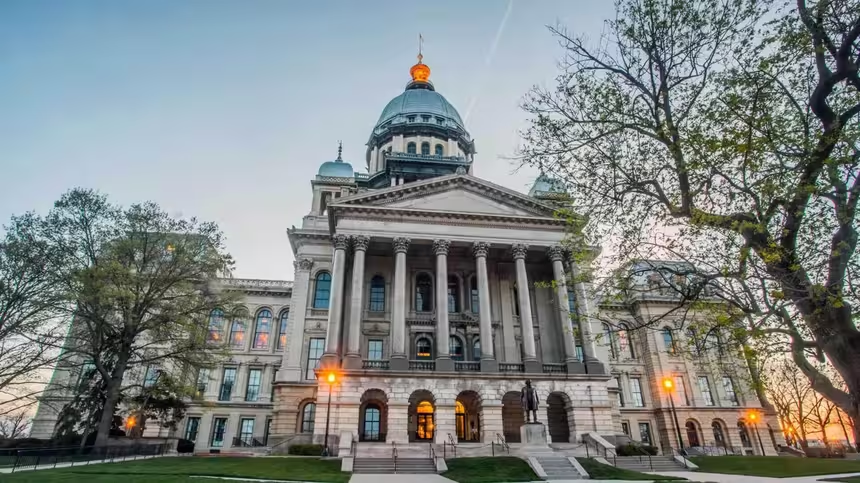
CapitolView
CapitolView is a weekly discussion of politics and government inside the Capitol, and around the state, with the Statehouse press corps. CapitolView is a production of WSIU Public Broadcasting.Providing Support for PBS.org
Learn Moreabout PBS online sponsorship[MUSIC] >> Welcome to Capitol view on SIUe.
I'm Brian Sapp.
We're a little more than two weeks away from the end of the spring legislative session.
The House and Senate are trying to hammer out a budget before the May 31st deadline, and a law banning credit card fees on sales tax and tips is set to go in effect on July 1st.
But a court case and an action by the US Treasury Department have kind of muddied the waters.
So we're going to find out a little bit about those.
Joining us today to talk about these stories and more are Mawa Iqbal.
She's the statehouse reporter for WBEZ radio.
And Jason Piscia.
He's the director of the Public Affairs Reporting Program at the University of Illinois, Springfield, Mo.
And Jason, thanks for joining us.
Good to see you.
>> Good to be here.
Thank you.
>> Well we'll start that takes up a lot of oxygen in the room.
Budgets.
It's kind of we've got some uncertain times.
The governor Pritzker at the back in February proposed a budget about $56 billion, limited increases in spending.
And now the legislators are trying to work that out.
Mawa, what are you seeing and hearing when it comes to this big topic there?
>> This is true.
Yeah, it's a very big topic, especially right now that, like you mentioned, Brian, we have, what, two and a half weeks left of session.
It's, it's always ends up being kind of the capstone, you know, legislation that we're, we're sort of waiting till the very end for them to, to drop the state budget and then for them to pass it super late at night on the final day of adjournment.
So, so far, what we're hearing is, um, that there's the, it's the abbreviations for, but it stands for the Commission on Governmental Forecasting and Accountability.
And they're the fiscal research arm of the legislature.
So they release reports pretty regularly on the state's fiscal outlook.
And so their April report came out not too long ago, I believe it came out a week ago.
And it's sort of the last like kind of the final snapshot before the lawmakers are set to vote on this budget, um, in, you know, two and a half weeks.
And so according to that snapshot, things look pretty good.
I guess as far as like, you know, staying on track with, with what has been projected already.
So there is no, what we call an April surprise, meaning that there's some kind of revelation where it's like, actually, guys, we don't have as much revenue as we thought we did.
Sorry.
So, so we, we've managed to avoid that as a state, which is pretty interesting given that, like you were mentioning, Brian, that this, you know, sort of, um, the, these constraints from the federal government that this seems to be kind of like a trend now over the past, I mean, really since, uh, Donald Trump had been inaugurated as president, you know, lawmakers in Springfield have been talking about just all the different federal funding cut policies.
The tariff policies and how that has been affecting the state's overall economic outlook.
With with, you know, revenues and with with economic, you know, revitalization.
So at least by the numbers, what came out of this report is that the income taxes increased by 2% this April compared to last April.
So this month was the second largest revenue generating month in the state's history with $7 billion in revenue.
Um, and then we also saw that personal income taxes grew by 1% when combined with March's numbers.
Um, through April, total revenue is up by $1.7 billion.
So almost $2 billion and sales taxes have been a pretty bright spot.
So they're up by 387 million or 4% this year.
Um, so, so you know that things, things are looking pretty okay.
I guess I will say too that there has been an effort in Springfield to, on this question of generating revenue to pass more progressive revenue generating bills.
So that would look like a billionaire's tax.
In fact, there was a lot of momentum behind the millionaire's tax amendment that was defeated in the House, um, a couple weeks ago, which is also being pushed by former governor Pat Quinn.
So, you know, you have a lot of lot of progressive Democrats, more left leaning Democrats in Springfield talking about these more progressive revenues and how that's needed to help bring the state out of this financial, this financially.
Right now, it's okay.
But but also, of course, like a lot of lawmakers and leadership are talking about this sort of looming crisis with what's happening at the federal level.
>> And, um, Jason, I wanted to kind of play off of things.
There's no April surprise.
Things seem to be going smoothly is.
How likely is that to last?
What are some of the headwinds maybe that you see that could be rigging up some challenges as legislators try to wrap this up?
>> Yeah, I kind of mentioned both of these elements already.
But, you know, the prognostications are only as good as the last snapshot.
And you know, this last one from Covid looked pretty good.
Um, the next one could maybe not look good.
There could be, you know, with higher gas prices, which I think we'll talk about later, uh, that may be curtailing spending in other areas around the state for sales tax revenue and things.
So who knows what, what the next round of, of, uh, you know, predictions are going to be.
And then, you know, also the wild card is always going to be the federal government, uh, with the Trump administration seeming to have an out for Illinois and a lot of other blue states, it seems.
Uh, you know, what, what effect will that continue to have on Illinois's finances?
As we as we try to put together our budget.
>> And let's stick with a little bit of some budget talk.
Um, they seem to be have um, stayed on topic.
The governor had asked for, you know, the agencies to limit their spending and not increase the spending.
But last week there was a couple of hearings, actually one hearing in the Senate about the F or the evidence based funding for schools.
Um, currently one of the stats that struck me was only 63% have reached the 90% of what they feel schools should have.
And actually Carbondale was I read in the story was by Peter Hancock was one of the lowest schools in reaching that evidence based funding.
That hearing last week, what did we learn?
Um, Jason and like where what are some solutions that they have?
>> Yeah.
And just for a bit of background.
Sure.
>> Yeah.
>> Please.
Evidence based funding formulas.
The how.
K through 12 schools are funded in Illinois.
Uh, this will be the 10th budget in which the F formula has been applied to state school funding.
Uh, when they passed that ten years ago, they talked about putting an extra about $300 million a year into the state budget for education.
A new $300 million.
And then, you know, distributing that in such a way to where school districts that are not well funded to begin with, ones that are in maybe rural areas or poor areas of the state that don't have a lot of property value to help shore up the property tax levels in that area.
We'll get more of that money compared to the richer districts that have big, expensive houses and things and have all kinds of money to, to spend from the property tax.
Um, and as you mentioned, there was a hearing last week in the Senate that sort of took take, took a look at, you know, how that is going.
And as you mentioned, the, the stat that was there was, you know, just, you know, less than two thirds of the districts are still not adequately funded under their under their definitions.
Um, but, you know, the other side of it says, you know, we've put, you know, ten years worth of $300 million, uh, into the school systems.
That's an extra $3 billion that's been invested.
And that's helped somewhat.
Uh, so, and, you know, there are also stats that indicated the ones that are, are being funded adequately.
Those numbers have increased as well.
Um, so, you know, I think, uh, they're, they're on track again, to put that money in this year's budget and to, to keep this going.
Uh, it was a big novel idea when this happened ten years ago.
Uh, and, uh, so there's still some questions about how useful it is.
There are some questions from Republicans at this hearing about, you know, should we be able to take anything away from this in terms of measurable educational improvement outcomes for students in districts that are now better funded?
Um, and there were some questions there about whether there's any solid data that can back that up.
Um, and, but we're to a point to where, you know, we need to figure out if there's enough money going into these things and all this is happening.
Of course, at the same time, there's a discussion in Springfield about maybe applying a similar sort of formula to higher education in Illinois.
Um, whether, you know, some of our poor funded state universities should have some new money, you know, shifted their way in future budgets.
And there's been some questions and controversy about that.
That bill passed the House committee a couple weeks ago.
It sort of laying in the weeds, sitting.
I'm not sure what's going to happen to it this month, but, uh, but we'll see.
And, uh, it's, uh, a big issue that we're talking about here in Springfield.
>> Okay.
Um, just one last thing is we kind of wrap up the budget.
What's your prognostication?
The best that you can tell?
Are we going to be racing up to the end and or what do you think?
>> I would say so.
You know, I think there's quite a few things to be hammered out here.
And one thing I'll add to about the ETF, um, formula stuff is that, um the Chicago Teachers Union actually released a headline or like a press release, uh, I think a few days ago that said that if the, if Governor Pritzker's budget is complying with the F funding mechanisms that, that it set out to back in 2017, then then Chicago public schools would have $1 billion surplus.
Um, and this is something that, you know, the Chicago Teachers Union has been talking about and raising the alarm bells about for like a long time, is that they say that, you know, the F formula is not being funded in the way that lawmakers should be funding it.
That and it's what Jason had talked about too.
You know, they came out with this analysis that like for the schools to reach the fully funded status, it would take the lawmakers 14 more years after 2027.
So until 2041.
Um, so it's interesting, I think, you know, especially when you're, when you're thinking about like the, you know, what, what, what Pritzker has been saying about we have to sort of tighten our belts, we have to cut spending for this program and this program.
But then education funding has to basically remain the same.
It's, you know, lawmakers have or I'm sorry, advocates, education advocates have been long railing for an increase in the funding, um, in F so as far as like the budget, just just where it stands in general, I will say that the bills have been filed.
So the House Executive Committee is there is scheduled.
I mean, obviously it depends on if they'll actually take it up, but they're scheduled to hear one of the bills.
Um, that is the spending portion of the bill today that the budget bill.
So, but but, you know, if they, if they stay in track with how they've always done things, and certainly this will be something that will come right up at the end.
There's also still this question of the Chicago Bears mega projects, Bill white offering them special tax incentives to build a new domed stadium in Arlington Heights.
So I can definitely see this being something that we talk about again on May 31st at 4:00 in the morning.
>> Yeah, I think there's there's plenty of things.
And I didn't put the mega projects bill on today's rundown just because it's been kind of quiet.
So my guess is that means that they're working on a behind the scenes and trying to hammer it out, maybe get on the same page.
Now, I wanted to stick with you for our next topic.
Um, two years ago, the legislature passed and I'll let you give me some more background on this.
The ban on swipe fees against taxes and tips.
There's been some court cases and I keep seeing commercials against it on my my watch, YouTube or other TV.
Where does this stand?
It's coming close, and I'm not sure that everything's figured out yet.
>> Yeah.
So just for context, in 2024, Illinois passed kind of like a first in the nation law to to end credit card fees on sales tax and tips that businesses pay, like you said.
Mhm.
So it's called the Interchange Fee Prohibition Act.
And it was essentially set to take effect in July, on July 1st of this year.
But but a bunch of banking associations like the Illinois Banking Association sued the state.
And so a federal judge back in April upheld parts of the law.
Um, or I'm sorry, not in February, upheld parts of the law.
But then the plaintiffs appealed.
And so there were going to be oral arguments that were set for this.
So actually today, um, on Wednesday, but were canceled when the seventh Circuit, um, the Court of Appeals sent the case back to a lower court.
Um, so, you know, it's, it's, yeah, it's definitely like, like the Illinois Retail Merchants Association.
You know, they they've been against the the law, too.
And they've been, you know, pushing for this lawsuit to, to move forward.
Um, like you said that the US Treasury Department has gotten involved.
So it's, it's really interesting.
I do I do see a lot of ads for it too about the law and like, like just in like different places online and like on different news sites to that, this, um, that this ban on the swipe fees, you know?
So.
>> Okay.
Um, we got about ten minutes left.
Um, Jason, one of the topics gas prices.
Um, I on my way into here to the university.
I watched as the prices went up there at 4.99 here in southern Illinois.
And I know that they're high around the nation recently.
There's been lots of chatter in the background, and it kind of brought its head up when the president said this week that he was considering getting rid of the gas tax, the federal gas tax.
But that would require an act of Congress to do it.
Which sounds kind of funny, but Josh Hawley, I believe, said he was going to do that.
And then there's been some chatter here in Illinois kind of pushing that.
Can you kind of give us some background on this gas tax and the Illinois tax automatically raises in July, and that has kind of fueled this fire.
Can you kind of give us some background and tell us where we stand?
>> Yeah.
And only like 475 here in Springfield.
So you should come drive up here.
Might work out for you in the end.
Uh, but yeah, gas prices are the big talk everywhere.
Uh, they've been high after the, uh, the war began in Iran, but, uh, and the president, as you mentioned this week, said he'll he'd like to see the federal gas tax of about 18.4 cents be at least temporarily rolled back to help provide some relief.
Um, uh, again, it would take Congress to do that.
And there does appear to be some bipartisan.
In addition to Senator Hawley, there's been some Democratic senators in DC that have also putting forth bills related to this as well.
So we'll see where that goes.
Congress is not well known for accomplishing things.
So we'll see.
We'll see what happens there.
But then on the state front, uh, you know, it's Illinois's gas taxes.
Illinois has lots of gas tax.
Uh, there's about a 48 cent flat gas tax per gallon that's already in place.
That's set to go up by a little more than a penny on July 1st.
Uh, and then also Illinois taxes, uh, puts sales tax on, on, on gasoline purchase as well.
So you're paying 6.2 $0.05 to the state for that.
So a lot of taxes get added to your gallon of gas that you put in your tank.
Uh, there's been some, maybe informal calls for maybe the state of Illinois to look at temporarily rolling back the, the, the, the tax year.
Uh, as far as I can tell, you know, nothing substantive that will actually make that happen.
You know, the cynical person in me says, you know, the Democrat controlled state government in Illinois maybe doesn't like higher gas prices, but they like that it makes the president look bad and makes Republicans look bad.
And they could sort of hang that on the down around the Republicans neck and complain about, you know, their policies and the war and everything else.
So I'm not sure if anything will come up with that in the next last few weeks here of session, but we'll see.
That said, there have been other states around us that have rolled back the gas tax a little bit.
Uh, Kentucky, which has a Democratic governor, uh, got rid of $0.10 of their state tax.
And, um, Indiana, which has a Republican governor, uh, the governor there has put like a 30 day order out.
He just renewed the 30 day order that, uh, cancels all or part of their state tax and the sales tax on gasoline.
And that's providing a savings of almost $0.60 per gallon.
So that's a pretty significant savings when you're talking about $5 a gallon for gas.
Um, but still, I'm not hearing much political will to touch that here in Illinois.
Uh, Illinois, as you know, relies very heavily on the gas tax to fund road and bridge projects and other transportation infrastructure.
And that is a lot of money to go away.
And especially in these tight budget times, uh, you know, every penny counts, I guess.
Um, even though it would provide some welcome relief to taxpayers and drivers here in Illinois.
>> That we got some, we got some trade offs.
Are you hearing anything in the state House, anything about the people worried about the tax or its impacts?
>> Yeah.
I mean, one thing I'll say is that, you know, affordability has been kind of a buzzword, right?
Especially during the primary election season back in March.
But but certainly in this legislative session, the spring session two, I would say that particularly like Speaker Welch has been talking about that a lot.
Like he's been doing these like media tours where he's having like sit down interviews with us, talking about how we just got to really put money back in people's pockets.
And like Illinois residents are hurting, you know, and actually, he was for this millionaire's tax amendment that ended up not getting through the chamber this this session.
But when it comes to the gas tax, you know, that that's that's something that Pritzker at least has been has been kind of avoiding, right?
So, so like, we'll be at press conferences, someone will ask him like, hey, you know, Indiana is doing this.
Um, have you considered doing this?
Just, just the fact that gas prices are really high.
And also the fact that you and other Democratic leaders in Illinois have made affordability such a big, big issue, um, that this, this year and, and he kind of like what Jason was, was saying too.
He kind of just, you know, points it back to President Trump and says that, you know, we're in this situation because of the president.
Mhm.
And, you know, uh, we, it's, it's, it's his fault, right?
That that illinoisans are being squeezed.
And then he'll talk about like other, you know, federal funding, cut policies or like other federal policies that the Trump administration has enacted that are also like hurting Illinois residents.
So, so it's, it's, it's, he's very much in like a deflection mode, I think at the moment.
Um, and then you go over to the Republican side, right.
Republicans are saying that, you know, Governor Pritzker can blame President Trump all he wants, but this state gas tax is within his control.
So if he wants to push for it, he can.
Um, I also like the, the cynical part of me thinks that because it's an election year, you know, lawmakers, even in the Democratic supermajority, tend to kind of shy away from doing anything too controversial or too crazy.
And like Jason was saying too, that the gas tax funds a lot of like Capitol, like road developments and bridges and infrastructure.
So it would be rather unpopular, I would think, although there is also this this issue of affordability and giving people some sort of relief.
Um, I think, I think I would be surprised if I were to see like a revenue package for the state budget and it has some sort of suspension or partial rollback of the state gas tax.
>> Yeah.
Because you do that and then roads aren't, you know, we always have roads that we drive over that we want to complain about.
And, and, and that would just make it easier for most of us.
Again, as we continue through the summer.
It's going to give us plenty of, I think, content to talk about.
We have just a little under five minutes now.
One of the things you did, a report on some AI legislation that's making its way through the Assembly.
Can you tell us a little bit about that?
>> Yeah, this was, you know, there is an AI working group in the House.
It's chaired by State Representative Jennifer Gong-Gershowitz.
But it's interesting that this package actually originated in the Senate.
And, you know, Rich Miller, who runs Cap Fax, the blog Cap Fax, had a quote from Representative Gong-Gershowitz that said, you know, I didn't know about this package, and I wish they would have consulted us beforehand, but perhaps that'll be something that gets hashed out now and in the coming coming days and weeks.
But there's this eight bill package that is supposed to address the growing artificial intelligence industry.
Um, and it's, it's essentially a lot of it's modeling or mirroring what's being done in New York and in California.
So one of the more, I guess, consequential measures of that package would be to require companies like ChatGPT and cloud who have these AI models, like open source AI models to draft up, like or contract with like a third party independent entity where they would then write a report about what cloud or ChatGPT or any of these companies are doing to mitigate what they call catastrophic risks.
So the way the bill defines it at the moment, which I'm sure will get amended and clarified as it goes through committees and the different chambers.
Um, what, what catastrophic risks means in the moment and where the bill currently stands is, you know, if someone's using ChatGPT and they're looking up like how to develop a weapon, like how to develop a biological or nuclear weapon, right.
And, you know, so, so basically the idea is that like companies should be held accountable that they should have like safety and, and mitigation tactics that they're, that they're using.
And we should all know about it too.
So that's the pretty big one.
Um, that's also being discussed in the New York and California legislatures.
There's also other, um, like measures that would basically regulate how different entities use AI.
So this could be school districts when they're, you know, assessing students grades.
This could be landlords when they're figuring out how to price or how to set their rent rates.
Um, this could also be just for like, you know, adolescents to that there's one, um, there's one bill that targets or would seek to address how adolescents and young children use ChatGPT, particularly those who are suffering from mental health issues.
So like if there's a child who, you know, like, like, unfortunately is going through suicidal ideations or is a really deep depression, then, you know, this, this bill would try to try to mitigate and limit these AI open source models from giving that child information on like how to harm themselves.
So it's a lot of it's a pretty sweeping suite of bills.
It covers a lot of different areas.
And, um, it's definitely something that's been on like top of mind for lawmakers, especially in recent years as AI has become more ubiquitous and widespread.
So I think, I think it'll be interesting to see the discussions that come out of it and how it moves through the legislature.
I can't see them not passing, but also don't quote me on that.
So yeah, we'll find out.
>> And I think we've got one minute here.
So I think, um, wrapping up anything, Jason, really quick as you think about AI or leave it here for today.
>> Yeah.
I mean, I just think of it, it's role here at the university where I work.
I mean, it's, it's touched every aspect of it.
It's, you know, students are using it for everything, uh, to help them come up with ideas, maybe to help them to write papers when they shouldn't have.
I have students who use it to write me emails when they need an extension on their assignment, and they want the email to sound good and persuasive.
So, um, you know, there's, we just got done with a faculty strike here at the university, where one of the issues that the faculty was concerned about was, you know, having some sort of a solid AI policy that helps ensure that AI won't be used in any way to replace faculty members in the the teaching process.
Uh, so many, many aspects to AI that everything is going quicker than, than, than we can legislate it.
>> That's and we're going to have to see what happens with it.
Well, thank you for joining us.
That's it for this week's edition of Capitol View.
On behalf of Mawa Iqbal and Jason Piscia.
I'm Brian Sapp.
Thank you for joining us.
[MUSIC] [MUSIC]
 New Episode
- News and Public Affairs

Top journalists deliver compelling original analysis of the hour's headlines.

- News and Public Affairs

FRONTLINE is investigative journalism that questions, explains and changes our world.
 New Episode
 New Episode
 New Episode
 New Episode
 New Episode
 New Episode
 New Episode
 New Episode

 New Episode
 New Episode
Support for PBS provided by:
CapitolView is a local public television program presented by WSIU
CapitolView is a production of WSIU Public Broadcasting.