
Capitol View – Oct 15, 2022
10/14/2022 | 27mVideo has Closed Captions
Jennifer Fuller talks with Amanda Vinicky & Jason Piscia about the week in IL Politics
With less than a month before the November 2022 General Election, candidates and campaigns are sharpening their attacks and solidifying their bases. Host Jennifer Fuller talks with Amanda Vinicky and Jason Piscia about their perspectives of the week in Illinois politics.
Problems playing video? | Closed Captioning Feedback
Problems playing video? | Closed Captioning Feedback
CapitolView is a local public television program presented by WSIU
CapitolView is a production of WSIU Public Broadcasting.
Capitol View – Oct 15, 2022
10/14/2022 | 27mVideo has Closed Captions
With less than a month before the November 2022 General Election, candidates and campaigns are sharpening their attacks and solidifying their bases. Host Jennifer Fuller talks with Amanda Vinicky and Jason Piscia about their perspectives of the week in Illinois politics.
Problems playing video? | Closed Captioning Feedback
How to Watch CapitolView
CapitolView is available to stream on pbs.org and the free PBS App, available on iPhone, Apple TV, Android TV, Android smartphones, Amazon Fire TV, Amazon Fire Tablet, Roku, Samsung Smart TV, and Vizio.
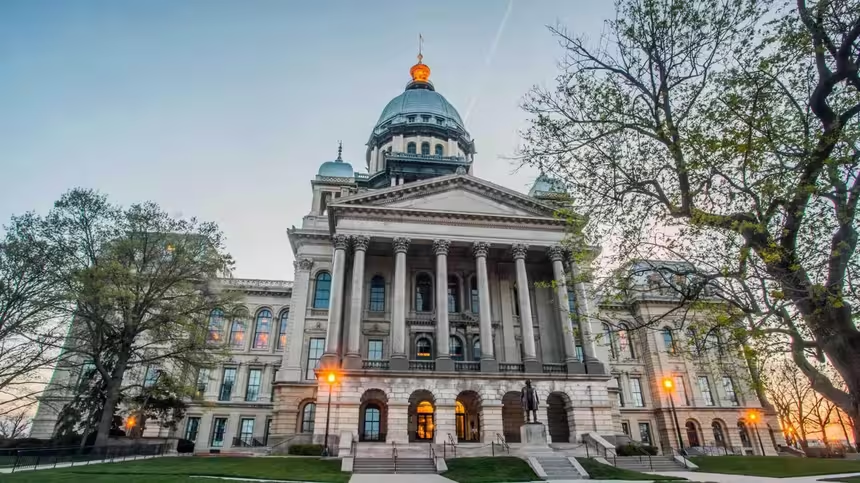
CapitolView
CapitolView is a weekly discussion of politics and government inside the Capitol, and around the state, with the Statehouse press corps. CapitolView is a production of WSIU Public Broadcasting.Providing Support for PBS.org
Learn Moreabout PBS online sponsorship(dramatic music) - Welcome to "CapitolView, our weekly look at happenings inside and outside the Illinois State Capitol.
I'm Jennifer Fuller.
Our guests this week are Amanda Vinicky of WTTW's "Chicago Tonight" and Jason Piscia, the Director of the University of Illinois Springfield Public Affairs Reporting Program.
Thank you both for taking the time.
- Sure thing.
- Glad to be here.
- Let's kind of get started with a recap.
As we recorded this show last week, it was still before the first gubernatorial debate between Democrat JB Pritzker and Republican Darren Bailey.
It was probably about as people expected, with accusations thrown, lots of interruptions, and quite a bit of drama, let's say.
Amanda, what takeaways do you have from this meeting?
And here we are less than a week from their second meeting on TV.
- I would say one of the big takeaways is, first of all, that there's only going to be two debates.
I know that public media organizations are among those who'd requested more, and so there's only gonna be two.
I'm not sure how much people want to watch more than that, given, Jen, as you just described how things went.
As you noted, really no surprise.
I think there was a time where you would talk about candidates and how there's really not that big of a difference in opinions.
These are two diametrically opposed candidates in terms of what their platforms are, what they stand for, their visions for the state.
And that came across during the stage, it came across on the stage as well as, I think, there were aspersions about lies and liar.
There's a lot of that, and I do think that that's something that's disheartening for a lot of voters and it's hard to kind of cut through some of those muddied waters.
- We've talked in the past with your fellow panelists about there aren't a lot of people who are perhaps undecided in this election, in this race.
What they may not be decided on is whether or not they'll vote in the first place.
Jason, does a debate like this spur people to go in and cast a ballot or does it turn more people away?
- Yeah, it's an interesting question about why we hold debates in the first place.
In the ideal world, as we mentioned, debates would be a place where candidates could have a robust exchange of ideas about policies affecting the citizens of the state of Illinois.
But as candidates' PR machines have ramped up, they treat debate style as another chance to have a press conference to where they'll control the narrative, pull out gimmicks when they need to.
Thinking about Darren Bailey's pulling of the pledge from his jacket, asking the governor to pledge that he'll serve all four years of his gubernatorial term and not run for president or anything else.
So we lose a lot of the back and forth policy issues that I think voters need to hear about to make an informed decision and something that will inspire them to go to the polls or to vote early.
- And as you noted, Jason, I mean, there's the gimmick of it and also, and this is certainly controlled messages and part of how this is more of like a press conference, not answering the question.
So there was a gimmick by Bailey and in response from the governor, "I intend," which is, I believe I read something and I think it described it well, intend does a lot of work there to serve all four years of the governorship were he to be elected.
It would be great if during debates candidates would actually answer the questions, and instead, that's not always what you get.
- Yeah, and that's not to say that the moderators- - No, not at all.
- Are having trouble controlling it.
I think they did a great job trying to keep it on topic, but both candidates have their talking points they need and want to get in, and they'll get 'em in at any cost.
And that's to the detriment of talking about real issues.
- I think you're both bringing up a good point here, and it's not just in the debates that the public, and in many cases journalists, are not able to get to those policy questions, asking questions about things that will dramatically impact the lives of people across the state as well as more specific issues that may affect specific regions of the state.
Amanda, you've been out on the campaign trail covering things for many years.
Are you seeing a shift?
Is this just in this one race or are we seeing this across the board where candidates are not really ready or willing to talk about issues versus staying on a specific message that they want to get out there?
- I mean, we're in sort of this new stage, right?
There's literal fake news.
I mean, newspapers that are published to appear as if newspapers when they are in fact partisan driven, paid for by packs.
I mean, you have that going on.
You have so much money going into these races now.
And so you can bypass the media in a lot of ways, get that message straight on to TV.
I'm sure we'll talk about the Supreme Court races.
My TV's been on all morning and that's the only thing that has been on, how many people know about the candidates for Supreme Court and the issues there versus what they see on these ads.
So I think that there's that.
I think that also, for example, the SAFE-T Act.
There's been a lot of attention on this major criminal justice overhaul.
And I'm just gonna take sort of one part of it.
And one of the issues that critics have that is part of many states attorneys lawsuits, is that the measure was passed in too quick a fashion, didn't follow all of the legislative procedures where it's to be read on three days.
It happened in the wee hours of the morning when it hadn't been thoroughly vetted.
And then you have backers that say, "That's a lie, that's not true.
This was the subject of various committees, commissions, full throated debates for months on end."
And so you listen to it, and if you want to cling on to either of those you could and actually be right.
Both sides are calling the other a liar when frankly both are true.
There were months of debate about the subject of eliminating cash bail and what could be done to overhaul criminal justice, but this particular bill, this particular legislation, didn't have all of those committees, it was 800 pages.
Surely legislators didn't have the time to read it because it passed in a matter of hours.
So both are true.
I think we're seeing a lot of talking past one another and sort of both sides digging in, clinging to whatever position they want to take and not giving the other side any sort of acknowledgement.
- Yeah, and we're definitely going to get into these accusations around the SAFE-T Act later in the program, but I wanted to stick with the campaign a little bit further.
And Jason, there was another, maybe not a debate, but definitely a forum between the two candidates for attorney general in the past week where Kwame Raoul and Tom DeVore traded their own accusations, each pointing at the other.
And now there are accusations of defamation.
Is this something that's going to impact, do you think, the office of the attorney general?
Typically, you see, hopefully, a race like this kind of staying out of the political fray.
- Yeah, you would hope.
The attorney general is the chief lawyer for the state of Illinois and you would think that office would kind of stay above the fray of the politics of it all.
Sure there's a D or an R attached to the name of the person who holds the office, but when it comes to investigating corruption or stopping wrongdoing in other parts of state law, you would think the attorney general would stay above that.
But again, I think it's coming back to, we have candidates who, especially on the Republican side, who like to stir up the pot and bring up things that sort of upset the status quo of how the Democrats have run things in the state, especially over the past three years with the pandemic.
And that brings up lots of emotions and lots of back and forth and lots of accusations of being a liar.
So again, it falls down into the depths and the dregs of these discussions as well.
And yeah, it happens with attorney general and I think we were seeing some of it in the Supreme Court and all these races where we, we hope they would stay above that.
It's not working out that way.
- You've both brought up the candidates in the Supreme Court races, and so let's jump into that.
There are two races open on the Illinois Supreme Court this time around.
They both are in the northern and eastern portions of the state.
One of those, U.S.
Senator Dick Durbin, who chairs the very powerful Senate judiciary Committee, has gotten involved in the race for, I believe it's the Second District of the Illinois Supreme Court, which is north and west of the city of Chicago.
Amanda, how unusual is it to see Senator Durbin get involved in a judicial race like this and how important is this race?
- I mean, it's rare, but also so are elections to the Supreme Court in general because these are tenured terms, and then once a justice wins a seat on the bench, they don't have to be up for election, per se, they're up for retention.
So that's why perhaps we don't see more of this.
I'm not surprised that he's getting involved at all.
The Republican nominee in the Second District is somebody who frankly ran against Durbin for U.S. Senate and was the Republican nominee there.
So not particularly surprising.
There is a lot of money being poured into these.
Democrats certainly have the advantage, both of the Democratic candidates, as they are supported by pro-choice groups that are pouring a lot of money, as are unions, and looked through, there are a lot of lawyers that are giving to it as well.
We don't know, of course, what cases might come before the Illinois Supreme Court.
This is a body that is intended to operate in a nonpartisan manner, but certainly we have seen some big cases get a lot of attention because they were decided on partisan lines when you look at things such as redistricting.
So that's, I think, where we see it.
And also again, pro-choice organizations are saying, "We need to keep control of the Supreme Court in Democrats' hands should there be any sort of decisions about reproductive health or abortion that go to the state's high court."
Republicans, however, say in in particular, you have in the Third District current Supreme Court Justice Michael Burke is saying that these ads are false, have asked that they be taken down because he says he hasn't made any sort of comments about abortion, his personal views and where he would stand on it.
And so this is again getting into sort of murky waters where a group of organizations, legal organizations, the Judge's Association, Bar Associations, are saying, "This is a problem."
This could harm the entire justice system and beliefs in the judiciary as a nonpartisan body because of all of the mudslinging that is going on in the ads that really are sort of stretching the judicial canons.
- There are specific rules in the U.S. or in the State Supreme Court, I should say, that bar judges and judicial candidates from talking about issues that they might rule on.
You're right, Amanda.
But Jason, when you're looking at campaign expenditures, campaign fundraising, and even more than that, independent expenditure organizations that are airing commercials, sending out mailers, doing these sorts of ads for a particular candidate or against a particular candidate, how is a voter supposed to understand where a judge might stand or a judicial candidate and how can they be sure that they will be nonpartisan when they are seated on the court?
- Yeah, it's difficult.
We have these independent expenditure committees that stand for an issue or maybe even stand for a certain candidate, but as long as they operate independently of that candidate, they can spend as much money as they want on commercials and anything else to get the message out that they wanna get out.
It's a free speech issue.
But yeah, it's difficult for the general public to figure out who stands for what.
I think if you're looking for maybe an unbiased or more of a down the middle look, the Illinois State Bar Association puts out ratings of whether these judges are recommended or not and they'll provide a report on that which can be looked at.
But yeah, and it's interesting we talk about this here in downstate Illinois where I am in Springfield, Supreme Court races are sort of a blind spot for us because all of the spending is in those two districts up in Northern Illinois.
So unless I turn on a Chicago sports station on my cable, I'm not seeing those commercials.
And it's also important to remember that it's a limited part of the state that will be voting on these and it is a judicial election, and in most precincts, judicial elections will appear on the back side of the ballot.
So it's gonna require a voter to take the initiative to actually turn their ballot over and look at all the other down ballot races that are there.
So for as much money as it's being put into, I'm not sure there's any guarantees.
- Yeah, I hear from voters a lot that they feel like they're having to do more homework than they used to have to do in terms of getting the actual information about candidates and sorting through what is actually true and what is not.
Wanted to get to perhaps a policy issue outside of the election talk that we spend so much time on.
And that is something that Governor JB Pritzker mentioned in an interview with "Crain's Chicago Business" earlier this week.
And he talked about hoping to have what he calls a closing fund which would allow the governor of Illinois to have some extra money available to sweeten some incentives or some potential deals to bring businesses into the state.
He points to states like Indiana, Michigan, I believe Texas has one as well, but he also points out that this is not just something that a governor can do.
He's going to need legislative approval to set up such a fund and it would require at least a budget appropriation, if not a budget surplus, in order to have the money to go into that.
Amanda, how could this help and how feasible is it?
- Well, so this came up in "Crain's" as the governor was pressed on why despite Illinois having an incentive for electric vehicle manufacturers and battery plants the states lost on those and instead they're going to neighboring states, Indiana, Ohio this week just received one.
So that was where this came up and he sort of tossed out and said, "You know, that could help."
I'm not sure that he will be given that authority.
Illinois has had a lot of issues, of course, with corruption over the years and questions about, hmm, who exactly will be receiving that money?
What is the approval process?
There's a whole lot of red tape.
So he sort of threw it out there, but he said it could be one way that Illinois might be to able to better attract some of these businesses.
Again, he's just sort of threw it out there.
So I'm also not sure how big an incentive that would be.
That's something that when you're talking about big businesses could probably be eaten up pretty quickly in just one deal.
Sort of other interesting takeaways, by the way, while we were there, were he said that one of the challenges that Illinois has had historically in terms of recruiting businesses are the budget.
And he said that hopefully will be getting better because of credit ratings being a little kinder anyway to Illinois.
And then the issue as well of crime.
He said those are the two things that have kept companies from coming, but he believes that more small businesses are coming here and that also got into sort of a contention about, another is something that is on the ballot, and that is that constitutional amendment.
And with pushback from the "Crain's" editorial board saying, "Is Illinois too union friendly?
Is that sending the wrong message to business?"
And the governor coming back and saying he believes that Illinois being so labor friendly is something that is an incentive to businesses because they will have a base of hard workers.
- Speaking of labor, the Illinois Manufacturers Association is touring the state this week highlighting the importance of manufacturing and factory work in the state's economy.
But one of the things that they're pointing out, they said this week, is that the number of workers, the number of openings has gone up exponentially over the last couple of years and companies are struggling not just in Illinois but across the nation to find skilled workers that can work in factories and do the jobs that need to be done today.
Jason, how important is it for the state to be involved in that job training, and maybe not guaranteeing, but helping those manufacturers get the workers that they need at the skill level that they need?
- Yeah, I think this issue, along with the incentive fund that the governor was talking about the other day sort of work hand in hand.
Once you get those companies to come here, there needs to be nearby talent that can handle it.
On the tour that the Manufacturers Association was making this week, the president of that organization was mentioning how the needs of the manufacturing industry have changed in a day when you had a bunch of manufacturing workers on the floor of a production facility, a lot of those jobs may have been reduced by automation and robots and things like that.
But now you need maybe a fewer number, but people who have higher levels of training to operate those automated manufacturing processes.
And then that's where Illinois might be following short.
I think as someone who could be a little bias, but as someone who works in higher education, I think there's always a need to invest more in higher education and vocational training and ways to get people the skills that they need and the specific skills that they need to meet the market of what's out there in terms of jobs right now.
So it's an interesting way that we'll move forward, but again, you can't have the big incentive fund without the workers to backfill it.
- Yeah, it sounds like that's definitely something that may be a part of negotiations as we get to perhaps higher education funding or other legislation that may come up in the spring session.
Speaking of things that may come before the legislature, Amanda, you talked about this a little bit earlier, and that's the SAFE-T Act.
We're seeing more states attorneys, more sheriffs join in lawsuits or filing their separate lawsuits against the act, against the governor, members of the legislature and others in order to try and block the act from going into effect in January.
There are also lawmakers who voted to pass the legislation who are now saying, of course, there are going to be some trailer bills, those bills that come behind the passage of a law that make some small changes, clean up language, make sure that things are easier to deal with in the agencies and areas that need to be done.
So my question after that long explanation is do you see that that will come about in the veto session?
Are we waiting for the lame duck session?
And how much change exactly do you think we'll see?
- So we have not really gotten clear answers on what exactly will be changed.
Again, the governor pressed on this during the debate.
"Crain's" asked him about it in his meeting before their editorial board and didn't get really any hard responses.
And I did speak with some of the legislators that are involved with those negotiations who likewise didn't really give details in part because they say they are still in talks and they don't want to disrupt those at all by getting something out in the media and then having it taken the wrong way or hurt negotiations.
But they are certain that there will be changes.
One legislator said to me there has to be before January.
So I'm not exactly sure what timing that will be other than I think the important part after the election is when that is going to be, and presumably the changes will be easier to vote on, that you'll have the sort of support that will be less controversial potentially than the SAFE-T Act was in the first place.
But I don't know, that's going to be part of the difficulty in terms of getting the number of votes.
Republicans certainly calling for changes, but they may be hesitant to get on board because they will, I don't know, we don't know what's happening, but I would not be surprised if the GOP says this doesn't make enough change, doesn't go far enough.
And then you'll have, I think, those who supported the original version who are very upset with some of the proposals that are floating about, saying that it would dismantle everything that they'd intended.
So it continues to be a battle brewing.
- Jason, what is this strategy in your mind?
You covered the legislature before your move to the University of Illinois, but this pass a bill and negotiate later, is this a new strategy, is this something that you think we're going to see going forward?
- Not a new strategy so much, but I think it's being used more than ever these days.
I think there's so many issues with politics and timings of elections and timings of session that all play into it that the Democrats want to portray some level of progress on an issue.
And when it gets down to it, it gets to be the end of the legislative session, they realize they need something to put in their pocket to take the voters on election day.
It's not gonna be perfect.
Bills are gonna get passed at 5:00 in the morning, even if they did have long committee hearings before that, months and weeks before that.
But they gotta get something in their pocket.
So they gotta take that vote.
And it's not gonna be perfect.
It's 700, 800 pages and not every word is gonna be right there.
So yeah, there is a trend to sort of realize that we need to come back and fix this.
It'll be interesting the timing with this.
Veto session is coming up.
There's two weeks of it scheduled.
It's the week after the election and then the week after Thanksgiving.
I think this would be probably the opportune time to deal with some questions with the SAFE-T Act, especially the cash bail part of it goes into effect on January 1.
And there's lots of talk out there about what's gonna happen on January 1 if the SAFE-T Act doesn't get adjusted at all.
Are the people passing along incorrect information that would have you think that the jail doors will open on January 1 and all the violent criminals of Illinois will spill out onto the streets?
It won't be that way.
But there are definitely some questions to determine how we handle this next, and it needs to be done before New Year's Day.
- Lots of questions to follow and lots of places to follow them both in the courts and the legislature and elsewhere.
Amanda, with less than a minute remaining, we're gonna come full circle on the things that we're talking about this week on "CapitolView."
Another debate between the two gubernatorial candidates in the major parties is scheduled for next week.
What does either candidate need to do to come out as a clear winner here?
- As we noted, again to go full circle, I can't imagine being undecided in this race other than do I wanna cast a vote for either of these candidates?
So I do think, however, that there was sort of the feedback by some that the governor could have performed better.
So he's gonna wanna come out strong and Darren Bailey trying to continue to, I think, walk the stance of both appealing to his base and sticking with his values while trying to get and grab any and as many voters from the Chicago suburbs as he possibly can who might be independent or more moderates.
Try, anyway.
- Amanda Vinicky with "Chicago Tonight" and WTTW and Jason Piscia with the University of Illinois at Springfield's PAR Program.
Thank you both for your time this week.
- Thanks.
- Thank you.
- And I'm Jennifer Fuller, thanks for joining us.
You can find us online at WSIU.org and at our YouTube channel.
We'll see you next time.
(dramatic music)

- News and Public Affairs

Top journalists deliver compelling original analysis of the hour's headlines.

- News and Public Affairs

FRONTLINE is investigative journalism that questions, explains and changes our world.












Support for PBS provided by:
CapitolView is a local public television program presented by WSIU
CapitolView is a production of WSIU Public Broadcasting.