
Capitol View - September 7, 2023
9/7/2023 | 26m 46sVideo has Closed Captions
CapitolView - September 7, 2023
In this episode of CapitolView: Fred Martino speaks with Jennifer Soble, Executive Director of the Illinois Prison Project. Soble was lead author of the Joe Coleman Medical Release Act. Governor JB Pritzker defended the number of releases under the Act. But advocates say the state is keeping prisoners eligible for release behind bars.
Problems playing video? | Closed Captioning Feedback
Problems playing video? | Closed Captioning Feedback
CapitolView is a local public television program presented by WSIU
CapitolView is a production of WSIU Public Broadcasting.
Capitol View - September 7, 2023
9/7/2023 | 26m 46sVideo has Closed Captions
In this episode of CapitolView: Fred Martino speaks with Jennifer Soble, Executive Director of the Illinois Prison Project. Soble was lead author of the Joe Coleman Medical Release Act. Governor JB Pritzker defended the number of releases under the Act. But advocates say the state is keeping prisoners eligible for release behind bars.
Problems playing video? | Closed Captioning Feedback
How to Watch CapitolView
CapitolView is available to stream on pbs.org and the free PBS App, available on iPhone, Apple TV, Android TV, Android smartphones, Amazon Fire TV, Amazon Fire Tablet, Roku, Samsung Smart TV, and Vizio.
CapitolView
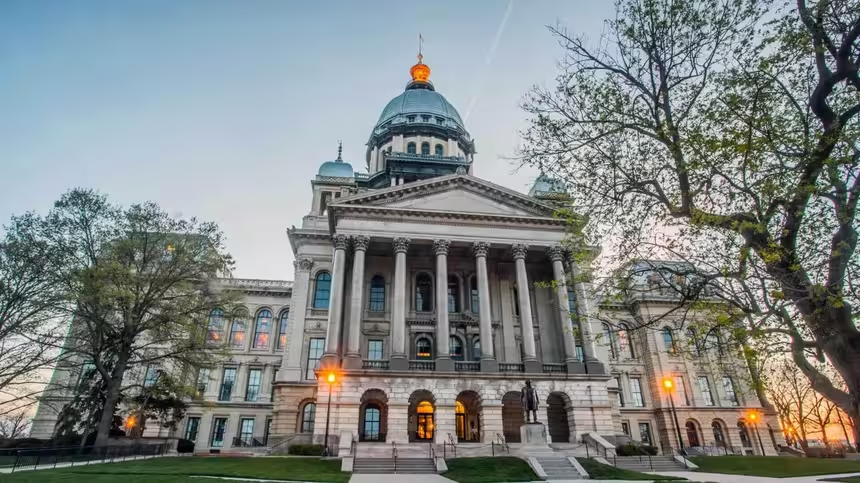
CapitolView is a weekly discussion of politics and government inside the Capitol, and around the state, with the Statehouse press corps. CapitolView is a production of WSIU Public Broadcasting.Providing Support for PBS.org
Learn Moreabout PBS online sponsorship(upbeat music) (camera clicks) (dramatic upbeat music) - Thanks for joining us on "Capitol View."
I'm Fred Martino.
The Joe Coleman Medical Release Act was expected to free hundreds of terminally ill and medically compromised prisoners in Illinois.
But an investigation from Injustice Watch and WBEZ revealed only a few dozen were released.
Illinois Governor, J.B. Pritzker, held a news conference where he said the law is being carried out as it, quote, "Should be."
My guest disputes that.
Jennifer Soble was lead author of the Coleman Act.
She is also executive director of the Illinois Prison Project, that is a nonprofit legal group representing medical release applicants.
Jennifer, thank you so much for being with us.
- Thanks so much for having me.
- Good to have you here.
So I wanna start with the numbers.
How many terminally ill and medically compromised prisoners in Illinois have been released, and why are the numbers lower than expected?
- Yeah, less than 60 terminally ill or medically incapacitated incarcerated people have been released to date.
The law went into effect January 1st of 2022.
So it's been rolling for about 18 months now.
I think there are a couple of reasons as to why the numbers have been so low.
It's a brand new law, so it did take some time for the law to go into effect, for the Prisoner Review Board and the Department of Corrections to create policies and procedures to carry it out, and for people to actually get to a hearing date and get released.
The bigger problem, however, has been the rate of denials coming out of the Prisoner Review Board.
To date, around 150 people have been found eligible for release.
That means a doctor from the Department of Corrections has certified that they are either terminally ill, meaning they will be dead within 18 months, or they're medically incapacitated, meaning they're disabled.
They need help with at least two activities of daily living.
It's not a huge number of people who have been found to be certified as eligible.
But of those people, every single one of whom is either within the last months of their life or so disabled that they need help doing things like toileting, moving around, getting their clothes on, feeding themselves.
Two thirds of those folks have been denied release by the Prisoner Review Board.
- Okay.
Very important.
And here's another important point from the story, the Injustice Watch and WBEZ report says that an independent monitor appointed by a federal judge found Illinois prisoners, or Illinois prisons, rather, are unfit to provide healthcare for the thousands of aging, disabled, and incapacitated prisoners.
Tell us what you found looking at this situation.
- Yeah, the Joe Coleman Act was designed really to do two things.
It was designed first to make sure that dying or disabled incarcerated people can be released so that they can get adequate medical care.
But the other thing that the Coleman Act was designed to do was to relieve the burden of expensive and time consuming healthcare from the prison system itself because that system is so over capacity.
The Illinois prison system's healthcare system has a 50% vacancy rate right now.
That means that one out of every two nursing, physician, physician assistant jobs are empty, which means that healthcare system is simply not in a position to provide basic, everyday care, checkups, acute emergencies, appendicitis, things that just come up in the normal course of everyday life.
When you layer on top of that the care for people who are terminally or chronically ill, and here I'm thinking about things like stroke patients, cancer patients, folks with Lou Gehrig's disease, folks who will never get better and whose care is unbelievably difficult to manage, you have a pressure cooker, you have an unsustainable system.
The Joe Coleman Act was designed to alleviate some of that burden by creating a mechanism to shift some of the most time consuming and costliest incarcerated people who also happen to pose no risk whatsoever to the community and shift their care back to their families and their loved ones.
- Care of individuals.
Very important to keep in mind.
I understand though, as you pointed out, there's also a financial issue here.
If more eligible prisoners were released, it would reduce costs for the state.
Give us a sense of the financial cost.
- The financial costs are hard to calculate because they're so big.
And I'll just give you an example to help folks understand why this is important.
I had a client who was struggling with cancer and we were able to get him released through the Medical Release Act.
Before we got him released, we got his hospital bills for the last year of his life.
And every cent of these bills was something that the Department of Corrections, and thus the state of Illinois, were paying out of pocket.
Incarcerated people are not eligible for Medicaid or any federal assistance.
Caring for my client in the last year of his life cost the taxpayers in the state $100,000.
It's a just a tremendous amount of money for one person for one year, and that's on top of everything else.
- Right, and of course, folks are initially thinking about medical cost.
What isn't even put into this calculation, as you're aware, all over the country, when there have been cases where states have been found not doing their job to care for prisoners, there have been lawsuits, too.
So that could be a potential cost.
- Oh, absolutely.
What the Federal Monitor that you talked about just a second ago found was that folks were getting their routine, specialist care deferred, deferred, deferred until people were so sick that they were incurable, that they were terminal.
There have been many cases of folks who had very treatable forms of cancer but because the prison system was so overburdened, they weren't able to get the test that they needed to get diagnosed, and by the time they got diagnosed, it was too late.
That not only leads to a tremendous loss of life which is a moral hazard to be sure, but tremendously costly litigation.
- Yeah, well, the report notes that failing to release these prisoners also undermines care for the incarcerated who are not eligible for release under the Coleman Act because medical staffing, as you pointed out, is a major, major issue.
This is something as well that may be overlooked as we talk about this issue, but it can't be, right?
- No, it absolutely cannot be.
The Illinois prison system has infirmaries, permanent infirmaries, sort of like little hospitals within each facility.
Every single one of those infirmaries is full to the brim.
In every single prison in the state of Illinois, there are people who are so sick that they should be living in those hospital settings, but they aren't just because there isn't a bed available for them.
The Illinois prison system right now is 25% elderly and that number is climbing every single day.
These are folks who, because of their age and because of years and years of poor healthcare, as we just discussed, have tremendous medical needs, and this isn't going away.
This problem is only going to get worse, not better.
If we can't find a way to release the sickest, the most permanently disabled from our prison system, we are only gonna continue to generate more and more folks who are sick and unable to care for themselves because they aren't getting the preventative or even maintenance.
- Okay, well, if folks are just joining us, the reporting indicates that part of the challenge is the Prisoner Review Board.
You've talked about that briefly, but I want to delve into the problem there.
- Sure.
So the way the process works is a person applies for medical release because they believe that they're either terminally ill or medically incapacitated.
And before their case can even get to the Prisoner Review Board, the Department of Corrections has to certify that yes, in fact, the applicant is sick, is terminally ill, or is disabled.
Once you get to that stage, the Prisoner Review Board has to give an up or down vote, basically, to say you can be released or you're not.
And what the reporting revealed was that in two thirds of the cases, the Prisoner Review Board is voting to deny release to a person who's already been found by the Department of Corrections to be terminally ill or medically incapacitated.
That's a really shocking number.
It's a really shocking denial rate.
- Okay.
The report notes that advocates want lawmakers to institute several changes to the Coleman Act to encourage the Prisoner Review board to release more people.
Let's talk about some of those ideas.
First, they say that lawmakers should require board members to visit prison infirmaries to see firsthand the state of prison healthcare.
Your thoughts on this?
- Yeah, I think it's a really great idea.
I will tell you that we get phone calls from nurses and doctors who are working in the prisons saying, "Can you please file a medical release application for this incarcerated person or for that incarcerated person?
Their care is so burdensome to us, they should not be here."
The Prisoner Review Board does not understand, and how could they, if they're not there, right?
They don't understand how dire the healthcare system in the prisons are.
They don't understand how burdensome it is to care for a person with the kinds of terminal or chronic and disabling conditions that come before them every day.
So I think in order to understand the power of this law and how necessary it is to implement it to its fullest, not only the Prisoner Review Board, but more folks in the legislature should be visiting prison healthcare units so that we all have a better sense of just how urgent the need for full implementation of this law is.
- Here's another idea.
The board should receive more training on how to evaluate the medical conditions of prisoners applying for release.
Your thoughts on that?
- Yeah, I also think that's a wonderful idea.
The law is new.
This law was passed in 2021, and it went into effect just 19 months ago at this point.
And I think everyone within the system could benefit from more training, both to understand the intents of the law and the impact the law could have if it were implemented more fully, but also to understand what having a series of conditions could mean both for an incarcerated person and for the healthcare staff within the prison where they're housed.
- Yeah, so important, and that context, you, I'm sure would agree, is just essential when you're making these kinds of decisions.
You know, advocates also want the state to provide prisoners who are applying for medical release with an attorney.
Your nonprofit has represented some of these prisoners.
Tell us about the need in in this area.
- Yeah, I think this is a really important recommendation.
What we've seen is that when folks apply for medical release with an attorney, the grant rate is significantly higher than when folks apply for medical release without an attorney.
And that makes a lot of sense.
Attorneys are able to explain to the PRB about the incarcerated person's condition, about the way that their healthcare is impacting the Department of Corrections, about where they would go if they were released, about them as a person.
And without such an advocate, incarcerated people don't have anyone to go to the Prisoner Review Board and share their story and share the impact of their illness, both on themselves and on their loved ones, but on the larger prison population.
The huge disparity in grants for folks who are represented versus folks who aren't should be a red flag that there's something else going on here, right?
It's not just about the applicants who don't have lawyers.
There's something about them.
It's about the process, that there's a tweak that we can make to the process to make this system work better, more fairly, and to be more advantageous for us all.
- My guest was Jennifer Soble, executive director of the Illinois Prison Project.
You can watch more of our interview on the WSIU YouTube channel.
We love to hear from you at "Capitol View."
Send us your letters.
It's easy.
Just email your comments to contact@wsiu.org.
Analysis now, and I'm very pleased to welcome Jason Piscia.
He is director of the Public Affairs Reporting Program at the University of Illinois Springfield.
Jason, thank you so much for being with us.
- Yeah, nice to be here.
Thanks for having me.
- Good to have you here today.
Well, our program began with a segment on the Joe Coleman Medical Release Act.
Governor J.B. Pritzker defended the number of releases under the act, but advocates say that the state is keeping prisoners eligible for release behind bars.
Give us a sense of the political challenge facing the governor on this matter.
- Sure, I think we all can agree that crime and criminal justice issues and the debate that we've had over the last several months about the elimination of cash bail and the fact that Republicans latch on to the fact that, you know, crime is bad and they illustrate that as much as they can in their political ads to try to come down on Democrats, that they're not tough enough on crime.
All that is to say that crime is a hot button political issue that is, you know, a so-called hot potato that any politician has to deal with.
So J.B. Pritzker and Democrats in general are treading carefully on this.
They do want to, you know, they have this bill that was passed at the beginning of last year.
The numbers of prisoners that have been released under it hasn't been as robust as some might have expected.
But you know, and the governor saying that each case should be taken on its own face and handled in that way.
But still, it's a political issue.
And even though we're trying to deal with these cases one at a time, we have to remember that the Political Review Board, which makes the decisions on whether these dying or ill prisoners should be released under this compassion based act or law.
- It's just incredibly, incredibly difficult decisions.
And as you point out, political in the sense of even the people who make the decisions because we have Republican appointees, Democratic appointees on this board.
- Sure, and the Injustice Watch story as you know, in many cases, when the Prisoner Review Board makes the decision that it's a subset of the members of the full membership that makes individual decisions on these cases.
And in most cases, it's the Republican members who are voting against releasing the prisoners in this case.
So that speaks to sort of the political effect on this and that's always gonna play in the background, 'cause there's always a worry of Democrats being portrayed as too friendly to crime.
And when that happens, the Republicans will pounce and say the Republicans, or the Democrats aren't tough enough on crime and everything is gonna be dangerous from here on in.
And that story gets told throughout every election cycle.
- And we should say, I mean, this is done for a reason because we know in the past, it has been effective in political campaigns, to use fear, fear about crime and other issues, effectively as a message point.
- Yeah.
It works.
I mean, if you think of any campaign for statewide office or federal office or whatever over the many years, the crime issue works.
It resonates with people.
I just think back to even the 2020 election with Biden and Trump, there was that ad where, you know, it was portrayed that the Democrats wanted to get rid of police, and then there was that ad that the Trump campaign put out with an elderly woman in her house and someone was breaking into the house and she called 911 and she was put on hold because the police had been let go.
Not much reality in that scenario itself, but it was a scary commercial.
And that's the example of something that works and resonates with people with people.
- Well, we saw another national political issue that is a hot button issue making news in Illinois in the last week as well.
Jason, Governor J.B. Pritzker, Senator Dick Durbin, and others held a news conference calling for an easier work permit process for immigrants.
Tell us about this and this issue.
- Yeah, so it's been about a year now that states like Texas have, you know, taken the migrants that have come over the border and into their state and have literally bused them or airplane them to cities that are more friendly to migrants, including Illinois, and more specifically Chicago.
The flow of migrants continues to this day, to the extent now that we have migrants sleeping on the floor at O'Hare Airport, in police stations.
And it's becoming a critical, humanitarian situation.
So the Pritzker administration and others have have written a letter to President Biden asking them to approve these work permits for these asylum seekers as they're waiting for their applications and paperwork to go through to make them official.
The thinking is, we get these migrants into work in industries where there's already noted labor shortages, you know, such as the food processing industry, clean energy, healthcare, transportation, warehousing, these sorts of industries that have, even since the pandemic started and we've had major labor shortages, the thought is get these migrants to fill these jobs to help the economy.
And then they'll get paid and then hopefully they'll be able to use the money that they receive in wages to find their own housing, which will free up spaces in these temporary housing situations to, you know, when more migrants undoubtedly arrive in Illinois.
Again, the president has not responded to this directly.
He says he's been talking to his cabinet about the issue but we haven't received any assurances yet that anything is gonna happen.
And again, it's one of those, another political hot button issue, immigration, that Democrats have to tread carefully on.
- Well, and let me ask you about that.
So going into next year, a pivotal year, 2024, with not only a presidential race, but looking at control of Congress, do you think it's likely that the Biden administration will be receptive to looking at this issue, especially knowing how explosive the immigration issue is politically, and again, used not only in advertising, but some would argue used in the partisan media as something for headlines and for stories when there aren't even stories, you know, basically, and again, this whole notion of fear.
- Yeah, definitely.
Again, I think, you know, you hear a lot of analysts saying already that the upcoming presidential election, the number one issue is gonna be immigration, and maybe even more than crime this time around.
So as a result, the president needs to tread lightly because anything he does on the issue of immigration is gonna trigger Republicans to come down on him hard.
If there's any sort of concessions made to the immigration rules or anything else along those lines, it's gonna be politically damaging and it'll give the Republicans a story to tell in their messaging and in their advertising as they go through this political campaign.
And I think, you know, you can see right away that Governor Pritzker and the other Democrats who appeared at this news conference recently to talk about these work permits, they too are treading carefully.
You notice they're not being too overly critical on the president's lack of action.
They're, for a better lack of a better term, they're sort of being soft, being nice about it little bit, in hopes that something will happen.
And I think it's a good move for the Illinois delegation to show some action that they're trying.
They realize the humanitarian crisis that this is, and they're trying to be compassionate and do the best that they can, but we all know the ball is clearly in the court of the federal government.
So yeah, I'm not sure Biden is gonna be willing to make that jump at this point, knowing how politically risky it is.
We may see some sort of a middle ground, and I'm not sure how that would manifest itself at this moment, but I think going the whole way and kind of letting them, letting the migrants sort of short circuit the usual process of becoming official, isn't gonna fly.
- Jason, this is perhaps interesting in another way because of the specific nature of this request, to make it easier to get a work permit, which of course then would make it easier for immigrants to compete for jobs.
Talk about the interesting, difficult dance for Democrats who want to address labor shortages while keeping union support.
So this would be competition for workers and conceivably even in some cases, union workers, in the labor market.
And we know that that competition might restrict the very large increases in pay that we've seen with the labor shortage situation over the last couple of years.
- Yeah, you mentioned the delicate dance that needs to be done.
As we know, labor is usually clearly in the corner of Democrats on this.
And it's interesting, even on this, the migrant work permit issue, we're seeing some level of bipartisan support as well.
Maybe not necessarily in Illinois, but we see other governors and other officials around other parts of the country that support this concept as well.
And we even have the Manufacturer Association and others who were at this news conference the other day, which are typically aligned with the other party.
So yeah, definitely a delicate dance to do.
But again, you mentioned, in this specific case, I'm not sure how in demand these empty jobs are in the first place, given that, you know, these are industries that have had chronic problems over the last several months and years to keep their ranks full and to provide, you know, to help provide the types of services that a lot of the economy depended on before the pandemic.
We've made do a lot with work shortages and then staffing shortages and the sacrifices that has meant for services and goods that we receive as part of the economy.
- Very interesting and something we'll continue to watch.
Thank you so much for your contribution today as we think about these issues.
Jason Piscia, he is director of the Public Affairs Reporting Program at the University of Illinois Springfield.
Thank you, Jason.
- Well, thanks.
- Thank you for joining us as well on "Capitol View."
For everyone at WSIU, I'm Fred Martino.
Have a great week.
(dramatic upbeat music)

- News and Public Affairs

Top journalists deliver compelling original analysis of the hour's headlines.

- News and Public Affairs

FRONTLINE is investigative journalism that questions, explains and changes our world.












Support for PBS provided by:
CapitolView is a local public television program presented by WSIU
CapitolView is a production of WSIU Public Broadcasting.