
“Caregiving Conversations” highlights caregivers and their stories
Clip: Season 54 Episode 21 | 5m 22sVideo has Closed Captions
As part of our ongoing caregiving coverage, Detroit PBS presents the stories of local caregivers.
We'll hear the personal stories of two caregivers featured in the Detroit PBS "Caregiving Conversations" series. We hear from a woman who cared for several members of her family. Plus, the executive director of the St. Patrick Senior Center in Detroit reflects on her caregiving experience.
Problems playing video? | Closed Captioning Feedback
Problems playing video? | Closed Captioning Feedback
American Black Journal is a local public television program presented by Detroit PBS
“Caregiving Conversations” highlights caregivers and their stories
Clip: Season 54 Episode 21 | 5m 22sVideo has Closed Captions
We'll hear the personal stories of two caregivers featured in the Detroit PBS "Caregiving Conversations" series. We hear from a woman who cared for several members of her family. Plus, the executive director of the St. Patrick Senior Center in Detroit reflects on her caregiving experience.
Problems playing video? | Closed Captioning Feedback
Where to Watch American Black Journal
American Black Journal is available to stream on pbs.org and the PBS app.
Providing Support for PBS.org
Learn Moreabout PBS online sponsorshipDetroit PBS has produced a series of conversations with local caregivers.
We captured their personal stories about the challenges and rewards of caregiving.
Here are some of those stories.
(bright music) - My first experience was with my mother.
My mother, she passed away, she was 77, and she needed care.
And somebody said they wanted her to go to a nursing home.
And I said, "No, I'll take care of her."
And so I did.
And then it goes all the way down to my mother, my father, my oldest sister, Pocie, Pocahontas, my brother, Thomas.
And then I had my oldest son, Joseph, was diagnosed with AIDS.
So I was his caregiver until he passed away.
And then my husband, the best husband in the world, he became ill with lymphoma, and he kept saying, "Frank, put me in the nursing home."
And I said, "No."
So for almost 10 years he stayed right at home.
But I know that if I were in that position, he would've done the same for me.
And so it's been a long ride, but a satisfying one.
The physical part of caring for them, sometimes it was difficult.
It's my job and it's my choice.
I was chosen to be a caregiver, by God, I guess, because it's like, as soon as one person is taken care of, another one needs me, and I'm here.
I feel proud that I had a chance to serve the people I love.
And my son is taking care of me now, and he's bossy, but I still say, "Wait a minute, I'm still your mama."
So it's still a mixed feeling, a mixed experience, but it's all good.
(bright music) - When I was finishing graduate school, my mother was trying to take care of my grandmother who was diagnosed with terminal cancer.
So as a only child with a mother who's a professional and probably not having a lot of caregiving skills, 'cause my grandmother used to be the one taking care of everyone, I really wanted to come home and help my family.
So just seeing the struggle of my mom trying to balance her career and her work with taking care of my grandmother, and then my grandfather always being the one that was being taken care of and seeing him struggle and decline, watching his wife decline, that was my first experience.
I have a research background.
And so I was like, "Okay, I can come and give back to my community just for a little while," and I was saying that.
Turned into 27 years of being here at St.
Patrick's Senior Center.
And I think just my caregiving experience made me more empathetic to what caregivers and older adults have to encounter.
So here at St.
Patrick's, we try to fill in the gap.
I'm always looking for money for caregiving resources.
I'm asking seniors to volunteer to help my staff, volunteers to help.
We try to find other programs that we can provide that may free up some money, or provide supplies, or get them access to other friends, you know, other senior members who may check on their friend, or they go over and do some things for 'em, or they pick them up, or they take 'em to the store, or they take them a meal to help out.
Sometimes I have to step into a different space from just being executive director, knowing that for many of the older adults that I serve, they don't have anyone.
And so my experience and just who I am makes me say that, you know, I'm their family.
Sometimes people don't know that there's resources available if you're not in that space.
You know, coming to a community center, having instances where outreach can be conducted and you can be a part of that makes you aware of resources.
But when I was a caregiver, I'm a caregiver now actually for my mother.
But when I was a caregiver for my grandmother, we didn't know.
Advice I would give someone who's having difficulties being a caregiver is that to know that you're not alone.
Seek community.
You know, there's resources out there, you just have to know where to look, which is hard, so reach out to your local area agency on aging, reach out to your local senior center, 'cause there are resources and we're here to help you.
Just as much as I give to the seniors they give to me, and they've helped me grow, taught me a lot, using their wisdom and experience to make a difference in my life and make me a better person.
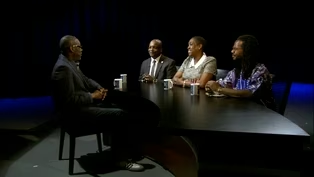
The Black Church in Detroit series examines the church’s role in supporting youth mental health
Video has Closed Captions
Clip: S54 Ep21 | 18m 41s | A look at the connection between spiritual care and mental health care for young African Americans. (18m 41s)
Providing Support for PBS.org
Learn Moreabout PBS online sponsorship New Episode
- News and Public Affairs

Top journalists deliver compelling original analysis of the hour's headlines.
 New Episode
- News and Public Affairs

Today's top journalists discuss Washington's current political events and public affairs.


 New Episode
 New Episode
 New Episode
 New Episode
 New Episode

 New Episode
 New Episode
 New Episode
Support for PBS provided by:
American Black Journal is a local public television program presented by Detroit PBS