
Caregiving: Healthcare planning for the future
Clip: Season 10 Episode 29 | 9m 41sVideo has Closed Captions
When Susan Major was faced with a cancer diagnosis, she ensured her loved ones knew what she wanted.
One Detroit is continuing our series of reports on caregiving with a look at the choices that older adults and their caregivers must make as they plan for the future. One Detroit contributor Marty Fischhoff sat down with a palliative care doctor and with Susan Major, a cancer patient who took important steps to make sure her loved ones knew her healthcare wishes.
Problems playing video? | Closed Captioning Feedback
Problems playing video? | Closed Captioning Feedback
One Detroit is a local public television program presented by Detroit PBS
Caregiving: Healthcare planning for the future
Clip: Season 10 Episode 29 | 9m 41sVideo has Closed Captions
One Detroit is continuing our series of reports on caregiving with a look at the choices that older adults and their caregivers must make as they plan for the future. One Detroit contributor Marty Fischhoff sat down with a palliative care doctor and with Susan Major, a cancer patient who took important steps to make sure her loved ones knew her healthcare wishes.
Problems playing video? | Closed Captioning Feedback
How to Watch One Detroit
One Detroit is available to stream on pbs.org and the free PBS App, available on iPhone, Apple TV, Android TV, Android smartphones, Amazon Fire TV, Amazon Fire Tablet, Roku, Samsung Smart TV, and Vizio.
Providing Support for PBS.org
Learn Moreabout PBS online sponsorship(relaxed electronic music) - Susan Major was diagnosed with pancreatic cancer four years ago.
Recently, we sat down with her at the Ann Arbor home of her sister and caregiver, Marsha, to discuss some of the crucial healthcare decisions she has made and how she's ensured that her wishes are carried out.
Susan, how are you feeling today, and is it okay if we talk a little bit about your condition and the decisions you made about the kind of healthcare treatment that you desired?
- I feel good today.
I don't have any pain, I have enough energy to do pretty much what I wanna do.
- Tell me about when you first got the diagnosis.
- The diagnosis happened because I was actually on my massage table that I have, and I was on there and I felt something really funny here, and I thought, "Hmm, I wonder if that's a hernia," and so, I called my doctor and she said, "We'll just get a CT, I'll just order it right away," so she did, and yes, I had a small hernia, but she also found pancreatic cancer, and it turned out to be fourth-stage and inoperable, and most people... Like, if you don't do anything, die within three months, most people die within a year, I guess, and I'm on year four.
- [Marty] Susan took chemotherapy on and off for four years before deciding to stop because of the side effects.
- I've stopped chemo longer than the three months that I was supposed to be dead, so ain't dead yet, and I'm not afraid of dying, and so, I feel like I had the honor of being able to have enough time to do all of that and tell everybody I love them, and, you know, spend time with people and live how I wanted to live.
- [Marty] Susan speaks highly of the physician she had at Michigan Medicine, not only her oncologist, but also her palliative care doctor.
- This is silly, but I have trouble with words and I found a palliative care doctor early on as well, and I call her my paleontologist.
- [Marty] Dr.
Jane Chargot is Susan's palliative care specialist at Michigan Medicine.
In her role, she helps relieve the pain and other symptoms of patients, but she does much more.
- So we try to manage complex symptoms for patients who may be needing a little bit more specialization and a little bit more expertise.
The other thing that we help do for patients is we help with communication, because when people have complex diseases, they often have a lot of different doctors, a lot of different members of their medical team, and they might hear a bunch of different things that are very confusing, and maybe at times, seems at odds to each other, so we help sit down, really get to know the patients, really help them navigate through their journey, and then, also help them really understand what it is that they are hoping for from their medical care, and then, help communicate that back to their medical team so that the whole team that surrounds them is really keeping them, that patient, at their focus.
- [Marty] We ask Dr.
Chargot what conversations she wishes older adults and their family members would have before a health crisis occurs.
- So we often talk about a group of documents that are called advance care documents.
Within an advance directive, we help patients start to think about what kind of care that they want... Would want in their end of life, whether or not somebody would want to go to the ICU when they start to get really sick, whether or not they would want to have something like a feeding tube, or have dialysis, or even have intubation, the tube that goes down your throat and helps you breathe, these are things that some people really don't want and these are things that other people feel very strongly that they do want, but if we don't have these conversations or if we don't have documentation indicating what we would want when it comes down to that spouse, or that parent, or that child trying to make decisions for you, they may feel adrift.
As difficult as it is to think about your own end of life or your own illness progressing, that this is a gift to the people that you love more than it is a gift to yourself, because it really helps them navigate these really awful decisions that they have to make and helping lift a little bit of that burden from their shoulders.
- [Marty] Susan Major has had conversations about her wishes with her patient advocate, the person who could speak on her behalf if she is unable.
- All of that, I got done in the first three months 'cause I thought I was gonna die in three months, I really did, so we were... I was in a hurry to get all that done and put into place, and we did, thanks to Marsha, she did all of that, not to mention the research and everything else, and going to every chemo session with me.
- [Marty] Marsha said the entire family rallied around Susan to support her, but she took on the role of primary caretaker.
- I think that one underrated aspect of caregiving is helping your loved one through issues that you don't always associate with caregiving, for instance, when Susan was first diagnosed, I helped her with her medical insurance, I, to this day, get all of her medical insurance communications so she doesn't have to look at them, we set up her financial... You know, all of her financial records so that her bills were on automatic payment and that sort of thing, and that really reduces a huge amount of stress that she's going through.
- [Marty] Marsha, who's an attorney, has another valuable piece of advice for caregivers.
- Well, I think one thing that people should be aware of is that not only do you need those documents, but you have to have those documents in a place where they're readily available so that, for instance, there are packages that you can put on your refrigerator that have all of the important documents that tell all contact numbers, insurance information, all the medications you're on, so that if you have to call 911, the ambulance company has all that information.
- Yeah, I have an envelope on my refrigerator, "Do not resuscitate" on the outside of it, I have one in my purse and my car.
- [Marty] Finally, we asked Marsha what the secret is to her sister's remarkable upbeat attitude.
- I don't know what gives her the strength and the energy, but I wish I did.
She... What's been most amazing to me is she has just remained so emotionally stable during this, and I don't think anyone who's not going through this can begin to imagine what it's like to have this kind of prognosis, and it just is mind-blowing that she can, you know, live every day and enjoy every day.
- Everybody thought I'd live to 100 because, you know, I'm one of those organic, all-natural, homeopathic, aerobatic kind of people that never did any drugs and all of that stuff, and it was very, very conscious, so it became... It's a surprise, I don't have any cancer in my family, it just came out of the blue, so what kicked in for me is I have spent a lot of my life doing spiritual work and emotional healing work, and I've had teachers that have really taught me to accept what is, and to take one day at a time and live in the present, and there's never been a better time to do that than now, let me tell you.
(laughs) - [Marty] After Susan had made all the other necessary preparations, she had one last thing to take care of.
- I think my greatest concern, and it was a huge concern to me, is my dog.
I love my dog, she's the most wonderful friend I have, and I didn't know who could take care of her, but fortunately, my next-door neighbor, who's never had a dog in her entire life, volunteered to try and get to know the dog, and see how it was gonna work, she was really nervous that she wouldn't, you know, be able to do it, but my dog's very, very well-trained, so for the past four years, they have already established a relationship, she walks him every morning, just lets herself in, takes the dog, and I know my dog is going to be with a wonderful mother and that was a huge relief to me.
- That's great.
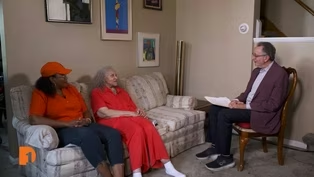
Caregiving: Legal planning for the future
Video has Closed Captions
Clip: S10 Ep29 | 7m 53s | Discussing caregiving and planning for the future with an attorney and a mother and daughter. (7m 53s)
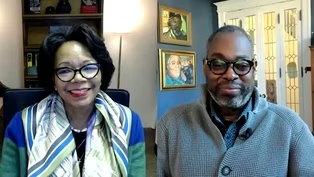
How The Henry Ford is celebrating the legacy of Dr. Martin Luther King, Jr. over the holiday weekend
Video has Closed Captions
Clip: S10 Ep29 | 6m 47s | Programming will include plays, musical performances, conversations and more. (6m 47s)
Providing Support for PBS.org
Learn Moreabout PBS online sponsorship
- News and Public Affairs

Top journalists deliver compelling original analysis of the hour's headlines.

- News and Public Affairs

FRONTLINE is investigative journalism that questions, explains and changes our world.












Support for PBS provided by:
One Detroit is a local public television program presented by Detroit PBS